Phonics Program Planning Guide
A free english worksheet ready for your classroom. Open in Kuraplan to grab the print-ready PDF, customize it for your students, or generate a fresh version in seconds.
Phonics Program Planning Guide
Year 2 Remedial Phonics & Reading — 10-Week Program
📋 Program Overview
This 10-week remedial phonics and reading program is designed for Year 2 students requiring additional support. It is aligned with the NSW English K–2 Syllabus and reflects the InitiaLit phonics scope and sequence. Activities are structured to support students with Autism, ADHD, and ODD tendencies through clear routines, short task segments, movement breaks, and visual supports.
Recommended session length: 30–45 minutes, 4–5 times per week in a small group setting (2–6 students).
Key NSW Outcomes addressed across the program:
EN1-PHOKW-01 — Recognises and uses phonological knowledge to read and write words.
EN1-RECOM-01 — Reads and comprehends texts using knowledge of phonics and word recognition.
EN1-UARL-01 — Understands and appreciates the way texts are created to achieve purpose.
EN1-VOCAB-01 — Builds vocabulary knowledge and uses it in context.
🧠 Behaviour & Engagement Notes for All Weeks
For students with Autism: Provide visual schedules, predictable routines, and pre-teach new vocabulary before activities. Use visual phonics cards and concrete manipulatives.
For students with ADHD: Keep tasks to 5–8 minutes each. Include movement-based phonics activities (e.g., clapping syllables, jumping for sounds). Use timers and clear task completion signals.
For students with ODD tendencies: Offer structured choices (e.g., "Would you like to use the whiteboard or the worksheet?"). Avoid power struggles — use calm, neutral language. Praise effort explicitly.
📅 10-Week Program Plan
How to use this table: Complete the Support and Lesson Notes columns each week to personalise the program for your group. Record adjustments, student responses, and next steps.
📗 Week 1 — Short Vowels Review (a, e, i, o, u)
NSW Outcomes: EN1-PHOKW-01 — Identifies and manipulates phonemes in spoken words; applies short vowel knowledge to decode CVC words.
Sound & Word Focus: Short vowel sounds /a/ /e/ /i/ /o/ /u/ in CVC words (e.g., cat, bed, sit, hop, bug). Introduce concept of vowels vs consonants using colour-coded letter cards.
Activity Guidelines:
🔹 Warm-up (5 min): Vowel chant with actions — students stand and say each vowel with a body movement (e.g., arms out for /a/, tap head for /e/). Repeat 3 times.
🔹 Phoneme Isolation (8 min): Teacher says a CVC word; students hold up the correct vowel card (a/e/i/o/u). Use 10–12 words. Students can use mini whiteboards to write the vowel they hear.
🔹 Blending Activity (8 min): Provide magnetic letters or letter tiles. Students build 3–5 CVC words by blending onset and rime (e.g., /c/ + /at/ = cat). Record words on worksheet.
🔹 Worksheet (8 min): Students sort 10 picture cards/words into five vowel columns. Then write two sentences using one CVC word each.
🔹 Reading Fluency (5 min): Read a short decodable text (Level 1–2) with CVC words. Students track with finger. Reread for fluency.
Support:
Lesson Notes:
📗 Week 2 — Consonant Digraphs (sh, ch, th, wh)
NSW Outcomes: EN1-PHOKW-01 — Recognises common consonant digraphs in reading and writing; blends digraphs to decode words.
Sound & Word Focus: Digraphs sh, ch, th, wh in initial and final positions. Focus words: ship, chat, thin, when, fish, much, with.
Activity Guidelines:
🔹 Warm-up (5 min): Show digraph anchor charts. Students say the sound and a word for each digraph. Play "I Spy a digraph" using classroom word wall.
🔹 Phoneme Game (8 min): "Digraph Slap" — place digraph cards face up. Teacher says a word; students slap the correct digraph card. Use 12–15 words. Adjust pace for engagement.
🔹 Blending & Segmenting (8 min): Students use Elkonin (sound) boxes to segment digraph words (e.g., sh-i-p = 3 boxes). Then blend back to read the word aloud.
🔹 Worksheet (8 min): Fill-in-the-blank sentences using digraph words. Students circle the digraph in each word they write. Extension: write their own sentence with a digraph word.
🔹 Reading Fluency (5 min): Partner reading of a decodable reader containing digraphs. Students highlight digraphs found in the text.
Support:
Lesson Notes:
📗 Week 3 — Consonant Blends (Initial: bl, cl, fl, sl, br, cr, fr)
NSW Outcomes: EN1-PHOKW-01 — Blends and segments words with initial consonant clusters; applies knowledge to read and spell CCVC words.
Sound & Word Focus: Initial blends in CCVC words: blob, clap, flag, slip, brim, crab, frog. Distinguish blends from digraphs.
Activity Guidelines:
🔹 Warm-up (5 min): Blend aerobics — teacher shows a blend card; students say the blend sounds separately then together while doing a jump (e.g., /b/ jump /l/ jump /bl/ jump).
🔹 Phoneme Game (8 min): "Build-a-Blend" — students draw a blend card and a rime card, blend them together, and decide if it makes a real word or nonsense word. Record on a T-chart.
🔹 Blending Activity (8 min): Dictation of 6–8 CCVC words. Students segment, write, then read back. Teacher provides immediate corrective feedback.
🔹 Worksheet (8 min): Students complete a word sort: sort 12 words by their initial blend into columns. Then write three words in sentences.
🔹 Reading Fluency (5 min): Read a short poem or decodable passage rich in initial blends. Students underline blends as they read.
Support:
Lesson Notes:
📗 Week 4 — Final Blends & Double Consonants (nd, nt, st, ll, ff, ss)
NSW Outcomes: EN1-PHOKW-01 — Recognises and applies final consonant clusters and double consonant spelling conventions.
Sound & Word Focus: Final blends and doubles: hand, tent, best, hill, off, miss. Introduce the "Floss rule" (ff, ll, ss after a short vowel in a one-syllable word).
Activity Guidelines:
🔹 Warm-up (5 min): Floss rule chant: "After a short vowel, at the end of the word — double the f, l, or s, that's what you've heard!" Students clap the rhythm together.
🔹 Phoneme Game (8 min): "Final Blend Bingo" — each student has a bingo card with final blend words. Teacher reads definitions or shows pictures; students find and mark the word.
🔹 Blending & Dictation (8 min): Dictate 8 words including final blends and Floss rule words. Students write, then self-correct using a word list on the board.
🔹 Worksheet (8 min): Students apply the Floss rule — given 10 words with a blank at the end, decide whether to add f/ff, l/ll, or s/ss. Write each word in a sentence.
🔹 Reading Fluency (5 min): Read a decodable passage. Students circle all final blend words they find.
Support:
Lesson Notes:
📗 Week 5 — Long Vowels & Silent 'e' (CVCe Pattern)
NSW Outcomes: EN1-PHOKW-01 — Understands how the silent 'e' changes a short vowel to a long vowel; decodes and encodes CVCe words.
Sound & Word Focus: CVCe words: cake, bike, home, tune, Pete. Compare short vs long vowel minimal pairs: cap/cape, kit/kite, hop/hope, cub/cube.
Activity Guidelines:
🔹 Warm-up (5 min): "Magic E" demonstration — write a CVC word on the board, add a silent 'e', and students say how the vowel sound changed. Use 5–6 examples together.
🔹 Phoneme Game (8 min): Minimal pair flip cards — students flip a card to add or remove the 'e' and read both words. Sort into "short vowel" and "long vowel" columns.
🔹 Blending Activity (8 min): Students use letter tiles to build CVCe words. They physically move the 'e' tile to the end and say the new word.
🔹 Worksheet (8 min): Students look at pictures and choose the correct spelling (CVC or CVCe). Then complete 4 fill-in-the-blank sentences using CVCe words.
🔹 Reading Fluency (5 min): Read a decodable text with CVCe words. Students track and reread for expression.
Support:
Lesson Notes:
📗 Week 6 — Bossy R (r-Controlled Vowels: ar, er, ir, or, ur)
NSW Outcomes: EN1-PHOKW-01 — Recognises and decodes r-controlled vowel patterns; understands that 'r' changes the vowel sound.
Sound & Word Focus: R-controlled vowels: car, her, bird, corn, burn. Introduce concept of "Bossy R" — when r follows a vowel, it changes (bosses!) the vowel sound. Note that er/ir/ur all produce the same /er/ sound.
Activity Guidelines:
🔹 Warm-up (5 min): "Bossy R" song/chant to a familiar tune. Students hold up the correct vowel+r card when they hear the sound in a word. Use anchor chart with pictures for each pattern.
🔹 Phoneme Game (8 min): "Bossy R Sorting" — students sort 15 picture/word cards into five columns (ar, er, ir, or, ur). Discuss that er/ir/ur sound the same but are spelled differently.
🔹 Blending Activity (8 min): Dictation of 8–10 r-controlled words. Students say the word, identify the Bossy R pattern, then write. Provide a reference card for er/ir/ur words.
🔹 Worksheet (8 min): Students complete a cloze passage (fill-in-the-blank) using Bossy R words. Then match 6 pictures to the correct Bossy R spelling pattern.
🔹 Reading Fluency (5 min): Read a short decodable passage or poem with multiple r-controlled words. Students underline all Bossy R words found.
Support:
Lesson Notes:
📗 Week 7 — Vowel Teams (ai, ay, ee, ea, oa, ow)
NSW Outcomes: EN1-PHOKW-01 — Identifies and applies common vowel digraph patterns to read and spell words; EN1-VOCAB-01 — Expands vocabulary using new words in context.
Sound & Word Focus: Vowel teams for long vowel sounds: rain, play, feet, beach, boat, snow. Focus on position patterns: ai (middle), ay (end), ee/ea (long /e/), oa/ow (long /o/).
Activity Guidelines:
🔹 Warm-up (5 min): Vowel team anchor chart review. Students say a word for each pattern. Play "Which team?" — teacher says a word, students hold up the correct vowel team card.
🔹 Phoneme Game (8 min): "Vowel Team Memory" — match picture cards to vowel team spelling cards. Discuss why some long vowel sounds have more than one spelling.
🔹 Blending Activity (8 min): Students build vowel team words using letter tiles or cards. Dictate 6–8 words; students write and underline the vowel team in each.
🔹 Worksheet (8 min): Word sort by vowel team pattern. Students write one sentence for each vowel team using a word from the sort. Peer share sentences with a partner.
🔹 Reading Fluency (5 min): Read a decodable reader or passage. Students use a highlighter to mark all vowel team words.
Support:
Lesson Notes:
📗 Week 8 — Diphthongs & Other Vowel Sounds (oi, oy, ou, ow, oo)
NSW Outcomes: EN1-PHOKW-01 — Recognises and decodes diphthong vowel patterns; distinguishes between different sounds made by the same letter combination (e.g., ow in cow vs snow).
Sound & Word Focus: Diphthongs: coin, boy, cloud, cow. Two sounds of oo: long /oo/ (moon) and short /oo/ (book). Two sounds of ow: /ow/ (cow) and /o/ (snow).
Activity Guidelines:
🔹 Warm-up (5 min): Introduce diphthongs as "gliding vowel sounds." Students say /oi/ and feel their mouth move. Contrast with single vowel sounds. Use mouth movement mirrors if available.
🔹 Phoneme Game (8 min): "Two Sounds of OW" sort — students sort ow words into /ow/ (cow) or /o/ (snow) columns. Repeat with oo words. Discuss that context and common words help us decide.
🔹 Blending Activity (8 min): Dictation of 10 mixed diphthong words. Students write and self-check. Focus on correct vowel team spelling.
🔹 Worksheet (8 min): Students complete a word-to-picture match for diphthong words, then write a short paragraph (3–4 sentences) using at least four diphthong words.
🔹 Reading Fluency (5 min): Read a passage aloud. Students circle diphthong words. Discuss any tricky words encountered.
Support:
Lesson Notes:
📗 Week 9 — Multisyllabic Words & Syllable Types
NSW Outcomes: EN1-PHOKW-01 — Applies syllabification strategies to decode and encode multisyllabic words; EN1-RECOM-01 — Uses decoding strategies to read unfamiliar words in context.
Sound & Word Focus: Compound words and 2–3 syllable words: sunlight, rabbit, napkin, fantastic, understand. Introduce closed, open, and CVCe syllable types. Clapping/tapping syllables to count.
Activity Guidelines:
🔹 Warm-up (5 min): Syllable clapping warm-up — teacher says a word; students clap the syllables and hold up fingers to show the count. Use students' names as a fun starting point.
🔹 Phoneme Game (8 min): "Syllable Smash" — students use a pencil to tap syllables on the desk as they read multisyllabic word cards. Sort words by number of syllables (1, 2, or 3).
🔹 Blending Activity (8 min): Syllable division practice — students draw a line between syllables in 8–10 written words, then blend each syllable to read the whole word aloud.
🔹 Worksheet (8 min): Students read 10 multisyllabic words, mark the syllable breaks, and write the number of syllables. Then use 3 words in sentences.
🔹 Reading Fluency & Comprehension (8 min): Read a short passage at instructional level. Students answer 3 literal comprehension questions orally or in writing.
Support:
Lesson Notes:
📗 Week 10 — Consolidation, Fluency & Comprehension Review
NSW Outcomes: EN1-PHOKW-01 — Consolidates phonics knowledge across all taught patterns; EN1-RECOM-01 — Reads texts with fluency and comprehension; EN1-VOCAB-01 — Uses vocabulary from the program in context.
Sound & Word Focus: Review of all patterns from Weeks 1–9: short vowels, digraphs, blends, CVCe, Bossy R, vowel teams, diphthongs, and multisyllabic words. Focus on applying knowledge fluently in reading and writing.
Activity Guidelines:
🔹 Warm-up — Phonics Revision Game (8 min): "Phonics Quiz Show" — teacher asks students to say, spell, or sort a word using any pattern from the 10 weeks. Use a points system on the whiteboard. Celebrate all correct responses.
🔹 Dictation Assessment (10 min): Dictate 15 words covering all taught phonics patterns (1–2 per pattern). Students write independently. Teacher uses results to identify ongoing needs and plan next steps.
🔹 Reading Fluency (8 min): Students read a connected decodable text at their current instructional level. Teacher records reading rate and accuracy. Students reread the same text for improved fluency.
🔹 Comprehension Activity (8 min): Students answer 4 comprehension questions about the text they read (2 literal, 1 inferential, 1 personal response). Discuss answers as a group.
🔹 Celebration & Reflection (5 min): Students share one phonics skill they feel proud of. Teacher provides specific, positive feedback for each student. Distribute a "Phonics Star" certificate or sticker.
Support:
Lesson Notes:
📊 Program Tracking & Reflection
Student Progress Summary
Use this section to record overall observations across the 10 weeks. Note which phonics patterns each student has mastered and which require continued support.
📌 Resources Checklist
Tick the resources you have prepared or accessed for this program:
📎 NSW Syllabus Reference
This program addresses the following NSW English K–2 Syllabus (2022) outcomes and content:
EN1-PHOKW-01: Phonological Awareness, Phonics and Word Knowledge — students apply phonics knowledge to decode and encode words across a range of spelling patterns.
EN1-RECOM-01: Reading and Comprehending — students read and comprehend a range of texts using decoding strategies and vocabulary knowledge.
EN1-VOCAB-01: Vocabulary — students build and use vocabulary encountered through reading and phonics instruction.
EN1-UARL-01: Understanding and Appreciating the Way Texts Work — students engage with a range of decodable and literary texts for meaning and enjoyment.
Program aligned with InitiaLit phonics scope and sequence (MultiLit, 2021) as recommended for systematic synthetic phonics instruction in NSW schools.
About This Worksheet
Free in Kuraplan
Sign up free, grab the PDF, and customize it for your class.
Print-Ready
Formatted for standard paper. Clean layout, easy to read.
AI-Generated
Created with Kuraplan's AI, designed for real classroom use.
For Teachers & Parents
Use in classrooms, for homework, tutoring, or homeschool.
Need a custom version of this worksheet?
Kuraplan's AI generates custom worksheets in seconds — differentiated for every learner, aligned to your curriculum.
Generate Custom Worksheets — FreeMore English Worksheets
Phonics Plus Word Search
Free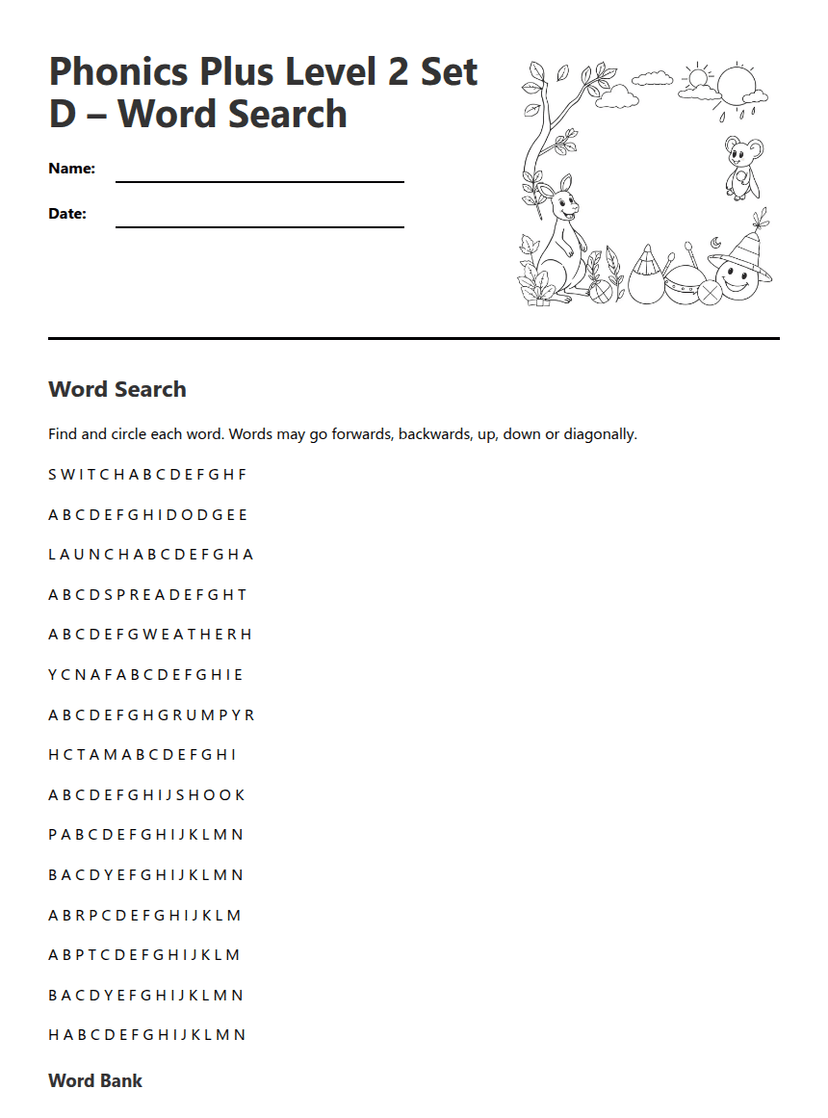
Phonics Plus Set D Word Search
Free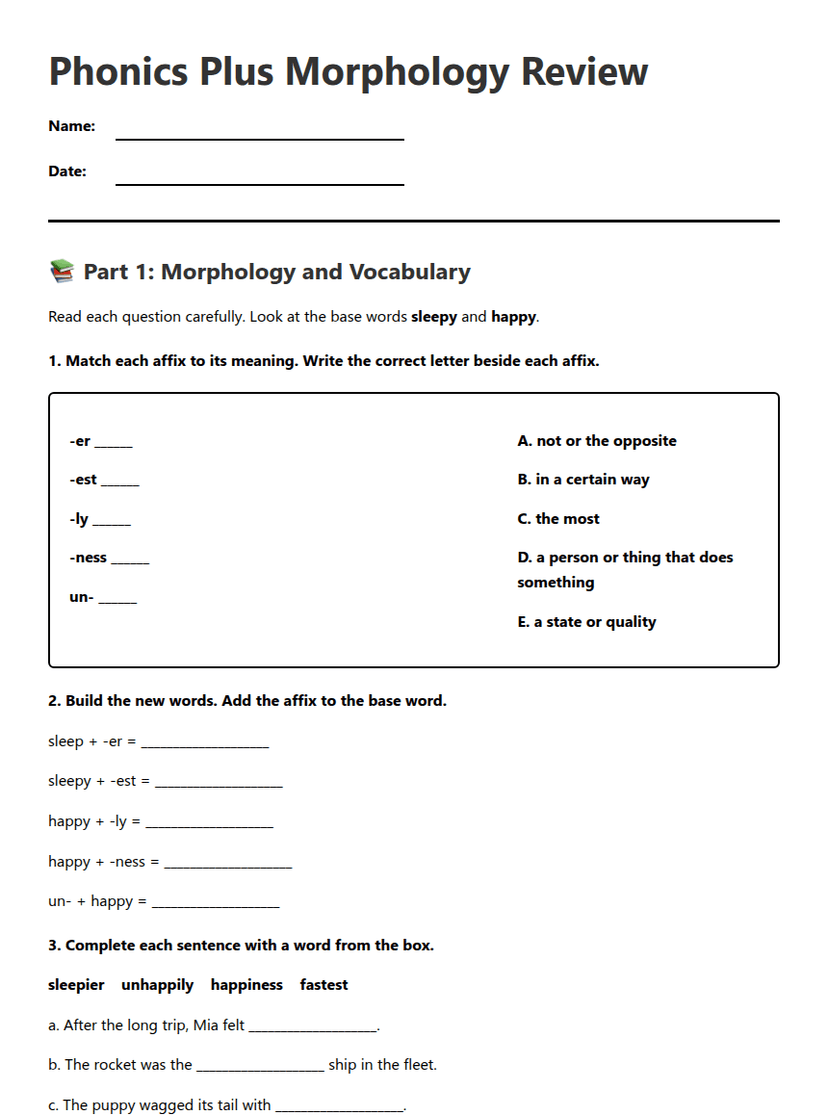
Phonics Plus Morphology Review
Free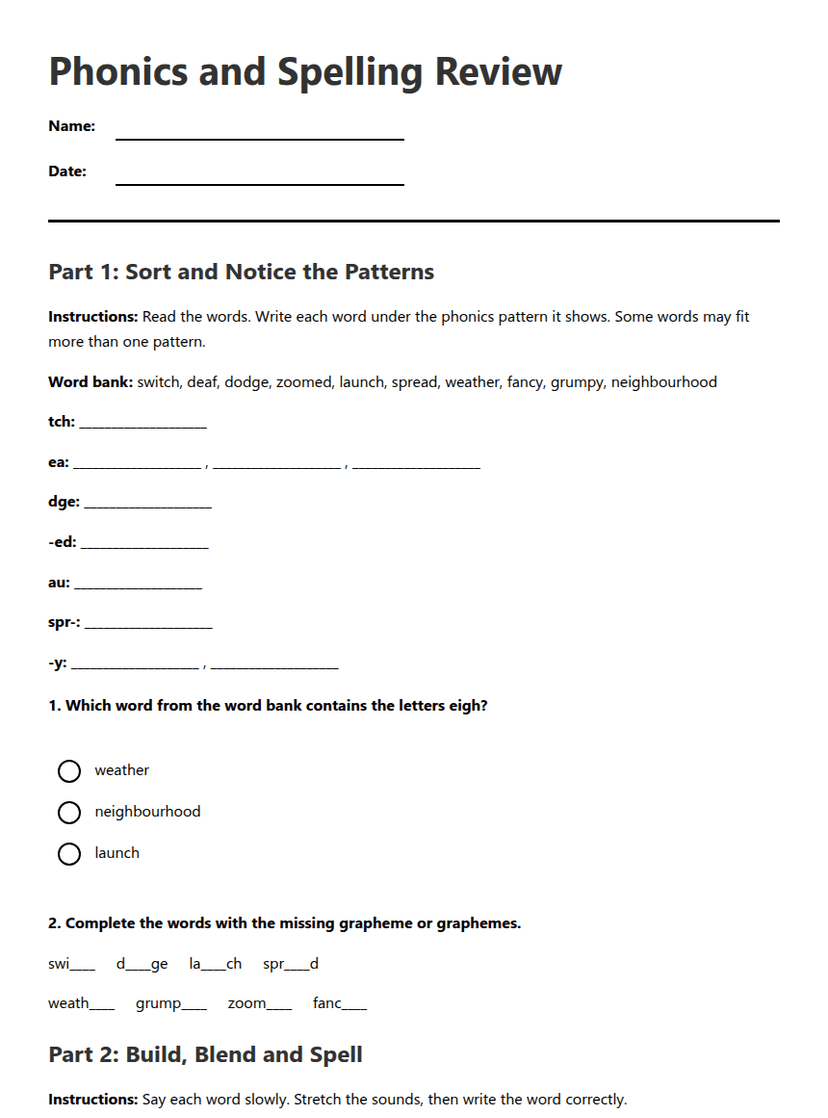
Phonics and Spelling Review
Free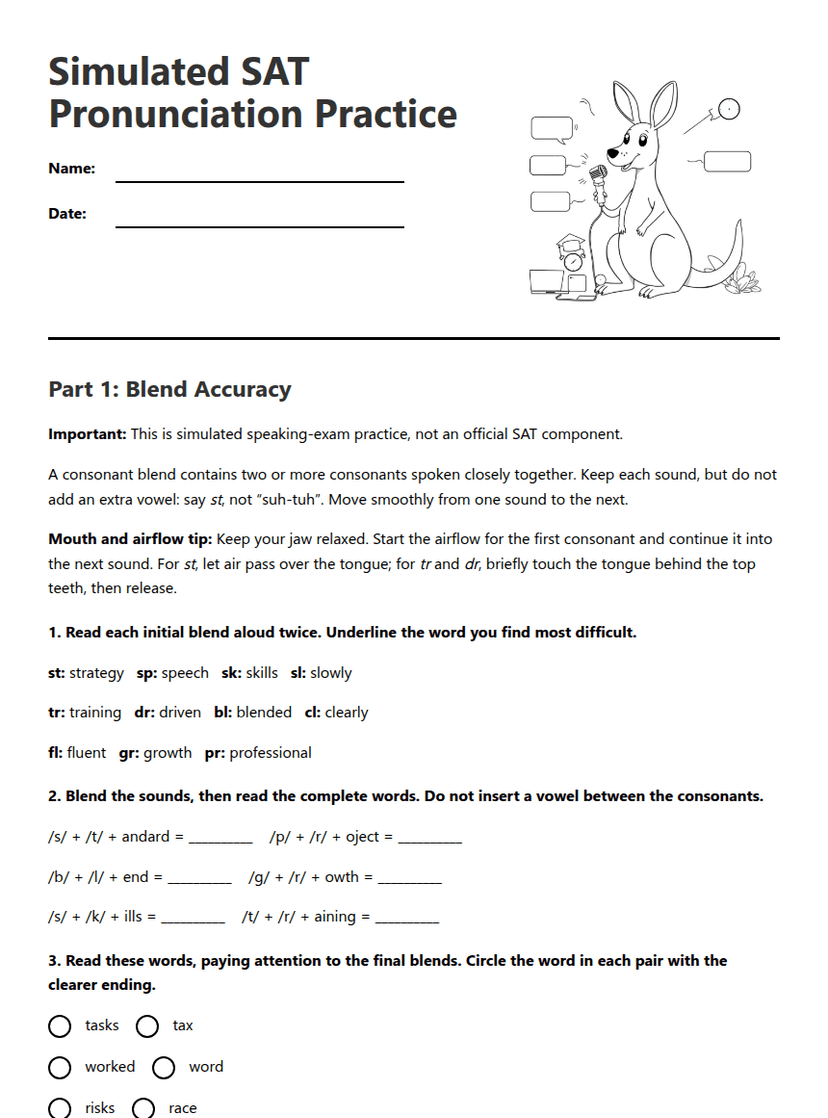
Simulated SAT Pronunciation Practice
Free
Practical Consonant Blends
Free
Consonant Blends Practice
Free