MathsFreePrintable

Probability Basics Introduction

A free maths worksheet ready for your classroom. Open in Kuraplan to grab the print-ready PDF, customize it for your students, or generate a fresh version in seconds.
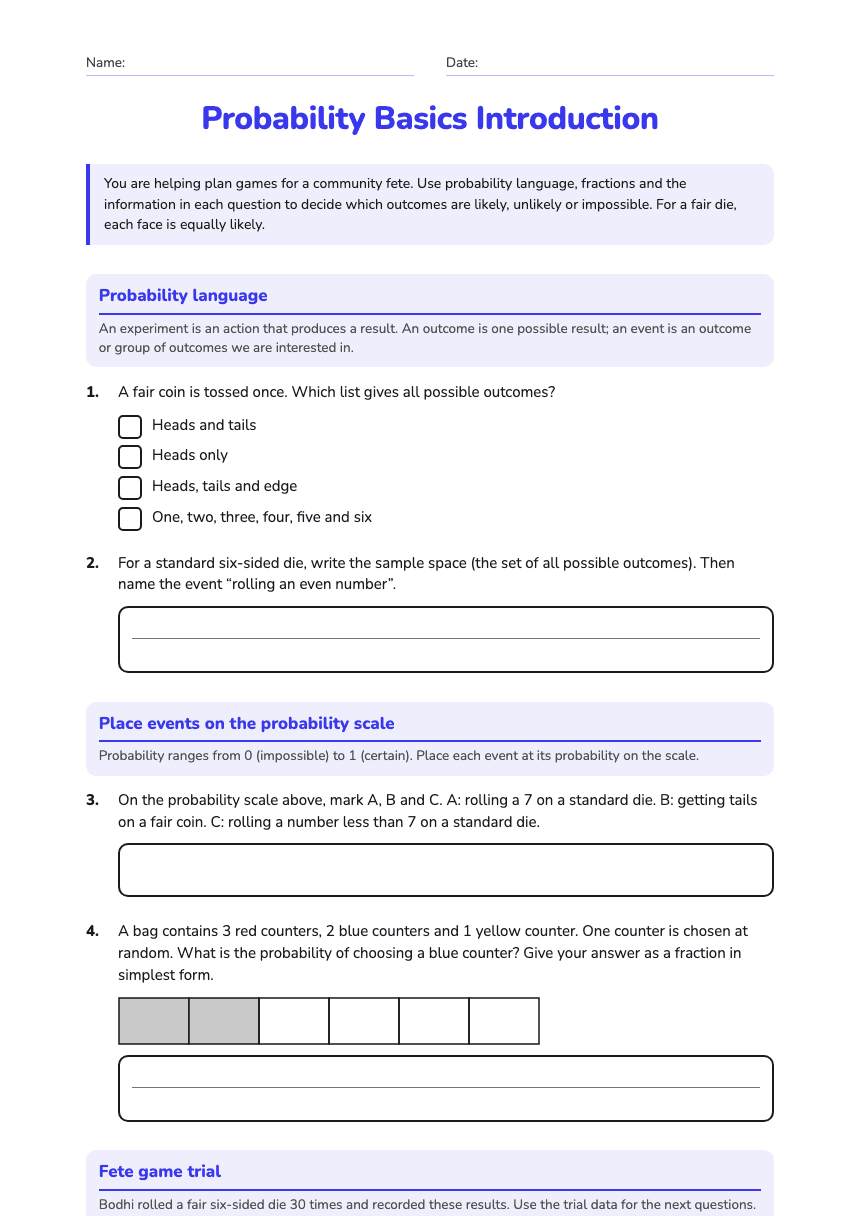
Probability Basics Introduction worksheet preview
Name:Date:

Probability Basics Introduction

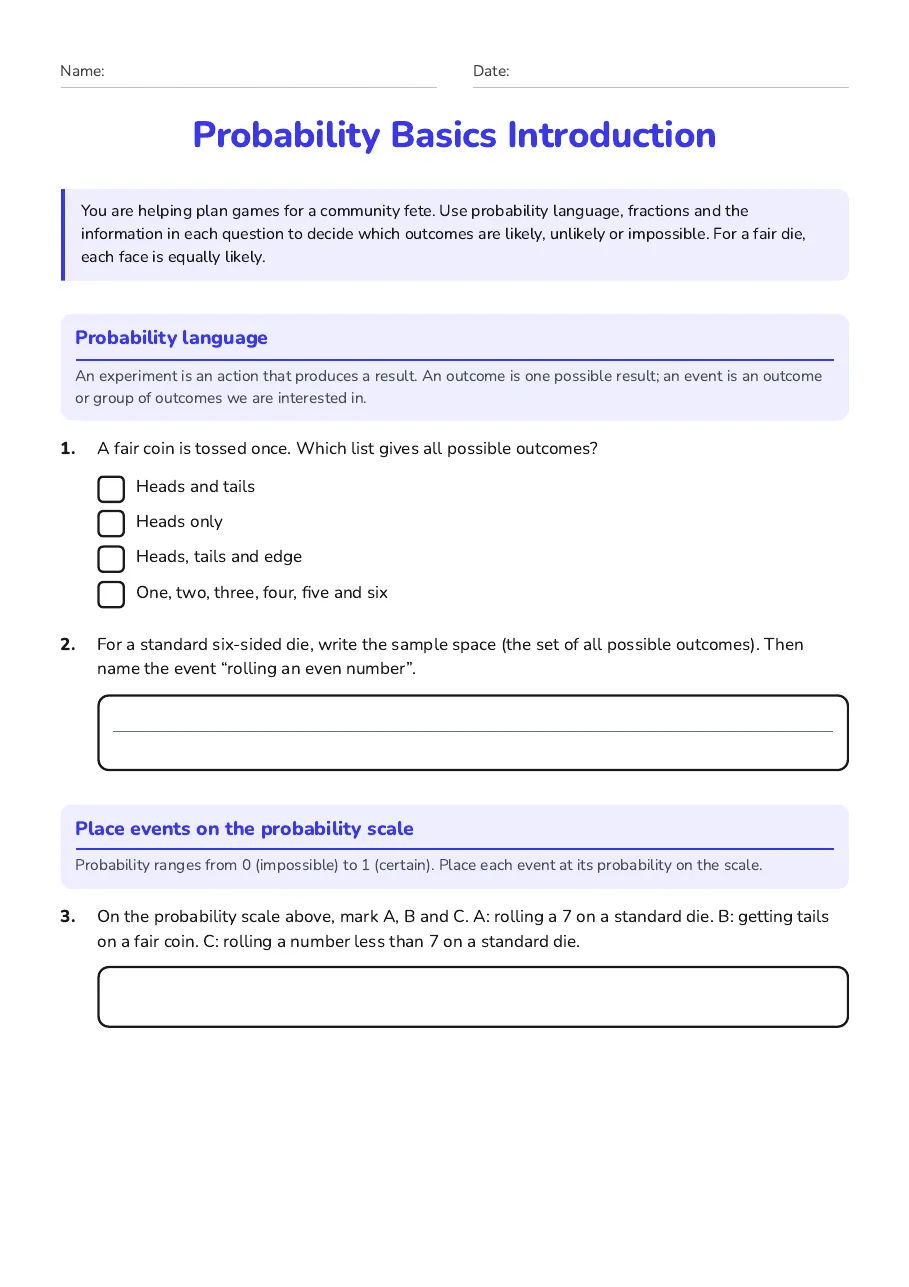
You are helping plan games for a community fete. Use probability language, fractions and the information in each question to decide which outcomes are likely, unlikely or impossible. For a fair die, each face is equally likely.

Probability language

An experiment is an action that produces a result. An outcome is one possible result; an event is an outcome or group of outcomes we are interested in.

1.A fair coin is tossed once. Which list gives all possible outcomes?
  • Heads and tails
  • Heads only
  • Heads, tails and edge
  • One, two, three, four, five and six
2.For a standard six-sided die, write the sample space (the set of all possible outcomes). Then name the event “rolling an even number”.

Place events on the probability scale

Probability ranges from 0 (impossible) to 1 (certain). Place each event at its probability on the scale.

3.On the probability scale above, mark A, B and C. A: rolling a 7 on a standard die. B: getting tails on a fair coin. C: rolling a number less than 7 on a standard die.
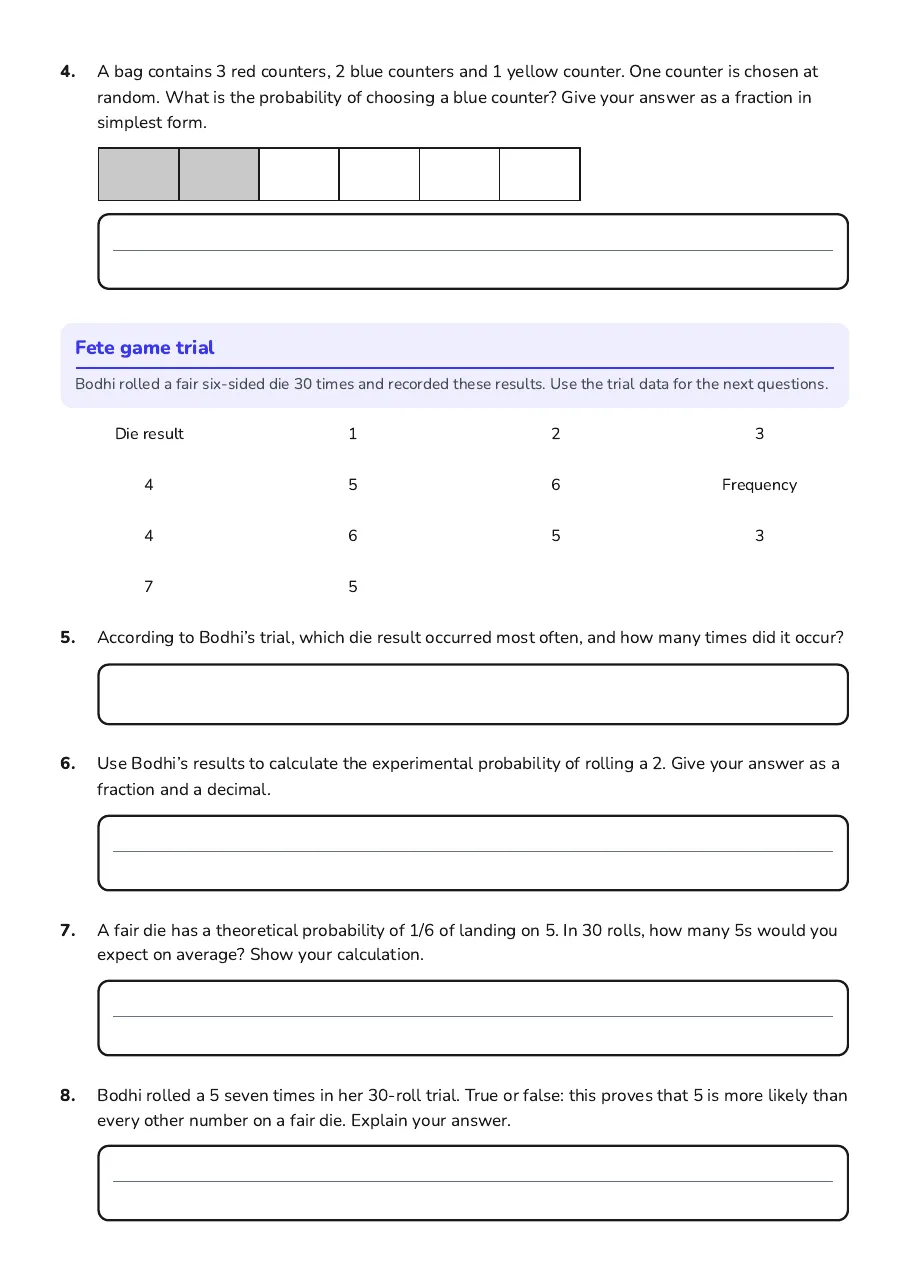
4.A bag contains 3 red counters, 2 blue counters and 1 yellow counter. One counter is chosen at random. What is the probability of choosing a blue counter? Give your answer as a fraction in simplest form.

Fete game trial

Bodhi rolled a fair six-sided die 30 times and recorded these results. Use the trial data for the next questions.

Die result

1

2

3

4

5

6

Frequency

4

6

5

3

7

5

5.According to Bodhi’s trial, which die result occurred most often, and how many times did it occur?
6.Use Bodhi’s results to calculate the experimental probability of rolling a 2. Give your answer as a fraction and a decimal.
7.A fair die has a theoretical probability of 1/6 of landing on 5. In 30 rolls, how many 5s would you expect on average? Show your calculation.
8.Bodhi rolled a 5 seven times in her 30-roll trial. True or false: this proves that 5 is more likely than every other number on a fair die. Explain your answer.
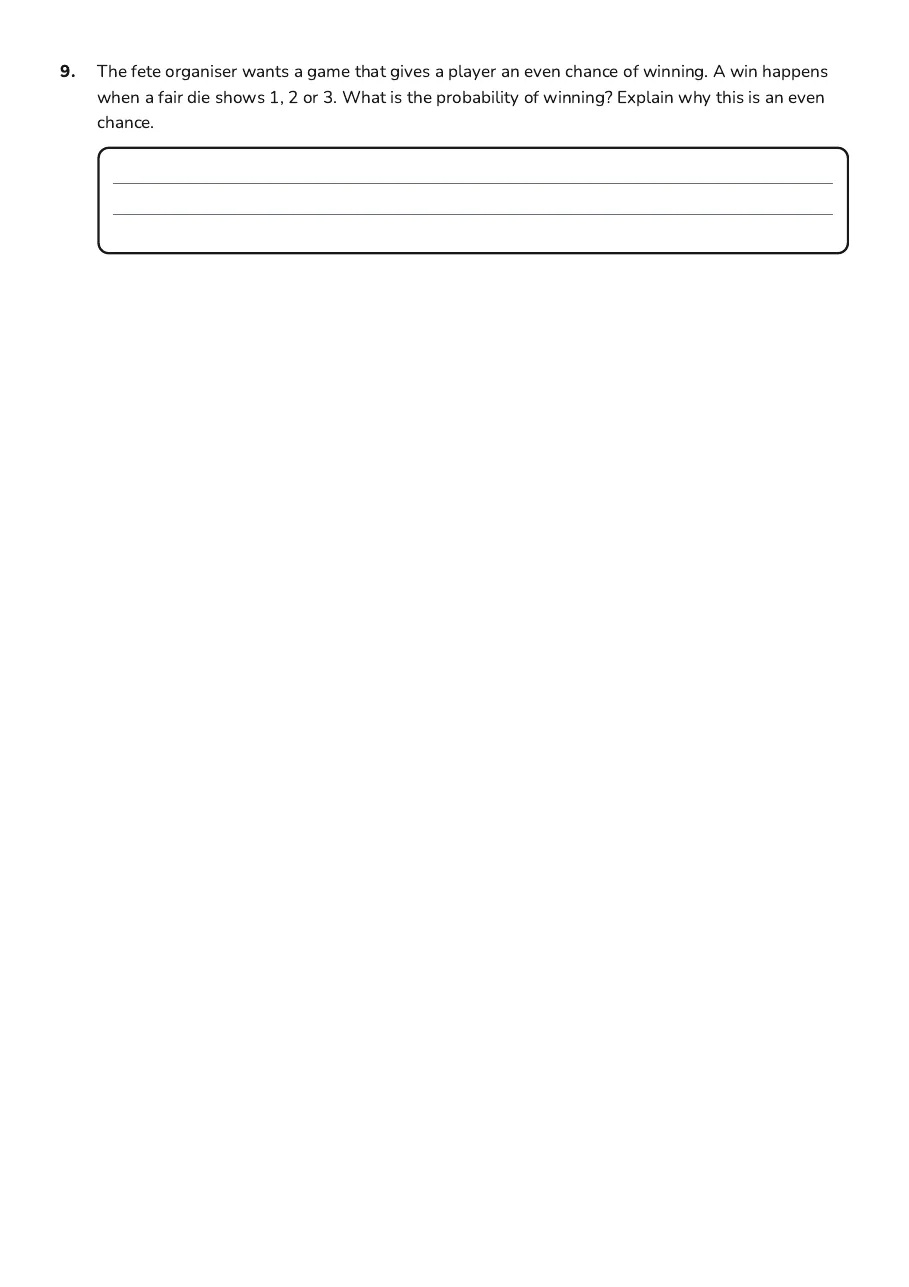
9.The fete organiser wants a game that gives a player an even chance of winning. A win happens when a fair die shows 1, 2 or 3. What is the probability of winning? Explain why this is an even chance.

3 printable pages

  • Probability Basics Introduction, page 1 of 3: Probability language, Place events on the probability scale

    Page 1

  • Probability Basics Introduction, page 2 of 3: Fete game trial

    Page 2

  • Probability Basics Introduction, page 3 of 3: 9. The fete organiser wants a game that gives a player an even chance of winning. A win…

    Page 3

About This Worksheet

Free in Kuraplan

Sign up free, grab the PDF, and customize it for your class.

Print-Ready

Formatted for standard paper. Clean layout, easy to read.

AI-Generated

Created with Kuraplan's AI, designed for real classroom use.

For Teachers & Parents

Use in classrooms, for homework, tutoring, or homeschool.

Need a custom version of this worksheet?

Kuraplan's AI generates custom worksheets in seconds — differentiated for every learner, aligned to your curriculum.

Generate Custom Worksheets — Free
No credit card Curriculum-aligned Under 60 seconds