Rocks and Rock Cycle Practice Test
A free science worksheet ready for your classroom. Open in Kuraplan to grab the print-ready PDF, customize it for your students, or generate a fresh version in seconds.
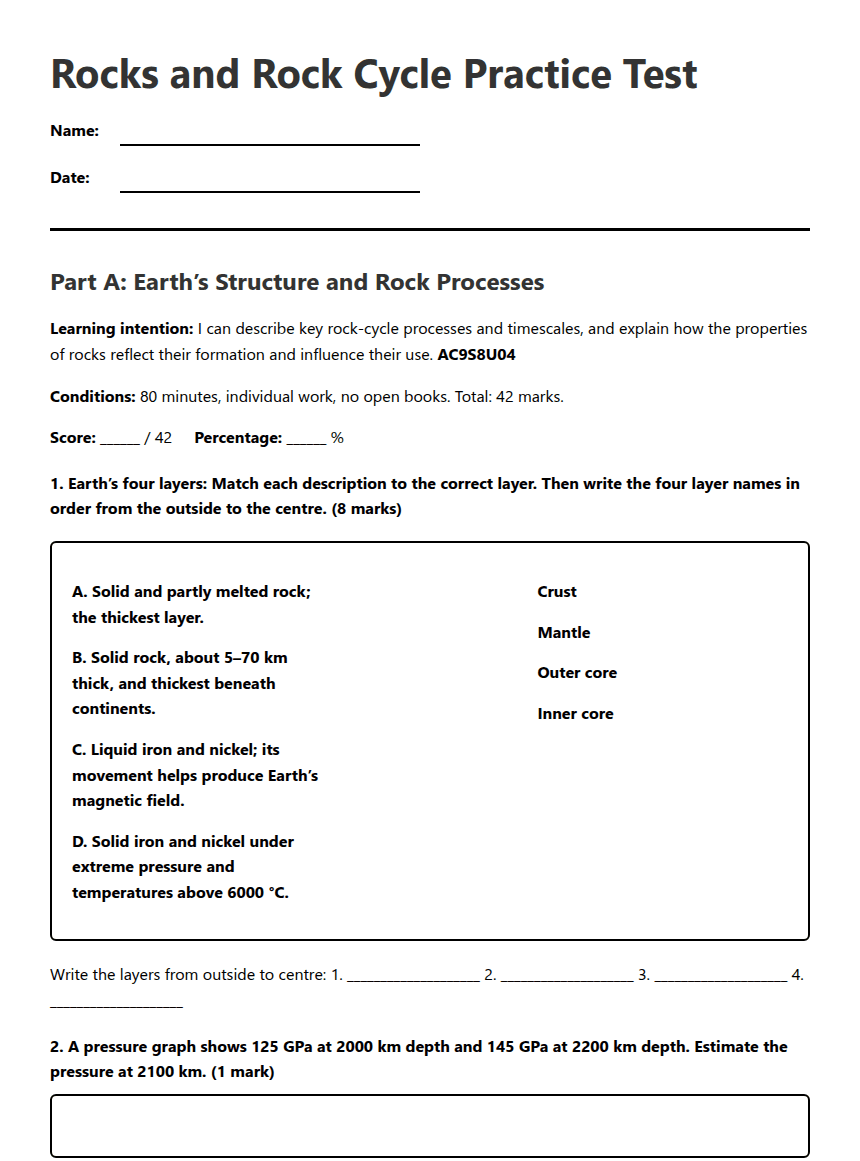
Rocks and Rock Cycle Practice Test
Part A: Earth’s Structure and Rock Processes
Learning intention: I can describe key rock-cycle processes and timescales, and explain how the properties of rocks reflect their formation and influence their use. AC9S8U04
Conditions: 80 minutes, individual work, no open books. Total: 42 marks.
Score: ______ / 42 Percentage: ______ %
Write the layers from outside to centre: 1. ____________________ 2. ____________________ 3. ____________________ 4. ____________________
a. ______________________________ b. ______________________________ c. ______________________________
a. Select the correct statement about the melted material. (1 mark)
b. What type of rock can form when this melted material cools and crystallises? (1 mark)
Part B: The Rock Cycle and Rock Identification
Practical Rock Identification
Your teacher will provide three numbered rock samples. Carefully observe each sample. Record features such as colour, grain size, crystals, layers, holes, hardness or fossils. Identify the rock type and name if you know it. Give other examples of that rock type.
Observations:
Rock type and name: __________________________________________
Other example(s) of this rock type: ______________________________
Observations:
Rock type and name: __________________________________________
Other example(s) of this rock type: ______________________________
Observations:
Rock type and name: __________________________________________
Other example(s) of this rock type: ______________________________
Teacher-Only Answer Guide
1. Earth’s layers: A = mantle, B = crust, C = outer core, D = inner core. Outside to centre: crust, mantle, outer core, inner core. Award 1 mark for each correct match and 1 mark for each correctly ordered layer.
2. Approximately 135 GPa.
3. Both temperature and pressure increase as depth increases. Award 1 mark for each trend.
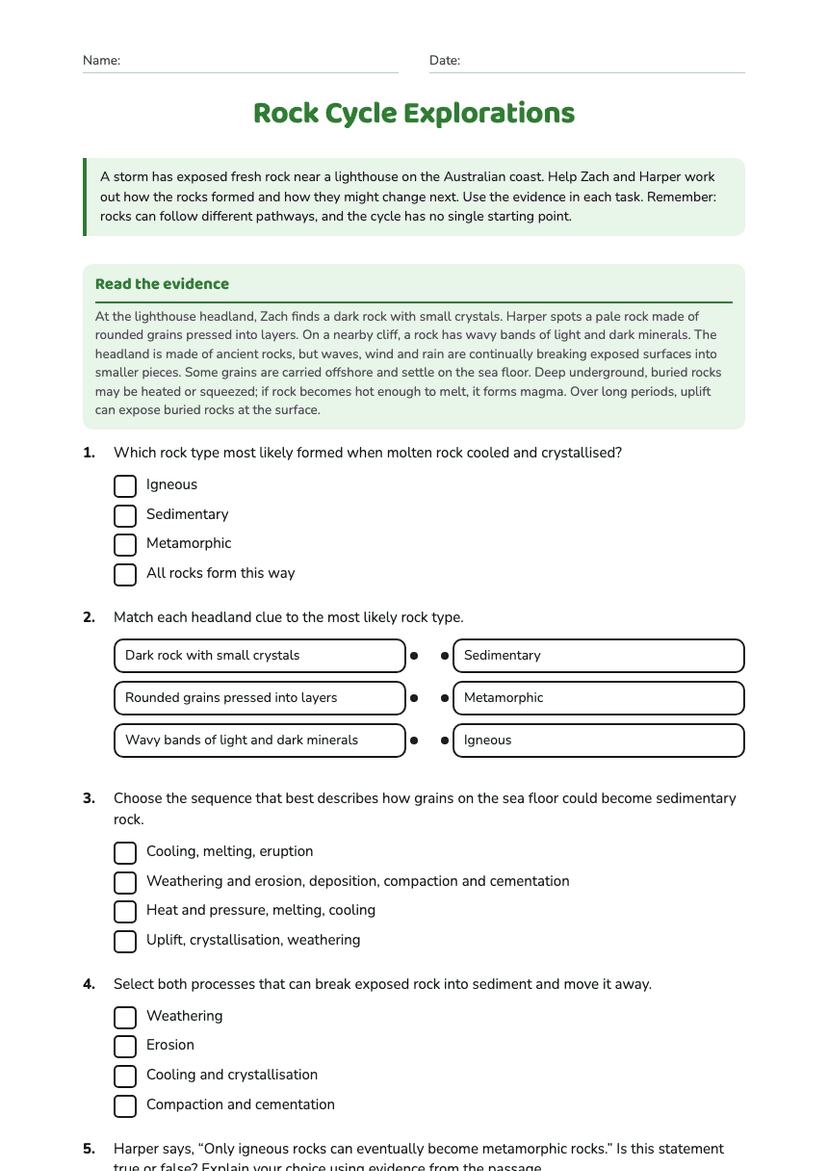
4. Sedimentary, igneous and metamorphic.
5. Weathering and erosion, or erosion and deposition if suitably explained. Accept mass movement as a related process.
6. a. It is called magma while underground. b. Igneous rock.
7. Cooling and crystallisation; igneous rock. Accept extrusive igneous rock.
8. Award up to 9 marks: correct inclusion and connection of weathering and erosion, sediment, compaction and cementation, sedimentary rock, melting, magma, cooling and crystallisation, igneous rock and metamorphic rock. Arrows should show that more than one pathway is possible.
9. The cycle has several possible pathways rather than one fixed sequence. Examples include sedimentary rock weathering into sediment, igneous rock changing into metamorphic rock through heat and pressure, or any rock melting to form magma.
10. The principle of superposition states that, in undisturbed layers, lower layers were deposited before layers above them. Therefore, the lahar layer formed first.
11–13. Award 1 mark for useful observations, 1 mark for a suitable rock type and name where possible, and 1 mark for accurate examples of that rock type. Accept scientifically justified alternatives based on the samples provided.
Total: 42 marks.
About This Worksheet
Free in Kuraplan
Sign up free, grab the PDF, and customize it for your class.
Print-Ready
Formatted for standard paper. Clean layout, easy to read.
AI-Generated
Created with Kuraplan's AI, designed for real classroom use.
For Teachers & Parents
Use in classrooms, for homework, tutoring, or homeschool.
Need a custom version of this worksheet?
Kuraplan's AI generates custom worksheets in seconds — differentiated for every learner, aligned to your curriculum.
Generate Custom Worksheets — Free