ScienceFreePrintable

Science Experiment Basics

A free science worksheet ready for your classroom. Open in Kuraplan to grab the print-ready PDF, customize it for your students, or generate a fresh version in seconds.
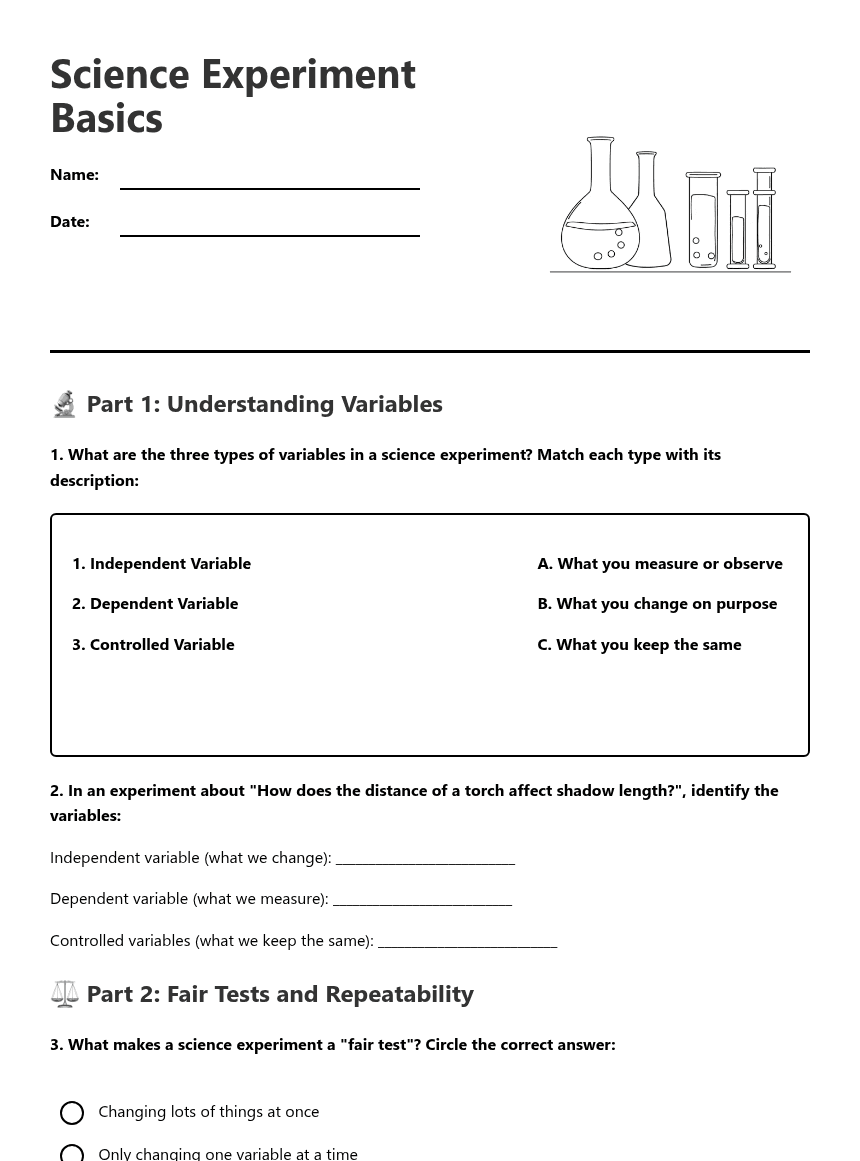
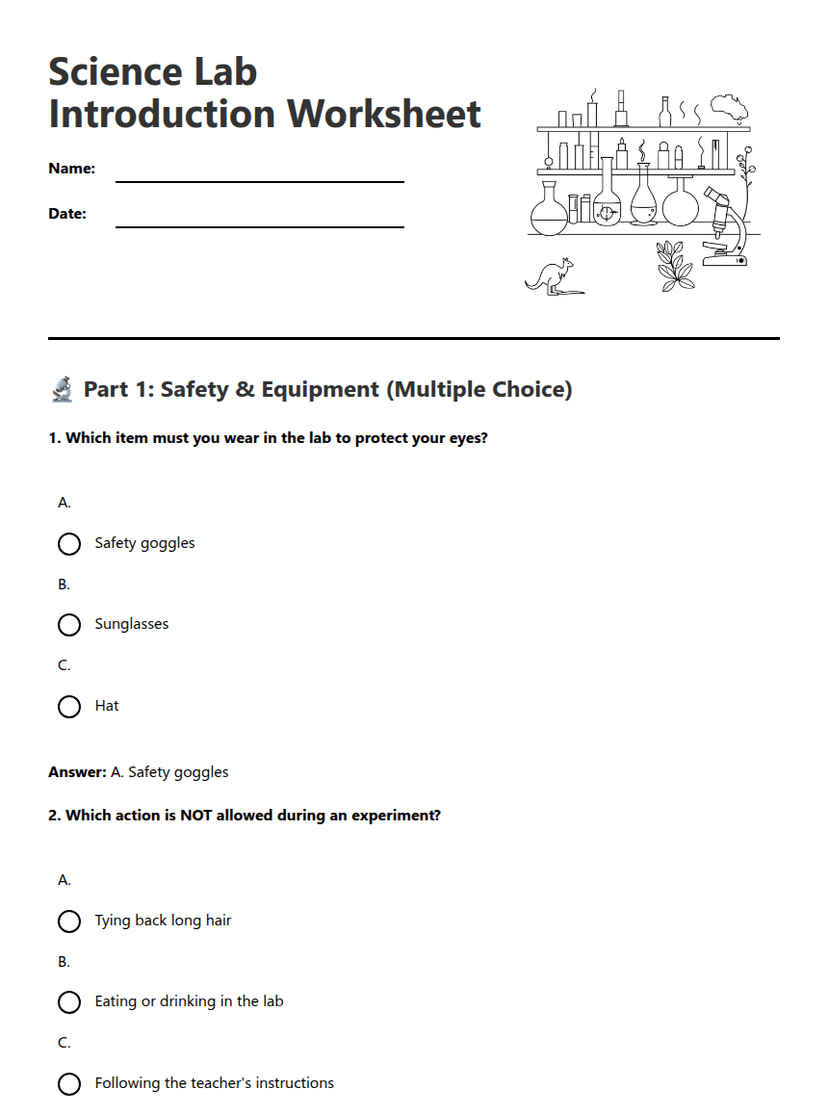
Science Experiment Basics worksheet preview
Science Experiment Basics

Science Experiment Basics

Science experiment with beakers and magnifying glass

🔬 Part 1: Understanding Variables

1. What are the three types of variables in a science experiment? Match each type with its description:
1. Independent Variable
2. Dependent Variable
3. Controlled Variable
A. What you measure or observe
B. What you change on purpose
C. What you keep the same
2. In an experiment about "How does the distance of a torch affect shadow length?", identify the variables:

Independent variable (what we change): ___________________________

Dependent variable (what we measure): ___________________________

Controlled variables (what we keep the same): ___________________________

⚖️ Part 2: Fair Tests and Repeatability

3. What makes a science experiment a "fair test"? Circle the correct answer:

Changing lots of things at once

Only changing one variable at a time

Not measuring anything

Using different equipment each time

4. Why is repeatability important in science experiments?
5. Check all the things that help make an experiment repeatable:

Writing clear step-by-step instructions

Recording what equipment was used

Keeping the method secret

Measuring precisely

Recording all observations

🛡️ Part 3: Safety in Science

6. List three important safety rules when conducting science experiments:

1. ________________________________________________

2. ________________________________________________

3. ________________________________________________

7. Which safety equipment might you need for different experiments? Match each experiment with appropriate safety gear:
1. Using chemicals
2. Working with hot water
3. Using electrical equipment
A. Keep water away from power points
B. Wear safety goggles
C. Use heat-proof gloves

📏 Part 4: Measuring and Recording Data

8. What does it mean to measure "with reasonable precision"?

Guessing the measurement

Using the right equipment and being as accurate as possible

Only measuring once

Rounding all numbers to 10

9. Fill in the blanks about measuring tools:

To measure length in centimetres, I would use a _______________.

To measure time in seconds, I would use a _______________ or _______________.

To measure temperature in degrees Celsius, I would use a _______________.

To measure mass in grams, I would use _______________.

10. Why is it important to record data during an experiment?

🧪 Part 5: Planning Your Own Experiment

11. Design a simple experiment to answer this question: "Does the type of paper affect how far a paper aeroplane flies?"

What will you change? (Independent variable)

What will you measure? (Dependent variable)

What will you keep the same? (Controlled variables - list at least 3)

What safety considerations do you need?

What equipment will you need?

12. Draw a simple diagram of your paper aeroplane experiment setup:

About This Worksheet

Free in Kuraplan

Sign up free, grab the PDF, and customize it for your class.

Print-Ready

Formatted for standard paper. Clean layout, easy to read.

AI-Generated

Created with Kuraplan's AI, designed for real classroom use.

For Teachers & Parents

Use in classrooms, for homework, tutoring, or homeschool.

Need a custom version of this worksheet?

Kuraplan's AI generates custom worksheets in seconds — differentiated for every learner, aligned to your curriculum.

Generate Custom Worksheets — Free
No credit card Curriculum-aligned Under 60 seconds