ScienceFreePrintable
Solar System Motion Research
A free science worksheet ready for your classroom. Open in Kuraplan to grab the print-ready PDF, customize it for your students, or generate a fresh version in seconds.
Name:Date:
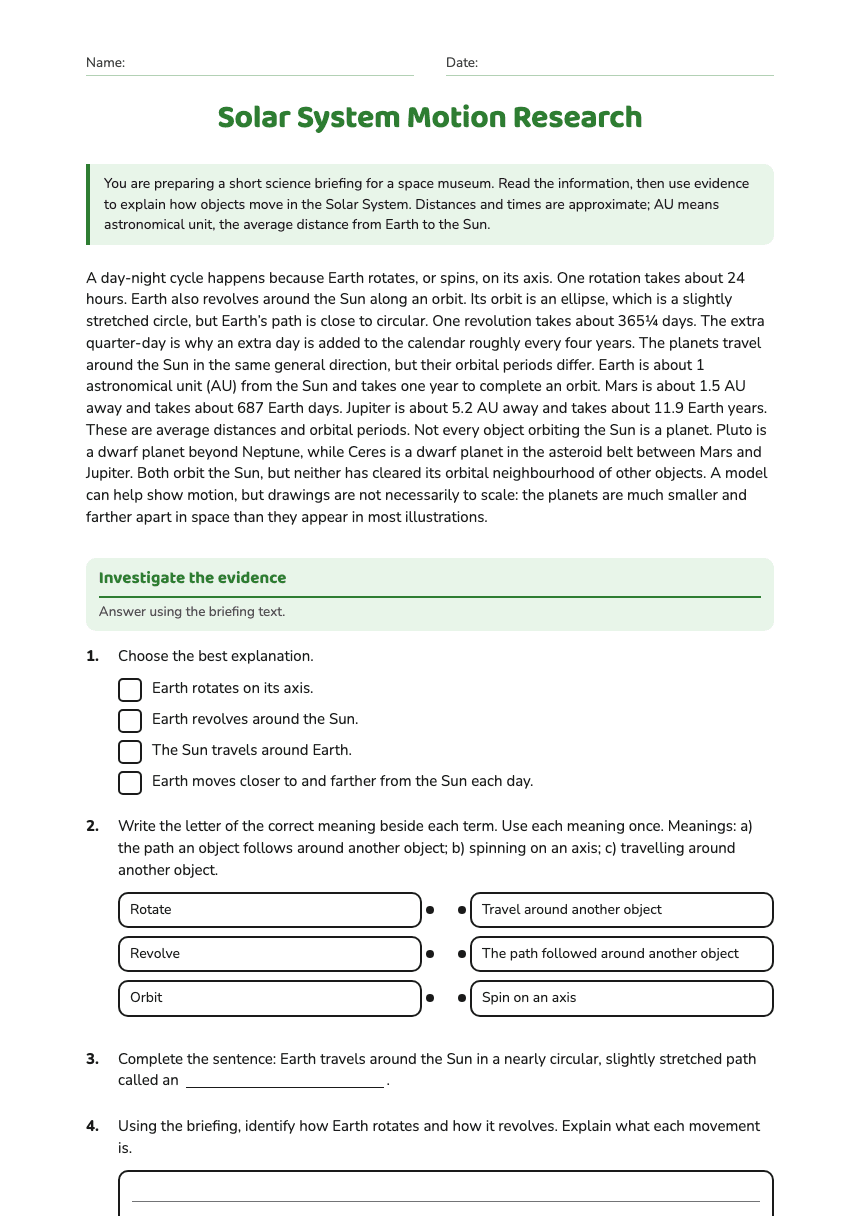
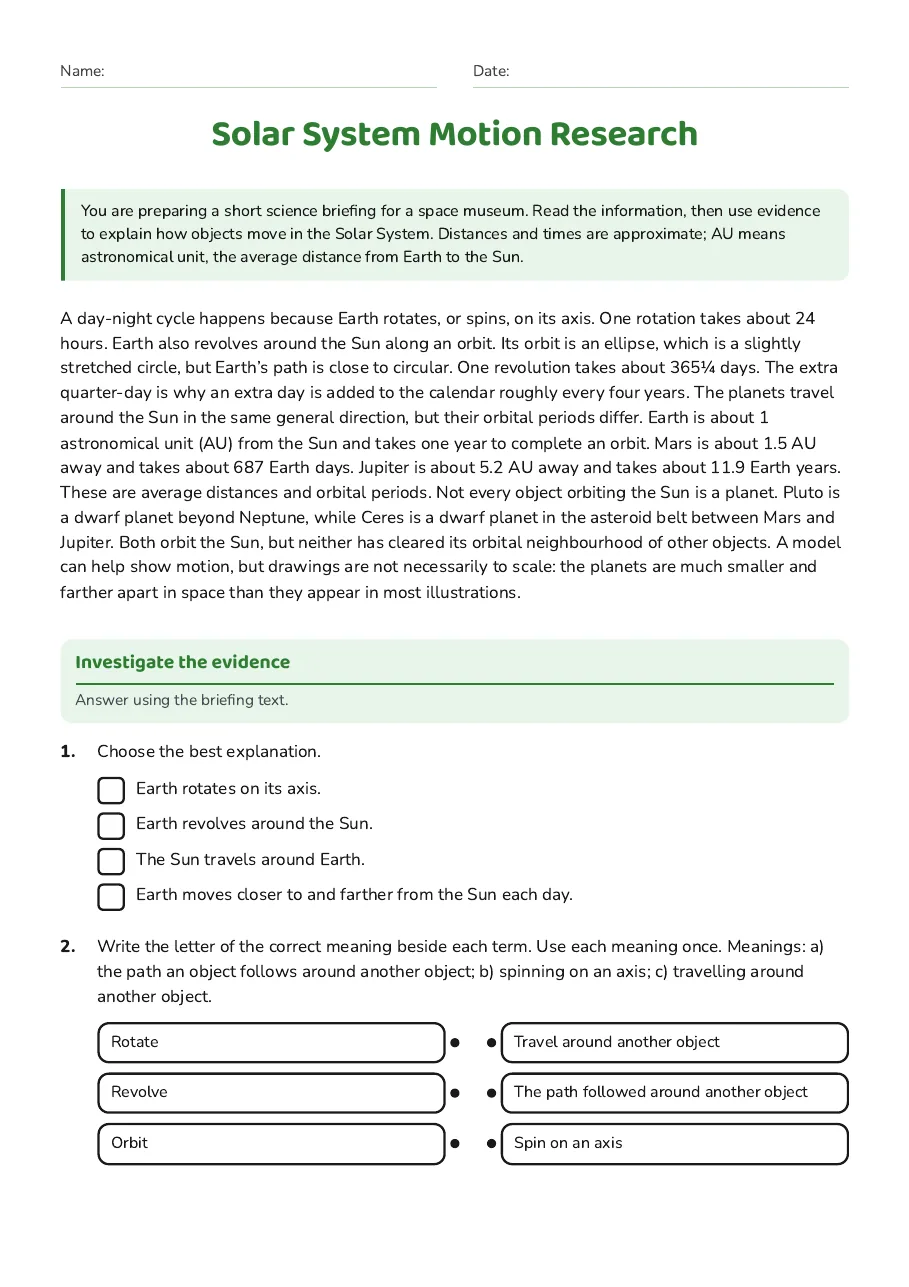
Solar System Motion Research
You are preparing a short science briefing for a space museum. Read the information, then use evidence to explain how objects move in the Solar System. Distances and times are approximate; AU means astronomical unit, the average distance from Earth to the Sun.
A day-night cycle happens because Earth rotates, or spins, on its axis. One rotation takes about 24 hours. Earth also revolves around the Sun along an orbit. Its orbit is an ellipse, which is a slightly stretched circle, but Earth’s path is close to circular. One revolution takes about 365¼ days. The extra quarter-day is why an extra day is added to the calendar roughly every four years.
The planets travel around the Sun in the same general direction, but their orbital periods differ. Earth is about 1 astronomical unit (AU) from the Sun and takes one year to complete an orbit. Mars is about 1.5 AU away and takes about 687 Earth days. Jupiter is about 5.2 AU away and takes about 11.9 Earth years. These are average distances and orbital periods.
Not every object orbiting the Sun is a planet. Pluto is a dwarf planet beyond Neptune, while Ceres is a dwarf planet in the asteroid belt between Mars and Jupiter. Both orbit the Sun, but neither has cleared its orbital neighbourhood of other objects. A model can help show motion, but drawings are not necessarily to scale: the planets are much smaller and farther apart in space than they appear in most illustrations.
Investigate the evidence
Answer using the briefing text.
1.Choose the best explanation.
- Earth rotates on its axis.
- Earth revolves around the Sun.
- The Sun travels around Earth.
- Earth moves closer to and farther from the Sun each day.
2.Write the letter of the correct meaning beside each term. Use each meaning once.
Meanings: a) the path an object follows around another object; b) spinning on an axis; c) travelling around another object.
- Rotate
- Revolve
- Orbit
- Travel around another object
- The path followed around another object
- Spin on an axis
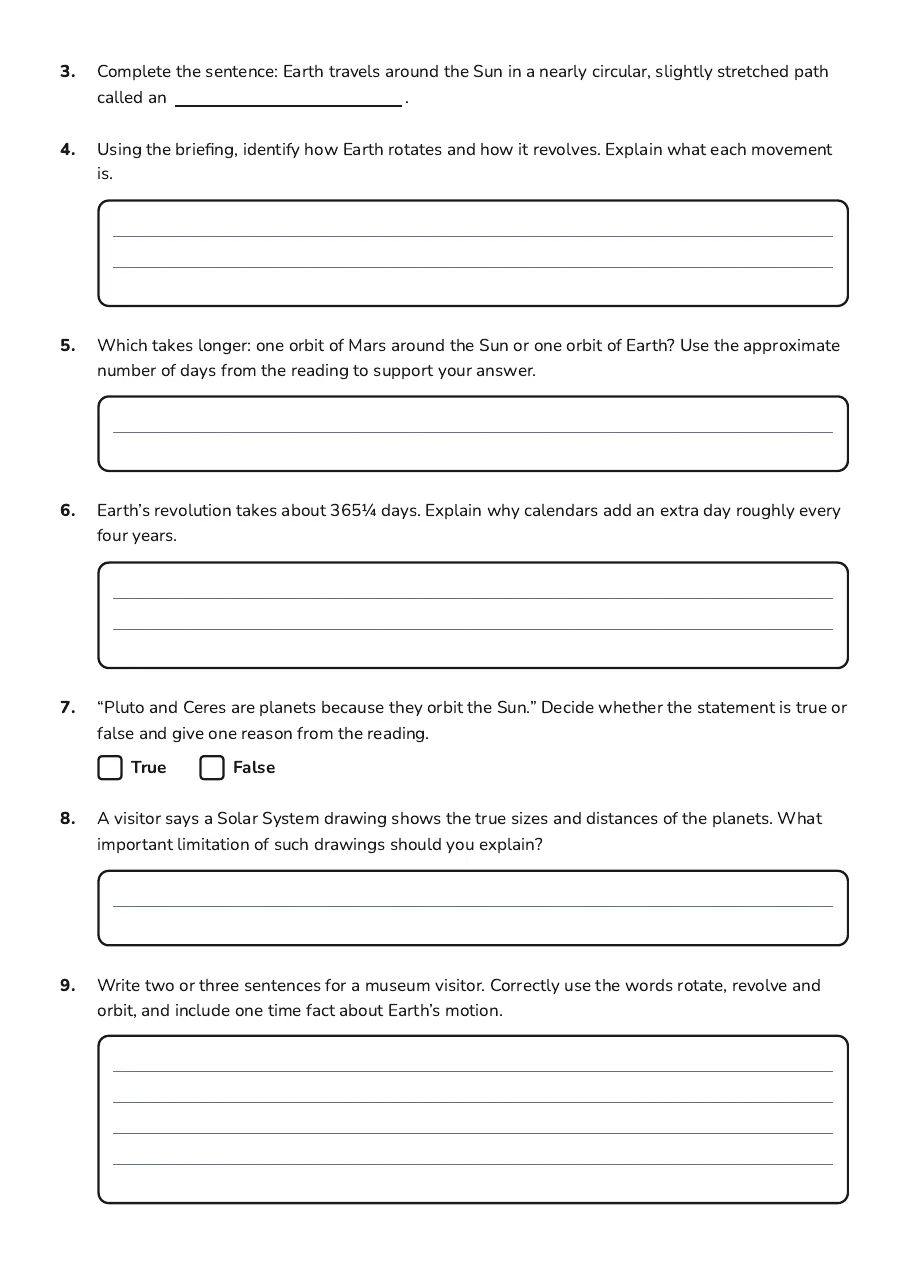
3.Complete the sentence: Earth travels around the Sun in a nearly circular, slightly stretched path called an .
4.Using the briefing, identify how Earth rotates and how it revolves. Explain what each movement is.
5.Which takes longer: one orbit of Mars around the Sun or one orbit of Earth? Use the approximate number of days from the reading to support your answer.
6.Earth’s revolution takes about 365¼ days. Explain why calendars add an extra day roughly every four years.
7.“Pluto and Ceres are planets because they orbit the Sun.” Decide whether the statement is true or false and give one reason from the reading.
TrueFalse
8.A visitor says a Solar System drawing shows the true sizes and distances of the planets. What important limitation of such drawings should you explain?
9.Write two or three sentences for a museum visitor. Correctly use the words rotate, revolve and orbit, and include one time fact about Earth’s motion.
2 printable pages
Page 1
Page 2
About This Worksheet
Free in Kuraplan
Sign up free, grab the PDF, and customize it for your class.
Print-Ready
Formatted for standard paper. Clean layout, easy to read.
AI-Generated
Created with Kuraplan's AI, designed for real classroom use.
For Teachers & Parents
Use in classrooms, for homework, tutoring, or homeschool.
Need a custom version of this worksheet?
Kuraplan's AI generates custom worksheets in seconds — differentiated for every learner, aligned to your curriculum.
Generate Custom Worksheets — Free No credit card Curriculum-aligned Under 60 seconds