ScienceFreePrintable

Solar System Motion Research

A free science worksheet ready for your classroom. Open in Kuraplan to grab the print-ready PDF, customize it for your students, or generate a fresh version in seconds.
Solar System Motion Research worksheet preview
Name:Date:

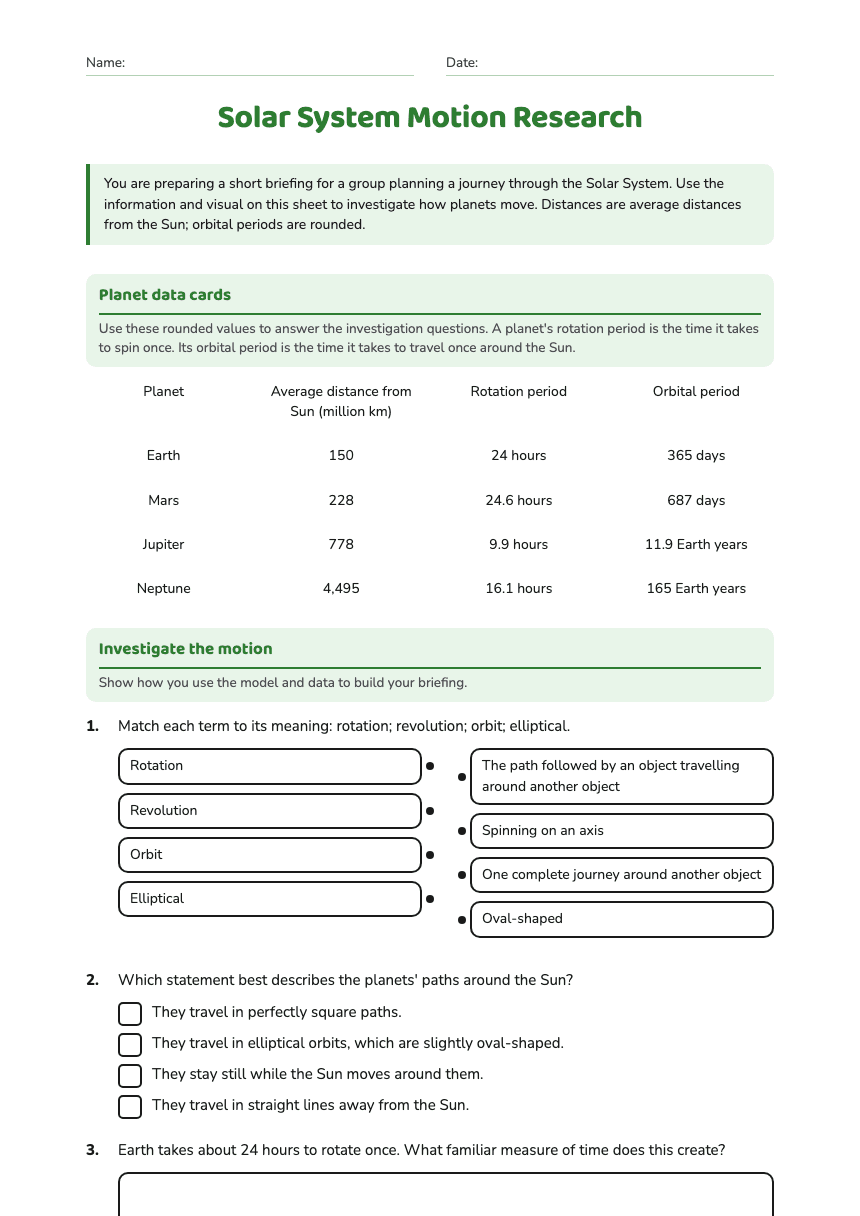
Solar System Motion Research

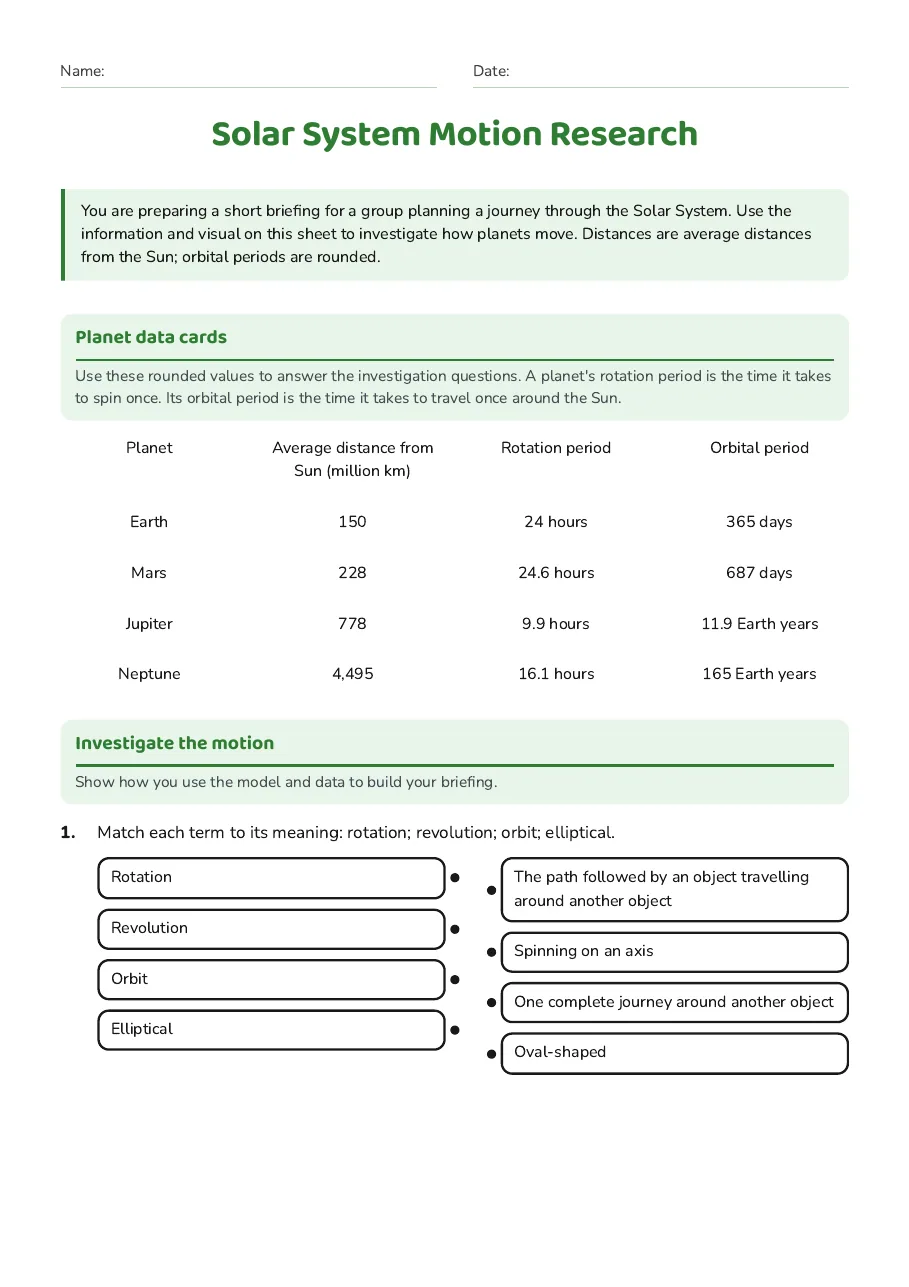
You are preparing a short briefing for a group planning a journey through the Solar System. Use the information and visual on this sheet to investigate how planets move. Distances are average distances from the Sun; orbital periods are rounded.

Planet data cards

Use these rounded values to answer the investigation questions. A planet's rotation period is the time it takes to spin once. Its orbital period is the time it takes to travel once around the Sun.

Planet

Average distance from Sun (million km)

Rotation period

Orbital period

Earth

150

24 hours

365 days

Mars

228

24.6 hours

687 days

Jupiter

778

9.9 hours

11.9 Earth years

Neptune

4,495

16.1 hours

165 Earth years

Investigate the motion

Show how you use the model and data to build your briefing.

1.Match each term to its meaning: rotation; revolution; orbit; elliptical.
  • Rotation
  • Revolution
  • Orbit
  • Elliptical
  • The path followed by an object travelling around another object
  • Spinning on an axis
  • One complete journey around another object
  • Oval-shaped
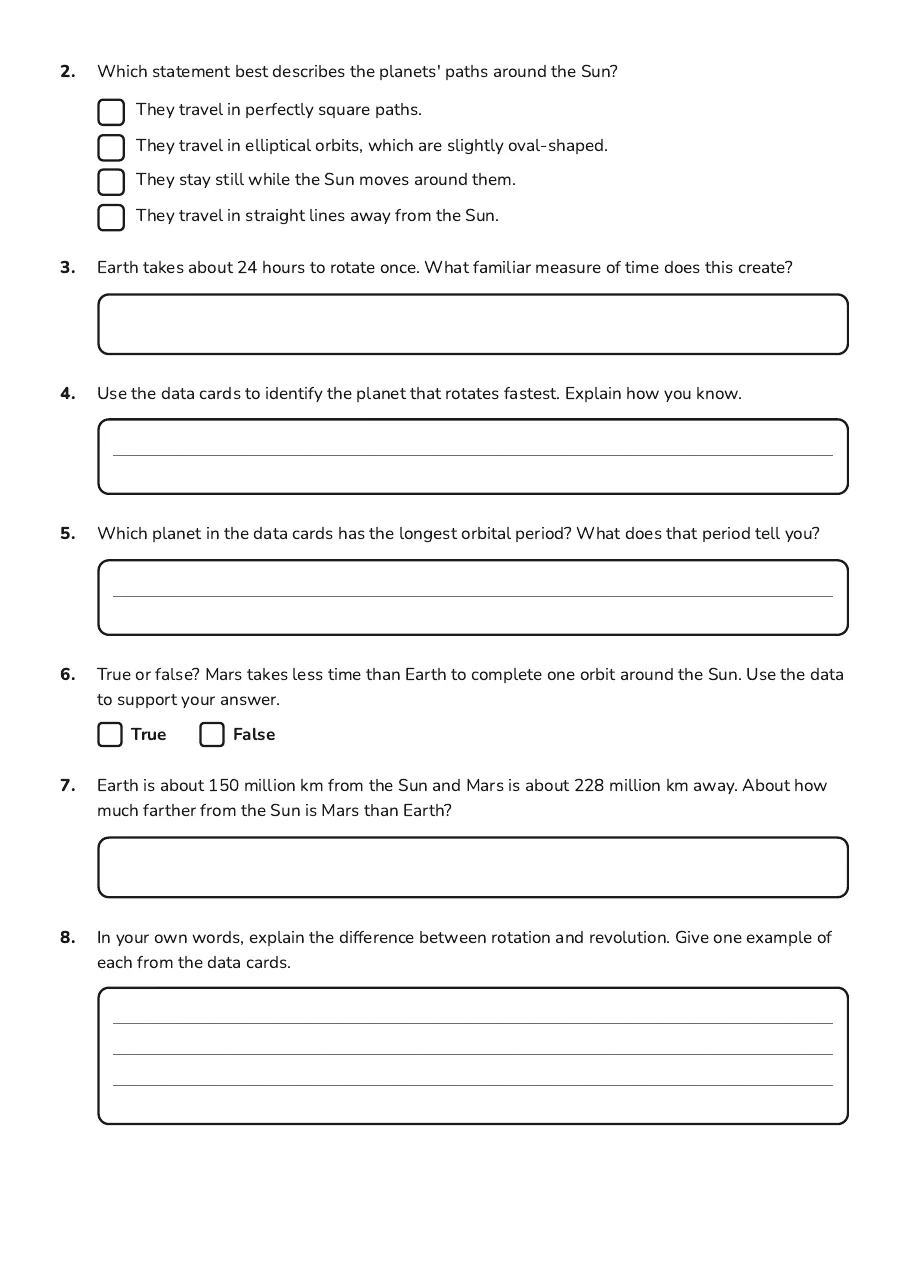
2.Which statement best describes the planets' paths around the Sun?
  • They travel in perfectly square paths.
  • They travel in elliptical orbits, which are slightly oval-shaped.
  • They stay still while the Sun moves around them.
  • They travel in straight lines away from the Sun.
3.Earth takes about 24 hours to rotate once. What familiar measure of time does this create?
4.Use the data cards to identify the planet that rotates fastest. Explain how you know.
5.Which planet in the data cards has the longest orbital period? What does that period tell you?
6.True or false? Mars takes less time than Earth to complete one orbit around the Sun. Use the data to support your answer.
TrueFalse
7.Earth is about 150 million km from the Sun and Mars is about 228 million km away. About how much farther from the Sun is Mars than Earth?
8.In your own words, explain the difference between rotation and revolution. Give one example of each from the data cards.
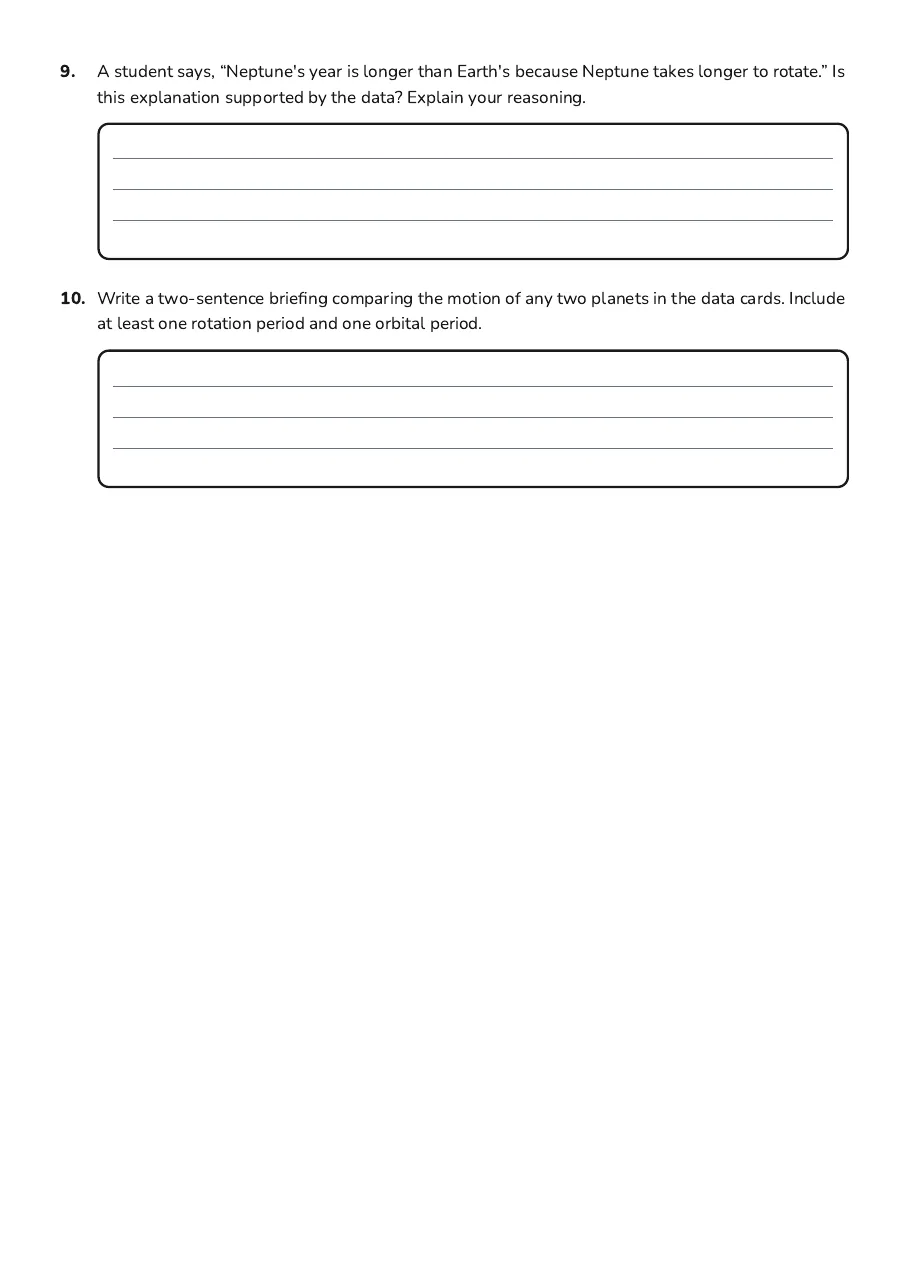
9.A student says, “Neptune's year is longer than Earth's because Neptune takes longer to rotate.” Is this explanation supported by the data? Explain your reasoning.
10.Write a two-sentence briefing comparing the motion of any two planets in the data cards. Include at least one rotation period and one orbital period.

3 printable pages

  • Solar System Motion Research, page 1 of 3: Planet data cards, Investigate the motion

    Page 1

  • Solar System Motion Research, page 2 of 3: 2. Which statement best describes the planets' paths around the Sun?

    Page 2

  • Solar System Motion Research, page 3 of 3: 9. A student says, “Neptune's year is longer than Earth's because Neptune takes longer to…

    Page 3

About This Worksheet

Free in Kuraplan

Sign up free, grab the PDF, and customize it for your class.

Print-Ready

Formatted for standard paper. Clean layout, easy to read.

AI-Generated

Created with Kuraplan's AI, designed for real classroom use.

For Teachers & Parents

Use in classrooms, for homework, tutoring, or homeschool.

Need a custom version of this worksheet?

Kuraplan's AI generates custom worksheets in seconds — differentiated for every learner, aligned to your curriculum.

Generate Custom Worksheets — Free
No credit card Curriculum-aligned Under 60 seconds