EnglishFreePrintable

Text Analysis Writing Fundamentals

A free english worksheet ready for your classroom. Open in Kuraplan to grab the print-ready PDF, customize it for your students, or generate a fresh version in seconds.
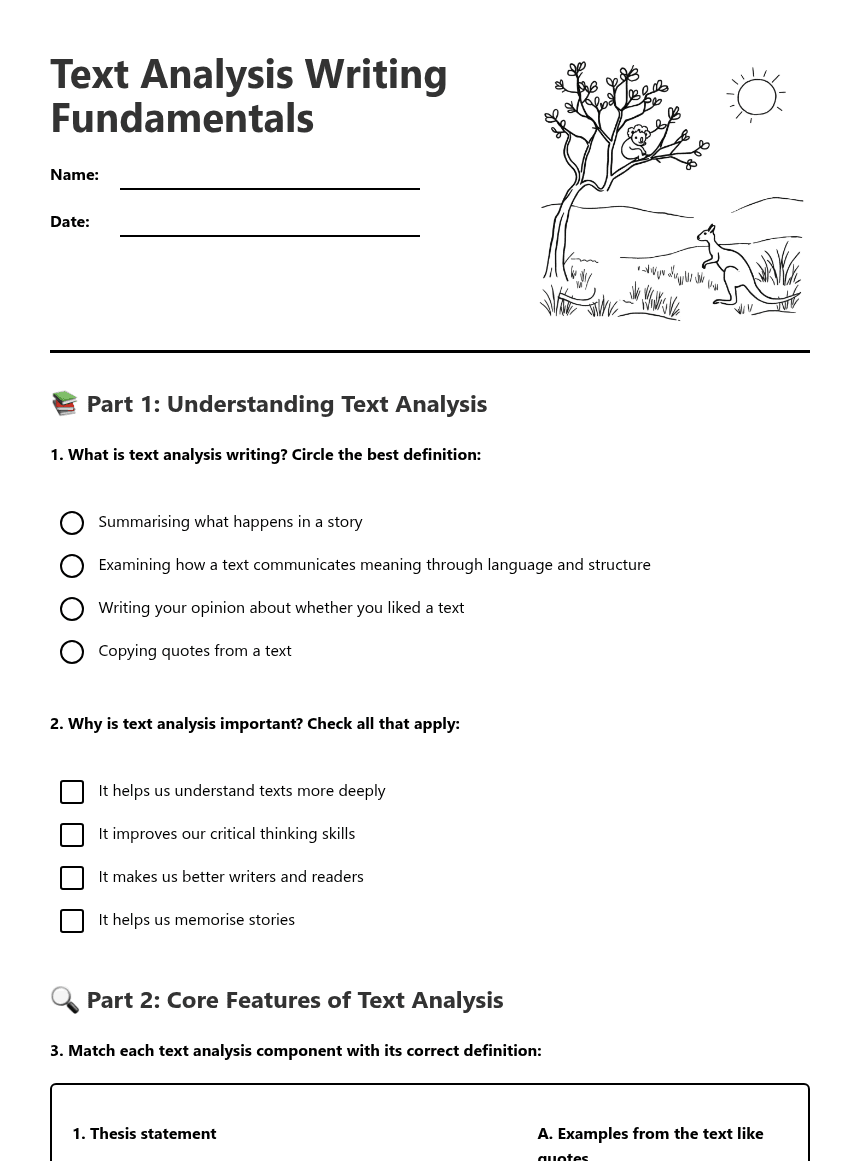
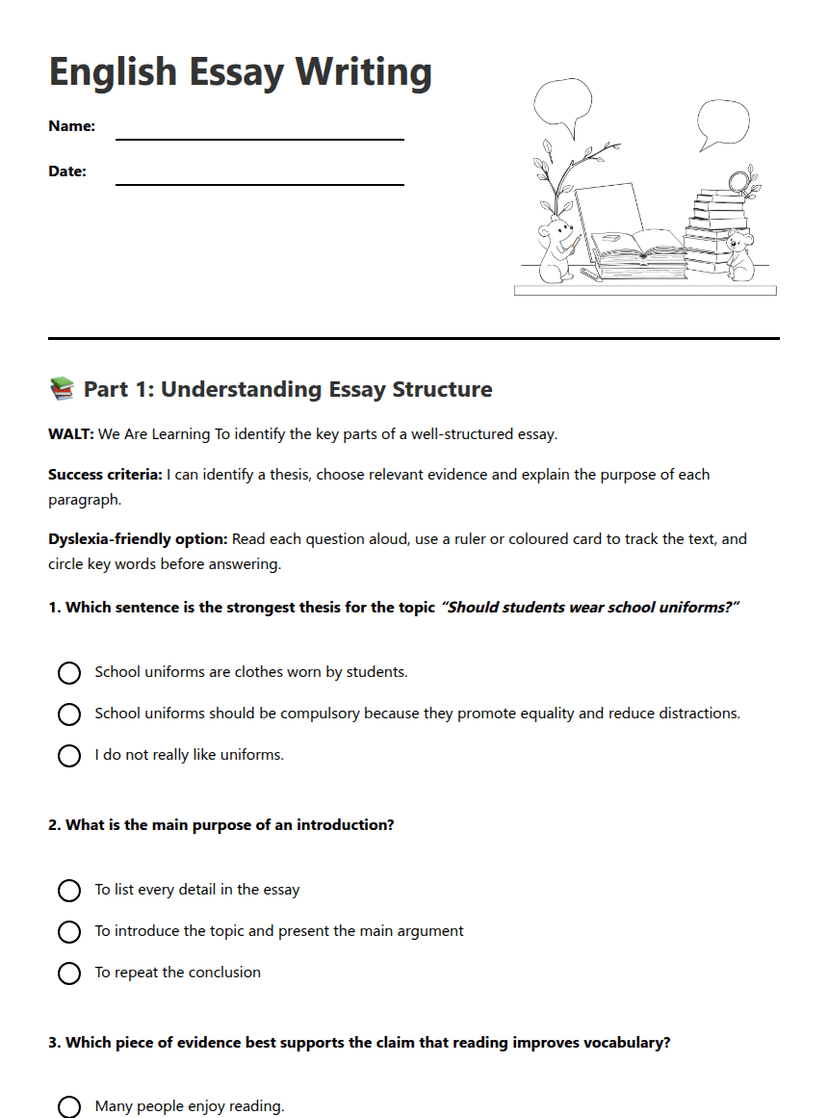
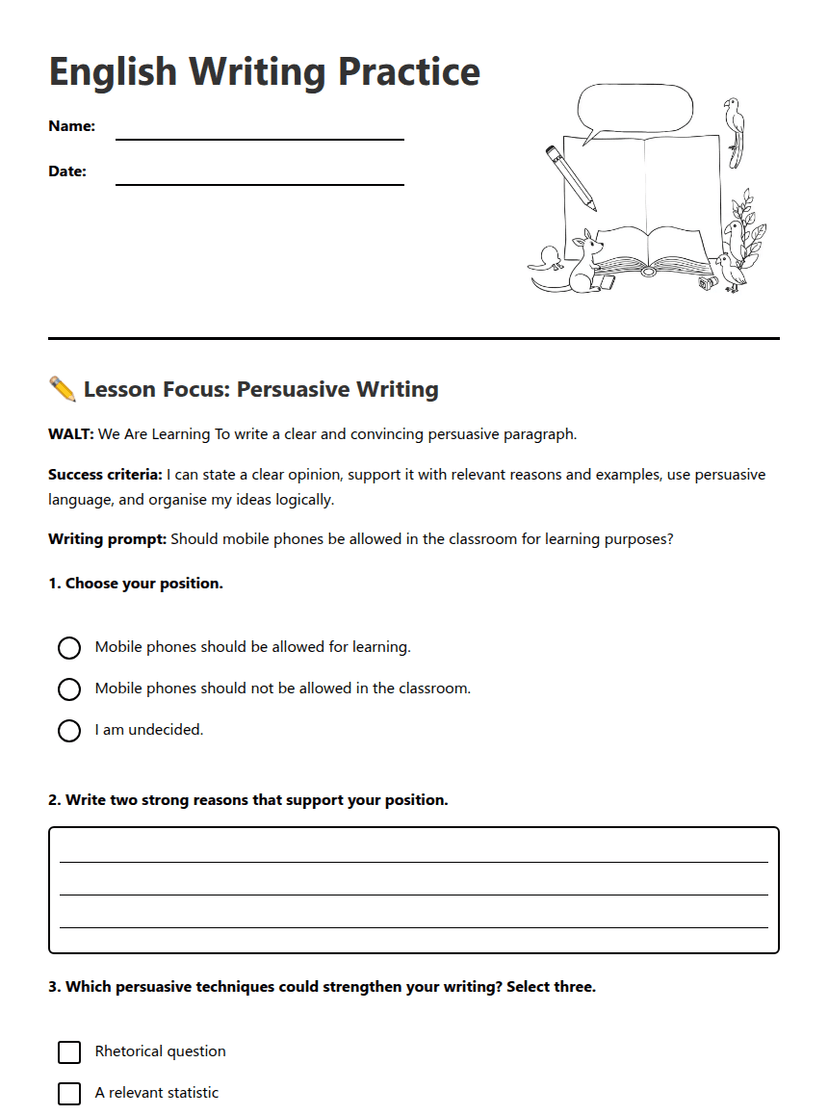
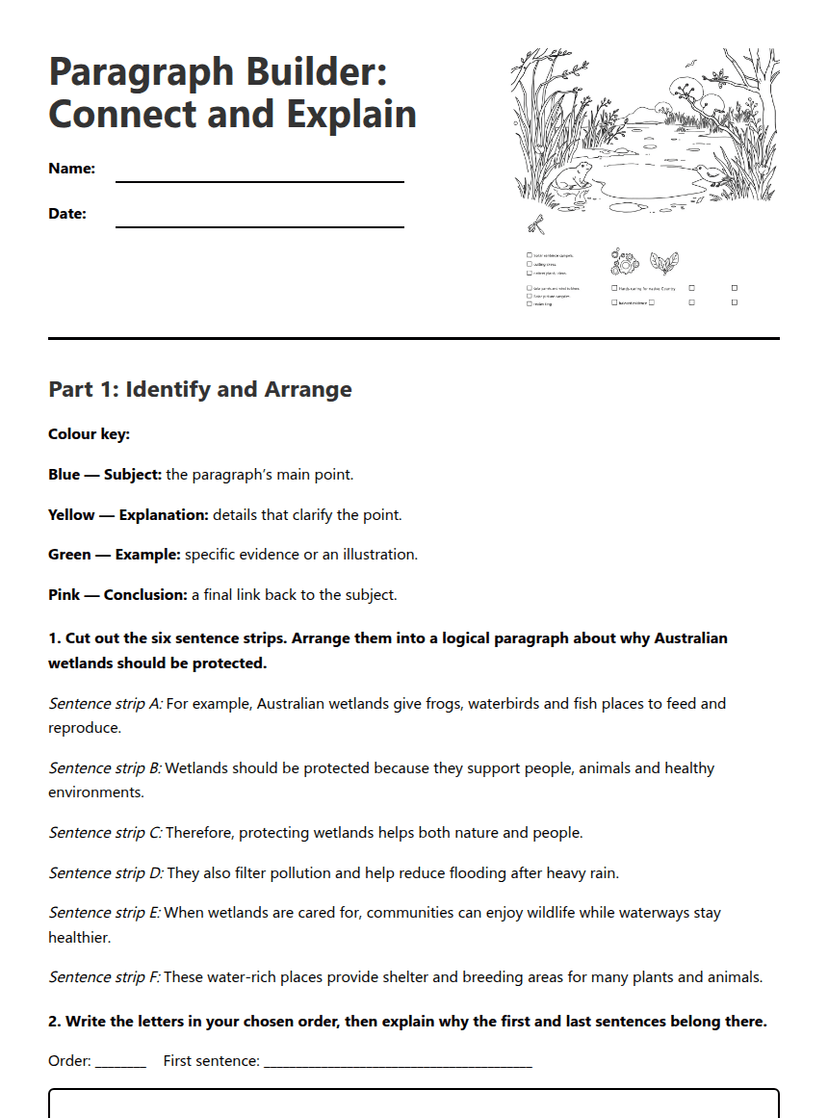
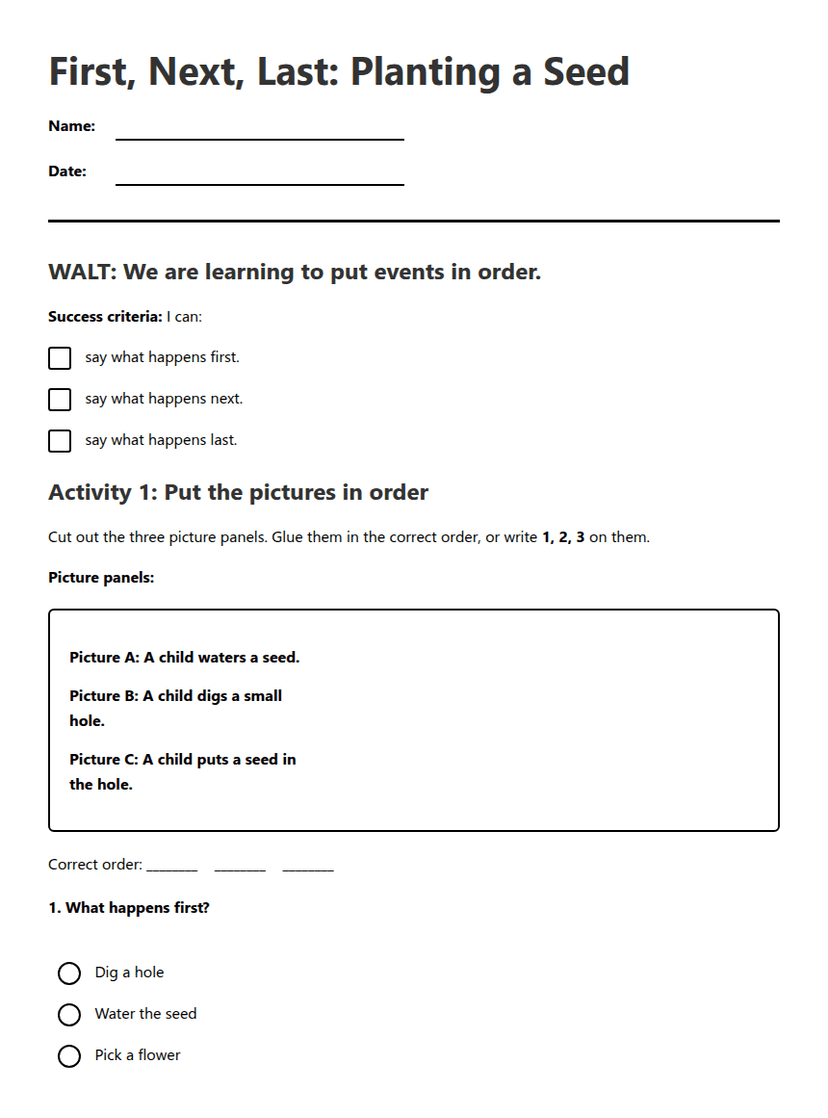
Text Analysis Writing Fundamentals worksheet preview
Text Analysis Writing Fundamentals

Text Analysis Writing Fundamentals

Student analysing text with magnifying glass

📚 Part 1: Understanding Text Analysis

1. What is text analysis writing? Circle the best definition:

Summarising what happens in a story

Examining how a text communicates meaning through language and structure

Writing your opinion about whether you liked a text

Copying quotes from a text

2. Why is text analysis important? Check all that apply:

It helps us understand texts more deeply

It improves our critical thinking skills

It makes us better writers and readers

It helps us memorise stories

🔍 Part 2: Core Features of Text Analysis

3. Match each text analysis component with its correct definition:
1. Thesis statement
2. Evidence
3. Explanation
4. Language features
A. Examples from the text like quotes
B. The main argument about the text
C. Metaphors, similes, tone, imagery
D. How evidence supports your thesis
4. Fill in the blanks using the words: thesis, evidence, explanation, language

When writing text analysis, you need a clear _____________ statement that presents your main argument. You must support this with _____________ from the text, such as quotes or examples. Then you need to provide _____________ of how this evidence proves your point. Finally, you should analyse the _____________ features the author uses.

📖 Part 3: Analysing a Text Excerpt

5. Read this excerpt from a short story:

"The old house stood like a forgotten giant against the stormy sky. Its broken windows stared blindly at the world, while the wind howled through its empty rooms like a wounded animal."

6. Identify the language features in the excerpt above. Check all that you can find:

Simile ("like a forgotten giant")

Personification ("windows stared blindly")

Metaphor ("wind howled")

Imagery (descriptive language)

7. Write a thesis statement about how the author creates atmosphere in this excerpt:
8. Choose one piece of evidence (a quote) from the excerpt that supports your thesis:
9. Explain how your chosen evidence supports your thesis statement:

✍️ Part 4: Reflection and Application

10. In your own words, explain the purpose of text analysis writing:
11. What is the difference between summarising a text and analysing a text? Circle the correct answer:

There is no difference - they are the same thing

Summarising tells what happens; analysing examines how the author creates meaning

Analysing is easier than summarising

Summarising uses quotes but analysing doesn't

12. List three language features that writers might use to create meaning:

1. _________________________

2. _________________________

3. _________________________

13. Challenge: Write one complete analytical sentence that includes a thesis, evidence, and explanation about the house excerpt:

About This Worksheet

Free in Kuraplan

Sign up free, grab the PDF, and customize it for your class.

Print-Ready

Formatted for standard paper. Clean layout, easy to read.

AI-Generated

Created with Kuraplan's AI, designed for real classroom use.

For Teachers & Parents

Use in classrooms, for homework, tutoring, or homeschool.

Need a custom version of this worksheet?

Kuraplan's AI generates custom worksheets in seconds — differentiated for every learner, aligned to your curriculum.

Generate Custom Worksheets — Free
No credit card Curriculum-aligned Under 60 seconds