The Five Vertebrate Groups Worksheet
A free science worksheet ready for your classroom. Open in Kuraplan to grab the print-ready PDF, customize it for your students, or generate a fresh version in seconds.
The Five Vertebrate Groups (Detailed)
Part 1: Information and Vocabulary
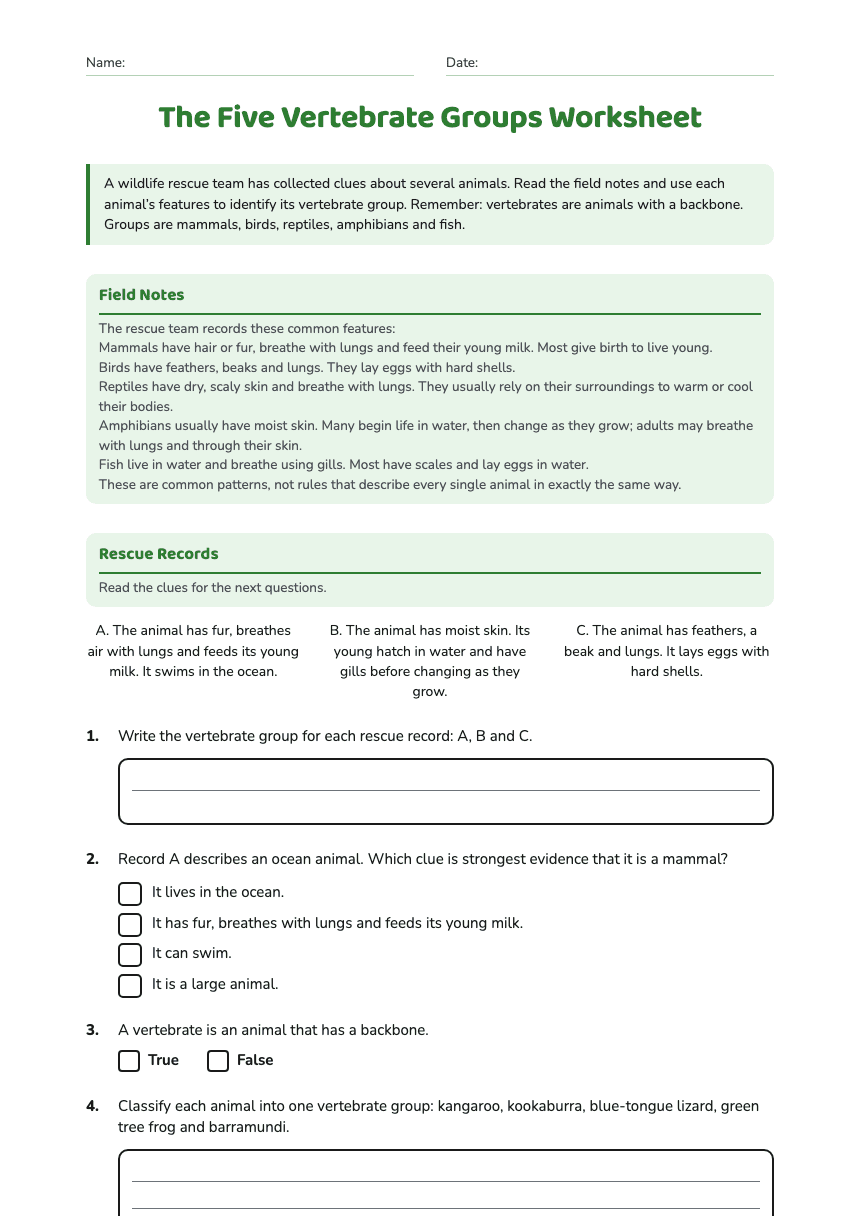
Refer to: The Five Vertebrate Groups (detailed) illustration.
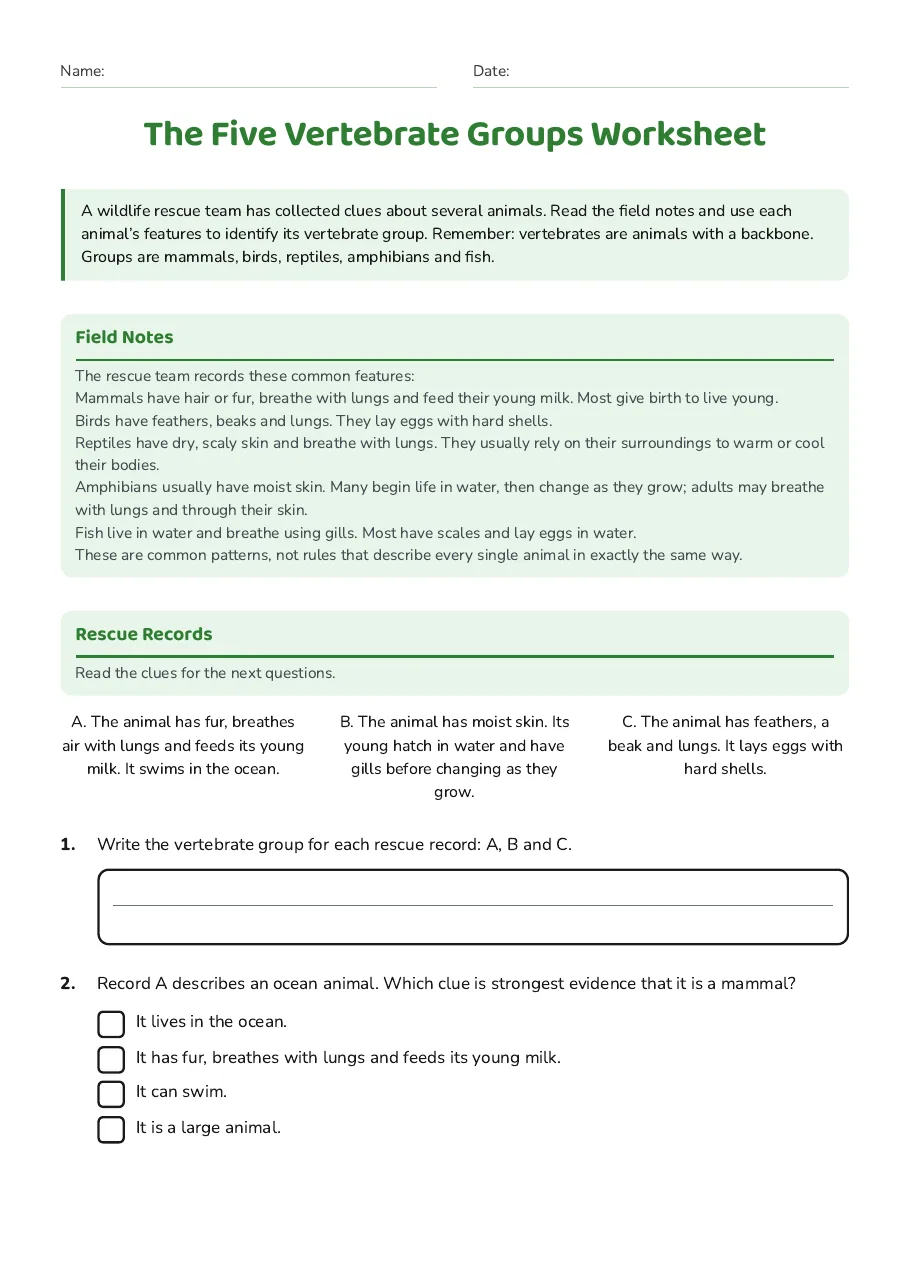
Vertebrates are animals with a backbone. The five main vertebrate groups are mammals, birds, reptiles, amphibians and fish. Each group has features that help scientists classify its members.
Mammals: Have hair or fur. They breathe with lungs, usually give birth to live young and mothers produce milk. Most mammals keep a steady body temperature. Examples include kangaroos, dogs and whales.
Birds: Have feathers, wings and beaks. They breathe with lungs, lay eggs with hard shells and keep a steady body temperature. Examples include emus, magpies and penguins.
Reptiles: Have dry, scaly skin. They breathe with lungs, usually lay eggs with leathery shells and rely on their surroundings to warm or cool their bodies. Examples include snakes, lizards and turtles.
Amphibians: Usually have moist, smooth skin. Young amphibians often breathe through gills, while adults may use lungs and skin. They usually lay jelly-like eggs in water and rely on their surroundings to regulate body temperature. Examples include frogs, toads and salamanders.
Fish: Live in water, have scales and breathe using gills. Most lay eggs in water and rely on their surroundings to regulate body temperature. Examples include goldfish, sharks and barramundi.
Comparison Guide
Mammals: covering—hair or fur; breathing—lungs; reproduction—usually live young; temperature—steady; examples—kangaroo, dog.
Birds: covering—feathers; breathing—lungs; reproduction—hard-shelled eggs; temperature—steady; examples—emu, magpie.
Reptiles: covering—dry scales; breathing—lungs; reproduction—usually leathery-shelled eggs; temperature—changes with surroundings; examples—snake, turtle.
Amphibians: covering—moist skin; breathing—gills when young, lungs and skin as adults; reproduction—usually jelly-like eggs in water; temperature—changes with surroundings; examples—frog, toad.
Fish: covering—scales; breathing—gills; reproduction—usually eggs in water; temperature—changes with surroundings; examples—shark, barramundi.
Vocabulary Matching
Match each word to its meaning by writing the correct letter beside each word.
Part 2: Classifying and Explaining
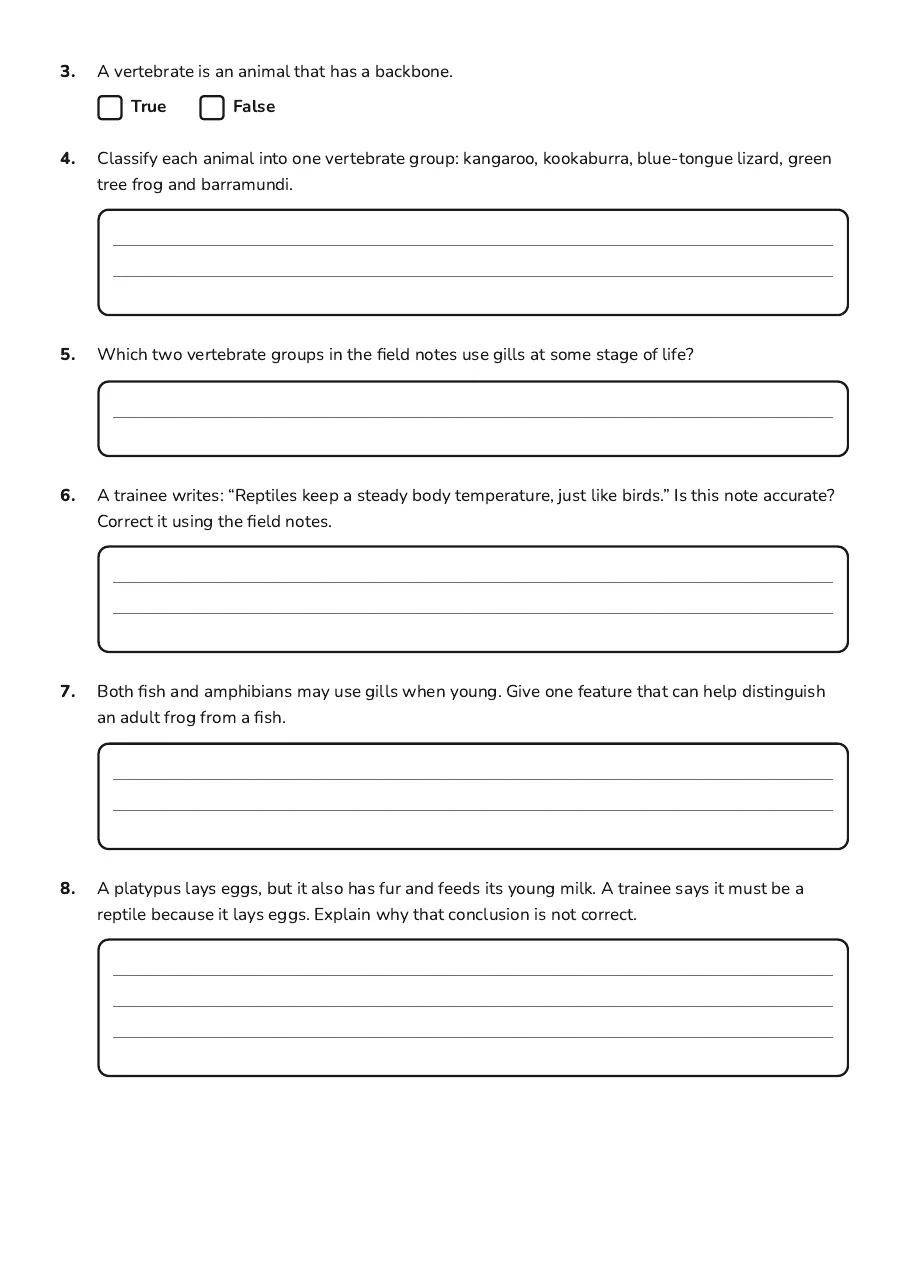
a) All vertebrates have a backbone. __________
b) Reptiles and amphibians usually keep a steady body temperature. __________
Correction: ________________________________________________________________
____________________________________________________________________________
Teacher note: This worksheet aligns broadly with NSW Stage 3 Science outcomes relating to classifying living things and communicating scientific information. It also supports English outcome EN3-CWT-01 through organised written explanations. Curriculum reference: NSW Education, Science and Technology K–6 Syllabus.
Answer Key
Vocabulary matching: 1–C, 2–E, 3–A, 4–B, 5–D.
1. Birds.
2. Fish and amphibians.
3. Platypus—mammal; crocodile—reptile; frog—amphibian; salmon—fish; kookaburra—bird.
4. a) True. b) False. Correction: Reptiles and amphibians usually rely on their surroundings to regulate body temperature.
5. A frog is an amphibian because it usually begins life in water with gills, then develops lungs and can breathe through its skin as an adult. It also has moist skin.
6. A whale is a mammal because it breathes with lungs, gives birth to live young and feeds its young with milk. Its body covering and habitat do not determine its group on their own.
7. The echidna is a mammal. It lays eggs, but it produces milk for its young, which is a key mammal feature. It also has hair, although some of its hair forms spines.
About This Worksheet
Free in Kuraplan
Sign up free, grab the PDF, and customize it for your class.
Print-Ready
Formatted for standard paper. Clean layout, easy to read.
AI-Generated
Created with Kuraplan's AI, designed for real classroom use.
For Teachers & Parents
Use in classrooms, for homework, tutoring, or homeschool.
Need a custom version of this worksheet?
Kuraplan's AI generates custom worksheets in seconds — differentiated for every learner, aligned to your curriculum.
Generate Custom Worksheets — FreeMore Science Worksheets
Danforth: Authority and Conscience
Free
Natural Resources Science
Free
Natural Resources Science
Free
Vitamins, Minerals, and Protein Science
Free
Exploring Science Materials
Free
Waka Buoyancy Science Worksheet
Free
Science Skills Made Simple
Free