ScienceFreePrintable

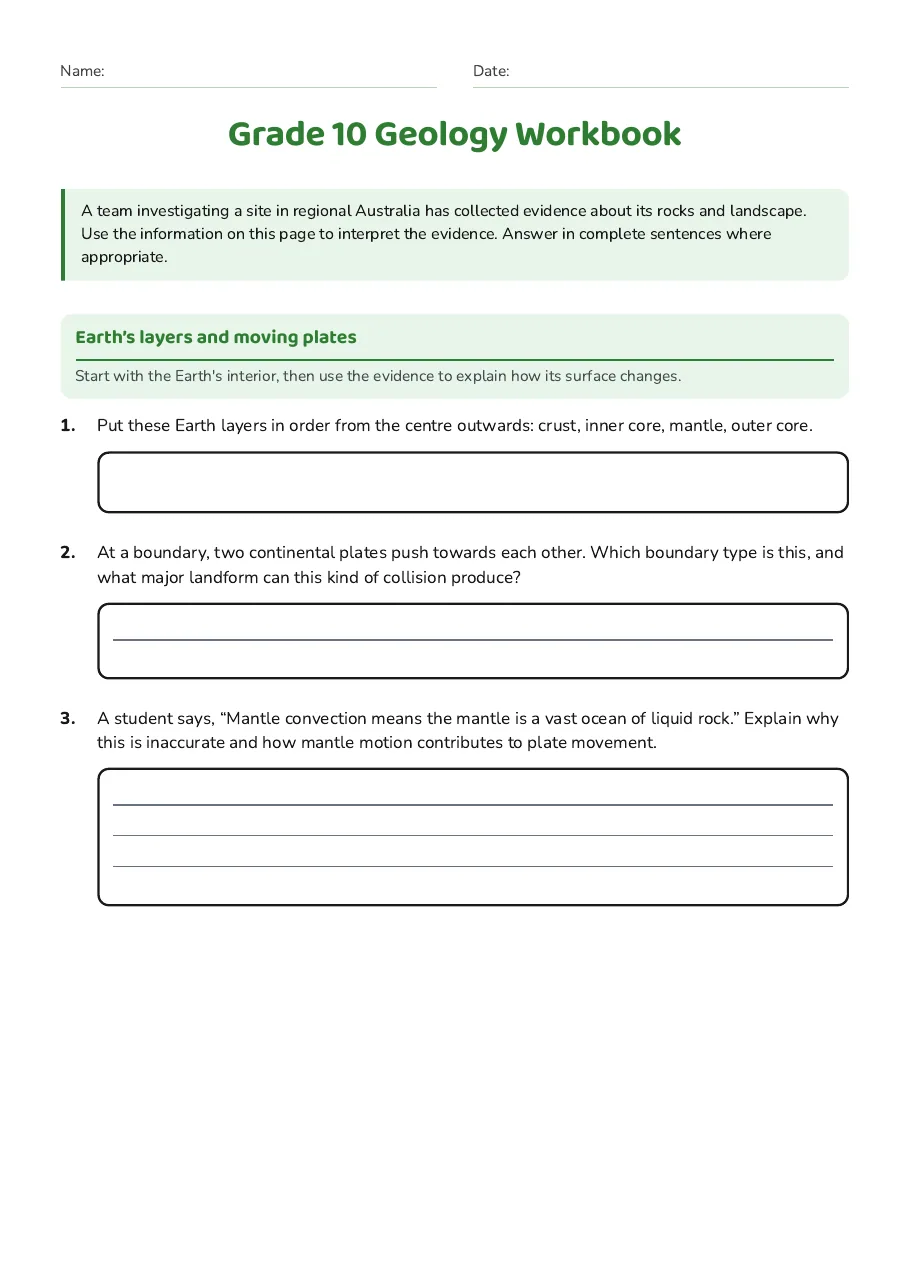
Grade 10 Geology Workbook

A free science worksheet ready for your classroom. Open in Kuraplan to grab the print-ready PDF, customize it for your students, or generate a fresh version in seconds.
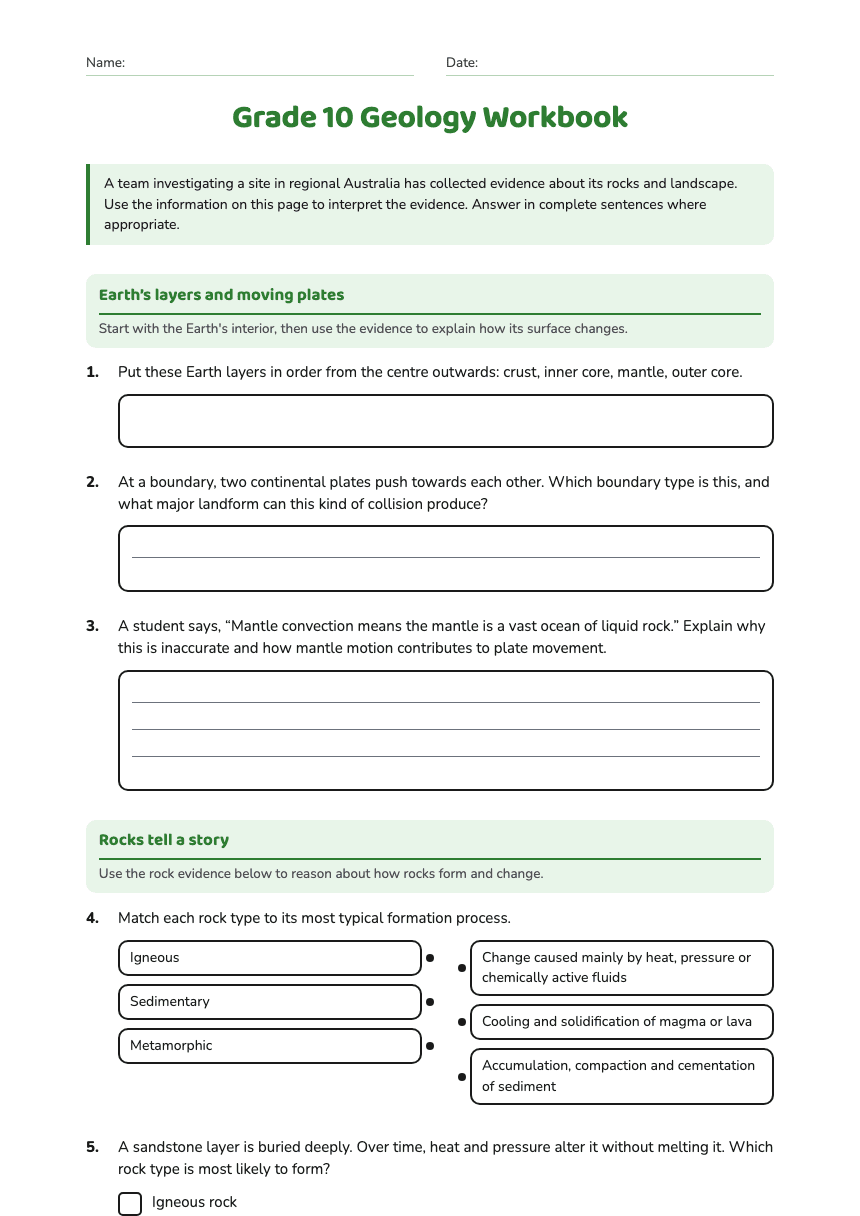
Grade 10 Geology Workbook worksheet preview
Name:Date:

Grade 10 Geology Workbook

A team investigating a site in regional Australia has collected evidence about its rocks and landscape. Use the information on this page to interpret the evidence. Answer in complete sentences where appropriate.

Earth’s layers and moving plates

Start with the Earth's interior, then use the evidence to explain how its surface changes.

1.Put these Earth layers in order from the centre outwards: crust, inner core, mantle, outer core.
2.At a boundary, two continental plates push towards each other. Which boundary type is this, and what major landform can this kind of collision produce?
3.A student says, “Mantle convection means the mantle is a vast ocean of liquid rock.” Explain why this is inaccurate and how mantle motion contributes to plate movement.

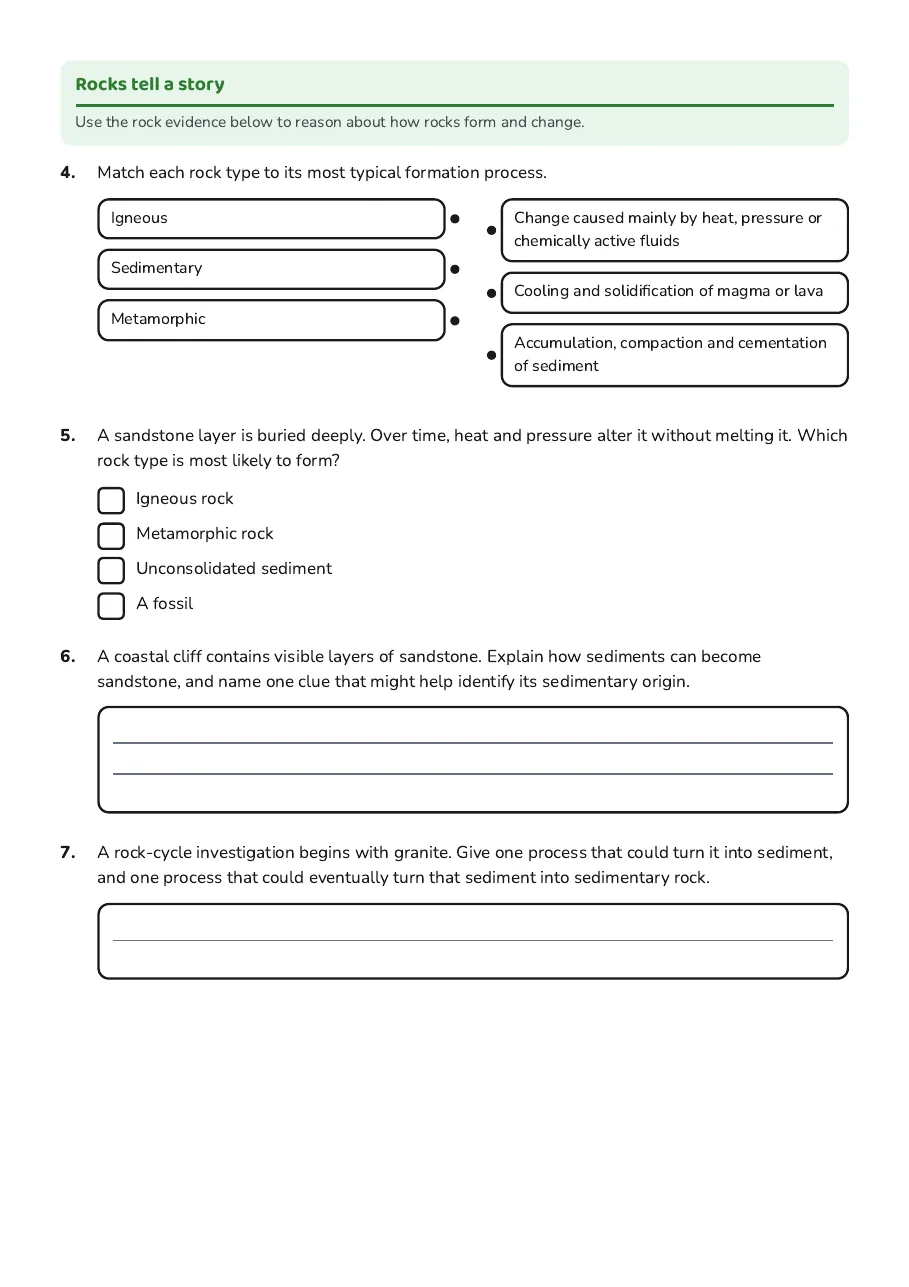
Rocks tell a story

Use the rock evidence below to reason about how rocks form and change.

4.Match each rock type to its most typical formation process.
  • Igneous
  • Sedimentary
  • Metamorphic
  • Change caused mainly by heat, pressure or chemically active fluids
  • Cooling and solidification of magma or lava
  • Accumulation, compaction and cementation of sediment
5.A sandstone layer is buried deeply. Over time, heat and pressure alter it without melting it. Which rock type is most likely to form?
  • Igneous rock
  • Metamorphic rock
  • Unconsolidated sediment
  • A fossil
6.A coastal cliff contains visible layers of sandstone. Explain how sediments can become sandstone, and name one clue that might help identify its sedimentary origin.
7.A rock-cycle investigation begins with granite. Give one process that could turn it into sediment, and one process that could eventually turn that sediment into sedimentary rock.

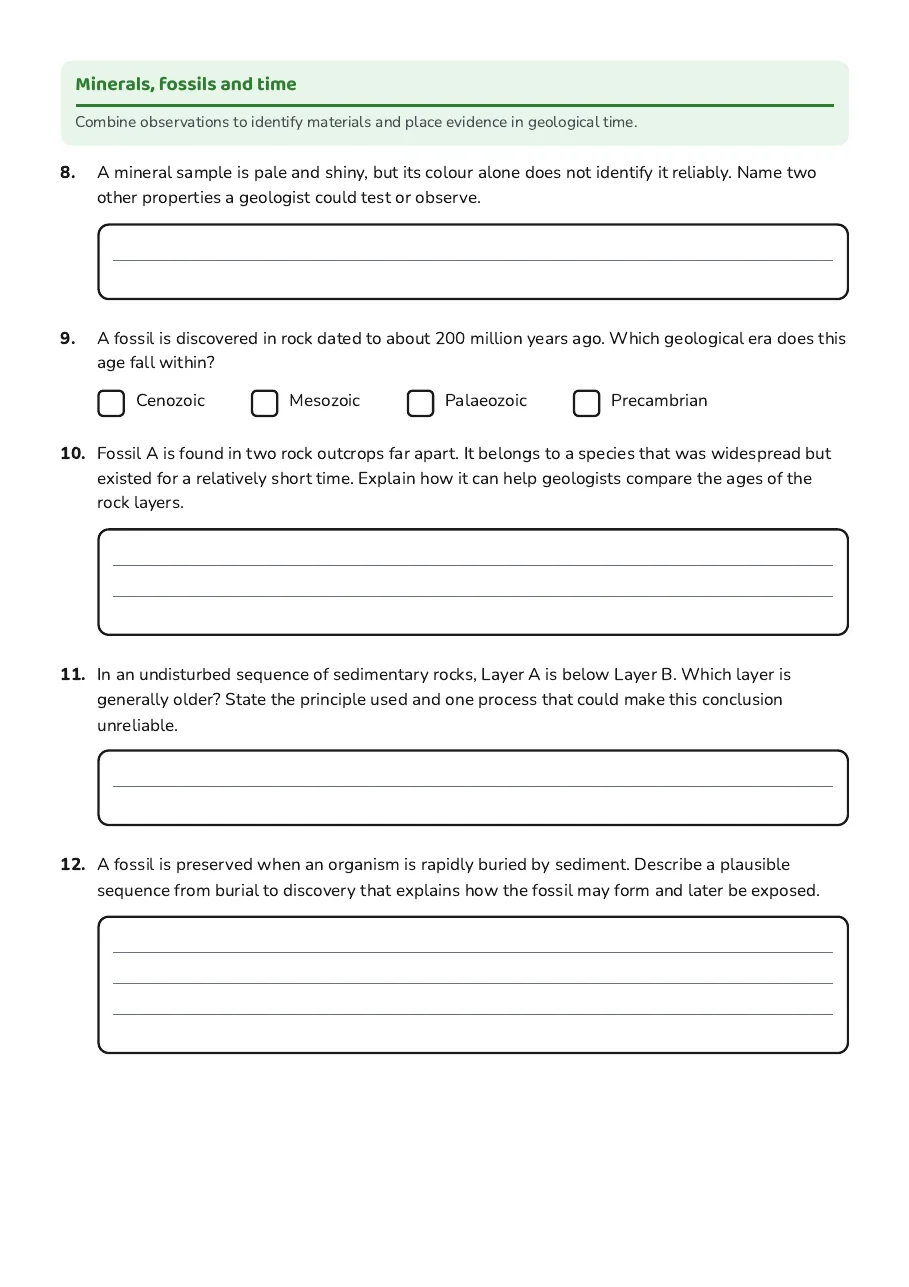
Minerals, fossils and time

Combine observations to identify materials and place evidence in geological time.

8.A mineral sample is pale and shiny, but its colour alone does not identify it reliably. Name two other properties a geologist could test or observe.
9.A fossil is discovered in rock dated to about 200 million years ago. Which geological era does this age fall within?
  • Cenozoic
  • Mesozoic
  • Palaeozoic
  • Precambrian
10.Fossil A is found in two rock outcrops far apart. It belongs to a species that was widespread but existed for a relatively short time. Explain how it can help geologists compare the ages of the rock layers.
11.In an undisturbed sequence of sedimentary rocks, Layer A is below Layer B. Which layer is generally older? State the principle used and one process that could make this conclusion unreliable.
12.A fossil is preserved when an organism is rapidly buried by sediment. Describe a plausible sequence from burial to discovery that explains how the fossil may form and later be exposed.

3 printable pages

  • Grade 10 Geology Workbook, page 1 of 3: Earth’s layers and moving plates

    Page 1

  • Grade 10 Geology Workbook, page 2 of 3: Rocks tell a story

    Page 2

  • Grade 10 Geology Workbook, page 3 of 3: Minerals, fossils and time

    Page 3

About This Worksheet

Free in Kuraplan

Sign up free, grab the PDF, and customize it for your class.

Print-Ready

Formatted for standard paper. Clean layout, easy to read.

AI-Generated

Created with Kuraplan's AI, designed for real classroom use.

For Teachers & Parents

Use in classrooms, for homework, tutoring, or homeschool.

Need a custom version of this worksheet?

Kuraplan's AI generates custom worksheets in seconds — differentiated for every learner, aligned to your curriculum.

Generate Custom Worksheets — Free
No credit card Curriculum-aligned Under 60 seconds