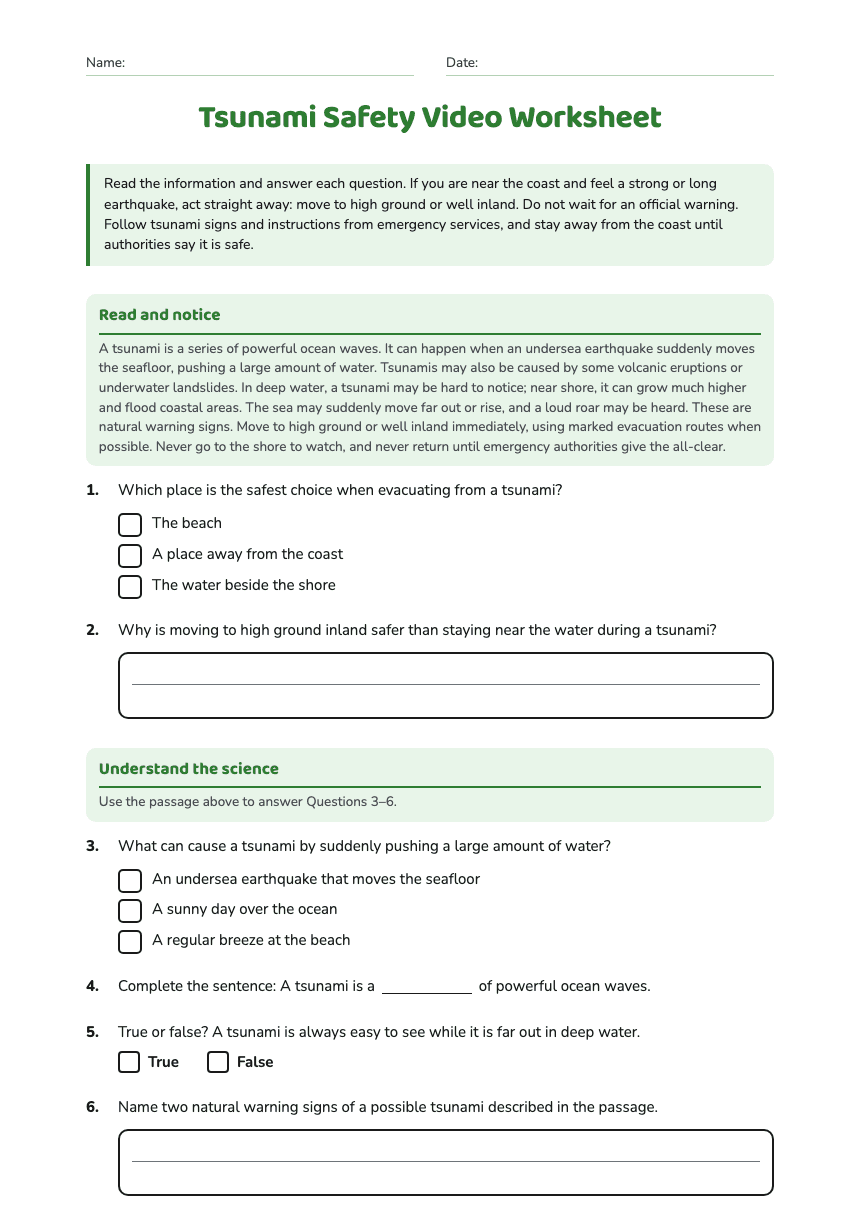
Tsunami Safety Video Worksheet
A free science worksheet ready for your classroom. Open in Kuraplan to grab the print-ready PDF, customize it for your students, or generate a fresh version in seconds.
Tsunami Safety Video Worksheet
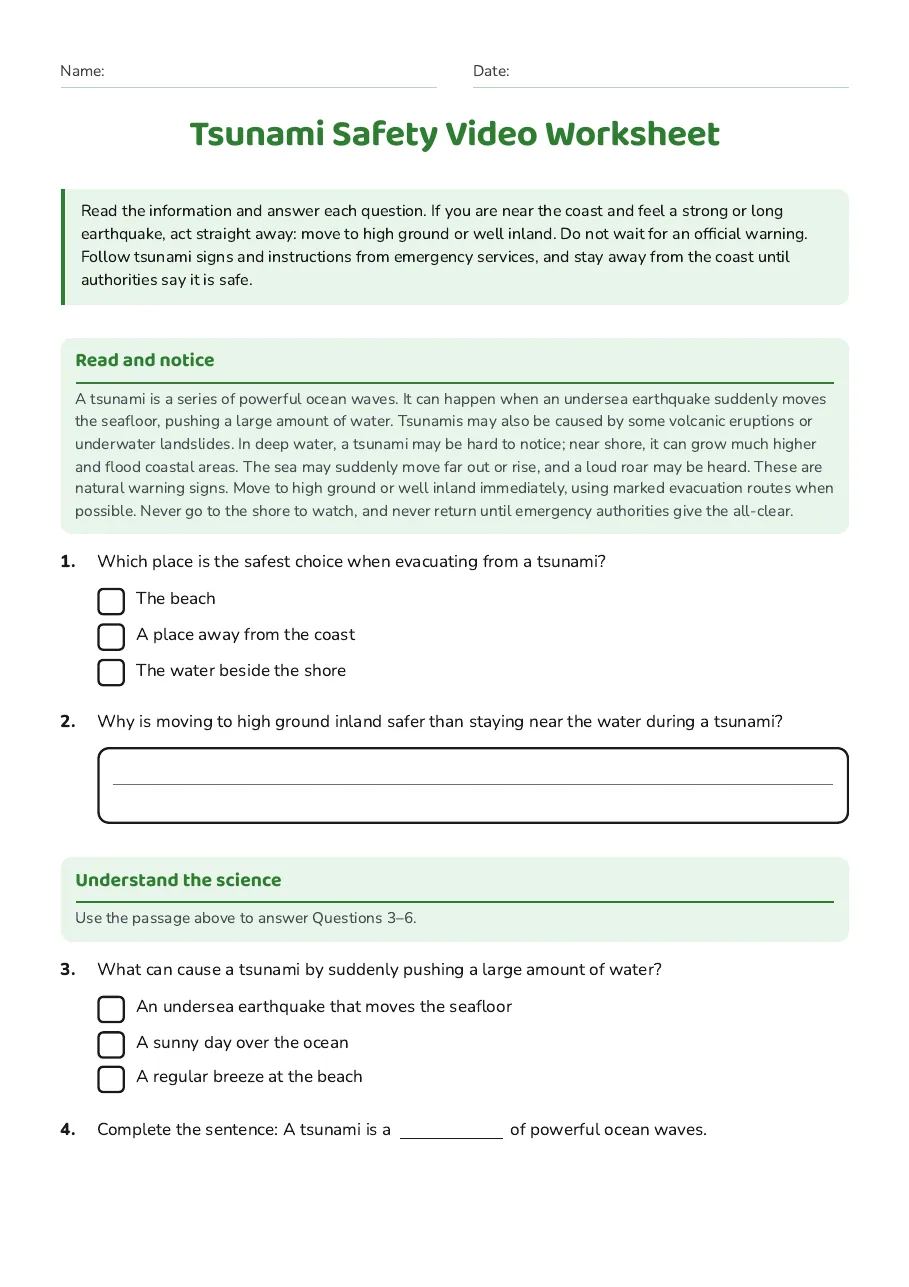
Read and notice
A tsunami is a series of powerful ocean waves. It can happen when an undersea earthquake suddenly moves the seafloor, pushing a large amount of water. Tsunamis may also be caused by some volcanic eruptions or underwater landslides. In deep water, a tsunami may be hard to notice; near shore, it can grow much higher and flood coastal areas. The sea may suddenly move far out or rise, and a loud roar may be heard. These are natural warning signs. Move to high ground or well inland immediately, using marked evacuation routes when possible. Never go to the shore to watch, and never return until emergency authorities give the all-clear.
- The beach
- A place away from the coast
- The water beside the shore
Understand the science
Use the passage above to answer Questions 3–6.
- An undersea earthquake that moves the seafloor
- A sunny day over the ocean
- A regular breeze at the beach
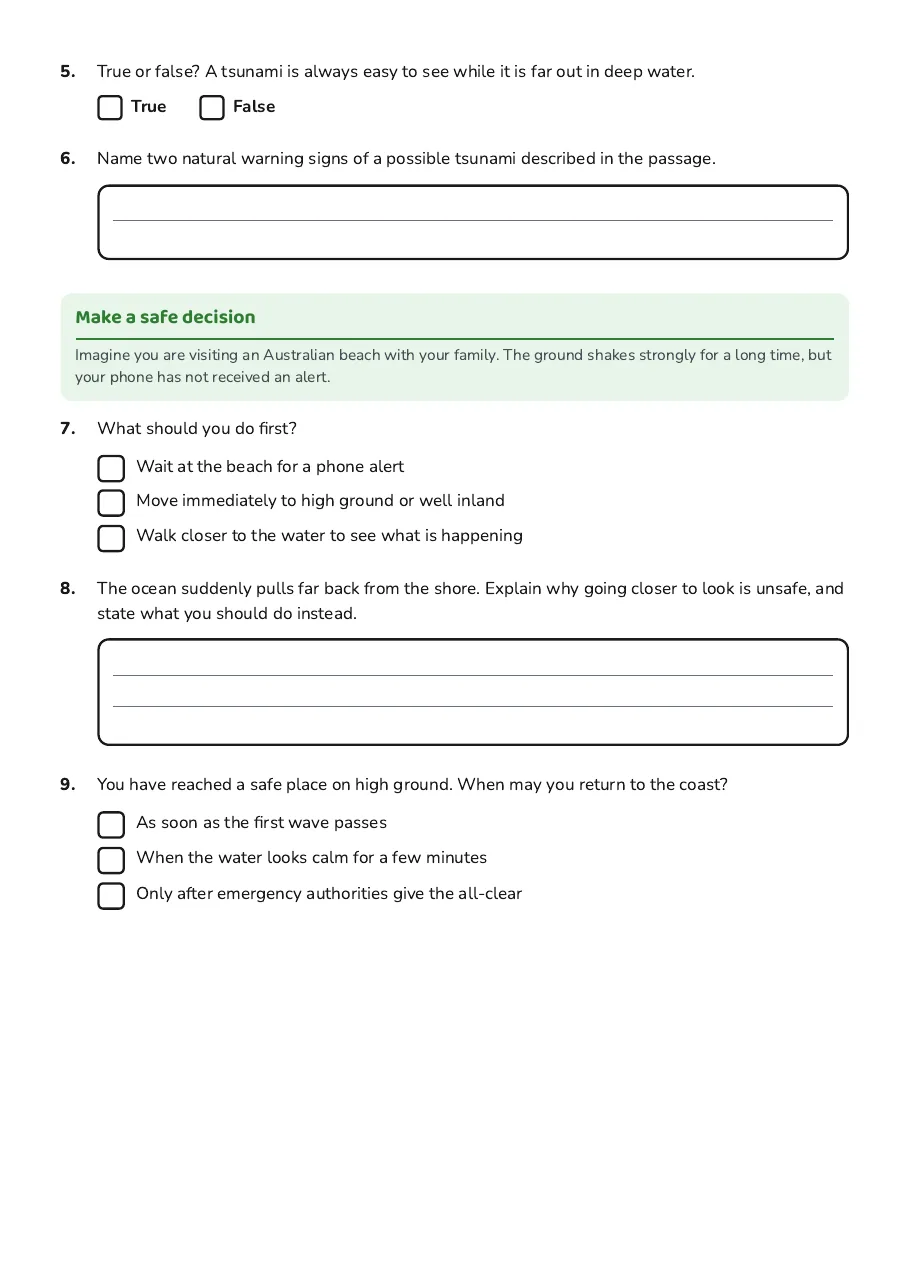
Make a safe decision
Imagine you are visiting an Australian beach with your family. The ground shakes strongly for a long time, but your phone has not received an alert.
- Wait at the beach for a phone alert
- Move immediately to high ground or well inland
- Walk closer to the water to see what is happening
- As soon as the first wave passes
- When the water looks calm for a few minutes
- Only after emergency authorities give the all-clear
3 printable pages
Page 1
Page 2

Page 3
About This Worksheet
Free in Kuraplan
Sign up free, grab the PDF, and customize it for your class.
Print-Ready
Formatted for standard paper. Clean layout, easy to read.
AI-Generated
Created with Kuraplan's AI, designed for real classroom use.
For Teachers & Parents
Use in classrooms, for homework, tutoring, or homeschool.
Need a custom version of this worksheet?
Kuraplan's AI generates custom worksheets in seconds — differentiated for every learner, aligned to your curriculum.
Generate Custom Worksheets — Free