MathsFreePrintable

Two-Way Tables Worksheet

A free maths worksheet ready for your classroom. Open in Kuraplan to grab the print-ready PDF, customize it for your students, or generate a fresh version in seconds.
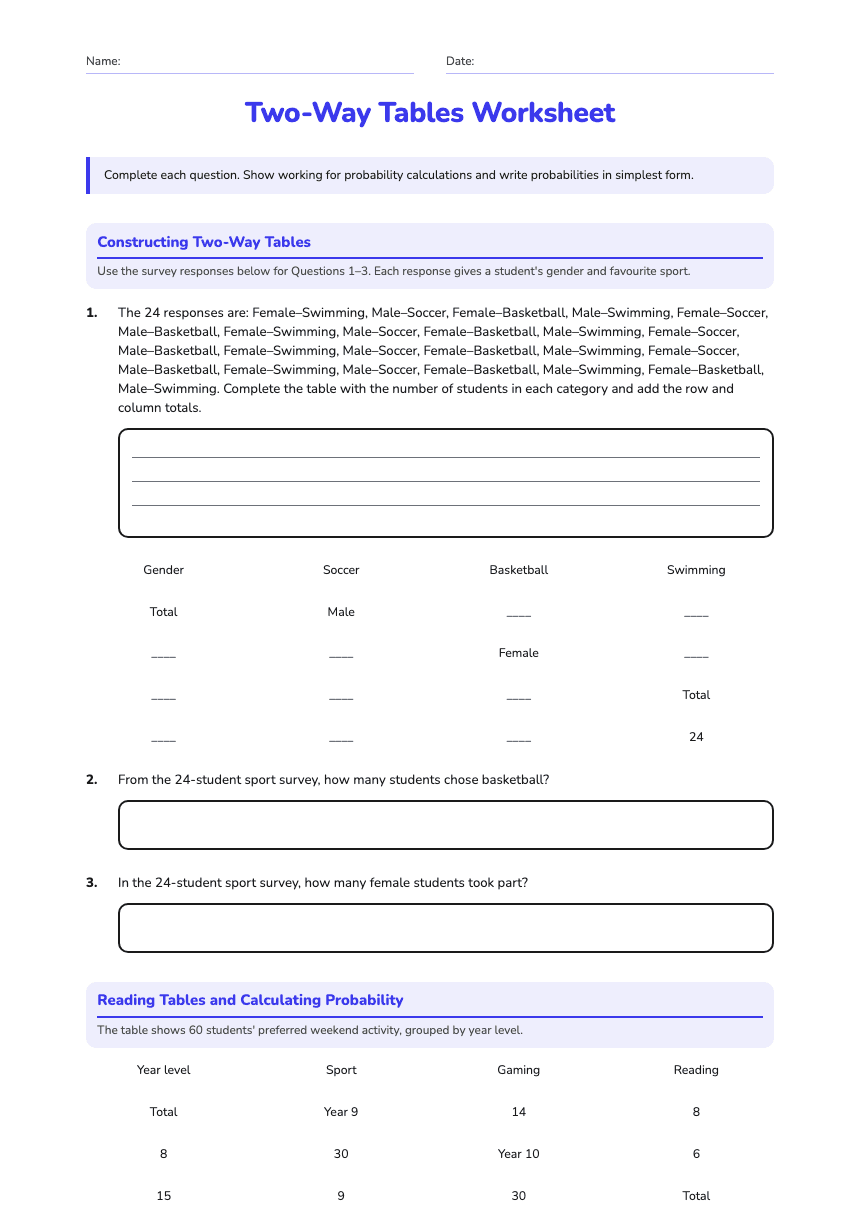
Two-Way Tables Worksheet worksheet preview
Name:Date:

Two-Way Tables Worksheet

Complete each question. Show working for probability calculations and write probabilities in simplest form.

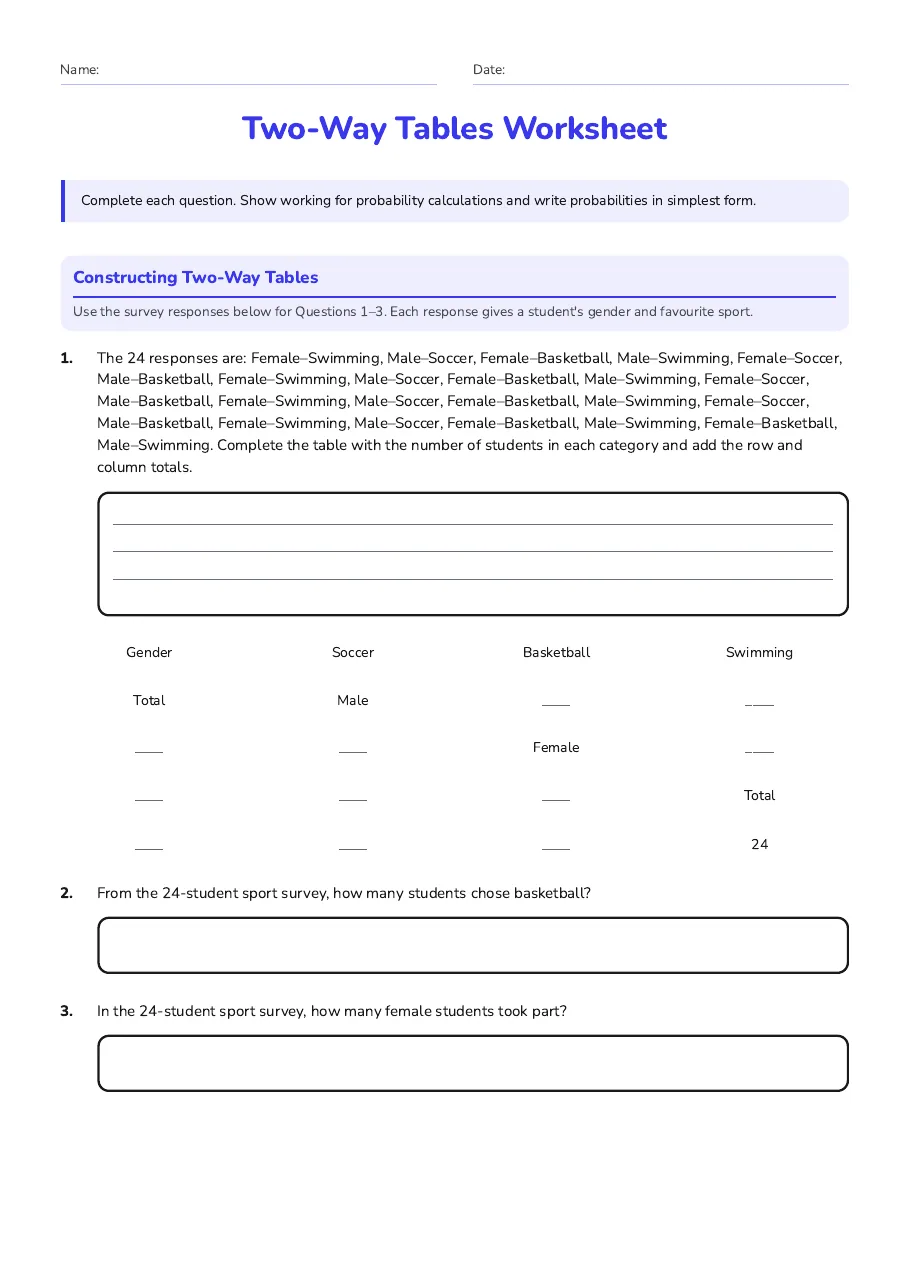
Constructing Two-Way Tables

Use the survey responses below for Questions 1–3. Each response gives a student's gender and favourite sport.

1.The 24 responses are: Female–Swimming, Male–Soccer, Female–Basketball, Male–Swimming, Female–Soccer, Male–Basketball, Female–Swimming, Male–Soccer, Female–Basketball, Male–Swimming, Female–Soccer, Male–Basketball, Female–Swimming, Male–Soccer, Female–Basketball, Male–Swimming, Female–Soccer, Male–Basketball, Female–Swimming, Male–Soccer, Female–Basketball, Male–Swimming, Female–Basketball, Male–Swimming. Complete the table with the number of students in each category and add the row and column totals.

Gender

Soccer

Basketball

Swimming

Total

Male

____

____

____

____

Female

____

____

____

____

Total

____

____

____

24

2.From the 24-student sport survey, how many students chose basketball?
3.In the 24-student sport survey, how many female students took part?

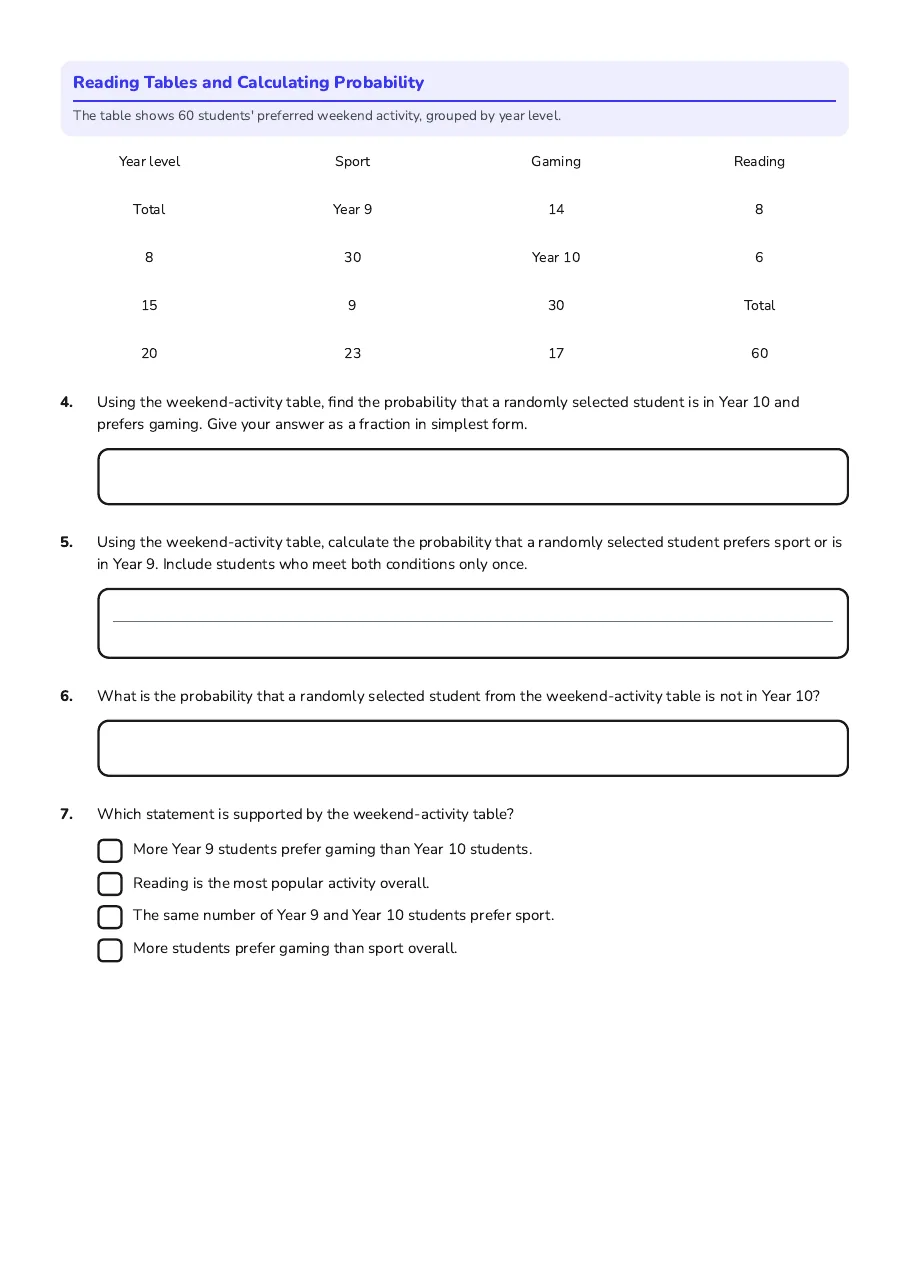
Reading Tables and Calculating Probability

The table shows 60 students' preferred weekend activity, grouped by year level.

Year level

Sport

Gaming

Reading

Total

Year 9

14

8

8

30

Year 10

6

15

9

30

Total

20

23

17

60

4.Using the weekend-activity table, find the probability that a randomly selected student is in Year 10 and prefers gaming. Give your answer as a fraction in simplest form.
5.Using the weekend-activity table, calculate the probability that a randomly selected student prefers sport or is in Year 9. Include students who meet both conditions only once.
6.What is the probability that a randomly selected student from the weekend-activity table is not in Year 10?
7.Which statement is supported by the weekend-activity table?
  • More Year 9 students prefer gaming than Year 10 students.
  • Reading is the most popular activity overall.
  • The same number of Year 9 and Year 10 students prefer sport.
  • More students prefer gaming than sport overall.

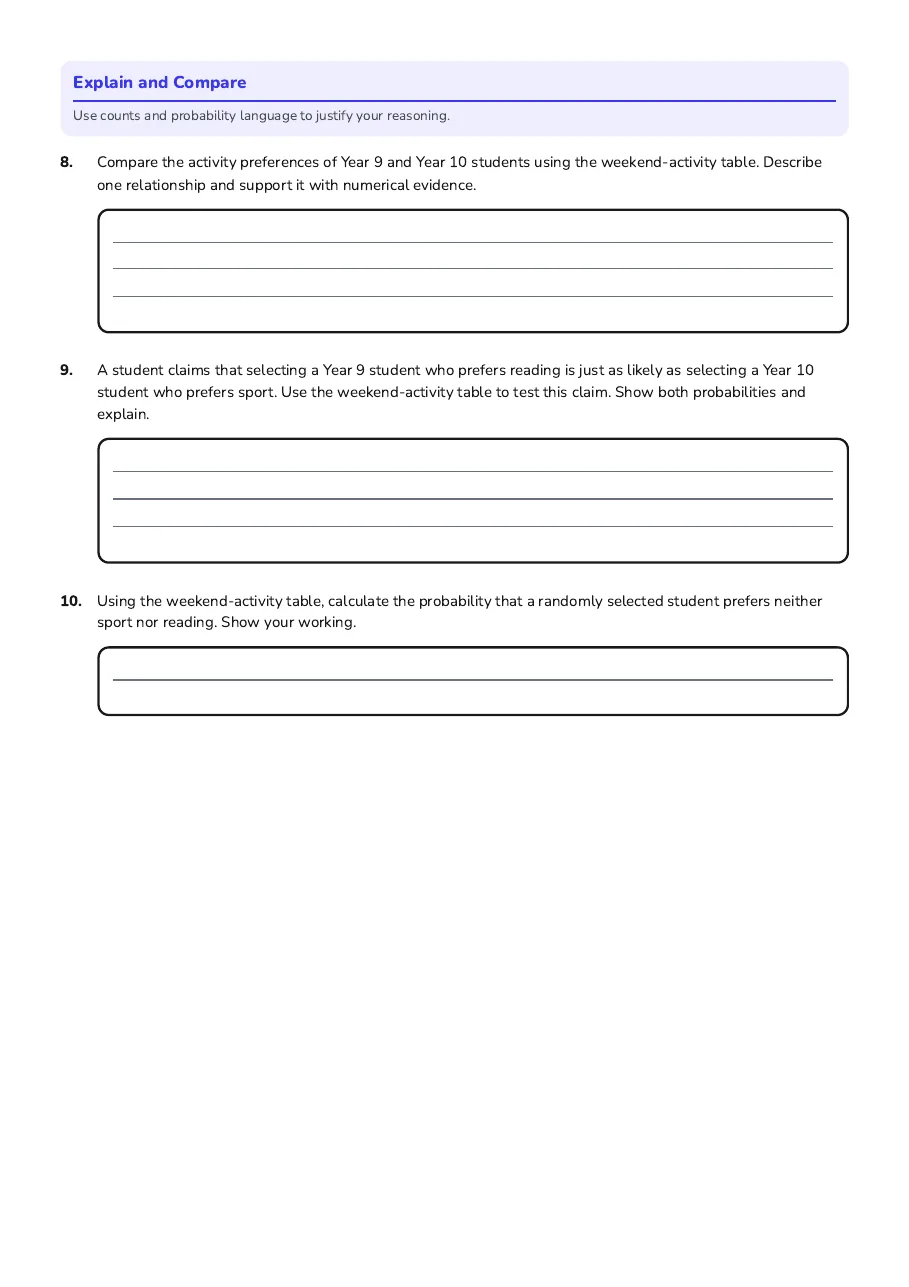
Explain and Compare

Use counts and probability language to justify your reasoning.

8.Compare the activity preferences of Year 9 and Year 10 students using the weekend-activity table. Describe one relationship and support it with numerical evidence.
9.A student claims that selecting a Year 9 student who prefers reading is just as likely as selecting a Year 10 student who prefers sport. Use the weekend-activity table to test this claim. Show both probabilities and explain.
10.Using the weekend-activity table, calculate the probability that a randomly selected student prefers neither sport nor reading. Show your working.

3 printable pages

  • Two-Way Tables Worksheet, page 1 of 3: Constructing Two-Way Tables

    Page 1

  • Two-Way Tables Worksheet, page 2 of 3: Reading Tables and Calculating Probability

    Page 2

  • Two-Way Tables Worksheet, page 3 of 3: Explain and Compare

    Page 3

About This Worksheet

Free in Kuraplan

Sign up free, grab the PDF, and customize it for your class.

Print-Ready

Formatted for standard paper. Clean layout, easy to read.

AI-Generated

Created with Kuraplan's AI, designed for real classroom use.

For Teachers & Parents

Use in classrooms, for homework, tutoring, or homeschool.

Need a custom version of this worksheet?

Kuraplan's AI generates custom worksheets in seconds — differentiated for every learner, aligned to your curriculum.

Generate Custom Worksheets — Free
No credit card Curriculum-aligned Under 60 seconds