Understanding Waves Worksheet
A free science worksheet ready for your classroom. Open in Kuraplan to grab the print-ready PDF, customize it for your students, or generate a fresh version in seconds.
Understanding Waves Worksheet
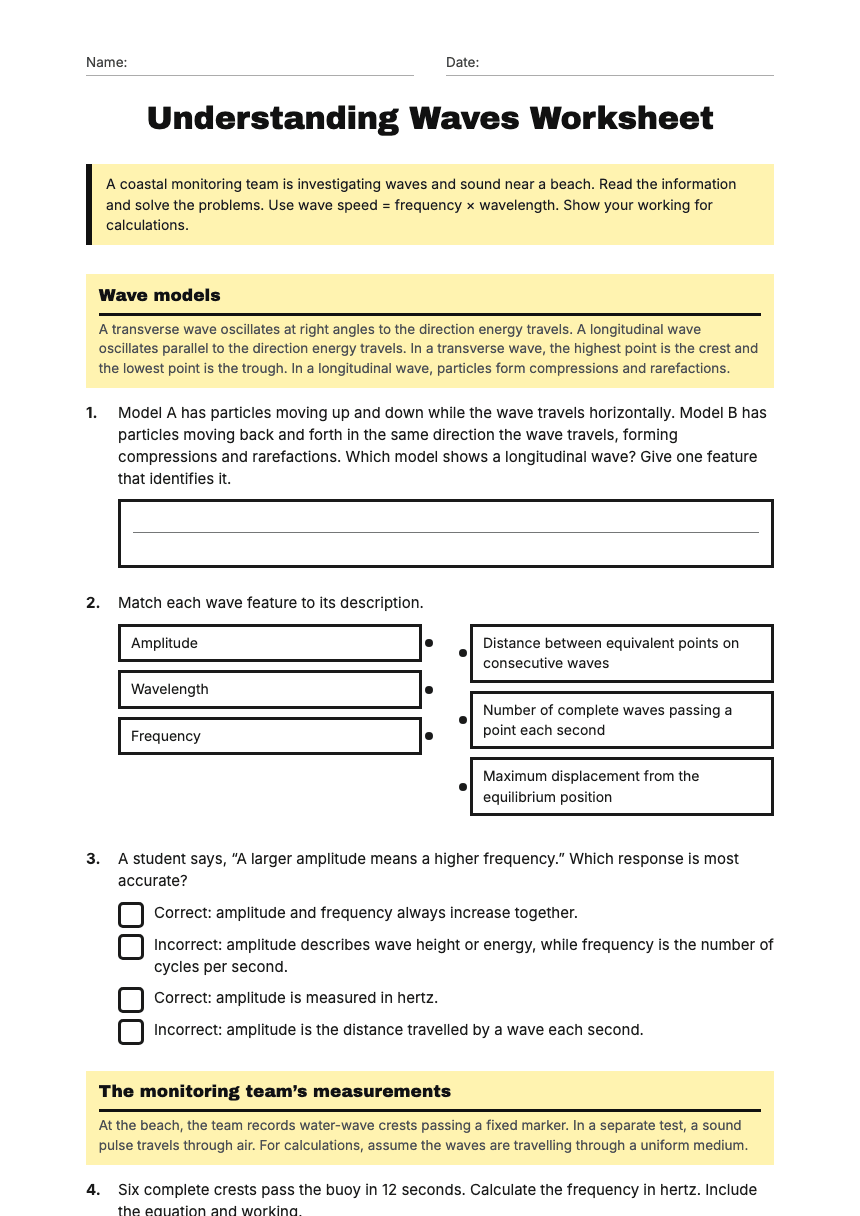
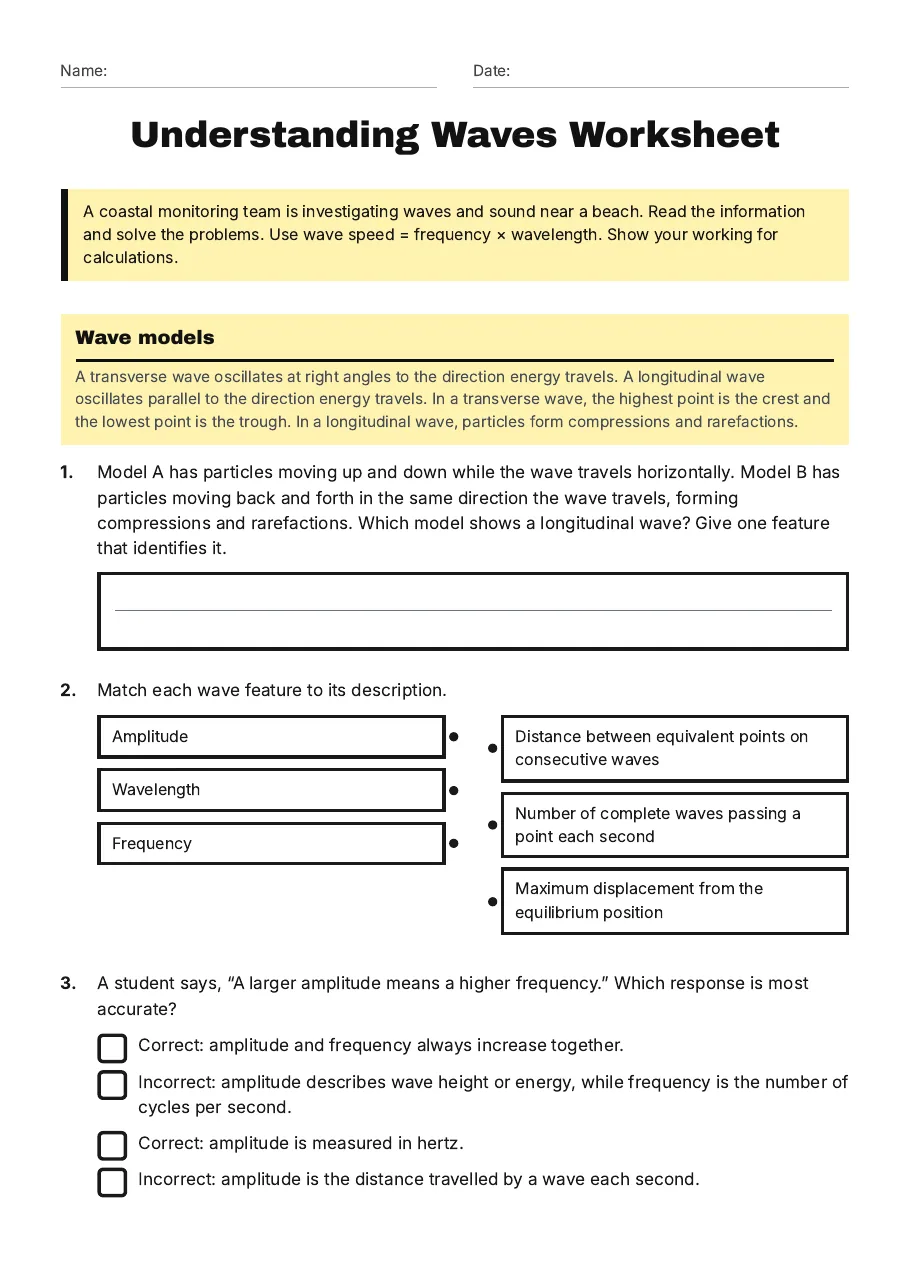
Wave models
A transverse wave oscillates at right angles to the direction energy travels. A longitudinal wave oscillates parallel to the direction energy travels. In a transverse wave, the highest point is the crest and the lowest point is the trough. In a longitudinal wave, particles form compressions and rarefactions.
- Amplitude
- Wavelength
- Frequency
- Distance between equivalent points on consecutive waves
- Number of complete waves passing a point each second
- Maximum displacement from the equilibrium position
- Correct: amplitude and frequency always increase together.
- Incorrect: amplitude describes wave height or energy, while frequency is the number of cycles per second.
- Correct: amplitude is measured in hertz.
- Incorrect: amplitude is the distance travelled by a wave each second.
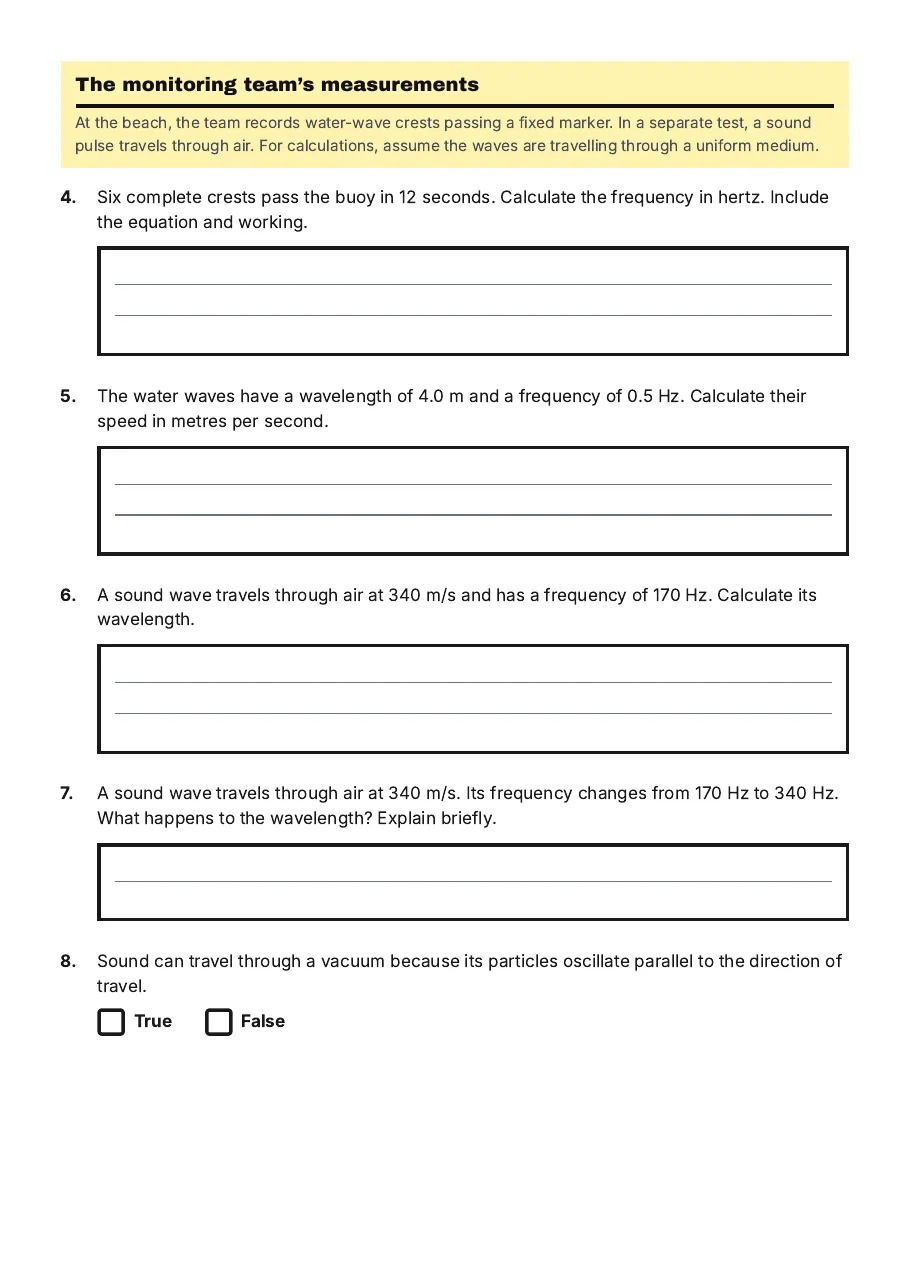
The monitoring team’s measurements
At the beach, the team records water-wave crests passing a fixed marker. In a separate test, a sound pulse travels through air. For calculations, assume the waves are travelling through a uniform medium.
3 printable pages
Page 1
Page 2
Page 3
About This Worksheet
Free in Kuraplan
Sign up free, grab the PDF, and customize it for your class.
Print-Ready
Formatted for standard paper. Clean layout, easy to read.
AI-Generated
Created with Kuraplan's AI, designed for real classroom use.
For Teachers & Parents
Use in classrooms, for homework, tutoring, or homeschool.
Need a custom version of this worksheet?
Kuraplan's AI generates custom worksheets in seconds — differentiated for every learner, aligned to your curriculum.
Generate Custom Worksheets — Free