Vehicle Safety Systems Research
A free science worksheet ready for your classroom. Open in Kuraplan to grab the print-ready PDF, customize it for your students, or generate a fresh version in seconds.
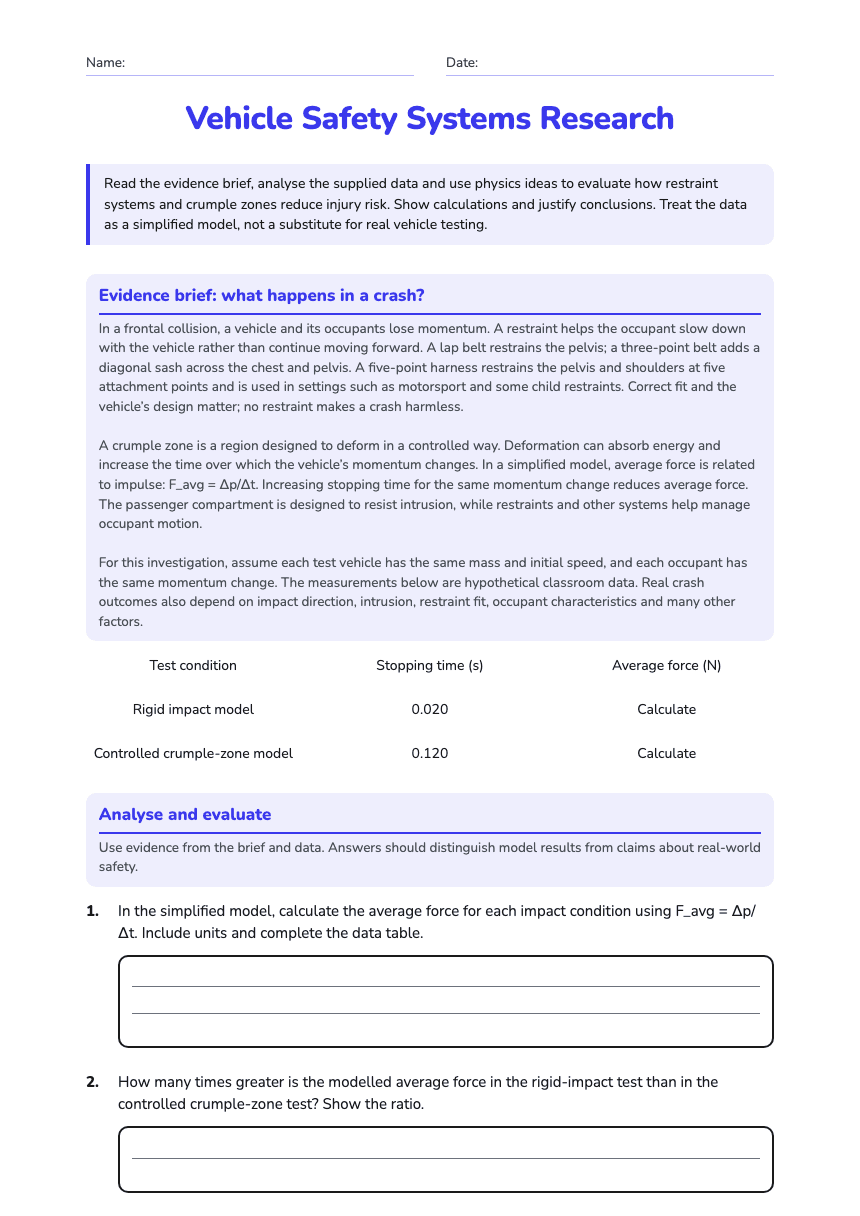
Vehicle Safety Systems Research
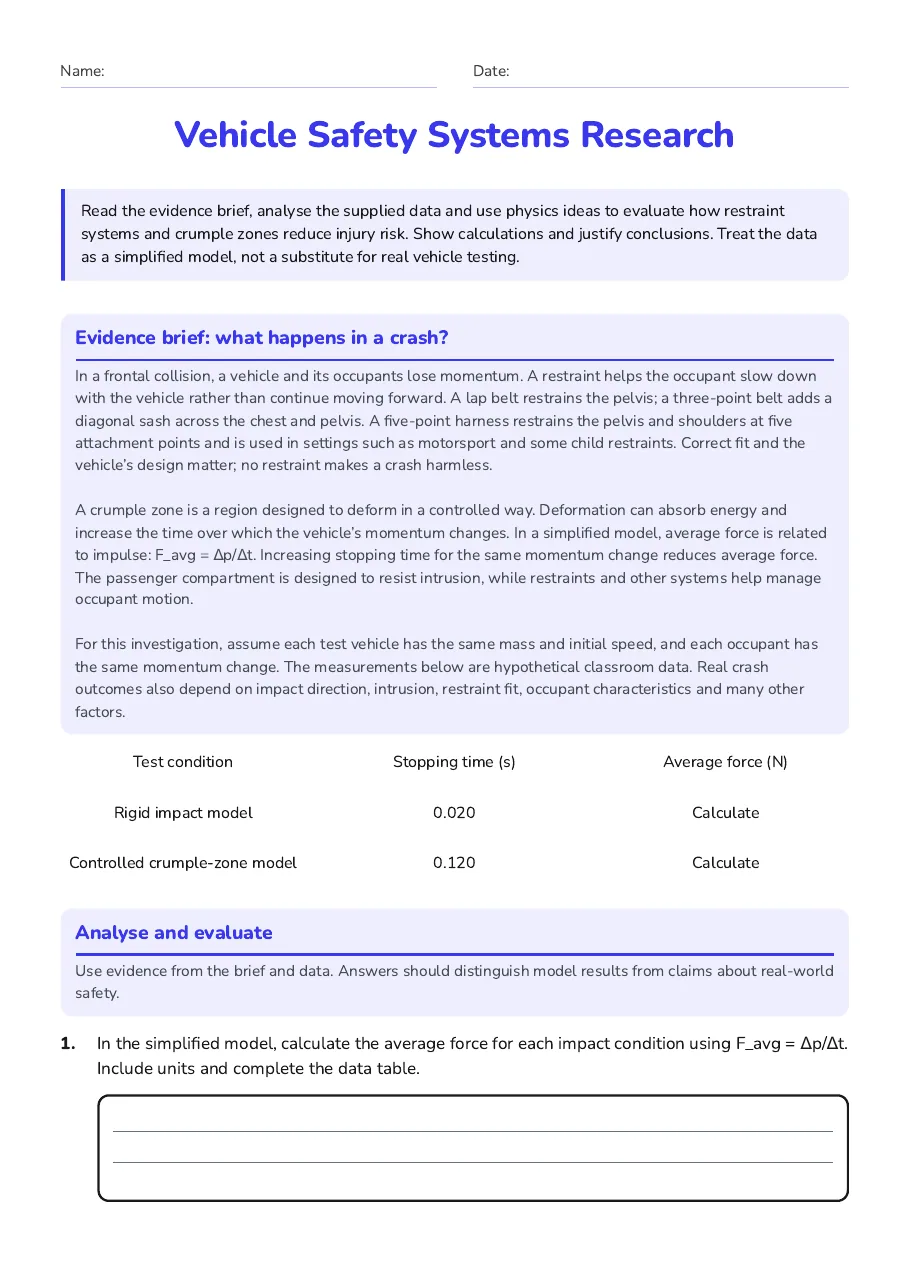
Evidence brief: what happens in a crash?
In a frontal collision, a vehicle and its occupants lose momentum. A restraint helps the occupant slow down with the vehicle rather than continue moving forward. A lap belt restrains the pelvis; a three-point belt adds a diagonal sash across the chest and pelvis. A five-point harness restrains the pelvis and shoulders at five attachment points and is used in settings such as motorsport and some child restraints. Correct fit and the vehicle’s design matter; no restraint makes a crash harmless. A crumple zone is a region designed to deform in a controlled way. Deformation can absorb energy and increase the time over which the vehicle’s momentum changes. In a simplified model, average force is related to impulse: F_avg = Δp/Δt. Increasing stopping time for the same momentum change reduces average force. The passenger compartment is designed to resist intrusion, while restraints and other systems help manage occupant motion. For this investigation, assume each test vehicle has the same mass and initial speed, and each occupant has the same momentum change. The measurements below are hypothetical classroom data. Real crash outcomes also depend on impact direction, intrusion, restraint fit, occupant characteristics and many other factors.
Test condition
Stopping time (s)
Average force (N)
Rigid impact model
0.020
Calculate
Controlled crumple-zone model
0.120
Calculate
Analyse and evaluate
Use evidence from the brief and data. Answers should distinguish model results from claims about real-world safety.
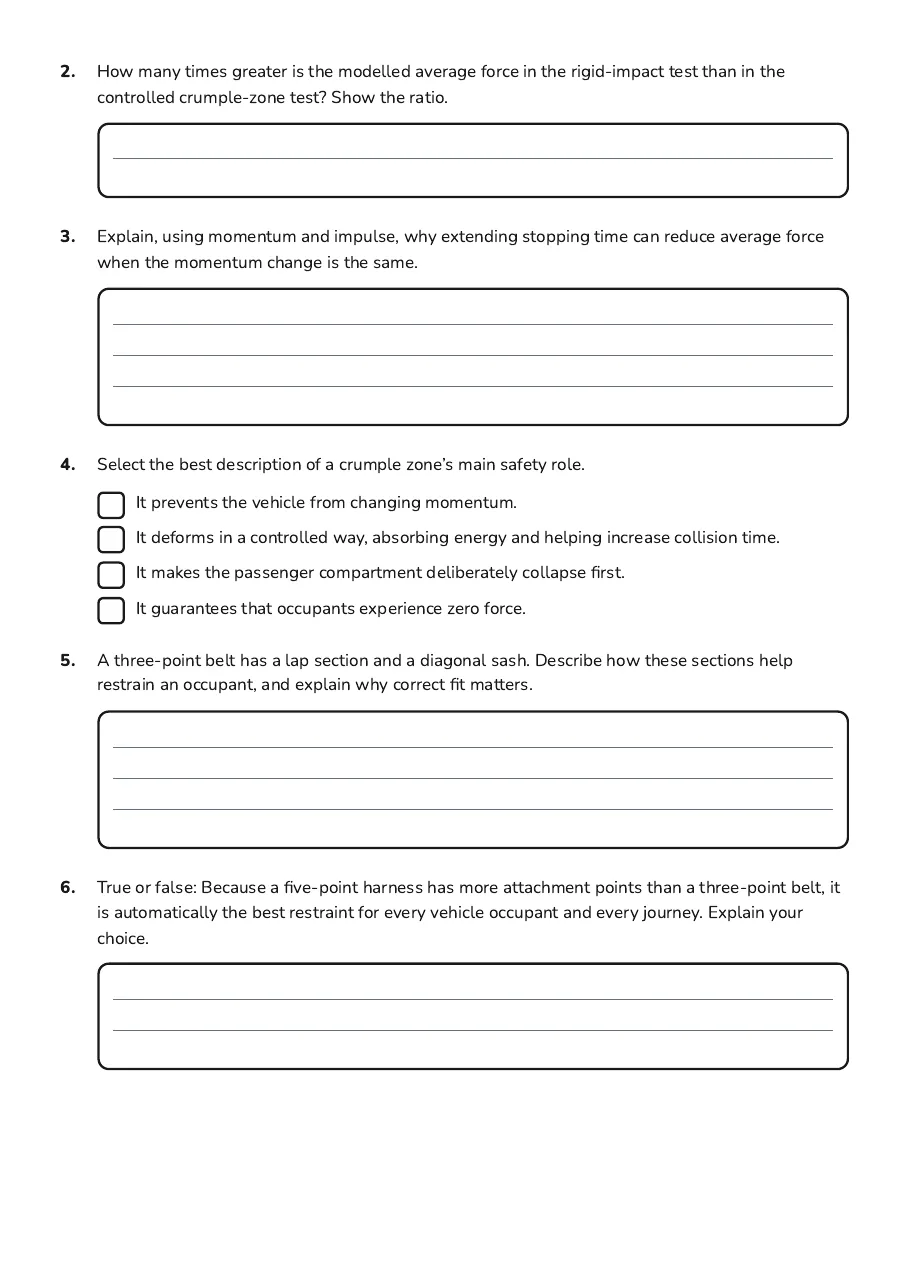
- It prevents the vehicle from changing momentum.
- It deforms in a controlled way, absorbing energy and helping increase collision time.
- It makes the passenger compartment deliberately collapse first.
- It guarantees that occupants experience zero force.
3 printable pages
Page 1
Page 2
Page 3
About This Worksheet
Free in Kuraplan
Sign up free, grab the PDF, and customize it for your class.
Print-Ready
Formatted for standard paper. Clean layout, easy to read.
AI-Generated
Created with Kuraplan's AI, designed for real classroom use.
For Teachers & Parents
Use in classrooms, for homework, tutoring, or homeschool.
Need a custom version of this worksheet?
Kuraplan's AI generates custom worksheets in seconds — differentiated for every learner, aligned to your curriculum.
Generate Custom Worksheets — Free