
Most teachers don't need another binder, dashboard, or initiative. They need to know whether the fractions unit they're starting this week builds on what students learned last year, prepares them for next year, and gives them enough evidence to decide who needs support tomorrow.
That's where the benefits of curriculum mapping become practical. A useful map can turn scattered pacing guides, unit plans, standards, and assessment notes into a shared view of the learning journey. But the map only earns its place if it changes decisions in classrooms. A polished document that nobody revisits is just extra work.
The Monday Morning Every Teacher Knows Too Well
By 7:35 on Monday morning, a fifth-grade teacher is already sorting through three competing priorities. There's a substitute folder to update, a new pacing guide attached to an email, and a request to pull intervention data before the first bell. On the board, the next mathematics unit is decimals.
The teacher opens last year's materials and finds three versions of the sequence. One colleague introduced place value with models, another moved quickly into operations, and a third spent several days reviewing work that students had already completed in fourth grade. Nobody did anything careless. Each teacher made reasonable decisions with the information available.
The trouble appears when the team compares notes. Two classes have covered the same standard at very different depths. Another class has reached the assessment, but the preceding lesson focused on a related skill rather than the standard being measured. Students who transfer between classrooms receive different explanations, different practice, and different assumptions about what they already know.
Practical rule: If every teacher carries a private version of the year in their head, the school doesn't have a shared curriculum.
Curriculum mapping responds to that problem. It gives teachers a common picture of what students learn, when they encounter it, how they practise it, and how the school checks understanding. The purpose isn't to force every classroom into the same script. It's to make the important connections visible, so teachers can spend less time reconstructing the past and more time responding to the students in front of them.
The test is simple. On a busy Monday, can a teacher look at the map and answer, “What should students already know, what do they need next, and what evidence will show me whether they're ready?” If the answer is yes, mapping is doing useful work.
What Curriculum Mapping Actually Means
Curriculum mapping is a living document that records what is taught, when it is taught, which students encounter it, and how each part connects to standards, assessments, and surrounding units. It can include essential outcomes, major concepts, learning activities, formative checks, summative tasks, resources, and notes about prerequisite knowledge.
The phrase is strongly associated with Heidi Hayes Jacobs' 1997 work, alongside later synthesis by Harden. A scholarly overview describes mapping as a visual representation of the curriculum based on real-time information, rather than a description of what a school hopes happens. That distinction matters. A written curriculum may say what should be taught, while a map helps a team examine what students experience. See the curriculum mapping overview from the University of Northern Colorado for that historical framing.
A subway map is a useful analogy:
- Each station is a concept, skill, or outcome.
- Each line represents a grade, course, or subject pathway.
- Transfers show where students carry knowledge from one unit or grade into another.
- The timetable represents when instruction and assessment occur.
- The connections show whether teaching activities and assessments serve the intended destination.
A scope and sequence tells you roughly when topics appear. A unit plan describes one stretch of teaching in detail. A curriculum map shows the whole network. A unit is a stop; the map helps you see whether students can reach it, what they passed on the way, and where the line goes afterward.
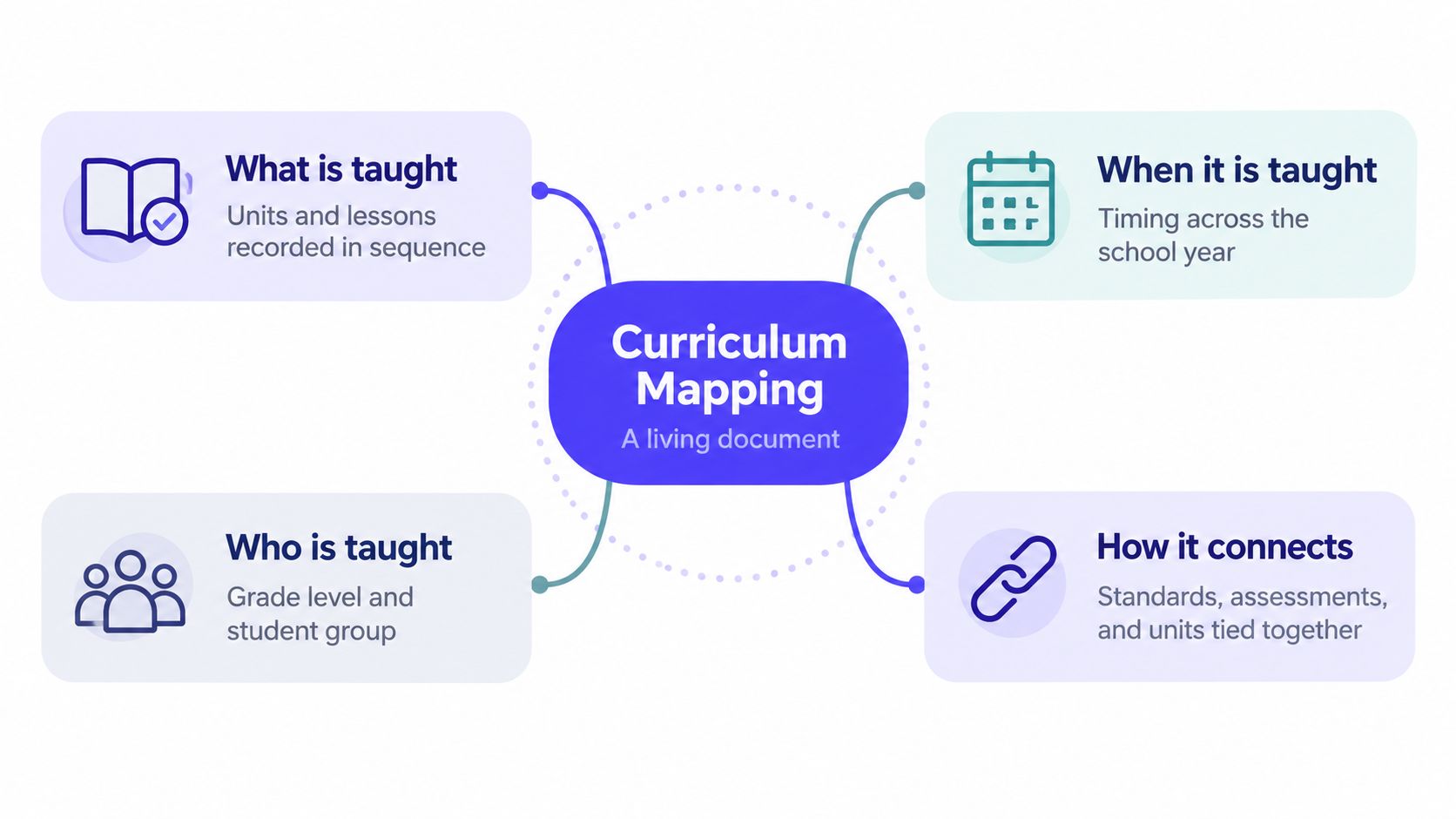
That shared view makes the other benefits possible. A map can reveal a gap, but only a teaching team can decide how to address it. It can show repeated coverage, but teachers must judge whether the repetition builds fluency or wastes time. The document isn't the improvement. The professional conversation and the decisions it supports are the improvement.
Better Alignment and Coherence Across Grades
Alignment answers a focused question: Do the standard, the instruction, and the assessment point in the same direction? If students are assessed on comparing decimal values, the map should help teachers see where that idea is explicitly taught, practised, and checked. Teachers shouldn't have to guess whether a lesson “counts” just because it sits near the right topic.
Coherence takes a wider view. It asks whether learning connects across classrooms, subjects, and grade levels. A third-grade fraction unit should prepare students for fourth-grade fraction work without requiring the next teacher to start over or assume skills students have never practised. At the same time, horizontal mapping can help a grade-level team see whether major writing, research, or project demands collide in the same part of the term.
The peer-reviewed study on curriculum mapping and standards alignment describes alignment with standards and assessment practices as a major benefit. Institutional guidance also identifies gaps, redundancies, outcome coverage, and assessment locations as practical uses. The Taylor Institute curriculum mapping guidance similarly describes maps as a way to view the curriculum as a whole and connect learning outcomes, assessments, and teaching activities.
Teachers usually feel the difference in meetings before they see it in formal reports. A PLC can move from “What are you teaching?” to “Students can identify equivalent fractions, but can they explain why the representations are equivalent?” A parent conference becomes clearer because the team can explain what students learned, where the skill sits in the progression, and what comes next.
Alignment versus coherence
| Dimension | Alignment | Coherence |
|---|---|---|
| Main question | Do outcomes, instruction, and assessment match? | Does learning build logically across units, subjects, and grades? |
| Problem it solves | Students are tested on content they weren't explicitly taught | Students repeat content, miss prerequisites, or face sudden jumps |
| Teacher benefit | Clearer lesson and assessment decisions | Better handoffs and more useful collaboration |
| Evidence to inspect | Standards, activities, tasks, and student work | Sequences, transitions, prerequisite skills, and coverage across grades |
Learning intentions and success criteria can help teachers make the daily link between the intended outcome and the evidence students produce. A practical explanation appears in this guide to learning intentions and success criteria. The gains won't last if the map is shelved after its first completion. Teams need to revisit it when student work exposes a gap, when pacing changes, and when teachers discover that a supposed prerequisite isn't secure.
Data-Driven Instruction and Planning Efficiency
Data-driven instruction and planning efficiency come from the same habit: write the learning pathway clearly enough that the next decision is easier. The map shouldn't merely record what happened. It should help teachers decide what to teach next, what to reteach, and what no longer needs a full lesson.
Consider a Grade 3 multiplication sequence. The Grade 4 teacher begins the year with access to the previous unit's essential outcomes, formative checks, and notes about fluency. The information doesn't replace a diagnostic task, but it gives the teacher a sensible starting point. If students understand the models but still need practice retrieving facts, September instruction can target fluency rather than repeat the entire introduction.
That is the assessment-to-instruction loop in ordinary language:
- Name the intended outcome.
- Choose evidence that shows whether students reached it.
- Record what the evidence reveals.
- Adjust the next lesson, group, or unit.
A map makes this loop visible across grades. It can show where a common formative check belongs, which outcome it measures, and whether a later unit depends on the result. Teachers can then discuss pacing with evidence instead of discovering in March that students never mastered an assumed foundation.
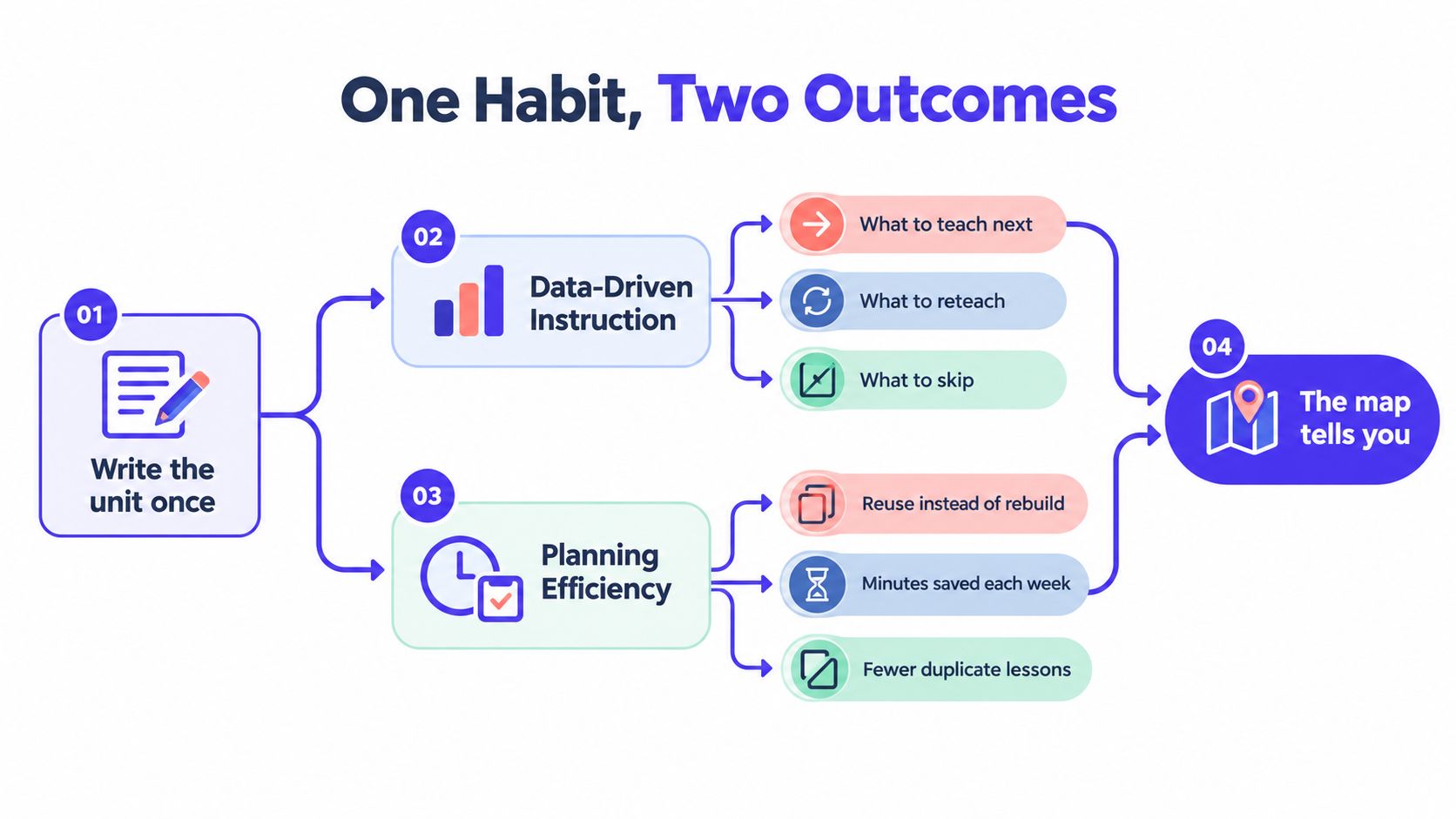
The time benefit is real, but it isn't magic. A shared map can reduce duplicated lesson design, make substitute coverage easier to understand, and help a new teacher locate the essential sequence. It won't eliminate planning. Teachers still need to adapt examples, group students, prepare materials, and respond to misconceptions.
What the map can remove
- Rebuilding: A team can reuse a clear unit framework instead of starting from scattered files.
- Guesswork: A teacher can see the prerequisite skills and assessment purpose before planning a lesson.
- Repeated conversations: PLC time can focus on student work and instructional response rather than reconstructing everyone's pacing.
- Invisible drift: A team can record when the taught sequence differs from the intended sequence and decide whether the change is justified.
The University of Sydney resource on teaching efficiency and program management connects mapping with reduced duplication and gaps, more efficient preparation and assessment coordination, resource sharing, and more efficient program reviews. The point isn't to promise that teachers will never plan on a Sunday night. It's to stop every teacher from solving the same planning problem alone.
A Side-by-Side Look at a Mapped Versus Unmapped Unit
Take a Grade 4 fractions unit. In an unmapped version, the teacher starts with equivalent fractions, moves to common denominators, and then teaches comparison. Each lesson looks complete on its own. The teacher may review halves and quarters because students seem uncertain, but there's no shared record of whether those ideas were secure in the previous grade. The sequence also gives little guidance about the fraction operations students will meet later.
A mapped version keeps the same broad content but adds useful connections. Prerequisite skills are flagged. Formative checks sit beside the lessons that depend on them. The team records which ideas are genuinely new, which deserve a short review, and which should move to a later application task. The Grade 5 link makes the future demand visible without turning Grade 4 into a preview course.
| Planning Decision | Without a Map | With a Map |
|---|---|---|
| Starting point | Review whatever students appear to remember | Check the prerequisite representations and target the weak ones |
| Equivalent fractions | Teach the full sequence as planned | Combine familiar examples and slow down where student evidence shows confusion |
| Common denominators | Assume the prior idea is ready for application | Connect the method to the exact models and language students already used |
| Comparison | Move on when the calendar says to move on | Use a formative check to decide whether students need more guided practice |
| Future connection | End the unit after the final assessment | Record how the work prepares students for later fraction operations |
| Planning resource | Search through separate files and notes | Use a shared framework, such as a lesson plan template for structured planning |
The mapped unit doesn't dictate the teacher's examples or classroom discussion. It changes the questions the teacher asks. Should these two lessons be combined? Does this group need another representation? Is the assessment testing comparison, computation, or reading language? Which parts can be skipped because students have already demonstrated mastery?
That's the practical difference. The map makes professional judgment easier to apply. It doesn't make the judgment for the teacher.
Does Curriculum Mapping Actually Improve Student Outcomes?
The honest answer is that a map alone doesn't guarantee higher test scores. Research and guidance consistently support clearer curriculum structure, stronger alignment, gap detection, and better collaboration, but the direct connection between producing a map and immediate achievement gains is less certain.
A 2026 article examining curriculum mapping's evidence and implementation limits notes that mapping is often documentation-focused because effective visualization takes resources. It also highlights a useful distinction: schools may create a transparent, well-aligned map without using it to redesign instruction. In that case, the school has improved its records, not necessarily its teaching.
That doesn't make mapping irrelevant. Instructional quality, coherent progression, well-matched assessment, and responsive reteaching all matter to learning. Mapping supports those conditions, but it doesn't cause them automatically. The strongest question isn't “Did the spreadsheet raise scores?” It's “Did teachers use the shared evidence to make better decisions for students?”
Schools that want to test the impact should measure the process and the learner experience together:
- Reteaching time: Are teachers spending less time repairing predictable gaps?
- Grade transitions: Are students arriving with the prerequisite knowledge the next unit assumes?
- Alignment audits: Do the taught activities and assessments still match the intended outcomes?
- Teacher confidence: Can teachers explain the sequence and make pacing decisions with shared evidence?
- Student work: Do tasks show stronger progression from recall to application and explanation?
A map in a shared drive, untouched after the initial upload, won't answer these questions. A map discussed in planning meetings, revised after assessment reviews, and used to coordinate support might.
The evidence therefore supports a careful conclusion. Curriculum mapping improves the conditions for responsive teaching more reliably than it proves a direct, automatic lift in standardized scores. That distinction protects teachers from inflated promises and gives school leaders a more useful implementation target.
How Modern Tools Like Kuraplan Make Mapping Easier
A spreadsheet can work well for a small team with stable standards and one grade level to coordinate. It becomes harder to manage when several grades use different versions, teachers need to compare coverage, and a change in one unit affects later learning. The question isn't whether technology is impressive. It's whether the tool removes enough coordination work to justify itself.
An AI-assisted workflow typically starts by importing standards as structured information. The team then connects standards to units, reviews where coverage is missing or repeated, and updates the map when the standards or teaching sequence changes. Teachers still need to verify the links. Automatic matching can reduce searching, but it can't replace local knowledge about student readiness, available time, or the way a school teaches a concept.
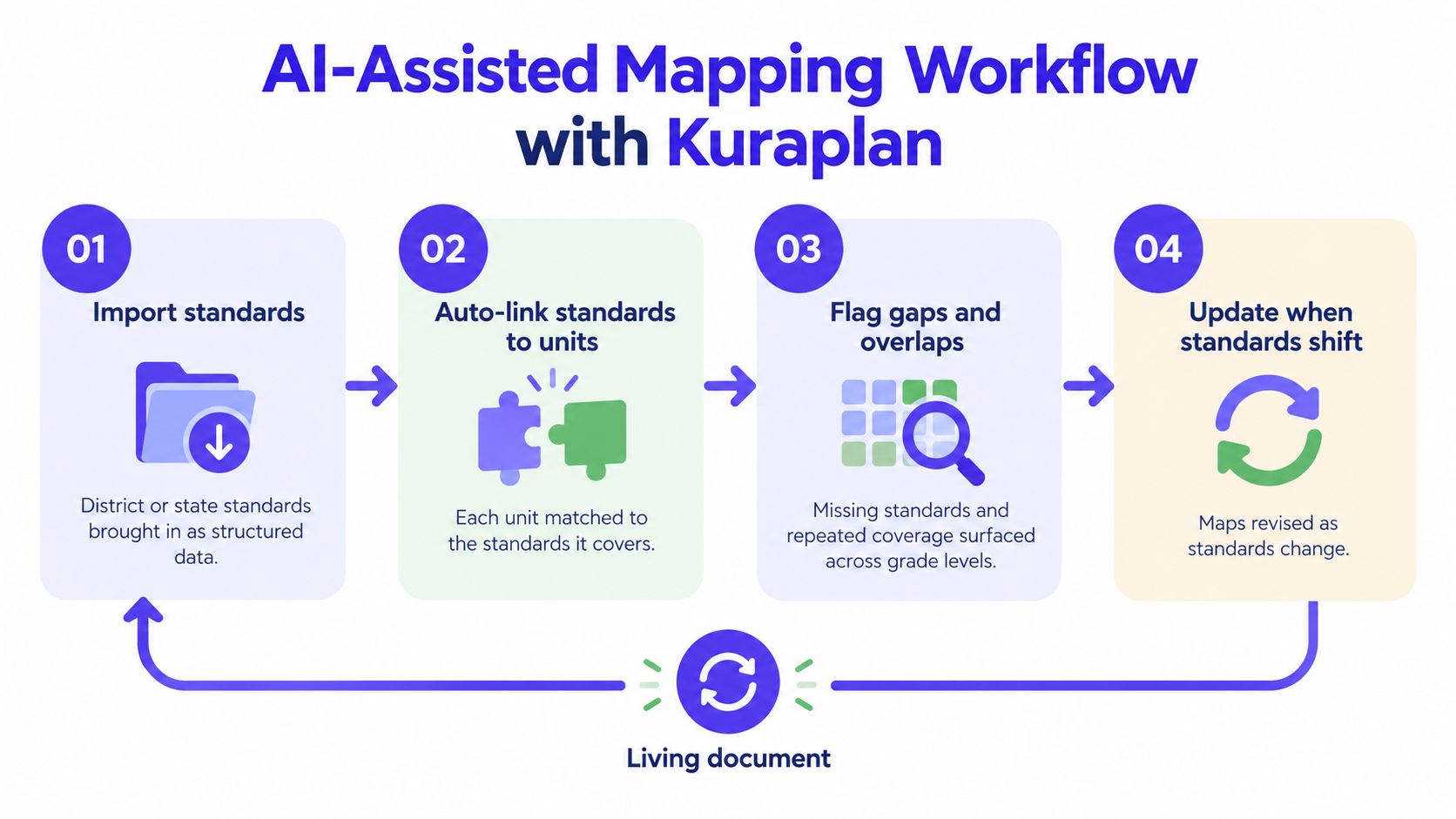
Suppose a team revises a Grade 4 fractions unit halfway through the term. A paper file may require teachers to inspect several pacing guides, unit plans, and assessment folders before they can identify the consequences. In a connected mapping platform, the team can review which outcomes, activities, and later units are linked to the revision, then decide what needs to move, remain, or receive an additional check.
Kuraplan is one option for this workflow. Its planning features support standards-aligned lesson and unit planning, scope and sequence, progressive objectives, formative checkpoints, assessments, and curriculum links. Teachers and curriculum teams can review the Kuraplan features for curriculum and lesson planning to judge whether that level of coordination fits their setting.
A dedicated platform makes more sense when several people need the same current view, when standards shift, or when leaders need to inspect gaps and overlaps without manually comparing files. A shared Google Sheet may still be the better choice for one stable team that can maintain it easily. The right tool is the one teachers will update and use during real planning, not the one with the longest feature list.
Putting the Benefits of Curriculum Mapping to Work
The benefits of curriculum mapping show up in ordinary decisions. A teacher sees that students need a prerequisite before starting a new unit. A grade-level team notices that two assessments measure the same narrow skill while another outcome has no clear evidence. A curriculum coordinator can follow a standard across grades without asking every teacher to send a separate document.
A useful map should pass a practical check:
- Standards are attached to units: Teachers can identify the priority outcome without searching through separate documents.
- The sequence is visible: The team can see what students learned before and what later teachers will expect.
- Assessments match objectives: Tasks give students a fair opportunity to demonstrate the intended learning.
- Student evidence changes plans: Formative results lead to reteaching, extension, regrouping, or pacing adjustments.
- The map has a review cycle: Teachers revise it when classroom experience shows that the planned sequence doesn't work as expected.
Start smaller than your ambition. Choose one unit, one visible gap, and one term. Invite the teachers who teach the grades before and after it, then compare the planned sequence with student work and actual classroom experience. Keep only the fields that help the team make decisions.
Mapping should become a habit of professional conversation, not a compliance deliverable. When teachers can see the same learning pathway and still retain the freedom to teach responsively, the map earns its place in the week.
Kuraplan helps educators organize standards-aligned units with scope and sequence, progressive objectives, formative checks, assessments, and supporting lesson materials. Visit Kuraplan to explore whether its planning workflow can help your team turn one priority unit into a living curriculum map.