How to choose: three questions
Does your child need review or depth? Some children learn a topic and keep it; they thrive in a mastery program that finishes fractions before it starts decimals. Others forget anything they have not seen for a week; they need a spiral program that revisits everything constantly. If you do not know yet, start mastery and add review.
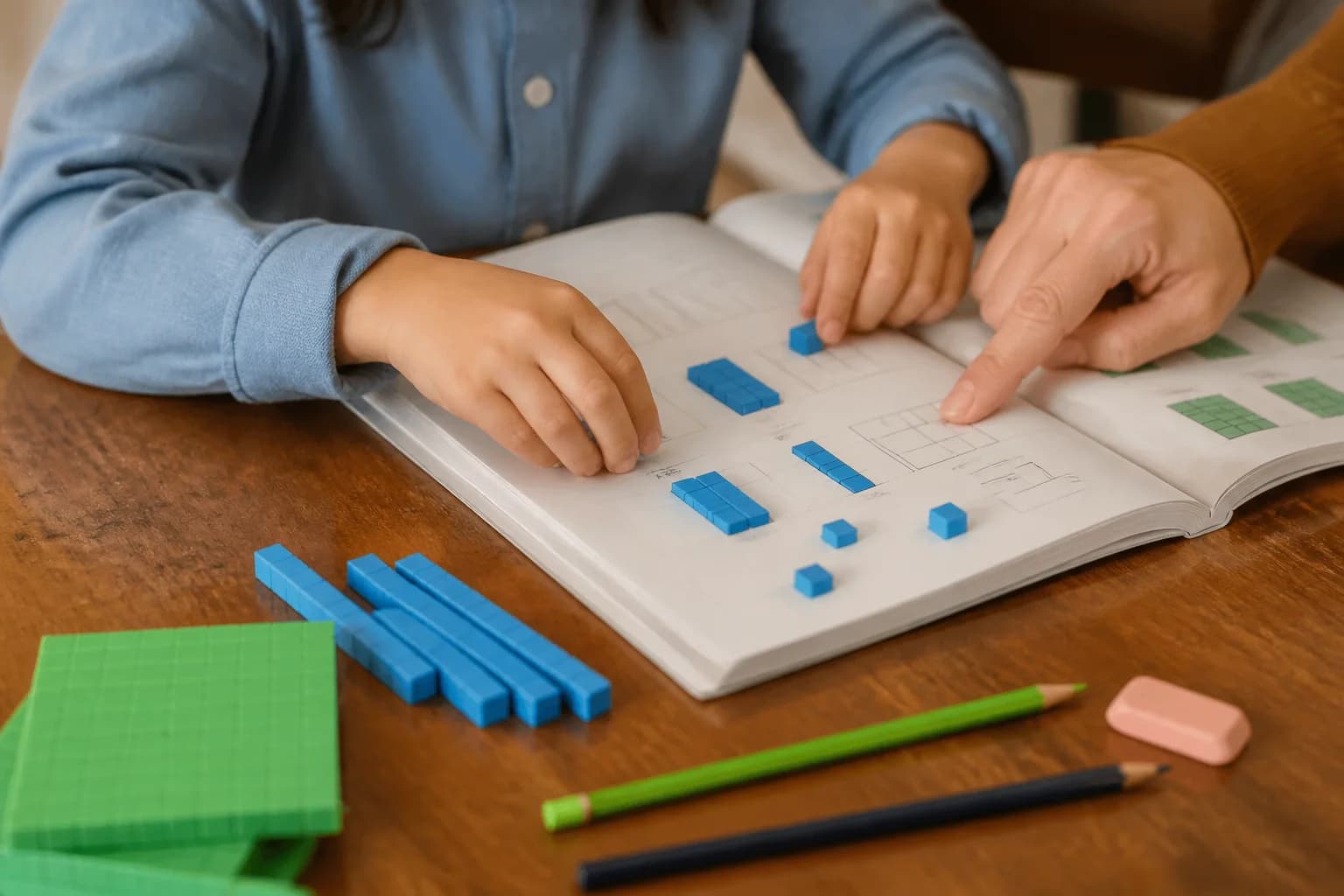
Does your child need to touch it? Base-ten blocks, an abacus, fraction tiles: some children cannot understand place value until they hold it. Math-U-See and RightStart are built around manipulatives; Singapore uses pictures as the bridge; Saxon and Teaching Textbooks mostly do not.
How confident are you teaching math? If the answer is “not very”, choose a program with video instruction (Math-U-See, Teaching Textbooks, Saxon with a video add-on) or with a teacher's guide that scripts the lesson (RightStart, Singapore Dimensions). Math Mammoth is written to the student and explains well enough that the parent learns alongside.
Quick comparison
| Program | Best for | Price |
|---|---|---|
| 1. Math Mammoth | Value and clear explanations, grades 1–7 | About $40 per grade (PDF) |
| 2. Singapore Math (Dimensions or Primary) | Deep number sense and problem solving | About $80–$120 per grade |
| 3. Math-U-See | Hands-on, video-taught mastery | About $150–$200 per level |
| 4. Saxon Math | Spiral review and retention | About $100–$150 per level |
| 5. RightStart Math | Abacus-based number sense in the early years | About $200–$300 per level with kit |
| 6. Beast Academy | Strong students who like puzzles | About $15/month online; books about $30 each |
| 7. Teaching Textbooks | Independent, self-grading lessons for grades 3–12 | About $40–$70 per level per year |
| 8. Khan Academy | Free mastery practice at any level | Free |
| 9. The Good and the Beautiful Math | Christian families who want a beautiful, scripted program | About $50–$80 per level |
| 10. Art of Problem Solving | Advanced middle and high school students | About $60–$100 per book; classes more |
1.Math Mammoth
About $40 per grade as PDF; printed moreBest for: value and clear explanations, grades 1–7
Math Mammoth is a mastery worktext: the explanation and the practice are on the same page, written to the child in plain language, with a lot of visual models. It covers grades 1–7 (the Light Blue series) and sells as PDFs you print or use on a tablet, which makes it the cheapest full program on this list. Secular.
Suits: families on a budget, parents who want to understand the math themselves, children who read well enough to follow a written explanation. Watch for: the pages are dense and some children find them overwhelming; do half a page a day rather than pushing through. No video, though the author's free YouTube lessons cover most topics.
2.Singapore Math (Dimensions or Primary Mathematics)
About $80–$120 per gradeBest for: deep number sense and problem solving
The Singapore approach (concrete, then pictorial, then abstract; bar models for word problems; mental math strategies) is the one most researchers point to when asked what works. Dimensions Math is the current homeschool-friendly edition with a teacher's guide; Primary Mathematics is the older classic. Secular.
Suits: children who like to understand why, and parents willing to read the teacher's guide. Strong students go far. Watch for: it moves fast, it assumes the parent teaches the lesson, and a child placed too high struggles. Use the placement test honestly.
3.Math-U-See
About $150–$200 per level including blocksBest for: hands-on, video-taught mastery
Math-U-See teaches one concept per level (Alpha is addition, Gamma is multiplication) with a short video, a set of coloured blocks, and worksheets until mastery. The child watches the lesson, builds it, writes it, and moves on when it is solid. Christian company, neutral content.
Suits: visual and hands-on learners, parents who want the teaching done by video, children who like to see progress. Watch for: the single-concept levels mean a grade 3 child is doing only multiplication for a year, which some parents find narrow; word problems are lighter than Singapore. Many families supplement with a bit of everything else.
4.Saxon Math
About $100–$150 per level; video add-ons extraBest for: spiral review and long-term retention
Saxon is the classic spiral program: each lesson introduces a small increment and then reviews everything that came before, forever. Children who forget things do not forget in Saxon. It runs from kindergarten through calculus, and there are excellent third-party video teachers (Nicole the Math Lady, Art Reed).
Suits: children who need constant review, families who want a predictable daily format for a decade, and parents who want the whole K–12 path in one series. Watch for: it is repetitive by design and some children find it soul-crushing; the problem sets are long. Cutting the review in half for a strong student is common practice.
5.RightStart Math
About $200–$300 per level with the manipulative kitBest for: abacus-based number sense in the early years
RightStart teaches with an AL abacus, card games and very little writing in the early levels. Children learn to see quantities in fives and tens rather than counting by ones, which pays off for years. Fully scripted for the parent.
Suits: young children, children who dislike worksheets, and parents happy to teach a hands-on lesson daily. Watch for: it is parent-intensive and expensive, and some families switch after level C or D when the writing increases. Superb start; not always the whole journey.
6.Beast Academy
About $15/month online; guide and practice books about $30 eachBest for: strong students who like puzzles, grades 1–5
From Art of Problem Solving, Beast Academy teaches through a comic-book guide and a practice book full of hard, interesting problems. Online includes the whole thing with instant feedback. It goes deeper than any other elementary program and it is genuinely fun for the right child.
Suits: children who find standard math easy and want a challenge, and families heading toward AoPS. Watch for: it is hard on purpose; a child who struggles with math will hate it. Secular.
7.Teaching Textbooks
About $40–$70 per level per year (subscription)Best for: independent, self-grading lessons for grades 3–12
Teaching Textbooks is an online program in which a friendly voice teaches each lesson, the child works problems on screen, and everything is graded automatically with a gradebook for the parent. It is the program most often chosen by parents who want out of teaching math.
Suits: independent learners, big families, parents who are not confident in math. Watch for: it runs about a year behind other programs in content, so strong students may want to skip a level; it is also lighter on conceptual depth. Fine for a child heading to a non-STEM path; supplement for a STEM one.
8.Khan Academy
FreeBest for: free mastery practice at any level
Khan Academy is a complete, free, secular math program from early grades to calculus, with video explanations, adaptive practice and a mastery dashboard. Khan Academy Kids covers the early years. It is a real option as the only math curriculum, and a superb supplement to any other.
Suits: families on no budget, older independent students, and as review for everyone. Watch for: it needs a present parent for younger children, and screen-only practice misses the pencil work that builds fluency. Pair with a printed workbook or Kuraplan worksheets.
9.The Good and the Beautiful Math
About $50–$80 per levelBest for: Christian families who want a scripted, beautiful program
TGTB Math is a full-colour, scripted course book with games, stories and a spiral-ish review, designed to be taught in about twenty minutes a day. It matches the language arts course in look and feel, which is why so many TGTB families use it.
Suits: TGTB families, parents who want a script, and children who respond to the illustrations. Watch for: faith content throughout (it is a Christian curriculum), a pace some find fast, and less depth on problem solving than Singapore. Secular families look elsewhere.
10.Art of Problem Solving (AoPS)
About $60–$100 per book; online classes several hundred dollarsBest for: advanced middle and high school students
AoPS is where Beast Academy leads: prealgebra through calculus taught through problems first, for students who want to think hard about mathematics. The books are rigorous; the online classes are demanding and excellent. Competition math lives here.
Suits: strong, motivated students, especially those considering STEM or math competitions. Watch for: it is not for a student who finds math difficult, and the parent needs to accept not being able to help by the middle of Introduction to Algebra.
Placing your child
Every program above has a free placement test. Use it, and place by skill rather than by grade. A child who is a grade “behind” in a program that fits will catch up; a child placed a grade ahead will stall and blame themselves. If your child is switching programs, expect a few weeks of adjustment and do not switch again for a year.
Whatever you choose, daily practice matters more than the program: twenty to forty-five minutes, five days a week, with answers checked immediately. When the program's practice is not enough on a skill, the math hub has free worksheets by grade and topic, and Kuraplan will make a sheet on the exact skill with worked solutions.