Tuesday afternoon: the science lab runs long, the writing block is already behind, and you're wondering how to make both subjects count without turning the lesson into a rushed compromise. Curriculum integration works best when it starts with a shared question or product, not a forced connection between two standards. Students should still learn the distinct skills in each subject. The difference is that they use those skills together to investigate something that matters.
The curriculum integration examples below focus on the planning moves that help a unit hold together, a short lesson outline, and the student work that can show what they learned. They also make the trade-offs visible. A garden project can make measurement meaningful, for instance, but it won't teach measurement well unless students collect and interpret usable data.
Before a planning meeting, Kuraplan can help line up standards across subjects and draft a sequence of lessons around shared objectives. The teacher still decides whether the connection makes sense and how to assess it. Start with the examples that fit work you already teach, then make one connection clear enough for students to explain.
1. STEAM Integration
A bridge-building challenge gives science, math, engineering, and art real jobs. Students investigate how materials behave, calculate dimensions and compare designs, build and test a structure, then communicate why its form works. The art isn't a coat of paint at the end. Students make choices about shape, appearance, and how clearly the model explains its design.
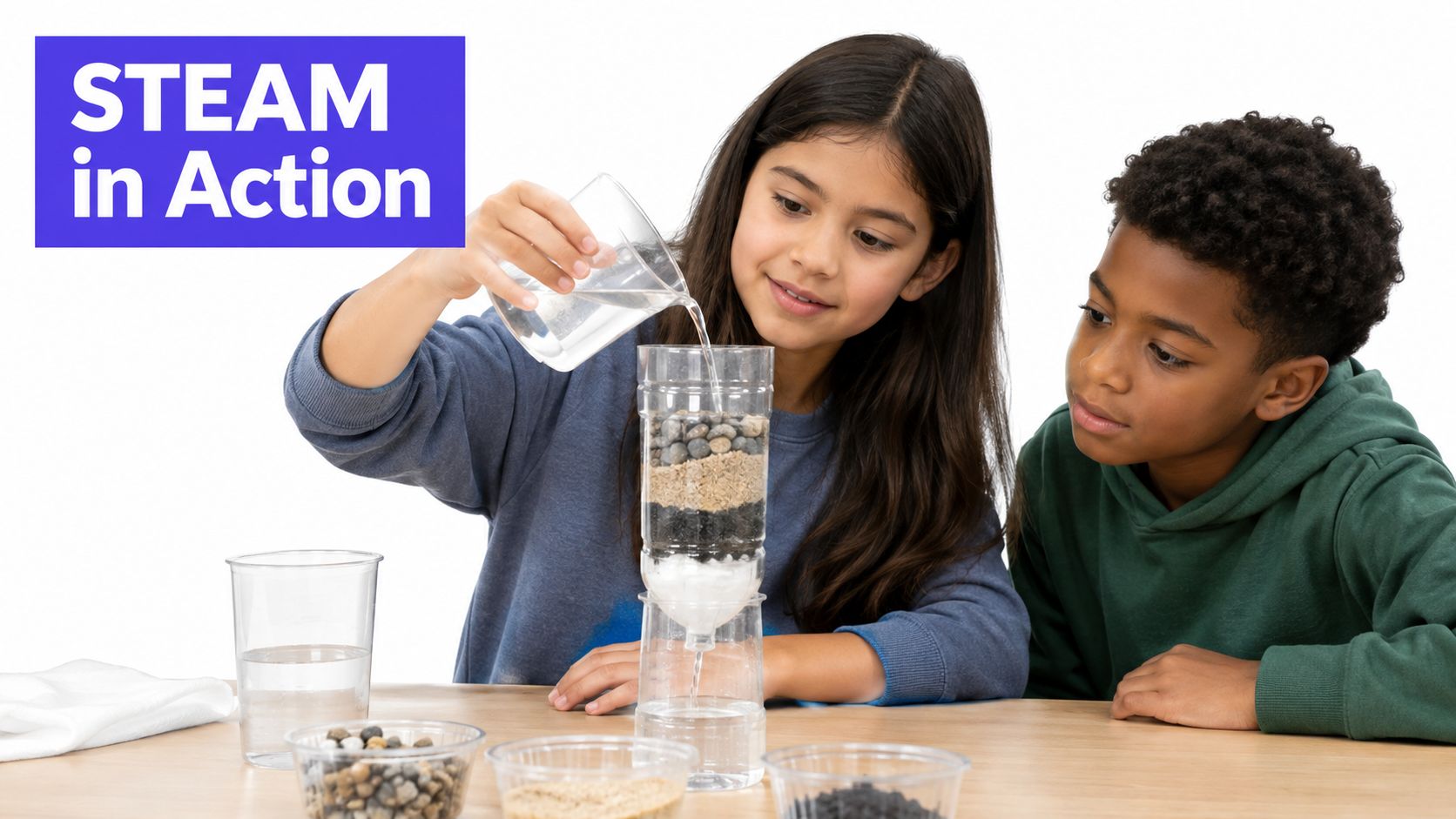
A water-filtration unit offers another route: test materials, measure water flow, build a simple prototype, and make a diagram that helps someone understand how the system works. The key planning move is to settle on one driving question, such as how to make a model that filters water while allowing it to pass through. Then identify what each subject contributes before choosing materials or splitting students into groups.
Keep the scoring separate: Assess science reasoning and design quality on distinct rubric criteria. A polished model shouldn't hide weak explanations about how the filter works.
A sample lesson and its evidence
Students first predict which materials will filter visible particles, then test and record results. They use their observations to choose materials for a prototype, compare how the design performs, and revise it. A finished artifact might include the working model, a labeled diagram, test notes, and a short explanation of the design choices. That combination makes both subject learning and creative judgment easier to see.
Kuraplan can help draft standards-aligned lesson sequences for the subjects involved. Put those lessons on one timeline and check where students need a science concept before they can make a sound engineering choice. If a subject connection doesn't contribute to the driving question or a learning objective, leave it out.
2. Project-Based Learning Interdisciplinary Units
“How can our neighborhood reduce flooding?” gives students a reason to use geography, statistics, persuasive writing, and civics. They can map places where water collects, examine rainfall or drainage information, consider who is affected, and present a recommendation to a real audience. The project feels coherent because every subject helps answer the same question.
A fifth-grade community-garden proposal works the same way. Students investigate soil and growing conditions, estimate costs, decide what to plant, and present a plan to the school board. Middle school students might investigate local water quality, write a public report, and explain their findings to city officials. The audience and the evidence make these more than craft projects with a few facts added.
Plan backward from the public product
Start by defining what students will produce and what it must demonstrate. Then work backward to identify the knowledge and skills they'll need, including research, data analysis, writing, and speaking. A useful checkpoint asks students to show evidence, not just report that they're on schedule.
The Gold Standard PBL framework from the Buck Institute for Education emphasizes a challenging problem, sustained inquiry, authenticity, student voice, reflection, and a public product. Those features help keep an extended unit from becoming a sequence of disconnected activities. They also create a practical test: can students explain how each lesson helps them investigate the problem or improve the final product?
A sample sequence might begin with a neighborhood map and a question wall, move into research and mini-lessons on graphing and persuasive claims, then end with a proposal presentation. The student artifact is the proposal, supported by maps, data displays, and cited evidence. Kuraplan's unit-planning tools can help sequence lessons and checkpoints so the calendar supports the product instead of becoming a scramble near the deadline.
3. Literacy Across the Content Areas
Reading and writing belong in content classes because students need them to learn the content. A science student has to interpret lab procedures, a history student has to compare sources, and a mathematician should be able to explain why a solution makes sense. If students can't make meaning from the text or communicate their thinking, a hands-on activity may not reveal what they understand.
The Common Core State Standards include separate literacy standards for history and social studies, and for science and technical subjects. In practice, that doesn't mean every subject teacher needs to teach a full English lesson. It means choosing a manageable literacy routine that helps students read, reason, or explain within the discipline.
A sample lesson and its evidence
A history and ELA team can compare two primary-source letters from the same event. Students identify who wrote each source and why, mark details that support a claim, and write a short comparison that distinguishes evidence from inference. In science, students can annotate a lab procedure before starting, then use a graphic organizer to record observations and explain results.
Pick one or two routines to use across subjects, such as sourcing a primary document or writing a claim with evidence and reasoning. Give content teachers a short, suitable text set rather than expecting each teacher to find materials from scratch. A student artifact might be an annotated source, a lab explanation, or a math response that shows how the student reasoned, not just the final answer.
Kuraplan can generate subject-specific reading guides and vocabulary worksheets to make this work easier to plan. For a ready-made cross-subject practice example, see this reading and multiplication skills worksheet. Keep the reading goal tied to the lesson: a vocabulary sheet is useful when it helps students understand the science or math, not when it becomes extra work with no clear purpose.
4. Arts Integration
Arts integration asks students to learn through an art form while also learning the academic content. A movement sequence can represent the water cycle, for example, but students should still be able to explain the processes the movement shows. The art needs its own objective, too, such as using space, rhythm, or gesture deliberately.
The Kennedy Center's Changing Education through the Arts (CETA) program is a well-known model that emphasizes teacher learning and collaboration with teaching artists. That co-planning matters: a dance activity is more likely to teach both movement and science when the academic and arts objectives are designed together, rather than when the art is added as a reward after the “real” lesson.
Give both subjects a target: Write one arts objective and one academic objective, then collect evidence for each.
A sample lesson and its evidence
A third-grade class can create tableaux showing causes of the American Revolution. Students choose a frozen pose for each scene, use body position to communicate relationships or conflict, and write a reflection linking the scene to a historical event. A second-grade class can use movement and percussion to model multiplication arrays, then draw the array and explain how the rhythm represents equal groups.
The finished artifact might be a performance plus a written reflection, drawing, or explanation. That makes it possible to assess historical understanding or multiplication separately from the artistic choices. A simple weekly arts-based warm-up can make the approach manageable without requiring a large production.
Kuraplan's AI assistant can help suggest low-prep activities tied to a current unit. Teachers can also use an art-inspired writing prompts worksheet to connect creative work to written reflection. Don't grade artistic polish as a substitute for content knowledge. Students should be able to show what they know in more than one way.
5. Historical Fiction Paired with Social Studies
Historical fiction can give students an emotional entry point into a period, but the novel isn't a substitute for studying the historical record. Pair Lois Lowry's Number the Stars with a unit on World War II and the Holocaust, or read Esperanza Rising alongside research into the Mexican Revolution and migrant labor in California. Students read for character, theme, and narrative choices, then check the historical context against reliable sources.
A fifth-grade class reading Esperanza Rising might compare the novel's depiction of migrant labor with historical accounts of conditions during the Great Depression. Middle school students reading Hatchet could connect the story to geography and the Canadian wilderness, while distinguishing a fictional survival narrative from factual study of the region.
A sample lesson and its evidence
Build a shared timeline that students update as they read. They can record a novel event beside relevant historical context, flag a passage where the story simplifies or departs from the record, and discuss why an author might make that choice. The finished artifact might be a timeline with annotated entries and a compare-and-contrast essay supported by both the novel and historical sources.
This approach works when students have time to discuss the difference between a believable scene and a documented fact. It falls short if the class treats every detail in a novel as historical evidence. Ask students to support claims with sources, and use comprehension questions that address both plot and context. Kuraplan can help draft those questions and worksheets around the book and the unit's history objectives.
For a field-trip connection, teachers can find Texas historic site hours and consider whether a visit fits the material students are studying. A trip should add evidence or context to the unit, not become an unrelated outing.
6. Edible Schoolyard and Place-Based Garden Learning
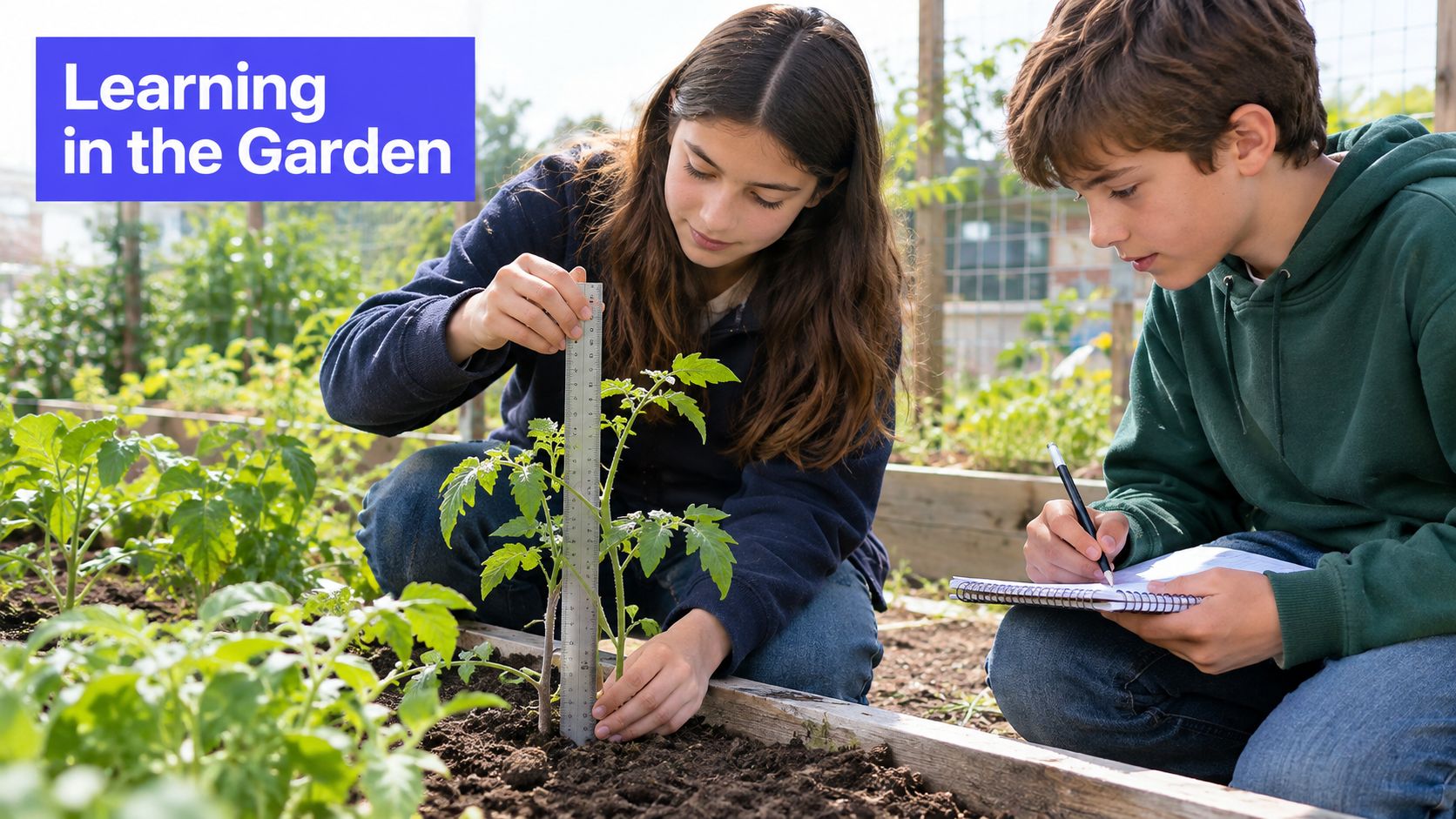
A school garden turns science and math into work students can observe over time. They can measure plant growth, record weather, test soil, graph results, and write an explanation of what the evidence suggests. Social studies can enter through local agriculture, food systems, or the history of what a community grows and eats.
The Edible Schoolyard Project, founded by chef Alice Waters at Martin Luther King Jr. Middle School in Berkeley, California, treats the garden and kitchen as learning spaces. A classroom doesn't need a full garden to borrow the idea. Containers or a few raised beds can support a focused investigation, as long as students have a clear question and a consistent way to record observations.
A sample lesson and its evidence
Students can grow bean plants in different light conditions, record observations in a shared data sheet, graph the results, and write a claim supported by their evidence. The artifact is the data table, graph, and explanation, not just the plant. In a younger class, planting a “three sisters” garden can lead into study of Indigenous agricultural knowledge, with age-appropriate sources and careful attention to whose knowledge is being represented.
Start small and build community support before expanding. A garden may be affected by weather, maintenance, or missed observation days, so choose a project that can survive an imperfect schedule. Give students clear jobs and use data sheets that also build measurement skills, such as recording plant height, leaf count, and weather conditions.
Kuraplan can turn observations into printable worksheets and diagrams of plant life cycles. A community garden reading comprehension worksheet offers another way to connect garden work to literacy. Teachers exploring outdoor learning can also find outdoor learning advantages as they decide which activities suit their students and setting.
7. Computational Thinking Across Subjects
Coding is useful when it gives students a way to model a content idea. Students can use a Scratch sprite to show a life cycle, create a simulation of supply and demand, or program a geometric pattern. The lesson isn't “learn to code” in isolation. It's to make a model whose instructions reveal how students understand a process or relationship.
A fourth-grade class might build a Scratch model of the solar system and use timing and variables to represent different orbital speeds. Middle school students can simulate predator and prey populations, adjust variables, and graph how those changes affect the model. The results aren't a perfect picture of reality. That limitation is part of the learning: students need to identify what their model represents and what it leaves out.
A sample lesson and its evidence
Teach one coding idea at a time, such as loops or conditionals, and tie it to the content objective. Students plan the sequence, build the model, test it, and debug errors with a partner. A finished artifact might include the program, a screenshot or screen recording, and a short explanation of the rules students encoded.
Pair programming works best when both students have a clear role and switch roles during the activity. Ask the partner who isn't typing to explain the logic or predict what a change will do. That makes debugging a reasoning task rather than one student fixing the code while the other watches.
Kuraplan can help draft project briefs, rubrics, and step-by-step student guides, leaving more planning time for the content decisions. A short video can introduce computational thinking before students begin:
8. Primary Thematic Units
A primary theme can help younger students see that the school day isn't made up of unrelated blocks. In a weather unit, students read stories about weather, measure rainfall, chart temperatures, and write about what they notice. The theme provides a shared context, but each subject still needs a clear learning target.
A first-grade “Weather” unit might use a class chart to record daily observations, a rain gauge for measurement, and books that help students describe weather. A second-grade “Our Community” unit can include interviews with local workers, neighborhood maps, and persuasive letters about a park improvement. EL Education, formerly Expeditionary Learning, is a known model for long-term topics, case studies, and fieldwork.
A theme should help students connect learning, not excuse a loose collection of activities.
A sample lesson and its evidence
Start with a unit map that places the theme in the center and connects each subject to a question or task. For weather, students might measure precipitation, read a nonfiction passage, compare daily conditions, and write a short report. A student artifact could be a weather journal that includes observations, a graph, and a written explanation of a pattern.
Keep a visible class question wall and update it as students learn. It helps younger students return to the unit's central question and gives the teacher a quick way to spot gaps. Check standards coverage before teaching the unit, then revisit the map as lessons unfold. If the theme is no longer serving a subject objective, adjust the activity rather than stretching the connection.
Kuraplan's unit-planning and sequential-lesson tools can help map a theme across weeks and keep standards in view. The best thematic units feel connected to students without becoming vague. By the end, children should be able to point to what they learned in reading, math, science, and social studies, and show evidence of it.
Side-by-Side Comparison of 8 Curriculum Integration Examples
| Approach | Ideal Use Case | 🔄 Implementation Complexity | Resource Requirements | 📊 Expected Outcomes & Key Advantages |
|---|---|---|---|---|
| STEAM Integration | Real-world design challenges combining arts with STEM | High: coordinate subjects, iterative work, and assessment | Planning time, shared scheduling, basic prototyping materials | ⭐ Builds creative and analytical thinking, collaboration, and persistence |
| Project-Based Learning (PBL) | Extended inquiry into a complex, authentic question | High: sustained facilitation, checkpoints, and careful pacing | Several weeks, teacher planning, materials, and an authentic audience | ⭐ Supports deeper learning, retention, student choice, and real-world application |
| Literacy Across the Content Areas | Developing reading and writing skills within every subject | Moderate: align routines and expectations across teachers | Subject-specific texts, shared planning, and teacher training | 📊 Strengthens comprehension, vocabulary, and communication across subjects |
| Arts Integration (Kennedy Center Model) | Teaching core content through visual art, music, dance, or drama | Moderate to high: plan and assess both arts and academic objectives | Arts materials, teacher training, or arts specialists | ⭐ Supports engagement, memory, and creative ways to demonstrate learning |
| Historical Fiction Paired with Social Studies | Connecting literature to a historical period and primary sources | Moderate: coordinate reading pace, research, and fact-checking | Suitable novels or picture books, historical sources, and discussion time | 💡 Builds empathy and historical perspective while prompting fiction-versus-fact analysis |
| Edible Schoolyard and Place-Based Garden Learning | Linking science, math, nutrition, and social studies to local food and environments | Moderate to high: maintain the learning space and coordinate support | Garden space or containers, tools, ongoing upkeep, and community support | 📊 Provides hands-on practice in observation, measurement, data, and nutrition |
| Computational Thinking Across Subjects | Applying coding and algorithmic reasoning to subject content | Moderate: align coding goals with content and support debugging | Devices, coding tools, and reliable internet access | ⚡ Strengthens sequencing, problem decomposition, and persistent problem-solving |
| Primary Thematic Units (Expeditionary Learning Model) | Organizing primary-grade learning around a shared theme | Moderate to high: map standards and subjects across several weeks | Unit-planning time, varied texts, and possible fieldwork | ⭐ Creates coherent learning connections, reduces fragmented lessons, and reinforces concepts |
Pick One Unit and Map It This Week
Start with a unit you already teach. Find one standard from a second subject that fits its central question, then sketch a shared product both classes could work on. A science investigation might become more meaningful when students explain their data in writing; a social studies project might benefit from measurement or mapping. Don't add a subject just to make the unit look interdisciplinary.
Try the idea for two weeks. Collect one student artifact that shows what learners did and understood, such as an annotated source, a data graph with an explanation, or a design model with test notes. Use that work to check whether the shared task revealed learning in both subjects. If a single grade would hide important differences, keep separate evidence for each discipline.
Then adjust the rubric before expanding. Ask whether students had enough instruction to complete the task, whether the evidence matched the objectives, and whether any group member's learning was hard to see. A small unit can reveal where the plan needs clearer checkpoints, better scaffolds, or a narrower product.
If you're planning with a colleague, bring the central question, the two subject objectives, and one possible student artifact to the meeting. That's enough to decide whether the connection is worth developing. Kuraplan can draft matching lesson outlines and worksheets around the shared objectives, helping the meeting end with a usable plan rather than a long list of ideas. For a possible team-building activity beyond the classroom, educators can explore Chronos One Escape Rooms Eltham activities.
Kuraplan helps K–12 educators map standards across subjects and create connected unit plans, lesson sequences, worksheets, and assessment rubrics. Use it to turn one shared classroom question into a practical cross-curricular plan, then visit Kuraplan to get started.