You know the scene. The lesson plan has the standard number, a polished objective, a text, an activity, and an exit ticket. During class, students highlight half a page, discuss the “main idea,” and complete a worksheet. By dismissal, the alignment box is checked, but you still can't answer the important question: What did students learn, and what evidence proves it?
That gap sits at the heart of English language arts standards. Standards aren't lesson scripts, and they aren't meant to turn teaching into a scavenger hunt for labels. They give us expectations. Our work is translating those expectations into a sequence of skills, a worthwhile task, and evidence that tells us what students can do next.
Why ELA Standards Trip Up Even Good Teachers
A colleague once showed me a lesson she was proud of. The standard asked students to cite textual evidence. Her plan included a short story, partner discussion, annotation, and a written response. On paper, it looked careful and purposeful.
In practice, students copied the first sentence they noticed, explained what the sentence said, and handed in paragraphs filled with plot summary. The task mentioned evidence, but it never required students to connect a quotation to an interpretation. The worksheet measured completion, not the standard.
That isn't a teacher failure. Alignment is harder than matching a standard to an activity. A standard usually contains several decisions at once: what students must understand, what they must produce, how independently they must work, and what counts as convincing evidence.
Practical rule: If you can't describe the student product in one sentence, the lesson probably isn't aligned yet.
A useful planning chain looks like this:
- Standard: Students cite textual evidence to support an inference.
- Objective: Students will make an inference about a character and support it with two relevant details from the story.
- Prerequisite: Students can distinguish a relevant detail from an interesting one and explain what the detail suggests.
- Task: Students write a short claim-evidence-reasoning response after rereading selected passages.
- Evidence: The response includes an accurate inference, relevant textual support, and an explanation connecting the support to the inference.
The need for measurable evidence isn't abstract. In 2022, fourth-grade students earned an average NAEP reading score of 217 on a 0–500 scale, down from 220 in 2019, and 33% reached or exceeded NAEP Proficient, according to the 2022 NAEP reading results. One assessment doesn't explain every classroom, but it does remind us that standards must become observable reading, writing, language, and reasoning.
How Common Core Shaped Today's ELA Standards
The Common Core State Standards changed the national conversation about ELA planning. In 2010, 45 states and the District of Columbia initially adopted Common Core standards for English language arts and mathematics. Minnesota adopted the ELA standards but not the mathematics standards, bringing the total to 46 U.S. jurisdictions using the CCSS framework for English language arts, as documented by the Education Commission of the States.
Why does that history still matter if your state has renamed or revised its standards? Because the movement made several planning habits familiar across districts:
- Standards describe progressions. Students encounter increasingly complex reading, writing, speaking, listening, and language expectations rather than unrelated skills.
- Texts matter. Teachers must consider the demands of literary and informational texts, not just the topic or reading level.
- Evidence matters. Students are expected to support interpretations and explanations with details from what they read.
- Alignment matters. Curriculum, assessments, teacher preparation, and daily instruction need a shared description of learning.
State variation is real. A state may reorganize strands, change wording, add local priorities, or replace Common Core entirely. District pacing guides may also emphasize different texts and sequences. Still, most ELA standards documents ask teachers to solve the same classroom problem: help students read closely, communicate clearly, use language deliberately, and support ideas with evidence.
When you move between systems, start by reading the action verbs. “Identify,” “explain,” “analyze,” “compare,” and “evaluate” don't ask students to produce the same kind of work. The labels may change, but the planning questions remain stable: What must students do with language, what knowledge do they need first, and what product will make their thinking visible?
The Five Strands Every ELA Standard Builds On
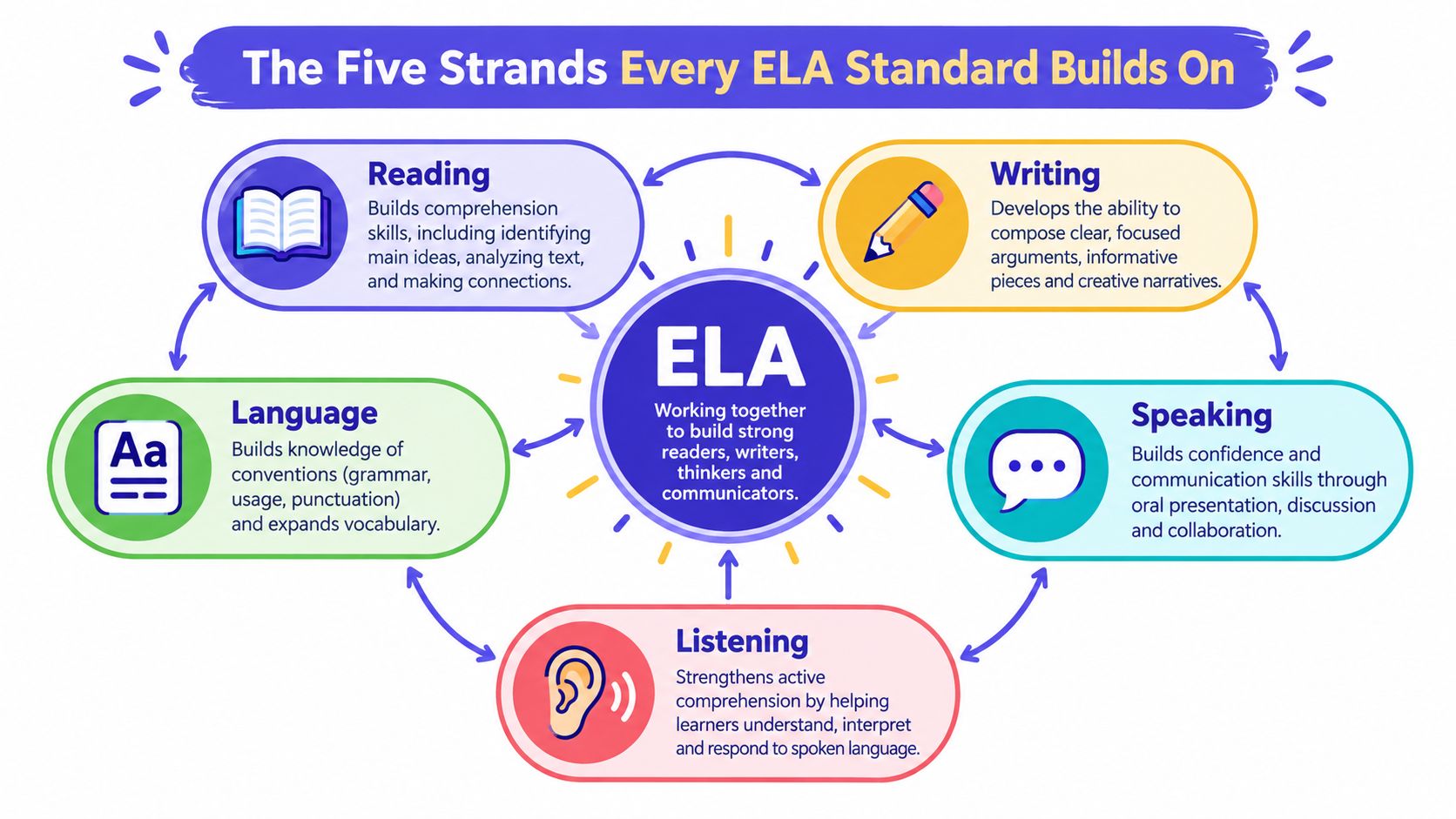
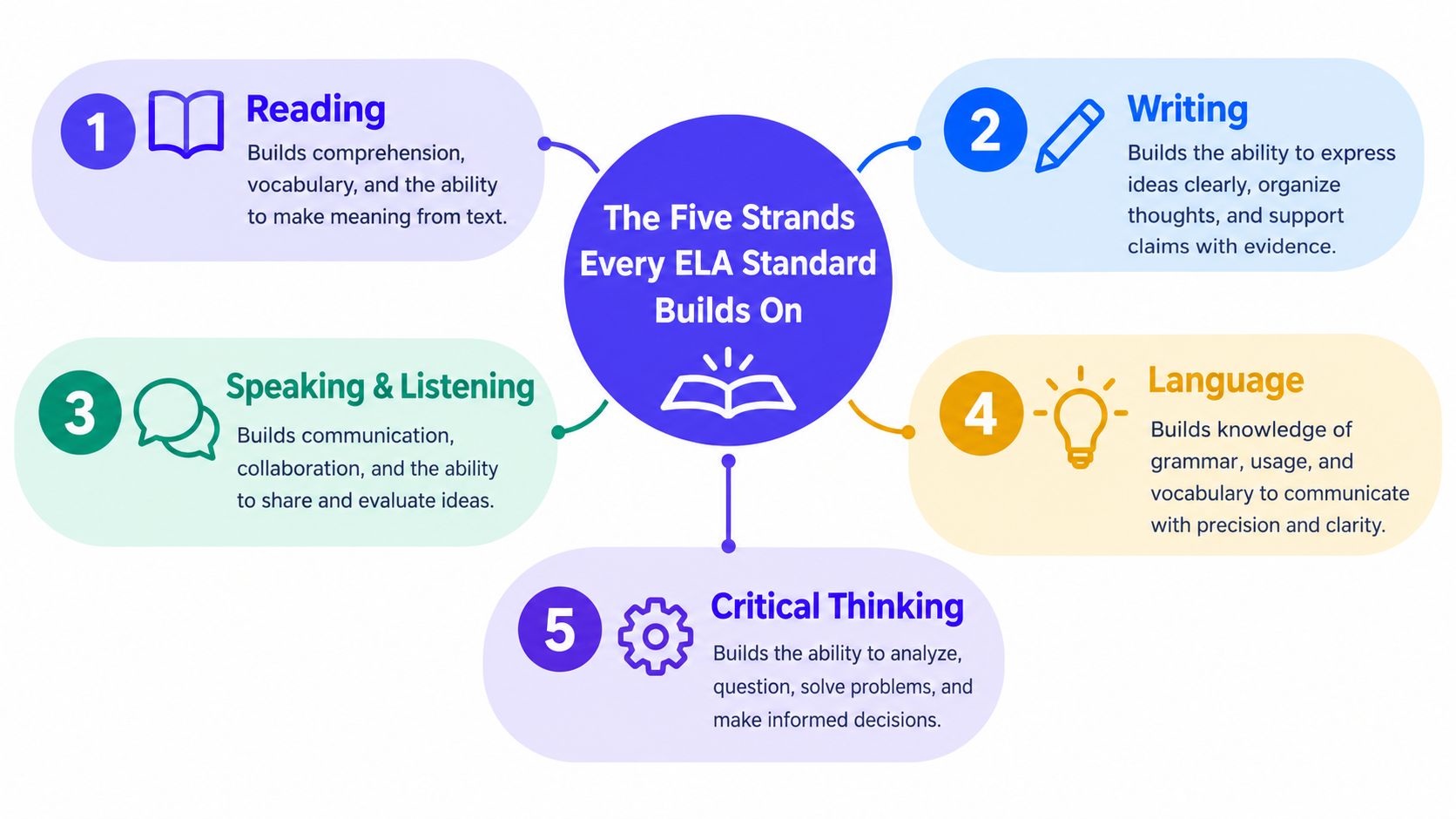
ELA standards work as a connected system. Reading supplies ideas and language. Writing gives students a way to shape and defend those ideas. Speaking and listening make thinking public, while language instruction gives students control over the conventions and vocabulary that carry meaning.
Reading and writing depend on one another
A reading standard might ask students to explain a theme. A writing standard might ask them to compose an analysis. In a strong lesson, those aren't separate errands. Students identify a pattern in the text, discuss what it suggests, and write an interpretation supported by details.
Speaking and listening provide the rehearsal space. Before students write about a character's decision, ask them to state a claim aloud, listen for a competing interpretation, and revise their thinking. That discussion isn't a decorative warm-up. It gives you evidence about vocabulary, comprehension, reasoning, and misconceptions before students commit their ideas to paper.
Language deserves equal planning status. A student may understand a theme but lack the sentence structures needed to explain it. A mini-lesson on contrast words, embedded quotations, or precise verbs can open up the target without lowering it. For teachers who want a focused explanation of how grammar operates within writing tools and language systems, understanding grammar engines for developers offers useful background, even though classroom instruction still depends on context and student purpose.
Early reading is a coordinated skill system
In kindergarten through grade 3, the strands become especially dependent on one another. The U.S. Institute of Education Sciences' What Works Clearinghouse recommends four connected components: academic language and vocabulary, phonological awareness, decoding and word-part analysis, and daily reading of connected text to build accuracy, fluency, and comprehension. The guidance is available through the IES practice guide for foundational reading skills.
That sequence changes how we interpret a struggling reader's performance. A child who can retell a story but can't decode unfamiliar words needs different support from a child who reads accurately but doesn't understand key vocabulary. An assessment labeled “reading comprehension” can hide those differences.
Find the strand doing the heaviest lifting
For any standard, ask which strand carries the main cognitive load.
- Reading: Students interpret a character's motivation using details from a story.
- Writing: Students organize an argument and support it with evidence.
- Speaking: Students present an interpretation clearly for an audience.
- Listening: Students track a peer's reasoning and respond to it accurately.
- Language: Students choose sentence structures and vocabulary that make an explanation precise.
The other strands can support the target, but they shouldn't blur it. If the goal is inference, don't grade handwriting as though it were the central outcome. If the goal is oral argument, don't let a lengthy written worksheet become the only evidence.
Grade by Grade Shifts in ELA Expectations
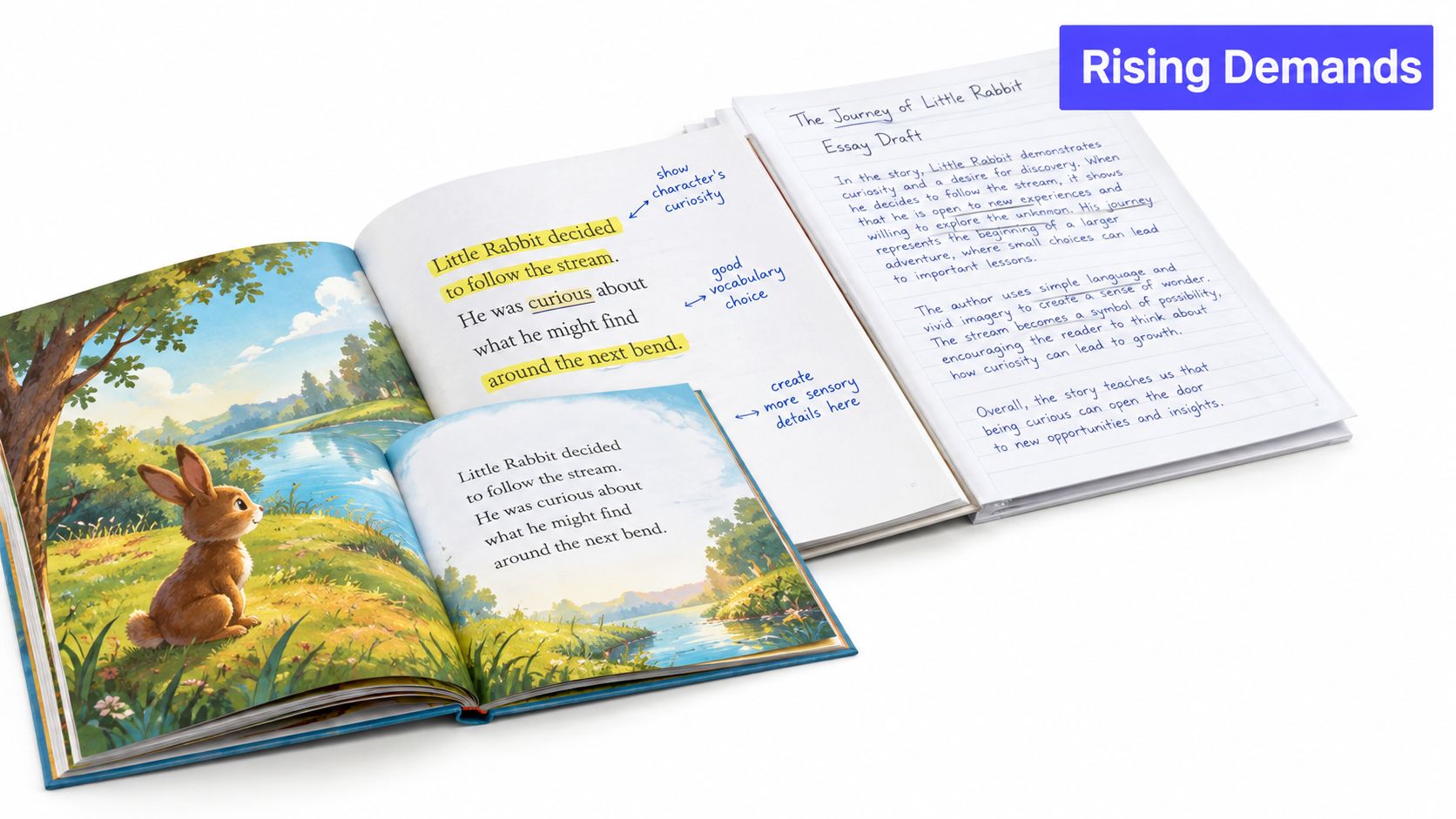
The same little rabbit story can support very different work across the school years. Young readers may first need to connect sounds to letters, read the sentences accurately, and retell what happened. Older students can examine how the author builds tension, compare the story with another version, or argue whether the rabbit's decision was justified.
In early elementary, access to print comes first. Students need oral language, phonological awareness, sound-spelling knowledge, decoding, spelling, handwriting, and repeated reading of connected text. A comprehension conversation can't compensate for a child who can't independently access the words.
At the next stage, students increasingly monitor meaning. They identify key details, summarize, describe characters, compare texts, and explain how a specific word or image affects meaning. The evidence might be an oral retelling, a marked passage, a short written response, or a conference in which the student explains a choice.
In middle school, the work becomes more analytical. Students examine structure, point of view, figurative language, author decisions, and the relationship between claims and evidence. They may still read a narrative, but the response shifts from “What happened?” to “How did the author's choices shape what the reader understands?”
High school ELA adds independence and complexity. Students evaluate arguments, synthesize sources, analyze rhetoric, and write sustained interpretations for specific audiences. The standard's verb predicts the evidence: identify may call for a precise selection, explain needs a connected explanation, and evaluate requires criteria and a defended judgment.
Use this progression when selecting support. Audio, vocabulary previews, sentence frames, chunked passages, and discussion partners can improve access without replacing the intellectual target. A teacher working with adult learners may also find context in adult English courses Kuwait, particularly when considering how language development and purposeful communication interact outside a traditional K–12 sequence.
A short visual or video explanation can help students see how literary analysis grows from comprehension into interpretation, provided the media supports the text rather than replacing it.
The planning mistake to avoid is importing an upper-grade routine before students have the underlying skills. Students can't produce a strong comparative argument if they lack the vocabulary, decoding fluency, comprehension, or sentence control needed to participate in the task. Rigor means preserving the thinking target while teaching the access skills that make the target reachable.
What Other Countries Show About ELA Standards
England organizes primary English around distinct but connected components. Reading includes word reading and comprehension, with comprehension covering listening and reading. Writing includes transcription, such as spelling and handwriting, and composition, such as generating and structuring ideas in speech and writing. Key Stage 1 uses year-by-year programmes of study, while Key Stage 2 uses two-year blocks, giving teachers visible planning checkpoints.
Spoken language is treated as an entitlement across the wider curriculum, not as an optional discussion activity. Students are expected to speak clearly, justify ideas, ask questions, build vocabulary, negotiate, evaluate others' ideas, and choose an appropriate register. That structure makes a useful point for any teacher: if discussion is part of the expected learning, plan observable discussion evidence.
Australia uses three strands: Language, Literature, and Literacy. By the end of Year 3, students are expected to identify implied meaning, explain how images contribute to meaning, and select structures suited to purpose, according to the Australian Curriculum English overview.
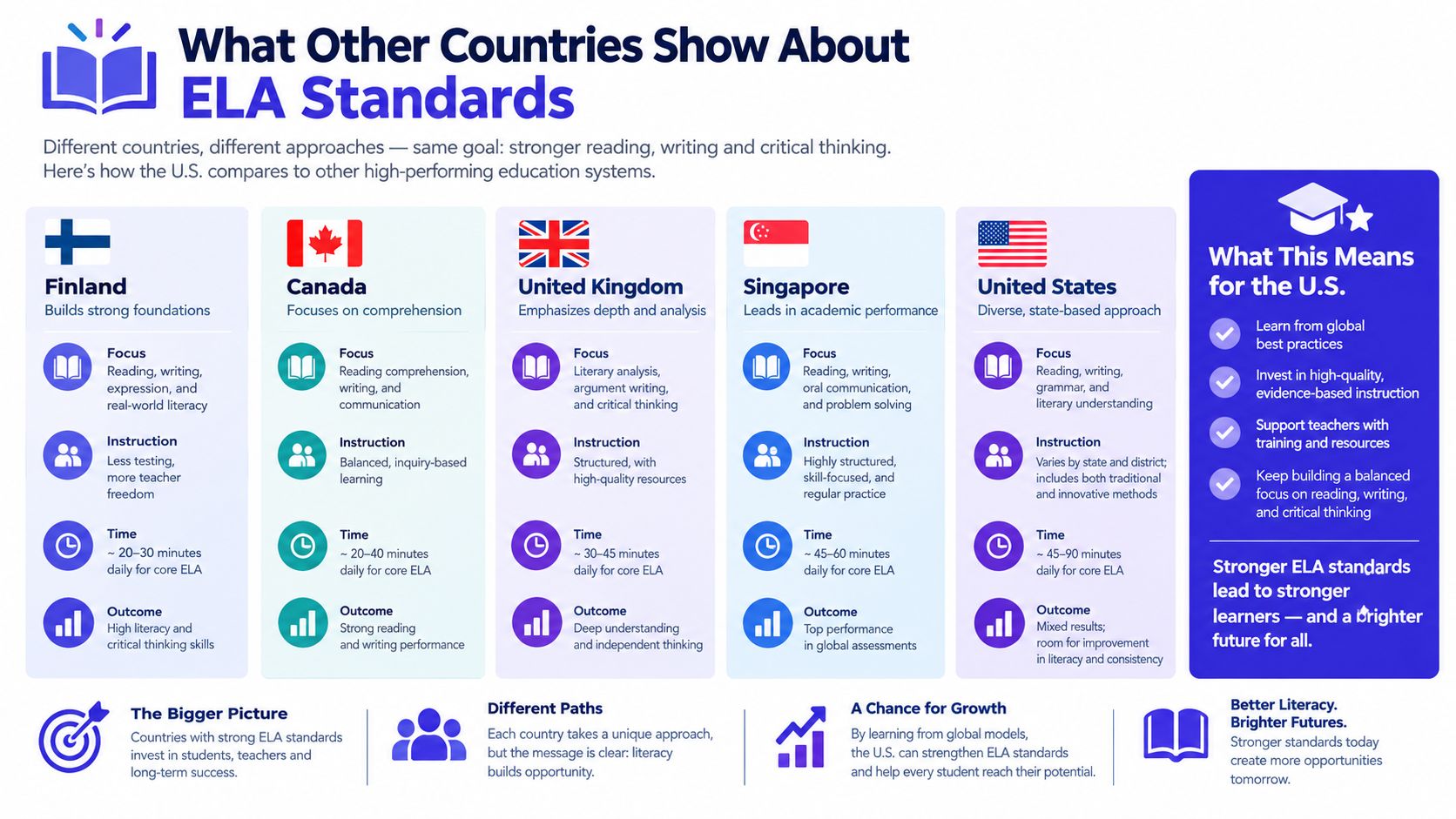
The transferable lesson isn't that one framework should replace another. It is that precise strand names make planning more usable. When a standard says what kind of reading, language, or composition is expected, teachers can choose better tasks and assessments.
Whatever your local document calls its strands, label three things in your plan:
- The language work: vocabulary, grammar, syntax, or conventions.
- The text work: decoding, comprehension, analysis, or comparison.
- The communication work: discussion, presentation, writing, or reflection.
That small act prevents “ELA” from becoming a broad label that hides the actual learning.
Turning One Standard Into a Lesson That Works
Take a standard requiring students to cite textual evidence to support analysis or inference. Don't begin by searching for an annotation worksheet. Begin by naming the performance you need to see.
Build the chain
- Write the outcome. Students will make an inference about a character and support it with two relevant details.
- List prerequisites. Students need to distinguish observation from inference, locate details, understand key vocabulary, and explain the connection between evidence and claim.
- Choose the text. Select a passage with enough depth to support more than one reasonable interpretation. Check quantitative complexity, then examine structure, language, background knowledge, and the reader-and-task demands.
- Plan the rereading. The first read can establish what happens. A second read can focus on the lines that reveal the character's motivation.
- Design the product. Ask for a claim, two brief pieces of evidence, and a sentence explaining how each detail supports the claim.
- Create the rubric. Score the inference, relevance and accuracy of evidence, reasoning, and language separately.
The key move is separating access from target. A student might use an audio version, a vocabulary bank, or an evidence organizer and still be assessed on the quality of the inference. Those supports change the route, not the destination.
Kuraplan can support this kind of workflow by mapping objectives to standards, sequencing prerequisite skills, generating differentiated materials, and attaching assessment rubrics. Used carefully, it can handle formatting and first drafts while you make the professional decisions about text quality, cultural relevance, discussion moves, and what counts as sufficient evidence. A practical reference for the planning sequence is this guide on how to write a lesson plan.
Teacher judgment stays central: An AI draft can suggest a task. It can't know whether the selected story gives your students something worth arguing about.
Save the plan as a reusable template: standard, objective, prerequisite, text demand, task, evidence, scaffold, and rubric. That template travels well across grade levels and state documents.
Building Assessments That Match the Standard
An assessment should make the target visible. If the standard asks students to explain how evidence supports an inference, a vocabulary matching page may provide useful practice, but it can't serve as the final evidence of mastery.
Start small. During reading, ask students to write one sentence that states an inference and one sentence that explains which detail supports it. Listen to partners justify their choices. Ask a student to revise an irrelevant quotation into a relevant one. These checks are quick, but they tell you whether the problem is comprehension, evidence selection, reasoning, or language.
For a larger task, write rubric anchors that describe quality rather than effort:
- Inference: The response states a defensible interpretation.
- Evidence: The selected details are accurate and directly relevant.
- Reasoning: The response explains how each detail supports the interpretation.
- Language: The writing uses clear sentences and appropriate vocabulary.
Keep component skills visible in early reading. A child may discuss a story successfully while struggling with decoding. Another may decode accurately while missing vocabulary or implied meaning. Separate evidence helps you choose instruction instead of assigning a broad label such as “low reader.”
The 2025 Loyola Marymount University partnership with a charter school found that teachers needed stronger knowledge of both ELA and English Language Development standards, along with coaching and data-driven instruction, to scaffold multilingual learners' access to complex text, as described in the Loyola Marymount policy brief. For multilingual learners, allow planning and discussion supports that reveal comprehension without confusing English production with the entire reading target.
You can apply the same principle to oral outcomes in other subjects. For example, a teacher assessing whether students can assess diplomatic skills would need criteria for listening, reasoning, register, and response, not merely a participation mark.
Before publishing an assessment, ask:
- Does the task require the exact thinking in the standard?
- Can students show the target through an accessible pathway?
- Does the rubric distinguish the skill from handwriting, speed, or compliance?
- Will the result tell me what to reteach?
- Have I separated formative checks from the final judgment, using this formative versus summative assessment guide?
Your Standards-Aligned Planning Routine
Standards become useful when they reduce guesswork. They become paperwork when teachers copy them into plans without changing what happens in the room.
Montana's 2025 economic-impact analysis projected that full implementation of revised ELA standards would take two to three years. About half of surveyed stakeholders expected partial curriculum updates, while 17% expected complete updates, according to the Montana implementation analysis. The timeline makes sense because alignment reaches beyond a single lesson. Teams may need to revise yearlong plans, units, assessments, proficiency scales, and collaboration routines.
A practical Monday-morning routine can stay much smaller.
- Name the standard and verb. Write the exact student action in plain language.
- Identify the main strand. Decide whether reading, writing, speaking, listening, or language carries the target.
- Check prerequisites. Ask what students must already know or do to attempt the task.
- Examine the text. Consider complexity, structure, vocabulary, knowledge demands, and access supports.
- Design evidence first. Decide what students will say, write, select, compare, or perform.
- Draft the rubric. Define what accurate, relevant, complete work looks like before writing activities.
- Plan the lesson sequence. Move from modeling and guided practice toward independent performance.
- Choose a formative checkpoint. Put it early enough that you can adjust instruction.
Use the routine with a grade-level team. One teacher may notice a decoding prerequisite, another may spot a language demand, and a coach may question whether the rubric measures analysis or just paragraph length. Standards give the team a shared language, but professional judgment keeps the planning connected to actual students.
Stop treating every worksheet as evidence. Stop teaching test formats that narrow a rich standard into answer selection. Stop assuming that a polished objective guarantees a coherent lesson.
For teachers who want a structured workspace for ELA planning, Kuraplan's English language arts resources can help organize standards-aligned objectives, lesson materials, differentiation, and assessment supports. The platform should serve the routine, not replace the teacher who knows which text will invite this class into serious reading.
Pick one upcoming standard today. Write its student action, identify the prerequisite, and create the final evidence task before you plan the opening activity. That is the point where standards stop decorating the plan and start improving instruction.
Kuraplan helps teachers turn English language arts standards into sequenced lesson plans, differentiated worksheets, and rubrics that make student learning visible. Try the planning routine with one upcoming standard, then visit Kuraplan to build the lesson materials around the evidence you want to see.