You're probably staring at a pacing guide, a standards document, last year's scattered files, and a calendar that already feels too short. That's a familiar place to start. New teachers often think the problem is that they need better lessons. Usually the problem is that they're planning in the wrong order.
Good K-12 curriculum design isn't paperwork for central office. It's the part of teaching that makes the rest of the year easier. When the curriculum is clear, daily planning gets faster, assessments make more sense, and students are less likely to hit random gaps between units.
Most teachers don't need more theory. They need a practical way to move from standards to a teachable sequence, then from a sequence to lessons they can deliver on a Wednesday afternoon when half the class is tired and the copy machine is jammed. That's the gap worth fixing.
From Standards Overwhelm to Confident Planning
The hardest part of curriculum work is often the blank page.
You have standards. You may have a textbook. You might even have a district map. But none of that automatically tells you what to teach first, what to spend more time on, what can be integrated, or how to build toward an assessment that feels fair and useful.
That's why I tell new teachers to stop thinking like day-to-day activity planners and start thinking like architects. Architects don't begin with paint colors. They begin with structure, purpose, and how people will move through the space. Curriculum design works the same way. If you plan the frame first, the weekly lesson decisions become much easier.
Here's the shift that helps most:
- Start with the outcomes: What should students know and be able to do by the end of the unit?
- Decide what counts as evidence: What will students produce, say, solve, explain, or create to show they got there?
- Then build the lessons: Only after the destination is clear should you map the path.
Practical rule: If you can't explain why an activity belongs in the unit, it probably doesn't.
That doesn't mean every lesson has to be rigid. It means your flexibility has direction. You can still reteach, slow down, extend, or swap materials. But you're making those decisions inside a clear plan instead of inventing the course one night at a time.
A lot of teachers feel guilty when they want structure, as if structure kills creativity. It doesn't. In real classrooms, structure protects creativity. It gives you room to improvise because the nonnegotiables are already settled.
When K-12 curriculum design is done well, three things happen quickly:
- Planning gets lighter: You're not reinventing the unit each week.
- Instruction gets cleaner: Lessons connect instead of feeling like isolated tasks.
- Students get a fairer shot: They see a sequence, not a pile of activities.
That's the goal. Not a prettier document. A calmer, clearer year.
The Core Principles of Effective Curriculum Design
A strong curriculum should pass a simple test. It should be relevant, coherent, engaging, and assessable. If one of those pieces is missing, the plan usually looks polished on paper but falls apart in class.
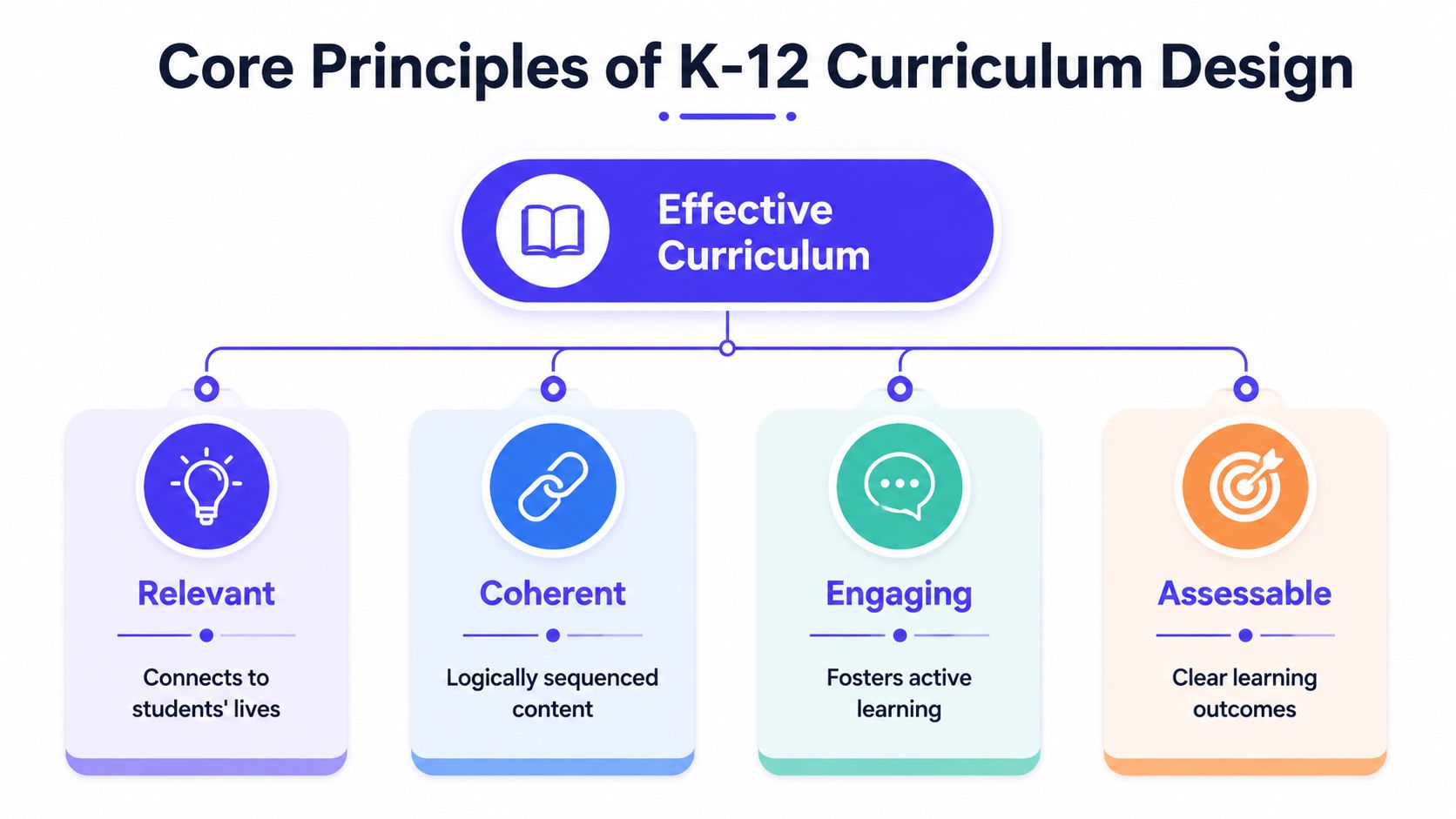
Relevant means students can connect the work to something real
Relevance doesn't mean every lesson has to be entertaining. It means students can see why the content matters. In practice, that looks like using authentic texts, real data, local examples, current issues, or tasks that mirror how the skill is used outside school.
If students keep asking, “Why are we doing this?” the curriculum is sending a warning sign.
Coherent means the learning builds on purpose
A coherent curriculum has a sequence. Skills don't show up randomly and disappear. Concepts are introduced, revisited, and deepened. Teachers can explain why Unit 3 comes before Unit 4, and students can feel that progression.
Many teacher-made plans often break down. The individual lessons might be fine, but the course doesn't build. Students complete tasks without developing a durable understanding.
Engaging means students do the thinking
Engagement isn't decorations, noise level, or constant novelty. It's intellectual participation. Students read, discuss, test, solve, argue, revise, and reflect. They aren't just receiving information.
A curriculum can be rigorous and still humane. In fact, students usually engage more when the work is clear, meaningful, and appropriately challenging.
Assessable means success is visible
If you can't tell what mastery looks like, neither can your students. Assessable curriculum has clear targets, aligned tasks, and evidence that matches the learning goal. Students should know what they're aiming for before they begin.
Here's a quick quality check you can use during planning:
| Principle | What it looks like in practice | Warning sign |
|---|---|---|
| Relevant | Real-world tasks, meaningful examples, clear purpose | Students ask why this matters |
| Coherent | Logical sequence, cumulative skill building | Units feel disconnected |
| Engaging | Students explain, create, debate, apply | Teacher does most of the cognitive work |
| Assessable | Clear outcomes, aligned checks, visible criteria | Grading feels subjective |
Connecticut's framework gives a useful real-world benchmark. The K-12 Universal Curriculum Design Principles state that curricula must align with standards, provide intentional learning targets, challenge all learners, communicate high expectations for historically marginalized students, and emphasize real-world, culturally relevant experiences and interdisciplinary connections.
That matters because it moves curriculum quality out of the realm of preference. A strong curriculum isn't just one teacher's style. It has to hold together across classrooms and for different groups of students.
If you want another practical lens for reviewing course quality, MEDIAL's guide to best practices for instructional design is useful for thinking about alignment and usability without getting buried in jargon.
Good curriculum should make a teacher's next decision easier, not harder.
When I review units with teachers, I rarely start by asking whether the lesson is fun. I ask four questions instead: Is it worth learning? Does it build on something? Are students doing meaningful thinking? Can we tell whether they learned it? If the answer is yes to all four, the curriculum is usually in good shape.
Starting with the End in Mind Using Backward Design
Backward design solves one of the most common planning mistakes in teaching. Too many units begin with activities. A teacher finds a lab, a read-aloud, a project, or a video and starts building around it. That can produce energetic lessons, but it often creates loose alignment.
A better sequence is simple. Decide where students need to end up, decide how they'll show it, then plan the instruction.
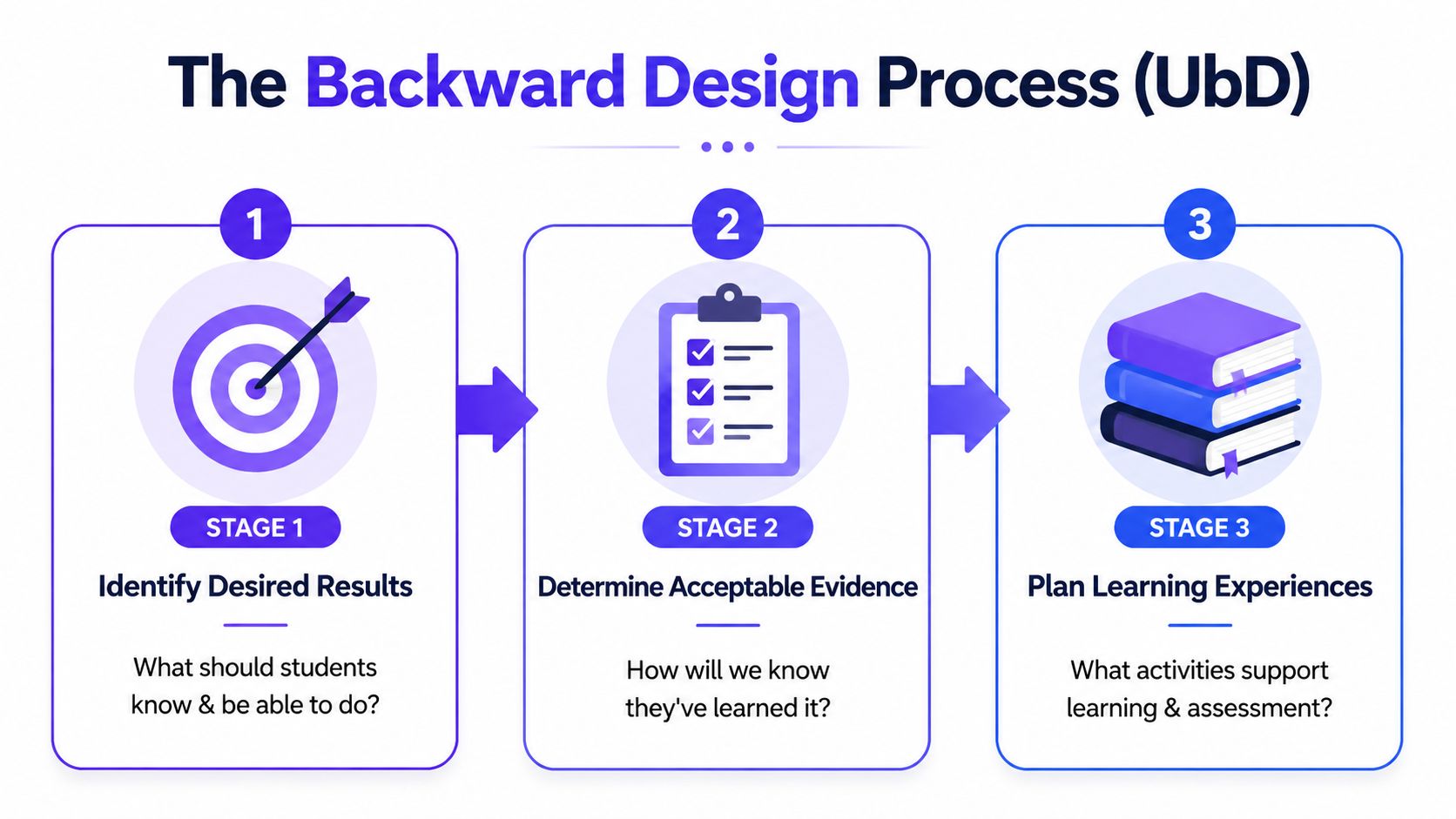
The road trip analogy works because it's accurate. You don't start by choosing snacks, playlists, and gas stops. You choose the destination first. Then you decide how you'll know you arrived. Then you map the route.
Stage one identifies the destination
This stage begins with the standard, but it can't end there. Standards are often broad. You have to unpack them into student-friendly outcomes.
The useful question is: What should students know, understand, and be able to do by the end of this unit?
For example, a broad standard about argumentative writing is not yet a teachable target. A usable version might sound more like this:
- Knowledge: Students know the parts of a claim, evidence, and reasoning.
- Skill: Students can write a paragraph that defends a claim with relevant evidence.
- Understanding: Students understand that strong arguments depend on both evidence and explanation.
That level of clarity saves time later. It also keeps teachers from trying to teach everything in one unit.
Stage two decides what counts as evidence
This is the step teachers skip most often. They assume they'll “check understanding as they go” and figure out the final assessment later. The problem is that the late assessment often measures something different from what the lessons emphasized.
The backwards design sequence described by Kuraplan is straightforward: first identify desired results by unpacking standards, second determine acceptable evidence by designing summative assessments before planning activities, and third plan learning experiences by asking, “Does this help students succeed on the assessment and master the standard?”
That quote matters because it captures the filter you need for every lesson choice.
Use a short planning table like this:
| Planning question | Example answer |
|---|---|
| What must students learn? | Write a claim supported by evidence and reasoning |
| How will they show it? | On-demand paragraph, essay, or debate response |
| What evidence will I collect earlier? | Exit tickets, annotated texts, paragraph drafts, conferences |
Here's a helpful walkthrough if you want to see the idea in action:
Stage three builds the route
Now you can plan lessons. Within these, materials, routines, group work, mini-lessons, modeling, and practice all belong. But each one has to earn its place.
Try using one recurring teacher question during planning: Does this lesson move students toward the final evidence of learning?
If the answer is unclear, cut or revise it.
A simple sequence for a writing unit might look like this:
- Launch the task: Show students the kind of writing they'll eventually produce.
- Study mentor examples: Analyze what makes a response strong.
- Teach one subskill at a time: Claims first, then evidence selection, then reasoning.
- Build in rehearsal: Short responses before full-length writing.
- Use feedback loops: Conferencing, peer review, revision checkpoints.
- End with independent performance: Students complete the summative task.
Start planning with the final student performance, not the first Monday activity.
What works and what usually doesn't
Teachers often ask whether backward design is too rigid for elementary classrooms, project-based learning, or intervention groups. It isn't. The method doesn't tell you what pedagogy to use. It tells you what order to make decisions in.
What works well:
- Clear unit outcomes: Narrow enough to teach, important enough to matter.
- One strong summative assessment: Better than several weak ones.
- Daily lessons with a visible line to the outcome: Students can explain why they're doing the work.
What usually doesn't:
- Planning around a resource: “I found a great worksheet set, so I built a unit around it.”
- Adding assessments at the end: That's where misalignment starts.
- Overstuffed units: If everything is essential, nothing gets taught in depth.
Backward design is one of those ideas that sounds obvious after you've used it well. Before that, it can feel slower. It isn't slower. It just shifts the work earlier, where it prevents confusion instead of cleaning it up later.
Building Your Scope and Sequence and Unit Plans
Once the unit design process is clear, zoom out. You now need a yearlong map that keeps the course coherent and realistic. That map is your scope and sequence.
A scope and sequence answers four practical questions: what you'll teach, when you'll teach it, how topics connect, and how much time each unit gets. Without it, pacing turns reactive fast. You either rush the important material in spring or realize too late that multiple standards got light coverage.
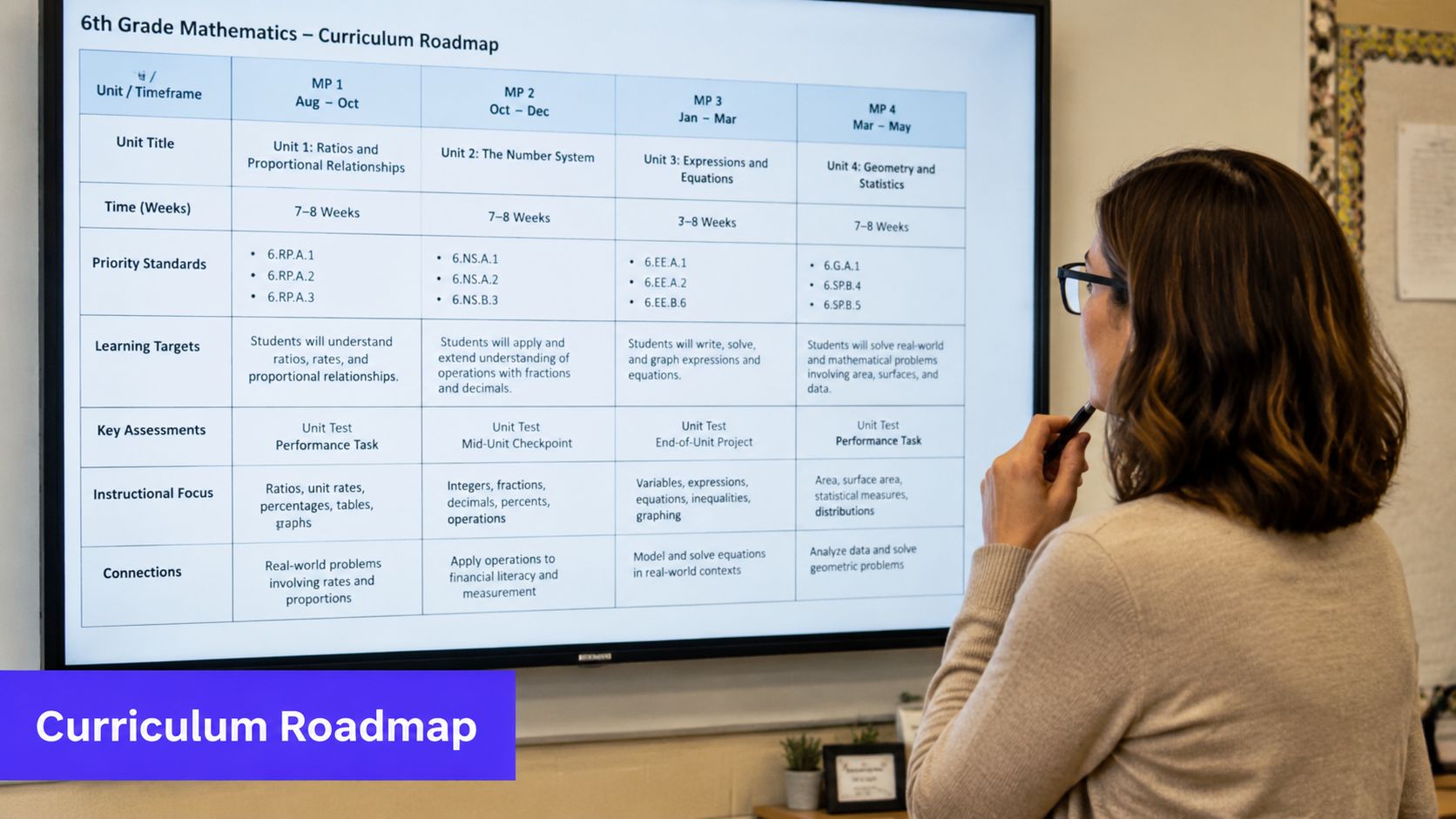
Build the year before you polish the week
Start with your standards and cluster them into teachable units. Don't map them one by one in isolation. Standards usually make more sense in families.
For example, in middle school science, one unit might combine data analysis, experimental design, and explanation writing. In elementary literacy, a unit might braid vocabulary, comprehension, and discussion rather than treating each as a separate block.
Use this process:
- Sort standards into logical groups: Which standards naturally belong together?
- Name the unit by its core learning: Avoid vague titles like “Unit 2.”
- Estimate time realistically: Add room for reteaching and assessment.
- Check the order: Ask what prior knowledge students need first.
- Mark nonnegotiables: Testing windows, school events, interdisciplinary projects.
A scope and sequence should be simple enough to read quickly
If your year map takes ten minutes to decode, it won't help you during the school year. Keep it visual and lean.
A practical version usually includes:
- Unit title
- Priority standards
- Essential question
- Approximate pacing
- Major assessment
- Key vocabulary or concepts
That's enough to guide planning without burying the team in paperwork.
The best scope and sequence is the one teachers can actually use during a busy week.
Turn the year map into a workable unit plan
After the year is mapped, each unit needs a tighter plan. At this stage, newer teachers often overbuild. They create giant documents packed with activities but thin on instructional decisions.
A useful unit plan should answer these questions:
| Unit element | What to include |
|---|---|
| Learning goals | What students must know and do |
| Assessment evidence | What will show mastery |
| Vocabulary | Terms students need for the work |
| Lesson progression | How learning builds day by day |
| Supports | Scaffolds, differentiation, extensions |
| Materials | Texts, tools, visuals, and tasks |
One helpful shortcut is to assemble your unit documents into a single team packet before instruction starts. If your files live in separate folders and formats, even a basic tool like Merge PDF can help combine pacing documents, assessment guides, rubrics, and handouts into one shareable resource for your grade-level team.
Where tech helps and where it doesn't
Technology can speed up the assembly work. It can't replace your professional judgment about pacing, student misconceptions, or the social dynamics of your classroom.
This is one place where Kuraplan fits naturally. Teachers can use its unit plan generation tools to draft standards-aligned unit plans, scope and sequences, assessments, and support materials faster than building each document from scratch. That's most useful when you already know the outcomes and need help producing the planning materials efficiently.
What tech handles well:
- Drafting aligned planning documents
- Organizing standards into usable planning formats
- Generating first-pass materials for revision
- Reducing formatting and document setup time
What still belongs to the teacher or team:
- Choosing what deserves more time
- Adjusting for your students' actual readiness
- Deciding what rigor looks like in context
- Knowing when the plan needs to bend
A strong unit plan doesn't try to predict every classroom moment. It gives you a stable route with enough structure that your daily decisions become smaller, faster, and better.
Aligning Assessments and Creating Clear Rubrics
Assessment should answer one question: What evidence do we have that students learned what we intended to teach? If it doesn't answer that, it's just grading activity.
That's why alignment matters more than variety. A flashy project that doesn't measure the target is weaker than a plain task that does. Teachers sometimes feel pressure to make every assessment creative. Students usually benefit more from clarity than from novelty.
Use formative and summative assessments for different jobs
Formative assessment helps you adjust instruction while students are still learning. Summative assessment evaluates what they can do at the end of a learning sequence.
The mistake is treating them as interchangeable.
Formative checks might include:
- Exit tickets: Quick checks for confusion or partial understanding
- Conferences: Short conversations that reveal thinking
- Drafts and practice tasks: Early evidence before final performance
Summative assessments usually ask students to synthesize or independently apply learning through a test, essay, presentation, lab report, or project.
When those two assessment types are aligned, students aren't surprised by the final task. They've been practicing pieces of it all along.
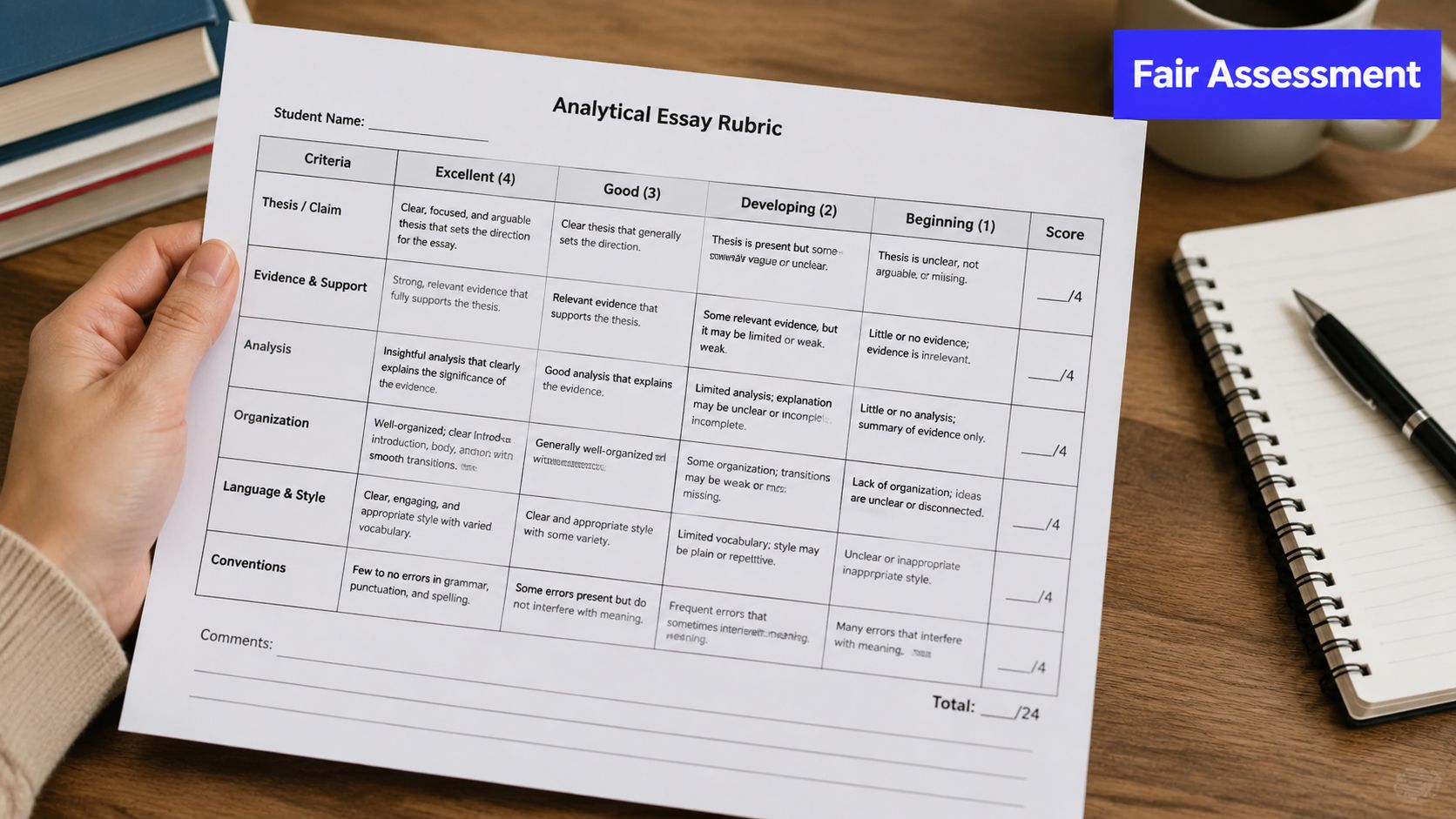
Build rubrics from the learning target backward
A rubric should not be a list of things that annoy the teacher. It should describe what quality looks like in relation to the unit goal.
Start with this formula:
- Name the criteria: What dimensions matter most?
- Describe success: What does strong work look like?
- Separate levels of performance: What changes from developing to proficient?
- Use student-friendly language: Students should be able to read it and act on it
For an argumentative writing task, your criteria might include:
- Claim
- Evidence
- Reasoning
- Organization
- Conventions
That's cleaner than vague categories like “effort” or “overall quality.”
Here's the practical test for any rubric: Could a student use it before submitting the assignment? Could another teacher score with it consistently? If the answer is no, the rubric needs tightening.
A digital tool can speed up drafting. If you want a first pass you can customize, Kuraplan's rubric generator is useful for creating aligned criteria and performance descriptors without starting from a blank page.
Students produce better work when the target is visible before they begin.
What good rubrics do in real classrooms
Clear rubrics reduce friction. They help students self-check, help families understand expectations, and help teachers give feedback that points somewhere specific.
They also make collaboration easier. If a team shares common criteria, then “good work” means roughly the same thing across classrooms.
What works:
| Better practice | Why it helps |
|---|---|
| Fewer criteria, clearly defined | Students can focus on what matters |
| Descriptors tied to the task | Feedback becomes actionable |
| Rubrics shared in advance | Students can plan toward success |
What gets in the way:
| Common problem | Why it creates trouble |
|---|---|
| Too many categories | Students miss the main target |
| Vague wording | Scoring becomes subjective |
| Rubrics written after grading starts | Criteria drift during scoring |
The strongest assessment systems don't produce more grades. They produce better evidence and clearer next steps.
Differentiation and Inclusion for All Learners
A curriculum isn't well designed if only your most independent students can access it. Real K-12 curriculum design has to anticipate variability from the start. That means language needs, processing speed, background knowledge, reading level, executive functioning, confidence, and attention all need a place in the plan.
The goal isn't to make a separate curriculum for every student. That's not realistic. The goal is to build a strong common path with flexible entry points, supports, and choices.
Plan supports before students struggle
Many teachers treat differentiation as a rescue move. A student falls behind, then the teacher scrambles. That's exhausting and usually too late.
It works better to build likely supports into the unit plan up front:
- Scaffolds for access: Sentence frames, guided notes, chunked texts, models
- Options for output: Writing, speaking, drawing, building, recording
- Flexible grouping: Whole class for modeling, small group for practice, partners for rehearsal
- Extension paths: Deeper analysis, transfer tasks, independent inquiry
Those moves don't lower the bar. They change the route students use to reach it.
A practical accessibility lens also matters online. If your materials live in slides, LMS pages, or digital handouts, it's worth understanding WCAG compliance for educational institutions so students can access content more consistently across devices and support needs.
Inclusion requires clarity, not just compassion
Teachers care about inclusion, but care alone won't fix a confusing unit. Students who need support are hit first and hardest by vague directions, overloaded worksheets, inconsistent routines, and unclear success criteria.
This is why structure matters so much. A predictable lesson arc, visible objective, model response, and short check for understanding help almost everyone, especially students who need extra support.
A few low-prep routines do a lot of work:
- Preview key vocabulary before complex tasks
- Model one complete example
- Give students one processing pause before discussion
- Offer one support tool without making students ask
- End with a short reflection or check
If you want a bank of classroom-ready options, Kuraplan's guide to differentiation teaching strategies is a practical starting point.
Inclusion gets stronger when support is built into the plan instead of added only after students miss the mark.
The whole-child challenge is real
There's also a bigger issue that curriculum teams are still trying to solve well. A whole-child policy discussion from American Progress points to a critical gap in current curriculum design: teachers still lack concrete strategies for dynamically adjusting lesson sequences based on real-time mental health and social-emotional learning screening data, even though policy proposals emphasize whole-child approaches.
That rings true in schools. Teachers may know a student is having a hard week, but they often don't have a clear system for how that information should change pacing, grouping, workload, or participation expectations.
Until better systems are common, the practical move is modest responsiveness:
| Situation | Low-prep response |
|---|---|
| Students show low readiness for discussion | Use written rehearsal first |
| Energy is scattered | Tighten task length and increase checkpoints |
| Students need emotional safety | Offer partner choice or private response options |
| The class is overloaded | Reduce task volume and preserve the core target |
That's not a complete answer. But it is teachable, manageable, and better than pretending every class arrives equally ready every day.
FAQs About K-12 Curriculum Design
How often should a curriculum be reviewed
Treat curriculum review as ongoing, not rare. Small revisions should happen during and after each unit. Teachers notice pacing issues, weak tasks, or confusing assessments while the memory is still fresh.
A bigger review makes sense when standards change, student needs shift, or the team sees recurring gaps across the year. Don't wait for a full rewrite if one unit is clearly causing trouble.
What's the best place to start if time is tight
Start with one high-priority unit. Pick the unit that causes the most confusion, carries the most important standards, or tends to produce weak student outcomes. Fixing one important unit gives you a repeatable model for the rest of the course.
Don't begin by trying to perfect the whole year. That's how teachers stall out.
How should teams collaborate without wasting meeting time
Use shared documents and come in with roles. One person brings standards, another brings current assessments, another brings student work, and another captures decisions. Teams lose time when everyone arrives with opinions but no artifacts.
A simple meeting protocol helps:
- Begin with the learning target
- Review current evidence or student work
- Decide what stays, what goes, what needs revision
- Leave with one agreed next step
What if I already have a district curriculum
Use it. But don't treat it like it's beyond revision. Strong teachers and teams look for gaps in clarity, pacing, accessibility, and alignment. The goal isn't to replace district materials automatically. The goal is to implement them with integrity and improve weak spots with intention.
How detailed should a unit plan be
Detailed enough that another teacher could teach it, but not so detailed that updating it becomes a burden. If your plan is too thin, it won't support instruction. If it's too bloated, no one will use it.
Aim for clarity on outcomes, assessments, lesson progression, supports, and materials. Leave room for teacher judgment.
What should new teachers avoid first
Avoid building units around random activities, overloading plans with too many standards, and writing assessments at the last minute. Those habits create misalignment and stress fast.
Choose a clear target. Build a fair assessment. Teach toward it. Revise after you've seen student work.
Kuraplan helps K-12 teachers turn standards into usable plans faster. If you want a practical way to draft unit plans, lesson sequences, rubrics, worksheets, and classroom visuals without starting from scratch each time, take a look at Kuraplan.