English language arts became a formal subject in 1892, and strong ELA planning still works the same way: build around a worthwhile text, ask text-dependent questions, and end with evidence-based writing students can show you. The planning headache most teachers feel now isn't because the job is new. It's because too many lesson templates still treat reading, writing, speaking, and remediation like separate chores instead of one coherent lesson.
Most teachers know the Sunday-night version of this problem. You've got a standard, a short text, a handful of ideas, and about six tabs open. You need something rigorous enough for admin walkthroughs, practical enough for Tuesday third period, and flexible enough for the student who still can't cite evidence and the one who finishes everything early.
A usable language arts lesson plan has to survive the week. That means it can't just be "engaging." It has to hold together when students miss background knowledge, when discussion goes sideways, and when the exit ticket shows half the class didn't get the main idea you thought you taught. The backbone matters more than the decorations.
Why Language Arts Planning Matters
By Sunday evening, the weak spots in an ELA lesson show up fast. The standard looks manageable on paper, then questions hit. What will students read closely? What will they write that proves understanding? Where will the students who missed last week's skill get the support they need without derailing the whole class?
That is why planning matters. In ELA, a lesson can feel busy and still fail to produce evidence of learning.
According to the Oxford Research Encyclopedia of Education overview of English language arts history, English language arts became a formalized field of study in 1892, when the Committee of Ten appointed by the National Education Association recommended a standard curriculum for secondary schools. That history still shows up in daily planning. Teachers are expected to connect reading, writing, speaking, listening, and research in one sequence that students can complete.
Strong plans close the remediation gap
The planning problem is rarely a lack of activities. The problem is a lesson built from disconnected pieces. A warm-up on theme, a discussion on character, and a paragraph at the end can fill a period without building toward one clear outcome.
The fix is structural. Start with the text work students must do, then build the questions that lead to it, then decide what writing will show mastery. After that, plan the support for the students who are still missing prerequisite skills, such as quoting accurately, identifying the speaker, or explaining an inference.
That last part gets skipped all the time.
In practice, the remediation gap is what breaks a lesson. Students cannot answer a strong text-dependent question if they still need help finding the relevant line. They cannot produce evidence-based writing if they do not yet know how to embed a quote or explain why the evidence matters. Good planning accounts for that before class starts.
ELA lessons need a clear line from reading to writing
ELA has expanded well beyond print-only instruction. The field now includes multiple literacies and multimedia forms, as described in that same Oxford Research Encyclopedia entry. That broadens the materials teachers can use, but it also raises the planning stakes. If the reading, discussion, and writing tasks are not tied to the same central demand, the lesson scatters.
A solid plan draws a straight line through the period. Students read with a question in mind. They discuss using evidence from the text, not guesses from memory. They write something short enough to check and specific enough to guide tomorrow's instruction.
I have found that teachers save time when they borrow planning routines from language instruction, especially models that sequence input, guided practice, and output with precision. This step by step Irish language method is a useful example. The value is the sequence. It keeps the lesson aimed at one visible performance instead of a pile of loosely related tasks.
What a workable plan does
A language arts lesson plan earns its keep when it does these three jobs:
- Sets one measurable target: Students analyze how an author develops a claim, trace word choice, compare two interpretations, or revise a paragraph using evidence and commentary.
- Uses questions to drive students back into the text: The strongest questions require rereading, citing, and explaining. They do not let students survive on opinion alone.
- Builds in a repair point: The plan includes a quick way to catch and address the missing sub-skill before it turns into failed independent work.
That is the difference between a lesson that looks organized and one that survives a real week of teaching.
Choosing Your Anchor Text and Questions
Third period starts in six minutes. The copies are still warm, one student is asking if this is graded, and the difference between a strong lesson and a long one usually comes down to two planning choices: the text you anchor to and the questions you ask.

Pick the text for the skill, not the calendar
A popular text can still be the wrong text. I have seen teachers lose half a period trying to force analysis out of a passage that only supports recall.
The anchor text has to carry the standard. If the goal is inference, students need implication, contrast, or silence that matters. If the goal is analyzing argument, the passage needs a claim, reasons, and evidence students can trace. If the goal is craft, the language has to be worth stopping for.
The Instructional Practice Toolkit for ELA/literacy gives a useful planning check: strong lessons center on one high-quality text, use text-specific questions, and connect reading to writing aligned to grade-level work, as outlined in the Achieve the Core toolkit for ELA analysis activities.
Before I commit to a text, I check three things:
| Question | What you're checking |
|---|---|
| Can this text support the standard? | Students have enough substance to analyze, not just retell. |
| Is there something worth proving from it? | Students can point to words, details, structure, or omissions as evidence. |
| Will struggling readers have a way in? | The text is demanding, but teachable with support and rereading. |
That last question gets missed. A text can be grade-appropriate and still collapse the lesson if too many students lack one prerequisite skill, such as tracking pronoun reference, following shifts in point of view, or reading complex syntax. Good planning catches that remediation gap early. It is easier to preteach one blocking skill than to repair twenty confused written responses later.
Write the questions before the activities
Slides, turn-and-talks, and graphic organizers are easy to build. Strong questions take longer, which is exactly why they deserve to come first.
Questions set the backbone of the lesson. They decide whether students reread, cite, and explain, or whether they drift into opinions that sound engaged but avoid the text.
A planning sequence that holds up in a real grading period looks like this:
- Choose the anchor text first.
- Draft text-dependent questions before building activities.
- Mark the exact places where students will need modeling.
- End with a short evidence-based writing task.
The same ELA instructional practice resource from Achieve the Core emphasizes that sequence: select the text, plan text-dependent questions in advance, model thinking, structure practice, and move students into independent writing tied to evidence.
The trade-off is simple. Front-loading question design takes more time tonight and saves time for the rest of the week. It also makes grading cleaner because the writing task grows directly from the reading work instead of feeling bolted on.
Build a question ladder, not a pile of prompts
Weak question sets are often random. One asks for a personal reaction, the next asks for theme, and the last asks for symbolism before students have done the groundwork.
A better set climbs.
Start with a question that fixes attention on a concrete part of the text. Move to a question about how that part works. End with a question that asks students to make a claim and support it in writing.
For a short narrative passage, that ladder might look like this:
- Which line first shows the character's attitude changing?
- How does the author use dialogue or description to make that shift believable?
- Which detail best supports the claim that the narrator cannot be fully trusted?
Those questions do more than fill discussion time. They prepare students for evidence-based writing because each answer generates material they can use in a paragraph.
For a practical set of routines that keep students returning to the page, Kuraplan's guide to reading comprehension strategies is useful because it focuses on classroom moves teachers can slot into an actual lesson.
Plan for the remediation gap before students hit independent work
This is the step many lesson plans skip. A solid question sequence can still fail if students are missing one small sub-skill the task depends on.
If students cannot tell who is speaking, they will miss tone. If they cannot separate a claim from a reason, they will struggle to analyze argument. If they quote lines but cannot explain how the evidence proves a point, the writing will stall at summary.
Plan one repair move in advance. It might be a sentence deconstruction, a quick model of annotation, a partially completed evidence chart, or a short teacher think-aloud on one paragraph. Keep it tight and targeted. The goal is to clear the blockage, not start a second lesson.
That is what makes the anchor text earn its place. It gives you something worth reading closely, something worth proving, and a clear path from question to evidence to writing.
Differentiation Strategies That Actually Work
Differentiation gets overcomplicated fast. Teachers hear the word and assume it means five versions of the same lesson, extra prep, and a color-coded small-group chart that collapses by Wednesday.
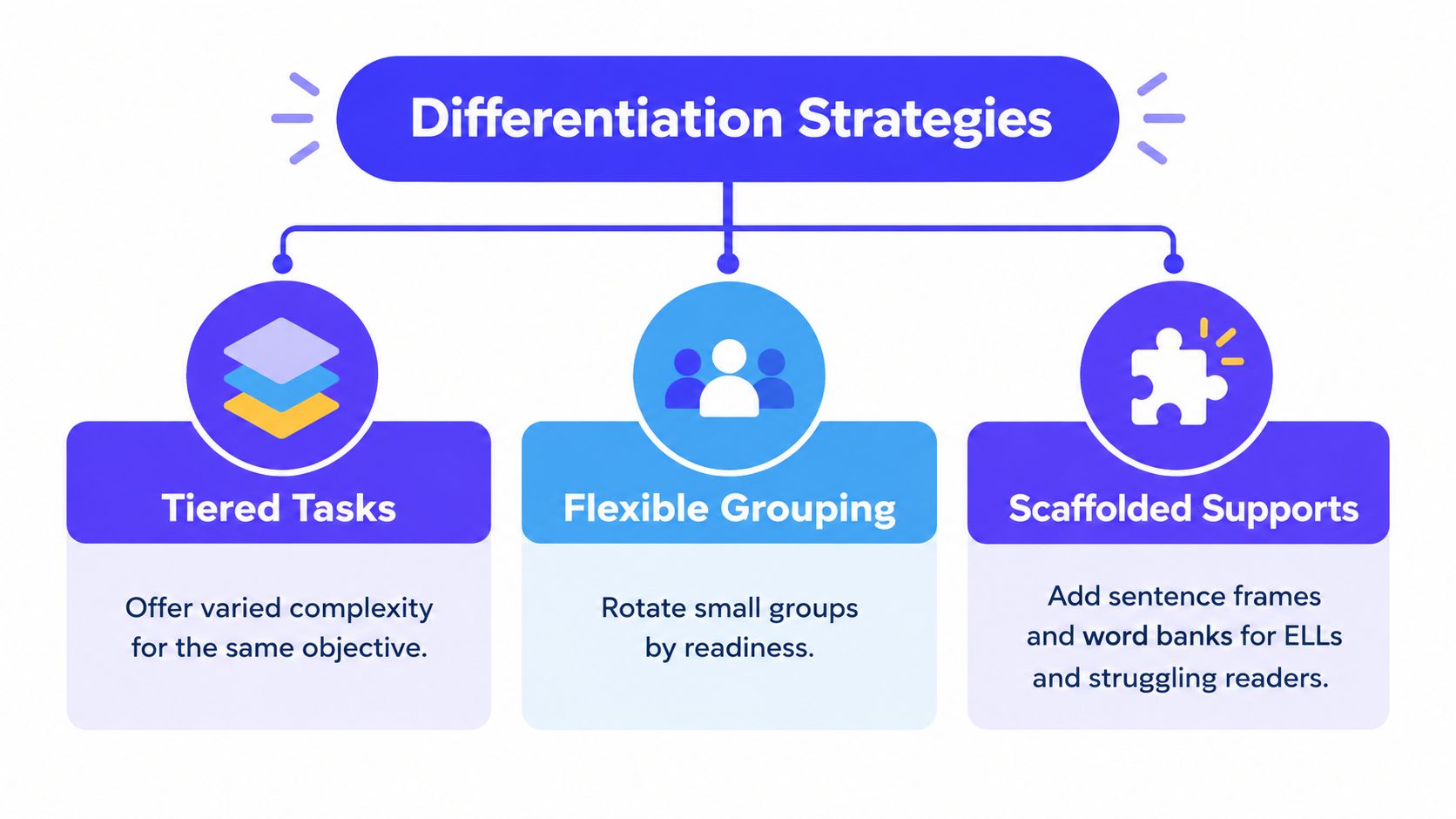
It doesn't have to work that way. The strongest support for multilingual learners comes from lesson sequences that deliberately include scaffolding, graphic organizers, interactive read aloud, and leveled questions within guided or shared reading. A 2021 meta-analysis found a mean effect size of g = 0.96 across 23 studies with 2,284 students, with results ranging from -0.05 to 2.23, which is a reminder that the strategy label alone doesn't do the work. The design matters, as reported in this meta-analysis on reading interventions for English learners.
Build supports into the sequence
The mistake I see most often is adding support after the lesson is already built. Someone finishes planning, remembers the English learners and struggling readers, and tacks on sentence frames at the end.
That rarely works well. Support has to be baked into the path of the lesson.
Three moves earn their place over and over:
- Graphic organizers with a job: Not decorative boxes. A cause-effect chart, claim-evidence tracker, or character change map gives students a place to hold thinking while they read.
- Leveled prompts on the same text: One student identifies a detail. Another explains how two details work together. Same lesson, different lift.
- Interactive read aloud with pauses: Stop at the sentence that matters. Model what noticing sounds like.
For teachers working on more individualized support, this piece on a personalized language learning path is useful because it frames support as a sequence of next steps, not a label you slap on a student.
What to change without rewriting the whole lesson
Use one core text and vary the access points. That keeps the class coherent and saves your sanity.
| Classroom need | Adjustment that usually helps |
|---|---|
| Students lose the thread while reading | Chunk the text and add a brief gist prompt after each section |
| Students can talk but not write | Give a sentence frame tied to evidence |
| Students find evidence but can't explain it | Add a second prompt stem such as "This shows..." |
| Students shut down in whole-class discussion | Let them rehearse with a partner using one targeted question |
Here's a helpful video if you want a quick visual refresher on differentiation in practice.
Don't confuse participation with understanding
Whole-class talk can hide a lot. A student can nod, turn-and-talk, and even offer a comment without ever showing solid comprehension of the text.
Classroom check: If your support only increases participation, but doesn't make the student's evidence more precise, it isn't enough yet.
If you want ready-to-apply examples, Kuraplan's page on differentiation teaching strategies is practical because it keeps the focus on adjustments inside the lesson, not on producing multiple separate plans.
The point of differentiation isn't to water the lesson down. It's to make the same thinking accessible.
Assessment and Rubrics for Measurable Growth
A language arts lesson plan isn't finished when the activities are written. It's finished when you can answer one uncomfortable question: what exactly will count as evidence that students learned the target skill?
Too many ELA assessments still reward compliance. Students completed the organizer, joined the discussion, and turned in a paragraph. None of that automatically tells you whether they cited relevant evidence, interpreted it accurately, or used the writing skill named in the objective.
Put the standard in plain sight
A strong lesson plan should explicitly include state-adopted standards or Common Core standards, a learning objective, informal and formal assessments, and instructional strategies. The edTPA Secondary ELA handbook is unusually direct here: lesson plans must list the number and text of each target standard, the associated learning objectives, assessment types and what is being assessed, and the instructional strategies and learning tasks supporting diverse student needs.
That sounds formal, but it solves a practical problem. When the standard, objective, and assessment are visible, you stop grading vibes.
A clean objective usually names:
- The skill: cite, compare, analyze, revise, explain
- The content: a passage, article, poem, speech, or student draft
- The evidence of success: a paragraph, discussion response, annotation set, or exit ticket
Rubrics should measure the skill, not the polish
A rubric for textual evidence shouldn't secretly become a handwriting, neatness, or presentation rubric. Students need to know whether you're measuring their claim, their evidence, their explanation, their conventions, or some mix of those.
A simple rubric often works better than a sprawling one. For a short evidence-based response, I usually want only a few categories:
| Rubric category | What it checks |
|---|---|
| Claim or response | Did the student answer the prompt accurately? |
| Evidence use | Did the student choose relevant details from the text? |
| Explanation | Did the student connect the evidence to the claim? |
| Conventions | Is the writing readable enough to assess the thinking? |
That keeps feedback pointed. It also makes reteaching easier because you can see the exact weak spot.
Plan for in-the-moment evidence
Good ELA teachers don't wait until after school to discover whether the lesson worked. WestEd's ELA instructional framework on eliciting and interpreting evidence emphasizes eliciting evidence during the lesson, interpreting it as close to the lesson as possible, and then deciding whether to continue, give feedback, or depart from the plan based on student needs.
That's the part many templates miss. Assessment isn't only the final product. It's also what you hear in partner talk, what you see in annotations, and what shows up in a two-sentence exit response.
A strong exit ticket should tell you what tomorrow's mini-lesson needs to be.
If half the class can find evidence but can't explain it, the next lesson shouldn't be "move on." It should be a targeted writing move. That's what measurable growth looks like in a real classroom. Small, visible adjustments based on actual student work.
Creating Printable Materials and Worksheets
Once the core of the lesson is solid, materials become either a help or a time trap. Teachers lose hours. Not in the thinking. In the formatting.
Manual prep versus aligned prep
The manual route gives you control. You can tailor every question, adjust spacing, add a word bank, and fine-tune the reading load. The downside is obvious. It eats planning time, especially when you need three versions of the same task for different readiness levels.
AI tools can speed this up, but only if the lesson itself is already clear. If the objective is muddy, the worksheet will be muddy faster.
Here's the comparison that matters:
| Approach | What it does well | Where it usually breaks down |
|---|---|---|
| Build everything manually | High control over wording and pacing | Slow, repetitive, easy to over-format |
| Adapt existing worksheets | Faster starting point | Often misaligned with your text and objective |
| Use a planning tool to generate materials | Saves drafting and formatting time | Still needs a teacher to check alignment and rigor |
The overlooked use of worksheets
Worksheets shouldn't only exist for whole-class practice. One of the most underused planning moves in ELA is building materials for targeted remediation and gap-filling.
Independent guidance from Alabama now explicitly tells teachers to assess for learning gaps, build a checklist from standards, teach only the missing skills, monitor progress, and reflect on the data before the next instructional cycle or IEP meeting, as outlined in this ELA differentiated instruction guidance document.
That shifts the worksheet question from "What can I hand out tomorrow?" to "What missing skill does this page address?"
Useful printables tend to fall into three groups:
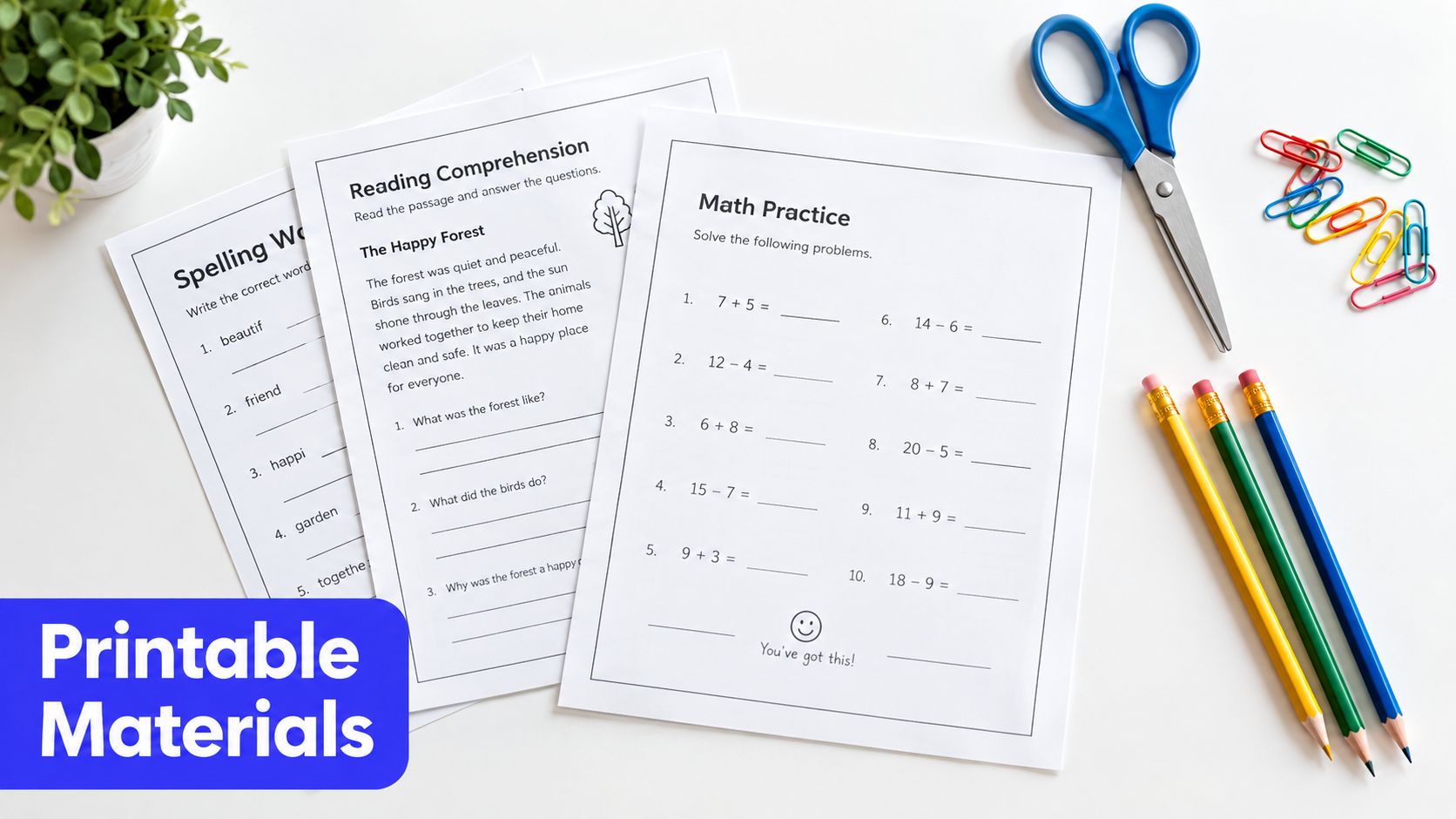
- Whole-class core work: annotation guides, text-dependent question pages, evidence-based short responses
- Small-group repair work: main idea practice, paragraph structure support, vocabulary-in-context prompts
- Progress checks: brief exit slips or targeted checks tied to one standard
Where a tool actually helps
This is the one place in the workflow where a platform can save real time without weakening instruction. Kuraplan's worksheet generation feature can turn a lesson into printable or shareable materials with age-appropriate question types, multiple-choice items, and visuals, which is useful when you already know the exact skill and text you want students to work on.
That matters during grading periods because formatting fatigue is real. Teachers don't need more clever templates. They need materials that stay aligned to the lesson and can be adjusted for reteaching without rebuilding the whole thing from scratch.
If the worksheet checks a different skill from the one you taught, it isn't support. It's noise.
Putting It All Together Your Planning Workflow
A reliable language arts lesson plan doesn't come from inspiration. It comes from a repeatable order of operations. The workflow matters because it cuts down the decisions you have to make when you're tired, rushed, or planning three preps at once.
The five-part cycle that holds up
When planning goes sideways, it's usually because one part got skipped. Maybe the text was chosen too casually. Maybe the questions were written after the slides. Maybe the assessment was really just participation.
A tighter workflow looks like this:
Start with the standard and the missing skill
Decide what students need to do, not what activity you feel like running. In mixed-readiness classes, this also means identifying which students need the core lesson and which need gap-filling on a smaller prerequisite skill.
Choose one anchor text that can carry the load
The text has to support the standard and the writing task. If it can't sustain close reading, don't force it.
Draft the questions in sequence
Build from notice, to interpret, to prove. Questions should move students toward the final written response instead of living as disconnected checks.
Embed supports before the lesson is finished
Add chunking, sentence frames, leveled prompts, or partner rehearsal where students will need them. Not as an afterthought.
Design the assessment and materials last
Once the learning path is clear, create the exit ticket, rubric, and printable pages that measure that exact path.
What this looks like during a real week
On Monday, you may teach the core close reading. Tuesday's evidence tells you whether students need another round of explanation practice or whether they're ready for independent writing. Wednesday's small group might reteach only the students who still confuse summary with evidence.
That's where planning gets more honest. A good plan isn't a script you defend no matter what. It's a living document you adjust based on what students show you.
The best planning systems don't remove teacher judgment. They protect it by clearing out the repetitive work around it.
Keep the workflow boring on purpose
Teachers sometimes chase novelty when what they really need is consistency. The workflow should feel plain enough to repeat:
- Text
- Questions
- Scaffolds
- Assessment
- Materials
If you use that order every week, your planning gets faster and your lessons get cleaner. Students also benefit because the structure becomes familiar. They know they'll read, discuss from evidence, write, and get feedback tied to the skill.
That's the kind of language arts lesson plan that survives the grading period. Not because it's flashy, but because it keeps the main thing in the center. Students read a real text, answer questions worth asking, write from evidence, and get support where the gaps are.
If you're tired of rebuilding the same lesson pieces every week, Kuraplan is built for exactly this kind of work. It helps teachers generate standards-aligned lesson and unit plans, create rubrics and differentiated materials, and turn a solid language arts lesson plan into printable classroom resources without burning planning time on formatting.