It's Sunday evening, your plans for the week are still blank, and your search returns the same thin worksheets you've already rejected. You don't need more pages of sums. You need lesson plans for 2nd grade math that tell you what to say, what to put in students' hands, where they'll get stuck, and how you'll know it worked.
These seven lessons are built that way. Each one is standards-mapped, starts concrete, and includes a quick way to differentiate and assess without making three separate lessons. Read them as Tuesday morning plans, not Pinterest ideas. If you want the follow-up practice made for you, Kuraplan can turn any of them into printable worksheets, diagrams, and exit tickets in minutes, so your prep time goes to teaching instead of formatting.
1. Adding Within 100 Using Base Ten Blocks (Illustrative Mathematics-Style Lesson)
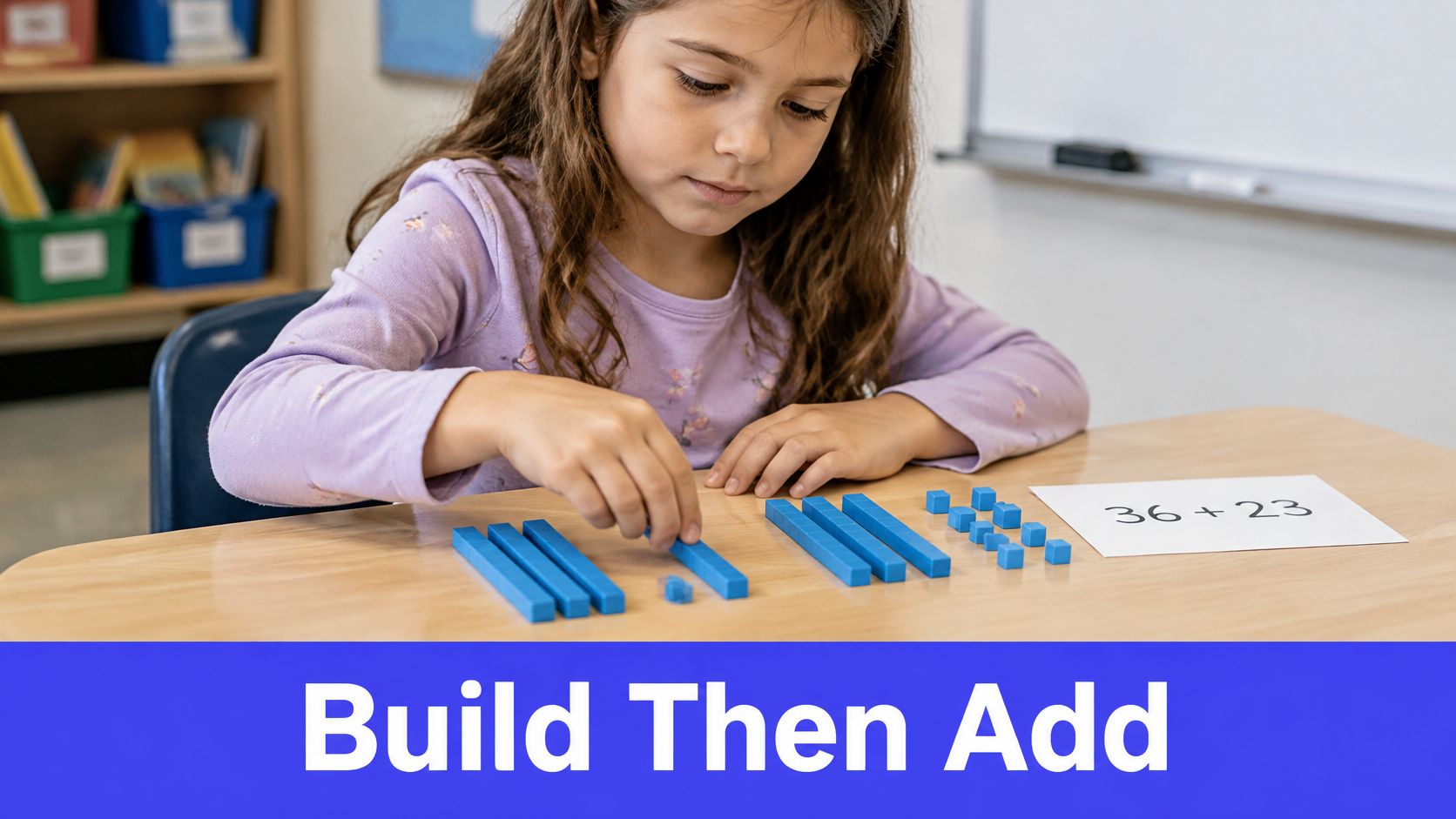
Write 38 + 45 on the board, but hold off on pencils. Students build 38 with three tens rods and eight ones, then build 45 beside it. They combine the piles and see 13 ones. Have them trade ten ones for a tens rod before drawing the model and writing the equation. This takes time, but it makes the regrouping visible before students try the written method.
The Institute of Education Sciences 2021 practice guide recommends a "well-chosen set" of concrete and semi-concrete representations to support understanding of concepts and procedures. Move from blocks to drawings to symbols so students can connect each step of the written method to place value.
Where Students Get Stuck
A common regrouping error is writing 713 after combining 7 tens and 13 ones. Before students calculate, ask whether the total should be more or less than 100. That estimate gives them a way to catch an answer that cannot make sense.
- Build, draw, write: Keep the drawing step. It connects the blocks to work students can do without manipulatives.
- Compare strategies: Ask whether blocks or an open number line is more efficient for this problem, and why.
- Assess in three minutes: Give one computation, one drawing, and one error to fix. Their work shows whether the difficulty is place value or addition facts.
Kuraplan can turn this lesson into a practice worksheet with varied question formats, so students don't only recognize one layout.
2. Measuring Length with Rulers and Adding Lengths (Eureka Math / EngageNY Grade 2)
Ask why a ruler starts at zero, not one, and watch half the class realize they've been counting marks instead of spaces. That question does more work than ten minutes of directions. A ruler is a row of equal units laid end to end.
Students measure a shoe in centimeters, measure a partner's shoe, then find the total length side by side. Now measurement is also addition. The Oregon Common Core mathematics standards for grade 2 expect students to use rulers, yardsticks, meter sticks, and measuring tapes and connect length comparisons to addition and subtraction.
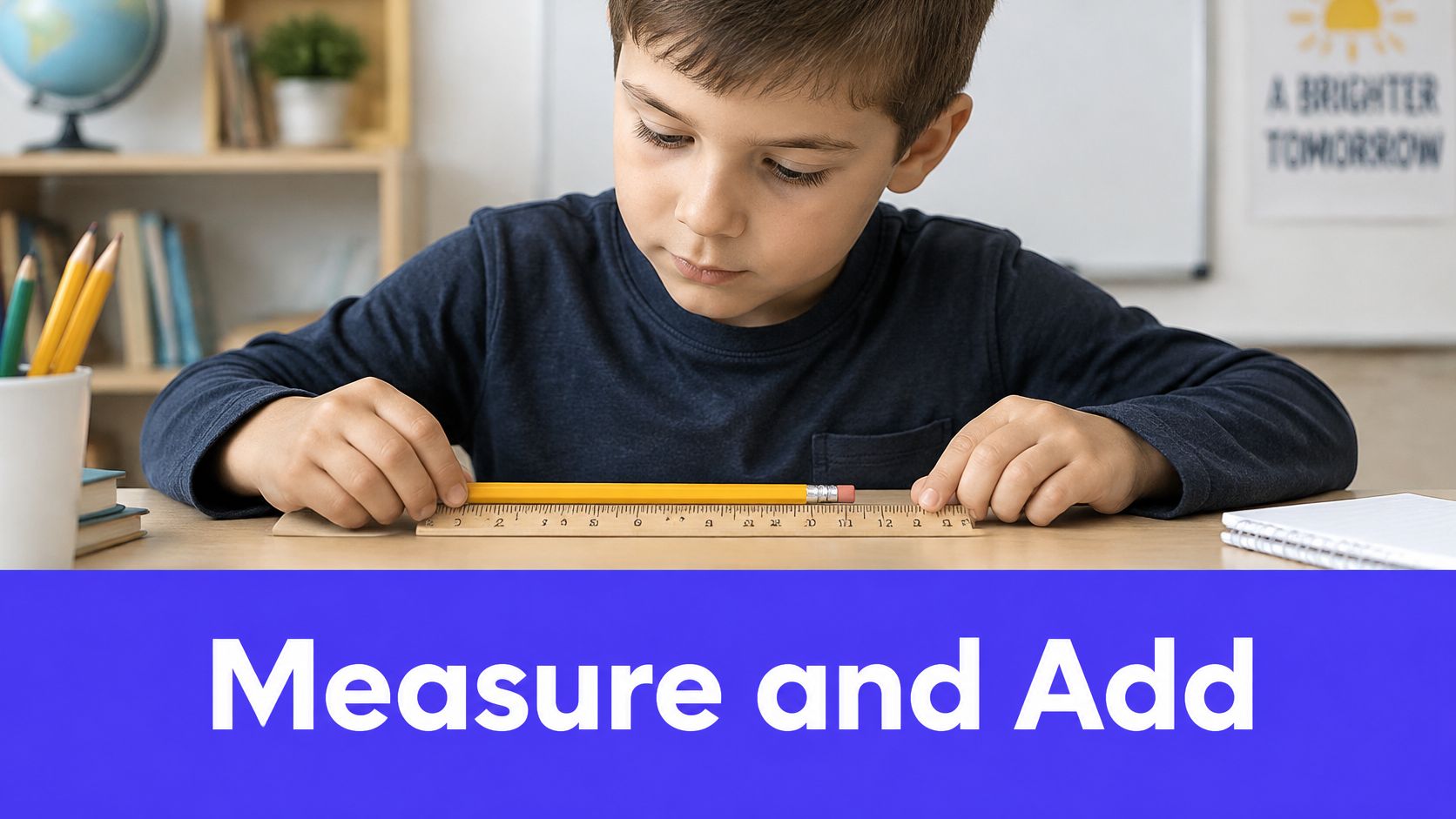
Model placing the zero mark exactly on the edge every single time. It's boring, and it's the whole lesson. Then draw the same lengths on a number line on the board, 5 inches plus 3 inches landing at 8, so students see the ruler and the number line as the same tool.
If a student measures from the 1, don't just correct the answer. Have them measure the same pencil from zero and explain why the number changed.
For independent work, Kuraplan can generate a labeled measurement diagram for reading scales when you don't want 24 kids wandering with rulers. Save measuring for guided time.
3. Number Talks for Mental Addition Strategies
This one isn't a lesson, it's a ten to fifteen minute routine, and that's why it works. You write 47 + 19, students think with a thumb up when they're ready, and you record strategies exactly as they say them. No correcting, no picking a winner yet.
For 9 + 6, you'll hear counting on, making a ten by moving one from the 6, and thinking 10 + 5. All three go on the board. Over weeks, students steal each other's strategies, which is exactly what you want.
Making Talk Safe for Every Learner
Language can hide math understanding here. A student may know the strategy but can't yet explain it fluently, so allow drawings, gestures, and home-language partner talk before whole-group sharing. The Tennessee Math Supports Act report identifies language needs and universal design as effective responses to math deficits, alongside diagnostic assessment and data-driven small groups.
- Sequence your numbers: Start with a clear pattern, then push one step harder.
- Record their words: Your rephrasing can accidentally change their thinking.
- Ask for another way: "Who can explain that differently?" gets quiet students in.
Kuraplan's AI teaching assistant is handy for building a bank of Number Talk strings matched to your current unit, so you're not inventing them at 7 a.m.
4. Introducing Equal Groups and Arrays
Give students 12 counters and one instruction, make 3 rows of 4. Then ask them to write what they made. Most will count by ones at first, and that's your opening to introduce 4 + 4 + 4 = 12 as a faster way to say the same thing.
You're not teaching multiplication facts yet. You're teaching structure. The California grade 2 mathematics standards map includes partitioning a rectangle into rows and columns of equal-sized squares and counting the total. Egg cartons, muffin tins, and grid paper all make that rectangle visible.
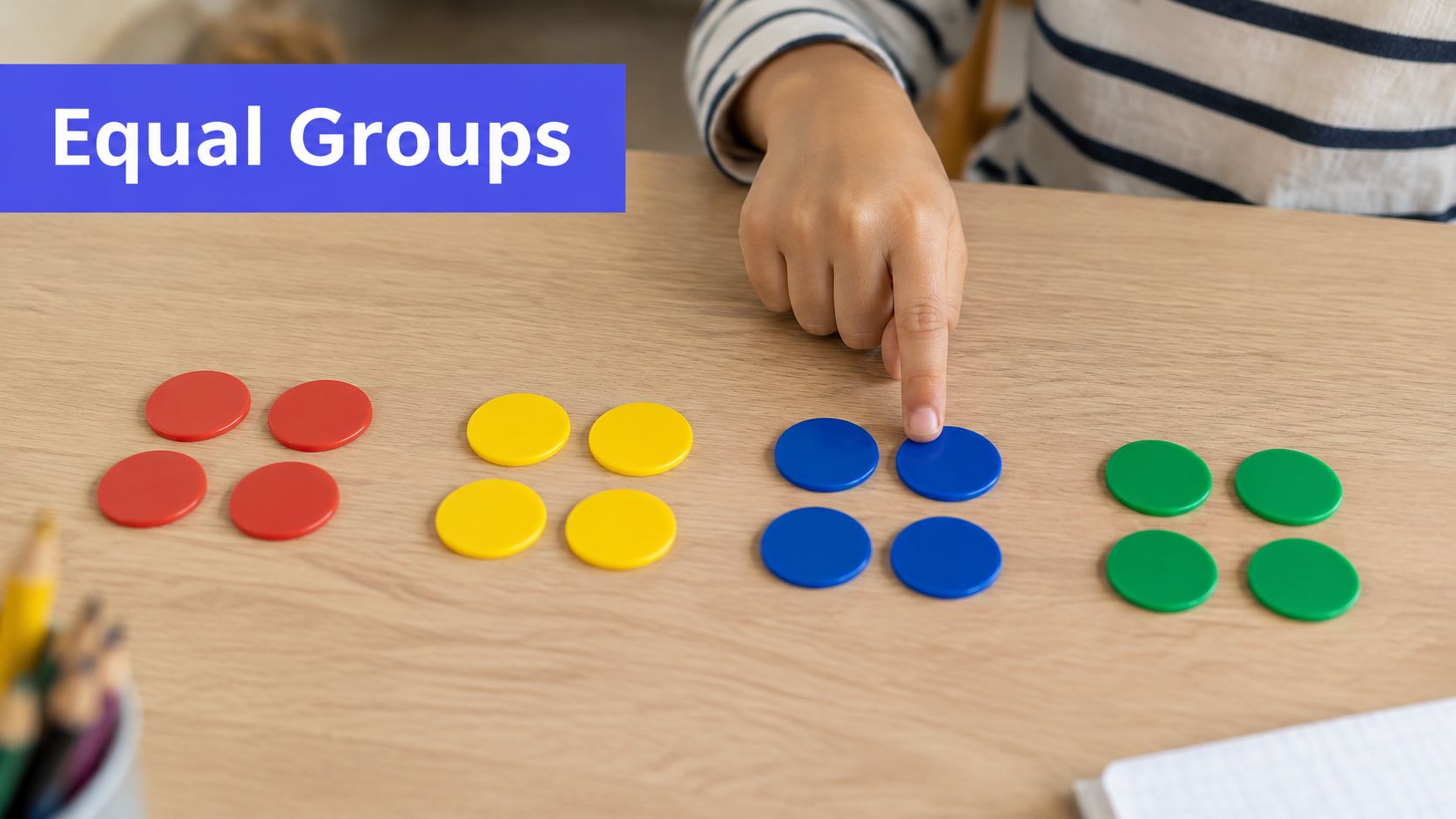
Have students say "three groups of four" out loud every time. That language carries into third grade, while silent counting doesn't. This guide to arrays in maths is useful background if you want the progression toward multiplication and area mapped out.
The trade-off is time. Building arrays is slower than a worksheet, but students who only see equations often can't tell 3 groups of 4 from 4 groups of 3. Mix in a less familiar array like 2 rows of 7 for your exit check, and you'll know who is really grouping.
5. Counting Coins and Money Totals
Money looks easy until a student counts a dime as one because it's small. Size lies, value doesn't, and second graders need that said out loud. Teach one routine and stick to it, largest coin first, touch and say each running total.
A class store earns its chaos here. Price tags, play money, and a real reason to make 67 cents will hold attention longer than any worksheet. Pairs can sort a mixed bag, line coins up from quarters down to pennies, then count on together before they try it alone.
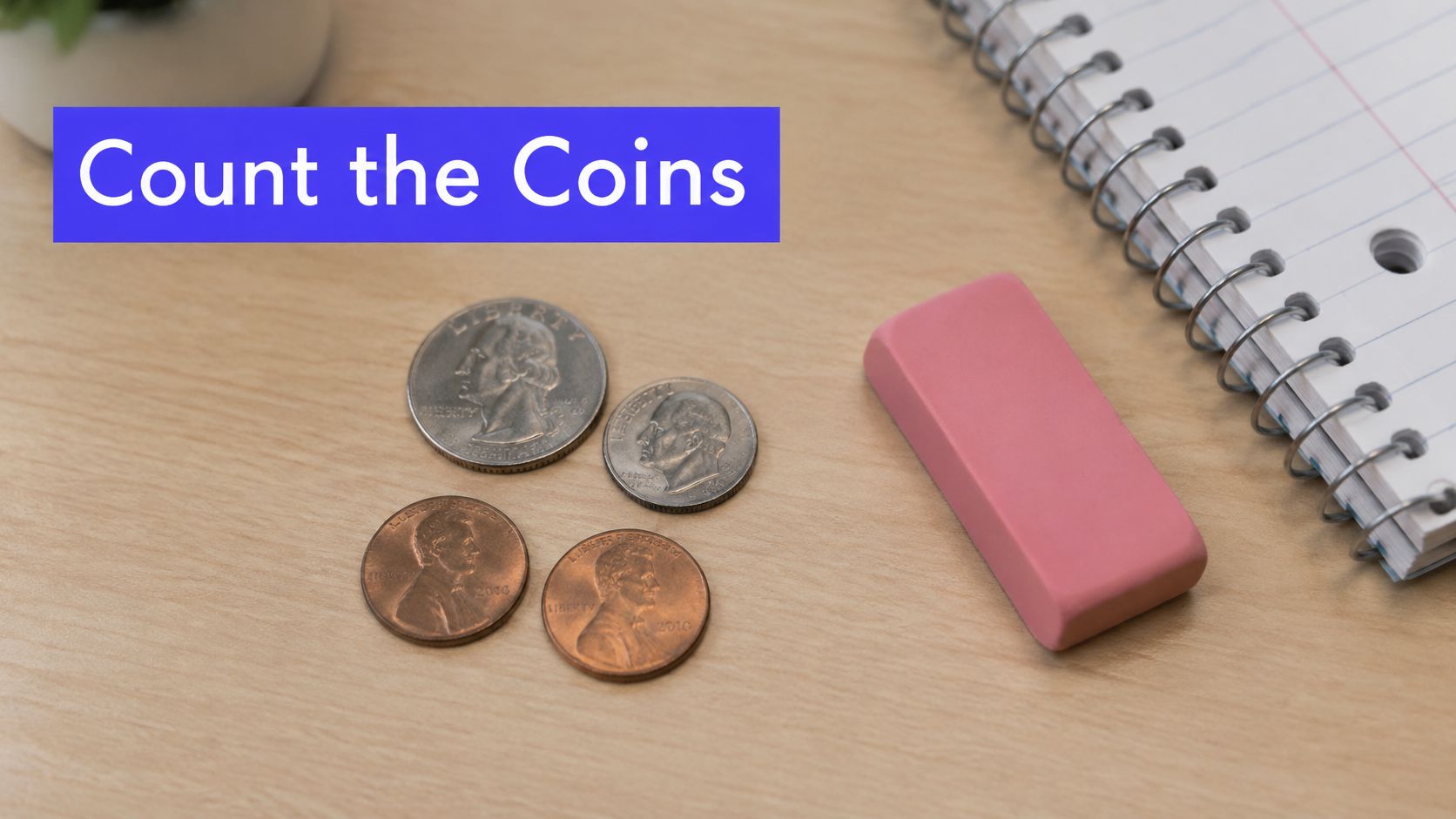
Keep a coin anchor chart with front, back, and value where students can see it during work, not behind your desk. Skip counting by 25s, 10s, and 5s is the hidden skill, so warm up with those counts before coins come out.
Practical rule: If they can't count by tens and switch to fives without restarting, they're not ready for mixed coins yet. Practice the switch by itself first.
For quiet practice days, these second grade money worksheets give you coin images without you hunting for clip art. Kuraplan can also generate new combinations so students can't memorize yesterday's answers.
6. Skip Counting on the Hundred Chart
Coloring multiples of 5 sounds like busywork. It stops being busywork when you ask students to predict the pattern before they color. Will it be columns, rows, or diagonals, and why? Now they're reasoning about structure, not filling boxes.
Students color the 5s, describe the two straight columns, then use the 10s pattern to find the number 10 spaces ahead of 47 without counting one by one. That jump down one row is place value in disguise, and it's the move they'll need for adding tens mentally.
Differentiating Without Lowering the Bar
Don't hand struggling students a smaller chart and call it support. Keep the same pattern, change the access. A blank hundred chart where they fill only the skip-counted numbers, a number line showing the jumps as distances, and explicit modeling of the first two jumps all preserve the thinking. A 2025 NCTQ research summary on mathematics preparation found roughly two-thirds of recent special-education graduates said arithmetic fluency and motivational strategies received little or no coverage in their preparation, so predictable routines and sequenced representations matter more than novelty.
Assess with a partially blank chart. If a student can fill the next three multiples and explain the column pattern, they've got it, even if their coloring is messy.
7. Telling Time to the Nearest Five Minutes
This is the topic that humbles confident second graders. Two hands, one circular face, and numbers that mean five minutes instead of one. Don't start by reading times. Start by counting by fives around the clock while pointing, several days in a row, until that count is automatic.
Students set a paper clock to 3:25, say the hour hand is a little past 3, then write it digitally. That "a little after" language catches the classic error of reading 4:25 because the hour hand looks close to 4. Partner games work well here, one student shows a time, the other writes and reads it back.
Use the chant if it helps your class, short hand tells the hour, long hand tells the minutes, but don't let the chant replace counting by fives. This guide to how to read a clock breaks the skill into teachable steps you can send home for practice.
- Teach the fives count first: Reading times before this just creates guessing.
- Check the hour hand position: Ask "a little after or a little before?" on every problem.
- Assess both directions: Show a time to read, and give a digital time to build.
Geared demonstration clocks beat paper ones for showing the hour hand move slowly. If you only have paper, move the hour hand yourself.
7 Second Grade Math Lesson Plans at a Glance
| Lesson | Core Standard | Time Needed | Materials | Best For |
|---|---|---|---|---|
| Adding Within 100 Using Base Ten Blocks | CCSS 2.NBT.B.5 and 2.NBT.B.7 | Longer than a worksheet drill | Base-ten blocks, paper | Building place-value understanding and regrouping skills |
| Measuring Length with Rulers and Adding Lengths | Grade 2 measurement and length addition | Hands-on lesson; allow time for measuring | Rulers, classroom objects, paper strips | Connecting measurement to addition and number lines |
| Number Talks for Mental Addition Strategies | Mental addition and place-value reasoning | 10–15 minutes | Whiteboard, carefully chosen problems | Practicing flexible strategies and explaining thinking |
| Introducing Equal Groups and Arrays | CCSS 2.OA.C.4 | Lesson-length activity | Counters or cubes, grid paper | Introducing equal groups and repeated addition |
| Counting Coins and Money Totals | CCSS 2.MD.C.8 | Activity-length lesson | Coins or play money, price tags | Practicing coin values, skip counting, and money totals |
| Skip Counting on the Hundred Chart | CCSS 2.NBT.A.2 | Short warm-up or center activity | Hundred chart, crayons or markers | Spotting number patterns and preparing for multiplication |
| Telling Time to the Nearest Five Minutes | CCSS 2.MD.C.7 | Repeated practice needed | Paper or classroom clocks | Learning analog time and matching it to digital time |
Making These Lessons Your Own
The pattern across all seven is simple. Start concrete, move to a drawing or number line, and only then ask for symbols alone. That sequence is your differentiation plan too. A student who needs blocks while a partner works abstractly isn't doing easier math, they're doing the same math at a different level of representation, and you can move them along that path during the same lesson.
Keep routines like Number Talks short and daily rather than saving them for a big Friday lesson. Ten focused minutes, four days a week, builds strategy flexibility that a monthly event won't. The same goes for skip counting and the fives count around the clock. Brief, predictable practice beats novelty, especially for students who need explicit modeling and a routine they can count on.
There's a bigger reason not to let these become pure computation drills. The 2024 NAEP mathematics results reported 39% of fourth-graders at or above NAEP Proficient and 24% below NAEP Basic. NAEP doesn't test second grade, but those later results warn against treating speed as the only outcome. Your exit tickets should ask for a representation or an explanation, not just an answer, so you learn whether the problem is place value, operation choice, or communication.
Balance your weeks across strands as well. NAEP reports results on a 0-to-500 scale across areas including number properties and operations, measurement, geometry, data, and algebra, according to the NAEP reporting overview. Second grade should feel that same breadth, one clear target at a time.
Pick one lesson for next week and run it as written. Note where students stall, adjust the representation, and run your version the week after. Kuraplan can convert that adjusted lesson into standards-aligned printable worksheets, diagrams, and assessments in minutes, which frees your Sunday evening for something better than formatting tables.
Turn any of these lesson plans for 2nd grade math into ready-to-print worksheets, visual models, and exit tickets matched to your standard and your students' level of support. Visit Kuraplan to build next week's lesson in minutes and spend your prep time on the teaching, not the paperwork.