It's Sunday night, the unit test is Tuesday, and every question you've written has an obvious correct answer. The stem gives away the lesson, one distractor is silly, and the other two don't even belong in the same subject. Students can earn points by spotting clues instead of showing what they know.
The difference between a quiz that measures learning and one that only checks reading often sits in the wrong options. A useful distractor reflects a mistake, a partial understanding, or a reasonable interpretation that fails under closer examination. The examples below pair multiple choice questions with answers and practical notes on the standard each item serves, why the incorrect choices work, and how to adjust difficulty. When time is tight, Kuraplan can draft and format a batch of questions, leaving you to review the thinking behind each option.
1. Reading Comprehension Identifying Main Idea
After reading The Very Hungry Caterpillar, what is the main idea?
A) The caterpillar ate many foods.
B) The caterpillar went through a transformation.
C) Fruit tastes good.
D) Caterpillars are green.
Answer: B. The caterpillar went through a transformation.
This question checks whether students can separate a story's central idea from details. Option A is tempting because eating is a large part of the plot, but it describes an event rather than the whole story. Option C takes one detail and turns it into a broad statement that doesn't explain the caterpillar's development. Option D may sound connected to the topic, but the color of the caterpillar isn't the story's central message.
The item supports a foundational K–12 reading skill, identifying the main idea and distinguishing it from supporting information. I'd use it after a read-aloud, then ask students to point to two events that support their choice. That small follow-up helps reveal whether a student selected B because they understood the plot or because it sounded more important.
Practical rule: A main-idea distractor should be a detail from the text, not a random incorrect statement.
For younger readers, add a picture sequence showing the caterpillar's changes. To increase difficulty, remove the title and ask students to select the best summary after reading a longer passage. You can also use the same structure with middle school social studies:
What was the primary cause of westward expansion in the 1800s?
A) Gold discovery.
B) Manifest Destiny ideology.
C) European trade routes.
D) Native American trade agreements.
Answer: B. Manifest Destiny ideology.
Here, gold discovery is a real associated factor, so it works as a distractor. The other choices test whether students can distinguish the main ideological cause from surrounding historical conditions. Kuraplan's assessment generation feature can help create standards-aligned questions from selected texts, but review each option against the passage. Vary the correct answer's position across a set so students don't learn a guessing pattern. For support with lesson sequencing, teachers can also connect these questions to before, during, and after reading techniques.

2. Mathematics Multi-Step Problem Solving
Sarah has 24 stickers. Her friend gives her 15 more. She then gives half of her stickers to her brother. How many stickers does Sarah have left?
A) 19.5
B) 20
C) 39
D) 58.5
Answer: A. 19.5
Students must complete the operations in order. First, Sarah has 24 + 15, which equals 39. Half of 39 is 19.5. Option C catches students who stop after the addition. Option D represents adding 24 and 15, then multiplying by two. Option B may attract students who expect a whole-number answer or round without checking whether rounding is appropriate.
The decimal answer creates a useful teaching moment. If your Grade 3 students haven't learned halves that produce decimals, change the starting numbers so the final result is a whole number. That adjustment keeps the item focused on multi-step reasoning instead of testing an unintroduced concept.
Check the mistake behind each option
Before using an item like this, ask what student work would produce each wrong answer. A distractor earns its place when you can connect it to a visible error:
- 39: The student completed the first operation but ignored the second.
- 20: The student may have rounded or assumed the answer should be a whole number.
- 58.5: The student may have doubled instead of halving.
A real-world context, such as stickers, shopping, or sharing food, gives students a reason to interpret the operations rather than only calculate. For Grade 8, use the following version:
A store is having a 25% off sale on all items. If a shirt originally costs $40 and you have a coupon for an additional $5 off, what is the final price?
A) $25
B) $30
C) $35
D) $45
Answer: B. $30
Students first find the sale price, $30, then apply the additional coupon to reach $25, so the provided answer B conflicts with the stated arithmetic. That makes this a valuable editing warning: always calculate and verify the key before publishing. If the intended answer is B, revise the question to say the coupon applies before the percentage discount, or change the options and answer key. A tool such as Kuraplan's quiz maker can generate the worksheet structure and worked solutions, but teacher review must catch ambiguity or an incorrect key.
A short video explanation can reinforce how students track operations in a multi-step problem.
3. Science Application of Concepts
A puddle on a playground disappears on a sunny day without rain. Which process best explains what happened?
A) Melting
B) Evaporation
C) Condensation
D) Freezing
Answer: B. Evaporation.
This item asks students to apply a process to an observation they may have seen themselves. Melting is plausible because the puddle changes, but melting describes a solid becoming a liquid. Condensation reverses the direction, changing gas into liquid. Freezing also moves in the wrong direction because it changes liquid into solid.
The stem gives enough information for students to reason from the situation. It doesn't require them to memorize a definition without context. To raise the difficulty, ask students what happens to the water after it leaves the puddle, or describe a covered container and ask them to distinguish evaporation from condensation.
Use misconceptions as evidence
Science distractors should represent ideas students actually hold. An absurd option makes the question easy but tells you little about understanding. I'd occasionally ask students to explain their choice to a partner, especially when the answer is correct but the reasoning may be weak.
For high school biology, consider this example:
If a mutation causes an organism to produce more offspring, but the offspring are weaker, how might natural selection affect this trait over many generations?
A) The trait will become more common.
B) The trait will become less common.
C) The trait will remain unchanged.
D) Cannot be predicted from this information.
Answer: B. The trait will become less common.
Option A focuses on the number of offspring while ignoring survival and reproductive success. Option C reflects the idea that inherited traits never change in populations. Option D may attract students who recognize that natural selection depends on environmental conditions but overlook the information given about weaker offspring. If the item is used in a unit on evolution, ask students to identify the evidence in the stem that supports B.
Kuraplan can generate science questions connected to unit objectives and add age-appropriate diagrams or illustrations. Use that output as a starting point, then check whether every diagram label, scenario, and distractor matches the concept you taught. Application questions work best after students have practiced similar reasoning with real phenomena.

4. Social Studies Historical Context and Causation
Why did many Native American nations move west in the 1800s?
A) They wanted to explore new territory.
B) The U.S. government forced them off their land.
C) There was no food in the East.
D) They wanted to escape cold winters.
Answer: B. The U.S. government forced them off their land.
This question addresses historical causation and requires careful wording because the event involved many communities and experiences. Option A turns forced removal into voluntary exploration. Option C offers a possible hardship but presents an unsupported single cause. Option D is geographically plausible but historically weak. The distractors are useful because they expose whether students understand the difference between migration by choice and displacement under government policy.
I'd pair the item with a short primary source excerpt, map, or timeline. Students can underline evidence before selecting an answer. That makes the question less dependent on recall and opens a discussion about whose perspective the source represents.
A high school version can ask:
Which factor was most significant in the North's victory in the Civil War?
A) Superior generals and military strategy.
B) Industrial capacity and larger population.
C) Confederate leaders' poor decision-making.
D) European support for the Union.
Answer: B. Industrial capacity and larger population.
Option A is attractive because military leadership mattered. Option C identifies a real factor but offers a narrower view. Option D tests whether students confuse limited foreign involvement with decisive support. The phrase most significant tells students they must weigh causes, not just identify something that contributed.
Leave room for historical complexity
Some historical questions have contested interpretations. Don't force one answer when the evidence supports several defensible conclusions. Instead, provide a source set and ask which claim is best supported by the evidence, then use the selected answer as the start of a discussion.
Kuraplan's curriculum mapping can connect causation questions to essential questions and learning objectives. Teachers should still check for oversimplification, missing perspectives, and language that treats a complex event as the decision of one group alone. Connecting past causes to a current civic issue can deepen relevance, but don't imply that two situations are identical.
5. English Language Arts Vocabulary in Context
The old house was dilapidated. This means the house was
A) Big.
B) Broken down and falling apart.
C) Haunted.
D) Dark.
Answer: B. Broken down and falling apart.
The sentence gives students a context clue, but it doesn't define the word directly. Option A is a common descriptive feature of houses, while C and D fit the mood students may associate with an old building. None of those choices means dilapidated, so a student must use the word's context and prior knowledge rather than select the most dramatic option.
I'd ask students to explain which details in a surrounding paragraph helped them infer the meaning. A stronger version places the word in a passage where the condition of the house is described through peeling paint, broken windows, or damaged steps. That tests the strategy of using multiple clues, not just recognition.
For high school English, try this item:
The speaker's vitriolic criticism of the policy angered its supporters. Based on context, vitriolic most likely means
A) Constructive.
B) Harsh and bitter.
C) Lengthy and detailed.
D) Well-researched.
Answer: B. Harsh and bitter.
Option A is a reasonable contrast because criticism can be constructive. Options C and D describe qualities that criticism might have without addressing its emotional tone. The phrase “angered its supporters” supplies a useful clue, but students still need to infer the word's meaning.
Make the context do the work
Choose vocabulary that appears naturally in grade-level reading. If the sentence sounds manufactured, students may focus on the test rather than the word. Vary the clues you provide:
- Definition clue: Place a direct explanation near the unfamiliar word.
- Contrast clue: Use words such as “although,” “unlike,” or “rather than.”
- Example clue: Show the meaning through an action, object, or event.
Kuraplan can generate age-appropriate vocabulary questions from passages you select, including aligned distractors based on common word confusions. Review the context carefully, then ask students how an independent reader could handle the word without a dictionary. That conversation is more valuable than memorizing the answer key.
6. Special Education and Differentiation Scaffolded Skill Assessment
Look at the picture. What is the dog doing?
A) Sleeping.
B) Playing with a ball.
C) Eating food.
D) Barking.
Answer: The option that matches the picture.
The item must include a clear picture, and the answer depends on the image supplied. Its purpose is to let a student demonstrate language comprehension or observation without adding unnecessary reading demands. The four options should name familiar actions, use consistent grammar, and remain visually easy to scan.
A scaffolded question is not a lower-expectation version by default. It's a way to remove a barrier that isn't part of the skill being assessed. If the target is identifying an action, a long written passage shouldn't decide whether the student succeeds.
For an emerging English learner, use a concrete image and a short prompt:
This is a _____.
A) Sun.
B) Moon.
C) Star.
Answer: A. Sun.
The visual should make the concept clear, while the vocabulary stays within the learner's instructional range. You might first present three options, then reduce the choices temporarily if the student is overwhelmed. As mastery develops, return to more options or remove the picture when independent language is the target.
Protect validity while adding support
Work with special education staff, speech therapists, and English language specialists when deciding which scaffold is appropriate. Consistent symbols, color coding, image placement, and response methods can reduce processing demands, but they shouldn't accidentally hint at the answer.
Kuraplan's differentiation features can help create versions with modified vocabulary, reduced answer choices, and several complexity levels. Teacher review remains essential. Test a scaffolded item with a few students, check that the support removes a barrier rather than supplies the answer, and combine selected-response items with oral, written, or performance evidence. Gradually remove scaffolds as students demonstrate mastery.
7. Higher-Order Thinking Analysis and Evaluation
Two plants receive identical sunlight and water. Plant A grows 10 cm in 4 weeks. Plant B grows 5 cm in 4 weeks. Which conclusion is best supported by the data?
A) Plant A is healthier than Plant B.
B) Plant A has better soil.
C) Plant A grows faster under these conditions.
D) Plant A is older than Plant B.
Answer: C. Plant A grows faster under these conditions.
The correct choice stays close to the evidence. Option A makes a broader judgment about health, option B invents a cause that the data doesn't provide, and option D adds information that isn't present. These are strong distractors because each conclusion sounds possible, but only C avoids claiming more than the experiment shows.
For high school English, use an excerpt before asking:
Based on the author's use of vivid descriptions and violent imagery, what inference can you make about the author's purpose?
A) To entertain readers with an action story.
B) To critique society's violence.
C) To instruct readers about historical events.
D) To persuade readers to join the military.
Answer: B. To critique society's violence.
Students must connect a textual pattern to an interpretation of purpose. Option A may reflect a partial reading of the passage, while C and D introduce purposes that require evidence not found in the description. Ask students to write one sentence defending their choice. That turns a selected response into a window into reasoning.
A good analysis item doesn't reward the most sophisticated-sounding option. It rewards the conclusion the evidence can actually support.
Build background knowledge before using these questions. If students haven't learned the content, a difficult item may measure vocabulary or guessing rather than analysis. Kuraplan's multiple-choice question resources can help organize items around higher-order standards, but map each question to a specific reasoning process. Use only a few complex items in a balanced assessment, and pre-assess student thinking when you need to design better misconception-based distractors.
8. Formative Assessment Quick Checks and Exit Tickets
At the end of a Grade 3 math lesson, ask:
Which of these is 25 + 15?
A) 30
B) 35
C) 40
D) 45
Answer: C. 40
This exit ticket checks the same-day objective without adding a reading challenge. Option A can show an error with the tens, B may reflect a partial calculation, and D may result from adding an extra five or miscounting by tens. Because each distractor points to a different error, the responses help determine what to reteach tomorrow.
A high school chemistry check can target one fact and the misconceptions around it:
Which statement about atoms is true?
A) Protons are negative.
B) Neutrons are in the nucleus.
C) Electrons are in the center.
D) All atoms have the same number of electrons.
Answer: B. Neutrons are in the nucleus.
Each wrong option represents a recognizable misunderstanding. A reverses proton charge, C places electrons in the wrong location, and D overlooks differences between atoms and ions. Display the question, collect answers with hand signals or cards, and ask a student who selected a distractor to explain the reasoning without identifying that student publicly. The explanation often reveals whether the error is conceptual or careless.
Turn responses into tomorrow's plan
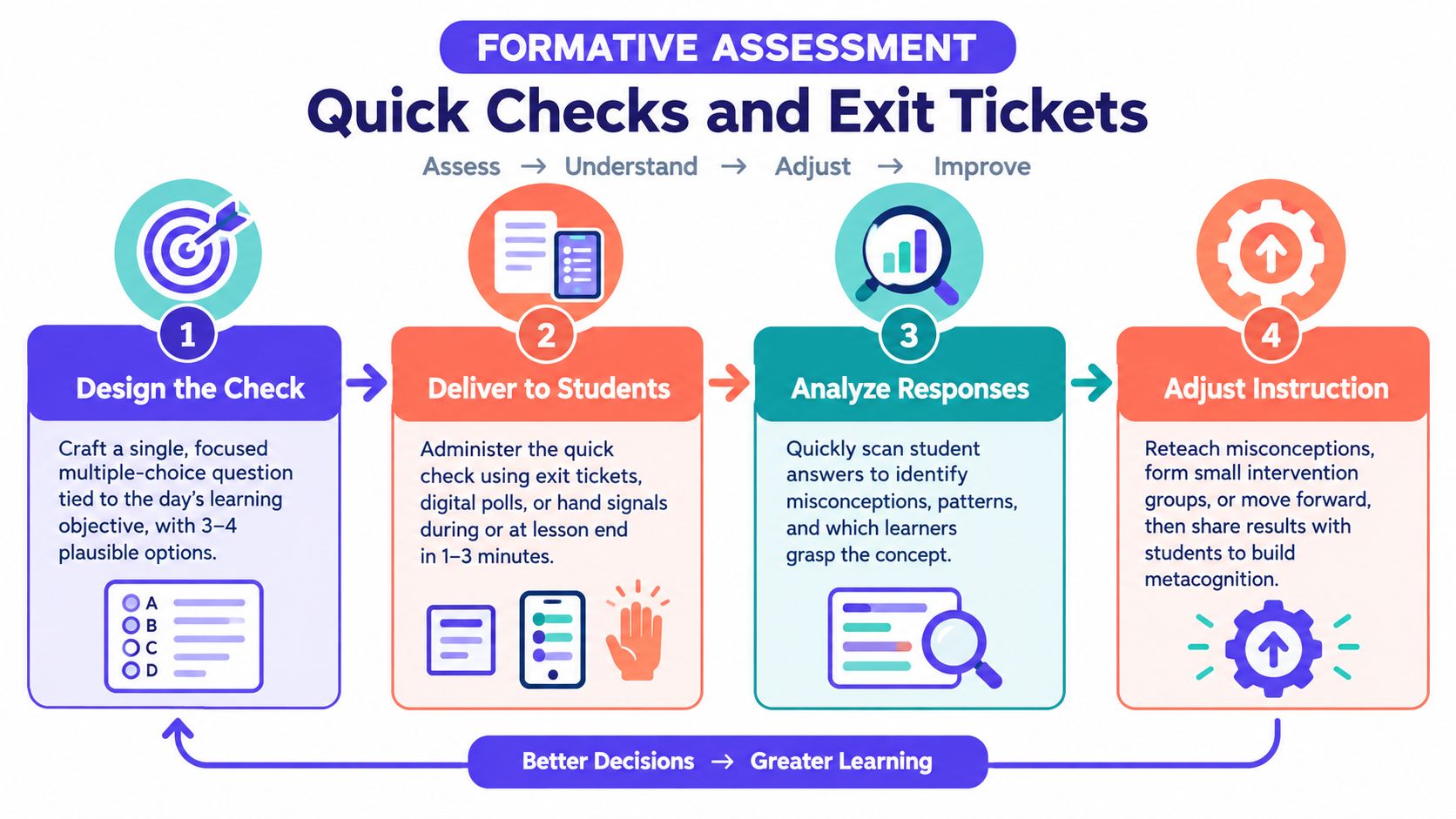
A quick check has value only when it changes instruction. Group questions by learning objective, keep the challenge appropriate, and record which wrong choices appear. Then make the response clear:
- One dominant misconception: Reteach it briefly with a new example.
- Several scattered errors: Form flexible groups for targeted practice.
- Mostly secure understanding: Move ahead and offer an extension.
Kuraplan's exit ticket generator can produce questions aligned with daily objectives for display or printed responses. Share results in plain language: “Most of us are ready for the next topic, but we need to review one concept first.” Students can then treat the check as information for learning rather than only a score.
8-Point Multiple-Choice Questions Comparison
| Item | 🔄 Implementation Complexity | ⚡ Resource Requirements & Speed | ⭐ Expected Outcomes / Quality | 📊 Ideal Use Cases | 💡 Key Advantages / Tips |
|---|---|---|---|---|---|
| Reading Comprehension: Identifying Main Idea | 🔄 Low, single‑passage synthesis; straightforward item writing | ⚡ Low, minimal materials; quick to grade | ⭐ Strong for measuring central comprehension; limited on deep inference | 📊 K–12 literacy lessons, benchmarks, practice tests | 💡 Use plausible distractors; vary answer positions; align to standards |
| Mathematics: Multi‑Step Problem Solving | 🔄 Medium–High, multi‑step logic and careful distractor design | ⚡ Moderate, real‑world context prep; longer student time | ⭐ High, diagnoses procedural fluency and misconceptions | 📊 Math units, diagnostic tasks, applied problem‑solving assessments | 💡 Include common error distractors; pre‑teach strategies; check reading load |
| Science: Application of Concepts | 🔄 High, novel scenarios requiring concept integration | ⚡ Moderate–High, time to craft valid scenarios and diagrams | ⭐ High, assesses transfer and conceptual understanding | 📊 NGSS units, inquiry tasks, performance items | 💡 Ground items in observable phenomena; scaffold as needed; use diagrams |
| Social Studies: Historical Context & Causation | 🔄 High, complex causation and multiple perspectives | ⚡ Moderate, needs context, primary sources, expert review | ⭐ High for causal reasoning but risk of interpretive ambiguity | 📊 History units, civic reasoning, document‑based questions | 💡 Present multiple perspectives; include evidence; avoid oversimplifying |
| ELA: Vocabulary in Context | 🔄 Low–Medium, craft clear context clues and distractors | ⚡ Low, short excerpts; quick administration | ⭐ Strong, builds vocabulary + comprehension transfer | 📊 ELA lessons, vocabulary interventions, test prep | 💡 Choose natural words; teach context‑clue strategies; vary clue types |
| Special Education & Differentiation: Scaffolded Skill Assessment | 🔄 Medium–High, individualized scaffolds and accessible design | ⚡ Higher, collaboration, visuals, multiple versions required | ⭐ High, enables equitable demonstration of content knowledge | 📊 IEP objectives, ELL supports, inclusive classrooms | 💡 Collaborate with specialists; pilot scaffolds; gradually remove supports |
| Higher‑Order Thinking: Analysis & Evaluation | 🔄 Very High, designs must elicit valid reasoning, avoid multiple defensible answers | ⚡ Moderate–High, time‑intensive for creation and student response | ⭐ Very High, reveals analytic reasoning and depth of understanding | 📊 Advanced learners, summative tasks, college/career readiness prep | 💡 Build foundational knowledge first; require brief justification; craft flawed‑reasoning distractors |
| Formative Assessment: Quick Checks & Exit Tickets | 🔄 Low, single‑focus items for rapid use | ⚡ Very Low, minimal prep; fast administration/scoring (digital or paper) | ⭐ Moderate, immediate instructional feedback; limited depth | 📊 Daily pulse checks, lesson adjustments, grouping decisions | 💡 Keep items focused; act on results quickly; maintain organized question banks |
Start Your Own Question Bank This Week
Pick one question type from this list that matches the unit you're teaching now. If students are reading a novel, start with main idea or vocabulary in context. If they're working with fractions, equations, or lab observations, choose a multi-step or application question. Don't begin by trying to write a complete test. Write three questions from your own material and make each one do a different job.
For every question, inspect the wrong options before you inspect the correct answer. Can you name the mistake behind each one? A student who selects the distractor should give you some useful information, such as “stopped after the first operation,” “confused evaporation with condensation,” or “treated a supporting detail as the main idea.” If an option is merely silly, unrelated, or grammatically awkward, replace it.
The number of answer choices matters less than their quality. Random guessing is more likely with fewer choices, but research comparing three-option and five-option versions of 138 questions found only a modest difference in observed average correct-response rates, 84% for three options and 80% for five, as reported in the published comparison of three-option and five-option questions. That supports a practical classroom choice: use three or four credible alternatives when a fifth option would be forced.
Feedback matters just as much as the key. In a randomized crossover trial of web-based instruction, modules with embedded self-assessment questions and feedback produced mean test scores of 78.9%, compared with 76.2% for a standard format without embedded questions, a 2.7-percentage-point difference reported as statistically significant in the study of question-based web instruction. I'd show the answer, explain why it works, and briefly name what each wrong option reveals. Correct-answer-only feedback leaves students with no clear repair strategy.
Keep the question set compact and tied to the lesson objective. Another randomized crossover trial comparing modules with 0, 1, 5, 10, or 15 self-assessment questions found the highest pooled post-test score with 10 questions, while increasing to 15 did not improve the result and took longer, as reported in the medical education trial on question quantity. The exact number won't transfer directly to every class, but the design lesson does. More items aren't automatically better.
Kuraplan can produce a first draft, format worksheets, and include worked answers, so your time goes into refining the distractors rather than arranging boxes on a page. If you're preparing students for a knowledge test, resources such as this guide to study for a G1 knowledge test also show how practice questions can pair answers with explanations. Use generated material as draft material, verify every key, and keep your judgment in charge of what reaches students.
Build your next quiz around one clear learning objective, then use Kuraplan to draft standards-aligned questions, answer keys, worksheets, and differentiated versions. Visit Kuraplan to turn your lesson material into practical multiple-choice practice that you can review and use this week.