You're probably reading this with a lesson open, a stack of unfinished materials nearby, and a class list that includes students who can discuss a topic brilliantly in one context and then freeze when the task turns academic. That's where scaffolding for English language learners either becomes a lifeline or a mess.
Most teachers already use scaffolds. The problem isn't whether to scaffold. It's whether the support moves students toward independence, or whether it turns into a crutch that never leaves. I've seen both. A well-timed sentence frame can get a student into the conversation. The same frame, left in place too long, can keep that student from building a sentence alone.
Good scaffolding isn't about making work easier. It's about making grade-level work reachable. Then, equally, it's about knowing when to pull back.
What Scaffolding Really Means in Your Classroom
On a normal school day, scaffolding doesn't look fancy. It looks like a teacher slowing down the language load without lowering the thinking. It looks like one student using a visual organizer, another using a sentence starter, and a third getting a quick model before trying the task independently.
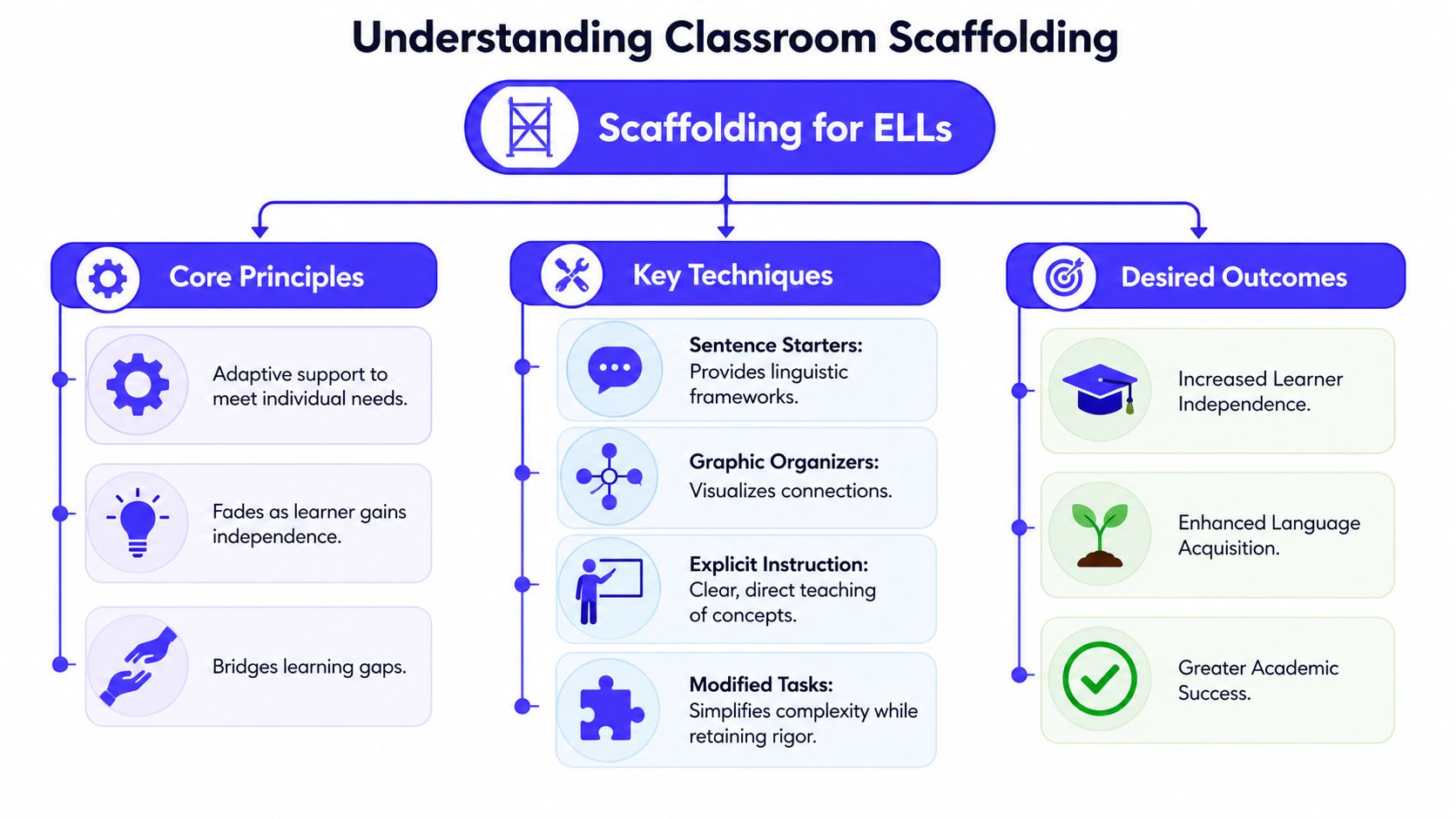
That's why I define scaffolding for English language learners as temporary support that helps students do work they couldn't yet do alone. Temporary is the key word. If the support never fades, it isn't scaffolding anymore. It's replacement.
For many teachers, the idea clicks when they connect it to Vygotsky's zone of proximal development. If you want a practical refresher on that idea in a classroom context, this piece on engaging online learning with Vygotsky is a useful companion. The big takeaway is simple. Students grow most when the task is just beyond independent reach, but still possible with support.
What scaffolding is and what it isn't
Teachers often confuse scaffolding with simplifying content. They aren't the same thing.
| Classroom move | Real scaffold | Not a scaffold |
|---|---|---|
| Reading support | Chunking a grade-level text and guiding discussion | Replacing the text with something unrelated and much easier |
| Writing support | Giving a sentence frame tied to the task | Writing the whole response for the student to copy |
| Discussion support | Modeling one academic response and posting key language | Letting the student opt out of speaking every time |
A scaffold keeps the learning goal intact. It changes access, not the standard.
The teacher-friendly version of gradual release
Most of us already use a form of gradual release, even if we don't label it that way. You model first. Then you practice together. Then students try with less help. If you want a clean walkthrough of that sequence, Kuraplan has a simple explanation of the gradual release of responsibility.
Practical rule: If a support helps a student start, continue, and finish a task, it's useful. If it does all the thinking for them, it's too much.
Three principles keep scaffolding on track:
- Start with the grade-level task: Don't build a separate low-level lesson unless a student exhibits an intensive need for intervention.
- Match support to the barrier: If the problem is vocabulary, pre-teach vocabulary. If the problem is language production, use sentence stems. If the problem is dense text, chunk it.
- Plan to remove the support: If you never ask, “When will I fade this?” you're setting up dependency.
That last point gets skipped a lot. Teachers get plenty of examples of scaffolds to add. They get much less guidance on how to remove them well. That's where strong practice separates itself from busywork.
Building Your Scaffold Before the Lesson Begins
The strongest scaffolds are usually invisible by the time students walk in. They're built into the lesson before the first direction is spoken. When planning is weak, teachers end up improvising support in the moment, and that usually means either too little help or too much.
Structured planning matters at scale, too. In New York State, the 2019 “Scaffolding for Success” initiative required at least three distinct scaffolding types in ELL lessons, and by 2023 that policy contributed to a 31% increase in the number of ELL students passing state ELA assessments, according to the New York State Education Department's 2023 Annual ELL Report%2C%20derived%20from%20the%202023%20Annual%20ELL%20Report). That doesn't mean every lesson needs to be complicated. It means intentional planning changes outcomes.

Plan the barrier, not just the activity
Before the lesson, ask one question for each task: What will block my English learners here? The answer is usually one of four things.
- Language load: Too many unfamiliar words, complex syntax, or vague directions.
- Background knowledge: Students don't have the context to make sense of the content.
- Output demands: The student understands more than they can say or write.
- Task structure: The assignment asks students to juggle too many steps at once.
Once you know the barrier, the scaffold becomes easier to choose.
Four planning moves that save the lesson
I'd build almost any scaffolded lesson around these:
Pre-teach the few words that enable the task Don't pre-teach every hard word. Pick the words students must know to access the text, discussion, or directions.
Activate background knowledge quickly
Use an image, short prompt, brief demonstration, or familiar example. Students need something to attach new language to.Prepare the response path
If students will talk, give talk supports. If they'll write, give writing supports. A task without a language entry point often looks like disengagement.Design the visual support in advance
A graphic organizer, model paragraph, labeled diagram, or worked example is much more effective when it's ready before the lesson starts.
One of the most common planning mistakes is adding supports after students struggle. By then, frustration has already eaten part of the lesson.
Build materials that are actually usable
A lot of teacher-made scaffolds fail because they're cluttered. If the worksheet has six fonts, dense directions, and three different boxes on one page, students spend their energy decoding the page instead of learning.
Keep materials clean:
- Limit text on the page: White space helps.
- Use one support purposefully: A word bank, a model, or sentence starters. Not all three unless the task really requires it.
- Align the support to the product: If the final task is a paragraph, the organizer should lead naturally into a paragraph.
For teachers who want to speed up that prep, tools can help. A platform like Kuraplan's lesson plan template can be useful for building standards-aligned lessons and creating differentiated materials such as sentence starters, guided notes, and scaffolded worksheets without reformatting everything by hand.
In-the-Moment Scaffolding Strategies That Work
Take a short classroom text analysis lesson. Students are reading a brief nonfiction passage, identifying the main idea, and supporting it with evidence. On paper, that sounds manageable. In real time, it can fall apart fast if the language demands pile up.
The fix usually isn't adding more talking from the teacher. It's using small, responsive supports during the lesson.
A major example is text chunking. A 2024 longitudinal study involving 12,000 ELL students found that breaking complex texts into 3 to 5 manageable chunks, paired with graphic organizers and sentence starters, improved reading comprehension scores by 27% within a single academic year. That lines up with what many of us see every day. Students can often handle the thinking if we stop handing them the whole language burden at once.
A lesson in motion
Start with the first chunk only. Read it aloud once with students following. Then model your thinking out loud.
You might say: I'm looking for repeated words and clues about what the paragraph is mostly about. I'm not trying to understand every single word first.
That think-aloud does two jobs. It makes your reading process visible, and it gives students academic language they can borrow.
The supports that hold up best
In a lesson like this, these are the moves I trust most:
- Think-alouds: Students need to hear how a proficient reader or writer approaches confusion, not just the final answer.
- Gestures and visuals: Quick sketches, pointing to text features, and acting out vocabulary can carry meaning when words alone won't.
- Purposeful partner talk: Pairing students with a clear role works better than vague “turn and talk.”
- Checks for understanding: Ask for a highlighted sentence, a one-line summary, or a verbal response with a frame. Don't rely on “Any questions?”
Here's what purposeful grouping looks like in practice. One student identifies the main idea. The partner finds text evidence. Then they switch. That structure keeps both students cognitively active.
When ELLs go quiet, don't assume they're lost. Sometimes they're processing. Sometimes they're translating internally. Sometimes they understand the idea but can't yet package it in academic English.
Oral rehearsal matters more than we admit
Before asking for written analysis, let students rehearse the response aloud. A sentence starter like “The main idea is ___ because the text says ___” gives enough structure to begin, but still leaves real thinking to the student.
That's also why speaking routines matter outside ELA. If you need a student-friendly example of how to build confidence and clarity before speaking publicly, these tips on mastering public speaking for MUN transfer well to classroom discussion. Clear structure lowers anxiety.
What doesn't work is stacking every scaffold at once. If students have a chunked text, a graphic organizer, a fully modeled answer, a word bank, and a partner script all at the same time, many will stop making decisions. The lesson feels supported, but the thinking has thinned out.
Differentiating Scaffolds for Every Learner
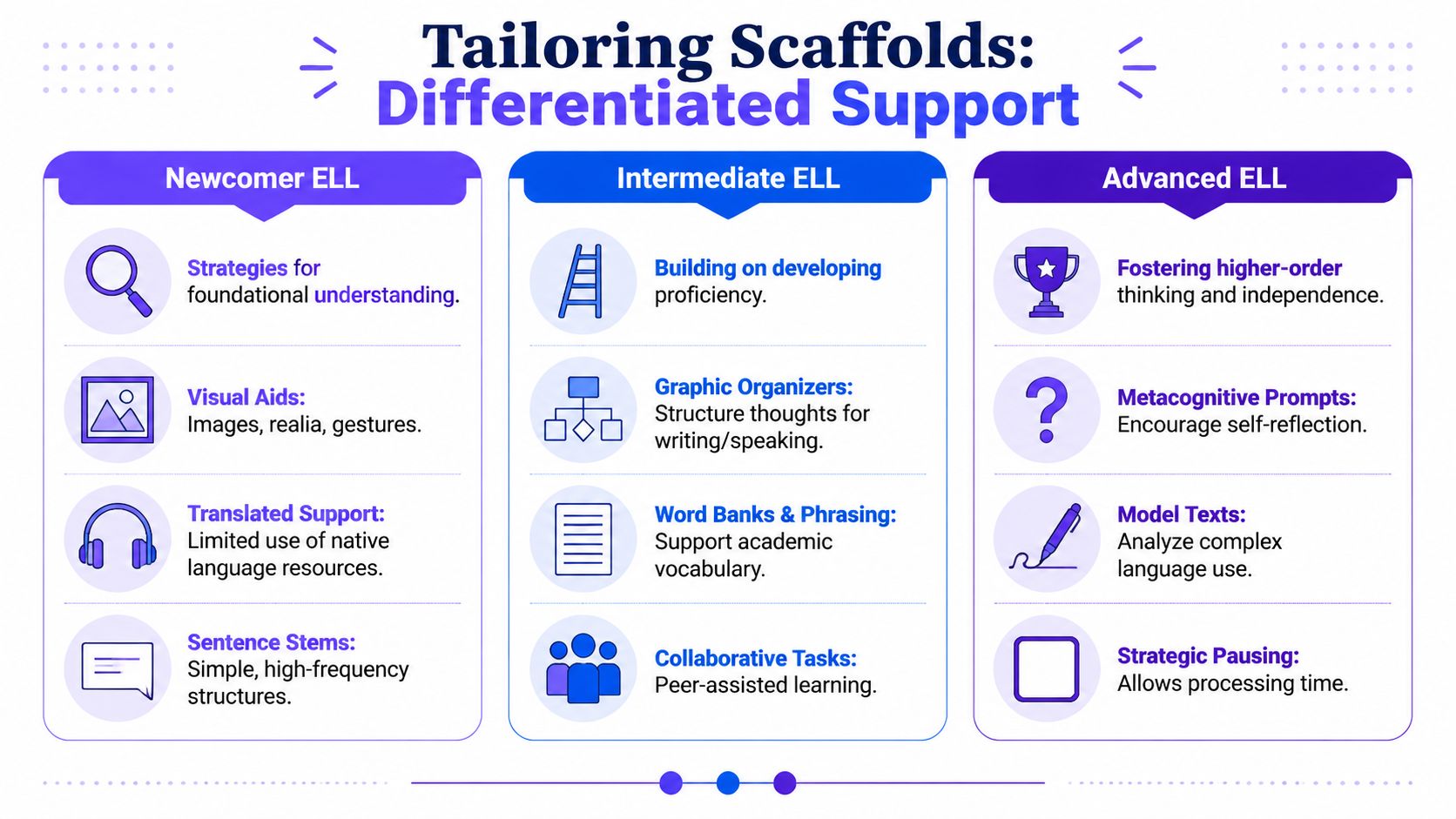
A newcomer, an intermediate multilingual learner, and an advanced ELL can all sit at the same table and need completely different supports. That's why generic “ELL strategies” often disappoint teachers. The strategy itself isn't wrong. It's just mismatched.
A 2018 study by Hammond et al. found that targeted scaffolding was especially effective for older students, with 91% of secondary ELLs in grades 6 to 12 achieving proficiency benchmarks after the intervention, as reported in the Hammond et al. study. Older students can absolutely benefit from scaffolding, but they need supports that preserve rigor rather than infantilize the task.
One task, three versions of support
Let's use one learning objective: Explain how a character changes over the course of a story.
| Learner profile | What they may need | Better scaffold |
|---|---|---|
| Newcomer | Access to core meaning | Images, key vocabulary, translated support where appropriate, simple sentence stems |
| Intermediate | Structure for explanation | Graphic organizer, word bank, partner rehearsal, paragraph frame |
| Advanced | Precision and independence | Model text, academic transitions, metacognitive prompt, reduced sentence support |
For a newcomer, I'd use a sequence of pictures from the story, teach a few key emotion words, and give a stem like “At first, the character is ___. Later, the character is ___.”
For an intermediate learner, I'd move to a cause-and-effect organizer and a frame such as “The character changes from ___ to ___ because ___.”
For an advanced learner, I'd probably drop the frame and instead offer a mentor response to analyze. The support shifts from helping the student produce language at all to helping them sharpen academic language and evidence.
Here's a classroom example in action:
Older students need different kinds of scaffolds
Secondary teachers sometimes resist scaffolding because they associate it with elementary visuals and simplified tasks. But high school scaffolds often look different. They might include guided annotation, partial notes, a model lab conclusion, or a source-analysis chart.
Coach's note: Advanced English learners still need scaffolds. They just need subtler ones.
That's where adaptive planning helps. If you're looking at how technology supports differentiation more broadly, this overview of how to create custom study guides with AI is useful because it highlights the shift from one-size-fits-all supports to materials customized to the task and learner.
The mistake to avoid is giving every multilingual learner the same sentence frame forever. A scaffold that helps one student participate can hold another student back.
Scaffolding Across Content Areas Practical Examples
Scaffolding for English language learners matters just as much in math, science, and social studies as it does in reading class. Students don't stop needing language support when they leave ELA. In many cases, they need it more because content-area texts and tasks are denser.
Math support that keeps the rigor
A multi-step word problem usually breaks down because students can't sort the language from the math. Try a three-read routine.
- First read: What's the situation?
- Second read: What quantities matter?
- Third read: What is the question asking me to find?
Then add a visual bar model or labeled diagram. Students still solve the same problem. They just aren't forced to untangle every language demand at once.
Science support for labs and explanations
Science asks students to do, observe, and explain. The explanation is often the hard part.
A scaffolded lab report can include:
- A hypothesis frame: “I predict ___ because ___.”
- A results table: Pre-labeled so students focus on observations.
- A conclusion starter: “The evidence suggests ___.”
If you want a concrete example of what a scaffolded science worksheet can look like, this ecological succession ESL worksheet shows how visuals, vocabulary support, and structured questions can sit inside a content lesson without watering it down.
Social studies support for complex sources
Primary sources can overwhelm multilingual learners because the syntax is often older, denser, or culturally unfamiliar. I'd rarely hand out the source and ask for immediate independent analysis.
Instead, use:
- A short source chunk
- A margin note prompt
- A sourcing question
- A response frame for claim and evidence
For example, students can complete:
- Claim: “The author believes ___.”
- Evidence: “I know this because the source says ___.”
That keeps the historical thinking intact. Students still analyze perspective and evidence. They just get a clearer lane into the task.
Across subjects, the pattern holds. Strong scaffolds reduce unnecessary language barriers. Weak scaffolds reduce intellectual demand.
Knowing When to Remove the Scaffolds
This is the part teachers inquire about with hesitation, usually after they've watched a student succeed beautifully with support and then freeze the moment the support disappears. That hesitation makes sense. Removing scaffolds too soon can set students back. Leaving them too long can do the same.
A 2023 meta-analysis of 47 randomized controlled trials found a common pitfall in 28% of classrooms: scaffold dependency. It appeared when teachers removed supports too rapidly, within 2 to 3 lessons, instead of fading them gradually over 6 to 8 lessons, according to the 2023 meta-analysis on ELL writing scaffolds). That finding is useful because it names a problem many teachers have felt but couldn't quite describe.
What readiness actually looks like
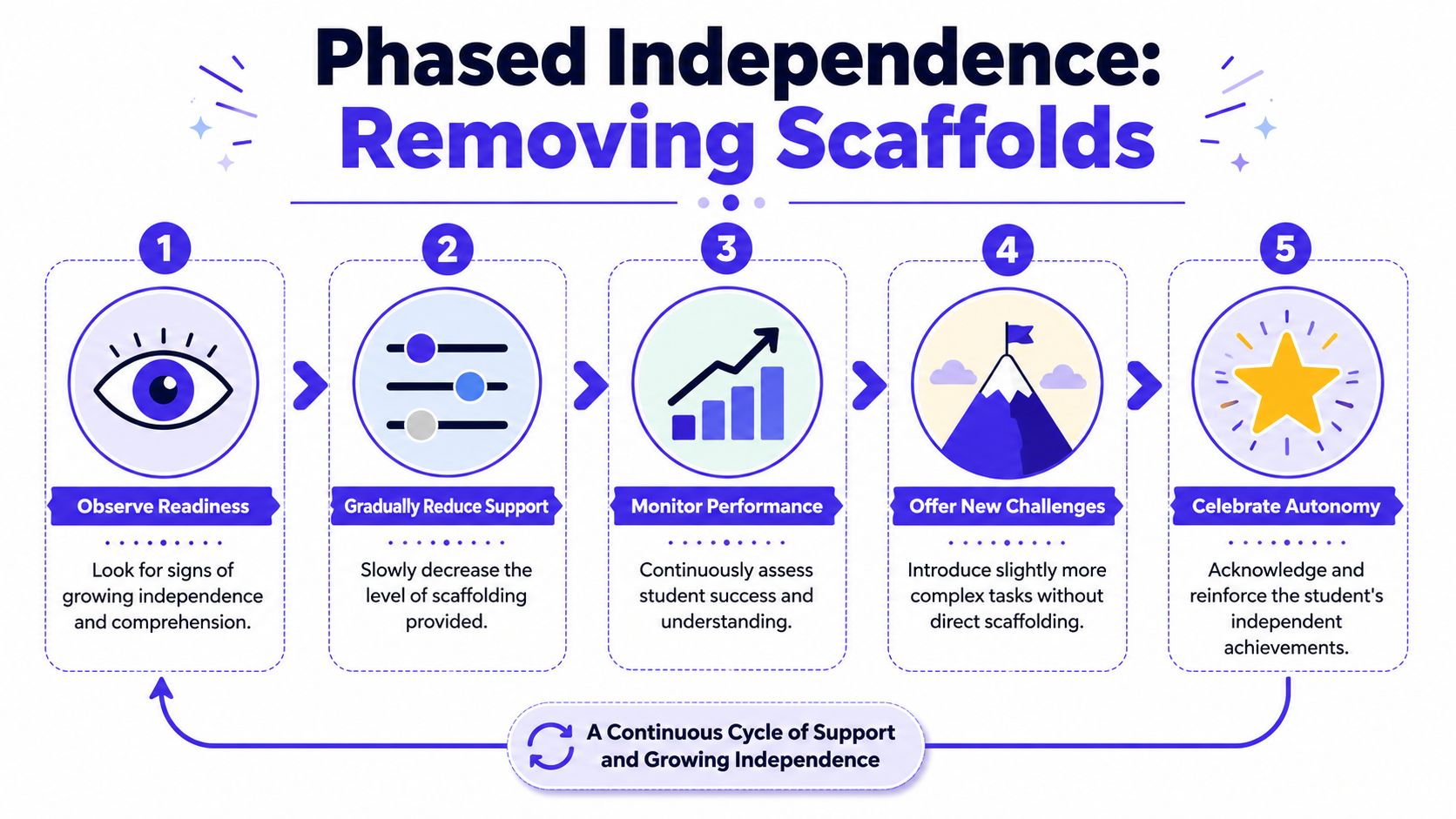
Don't fade a scaffold because the calendar says it's time. Fade it because the student is showing signs of transfer.
Look for these signals:
- The student initiates without waiting: They begin the task before you prompt.
- The student uses the support selectively: They glance at the frame or organizer but don't cling to it.
- The student can explain the process: They can say how they found the answer or built the response.
- The quality holds when support shrinks: Their work stays strong when one layer is removed.
If those signs aren't there, keep the scaffold. But adjust it. Sometimes the issue isn't that the student needs more support. It's that they need a different kind.
Fade one layer at a time
Teachers get into trouble when they remove everything at once. A better move is to peel supports back in stages.
For example:
| Original support | First fade | Next fade |
|---|---|---|
| Full sentence frame | Sentence starter only | Prompt with no frame |
| Completed model paragraph | Partially completed model | Mentor text only |
| Detailed graphic organizer | Reduced organizer | Blank planning space |
That progression protects confidence while still building independence.
“If students can only succeed when the scaffold stays exactly the same, they haven't learned the skill yet. They've learned the routine.”
Use quick formative checks, not gut feeling alone
You don't need a big assessment to decide whether to fade support. A short exit ticket, a quick oral response, or a side-by-side comparison of today's work and last week's work can tell you a lot.
I'd especially watch for whether students can transfer the skill to a slightly new task. That is the true test. A student who can fill in the same paragraph frame every day may still struggle to write independently when the topic changes.
The goal of scaffolding has always been autonomy. Support should leave fingerprints on student growth, not permanent handprints on every task.
If you're trying to build scaffolds that are differentiated, standards-aligned, and easier to fade over time, Kuraplan can help streamline the planning side. It's built for K to 12 teachers who need lesson plans, worksheets, visuals, and structured supports without spending another late evening formatting materials by hand.