You're probably sitting with a half-finished planner, a standards document open in one tab, yesterday's exit tickets in a pile, and that uneasy feeling that your lessons are decent but the learning still feels patchy.
I've been there. Most math teachers have.
Monday's lesson on equivalent expressions goes well. Tuesday's practice looks fine. By Friday, students can do the steps when the numbers look familiar, but they freeze when the problem changes shape. That's usually not a lesson-quality problem. It's a unit problem. The students didn't just need a good activity. They needed a bigger story that connected ideas across days, gave them chances to show what they understood, and made room for support without lowering the goal.
That's where a strong unit plan in mathematics earns its keep.
Why Your Math Lessons Need a Bigger Story
A lot of new teachers plan the way exhausted teachers survive. One lesson at a time.
You find a warm-up. You build a mini-lesson. You add guided practice. You hope tomorrow will connect itself. Sometimes it does. Often it doesn't.
When good lessons still leave gaps
I once watched a colleague teach a sharp set of lessons on solving equations. Each day had clear examples, solid questioning, and students were busy the whole time. But when the unit ended, many students still treated every equation as a separate trick. They hadn't built a connected idea of balance, structure, and why inverse operations work.
That's the trap. Isolated lessons can produce activity without producing coherence.
Math especially punishes disconnected teaching. Students need to carry one idea into the next lesson, then into the next unit, then into the next grade. If they don't, fluency becomes fragile and transfer almost disappears.
Good math teaching isn't just about what students do today. It's about what today prepares them to understand tomorrow.
A unit gives the learning somewhere to go
A math unit solves that problem by giving your lessons a through-line. Instead of planning five separate class periods, you plan a progression.
You decide:
- What understanding anchors the unit
- What students need before they can succeed
- Where they'll practice
- How they'll apply the idea
- How you'll know they're getting there
That changes everything. Now the lesson on models isn't “Monday's activity.” It becomes the foundation for Tuesday's procedure, Wednesday's misconception check, and Friday's application task.
Why this matters for real classrooms
This isn't about making your plan book prettier. It's about reducing those familiar classroom headaches:
- Students forget yesterday's idea because the connection was never made explicit.
- Intervention turns into random reteaching because the unit never identified the critical building blocks.
- Advanced students stall out because extension wasn't built toward the same goal.
- Assessment comes too late because the only real check is the test at the end.
A strong unit plan fixes those issues before they show up. It helps you teach with purpose instead of reacting day by day.
What a Unit Plan in Mathematics Really Is
A unit plan in mathematics is not a folder full of worksheets. It's not just pacing, either. It's a connected design for helping students build understanding over time.
A major shift in math planning has been the move to standards-based unit design, where the unit is organized around a small set of standards, objectives, essential questions, and a lesson timeline. Louisiana's math unit-planning guidance lays out that pattern clearly: identify standards in the scope and sequence, create a unit assessment and culminating task, and then build daily tasks that connect concepts across the unit, a structure that reflects the broader move from loose lesson sequences to explicit learning progression and evidence of mastery in math planning (Louisiana mathematics unit-planning guidance).
Think road trip, not single stop
The easiest analogy is a road trip.
A lesson plan is today's stretch of road.
A unit plan is the whole route.
The standards are the destination. The objectives are your checkpoints. The essential questions are the signs that keep students oriented. The assessments tell you whether the class is on the road or lost two exits back.
When you plan this way, math instruction becomes much more deliberate. You're not asking, “What should I do tomorrow?” You're asking, “What does tomorrow need to accomplish so students can handle what comes after it?”
What makes math units different
Math units need structure because the subject builds vertically. Students don't just collect facts. They develop concepts, procedures, and the ability to apply them in unfamiliar situations.
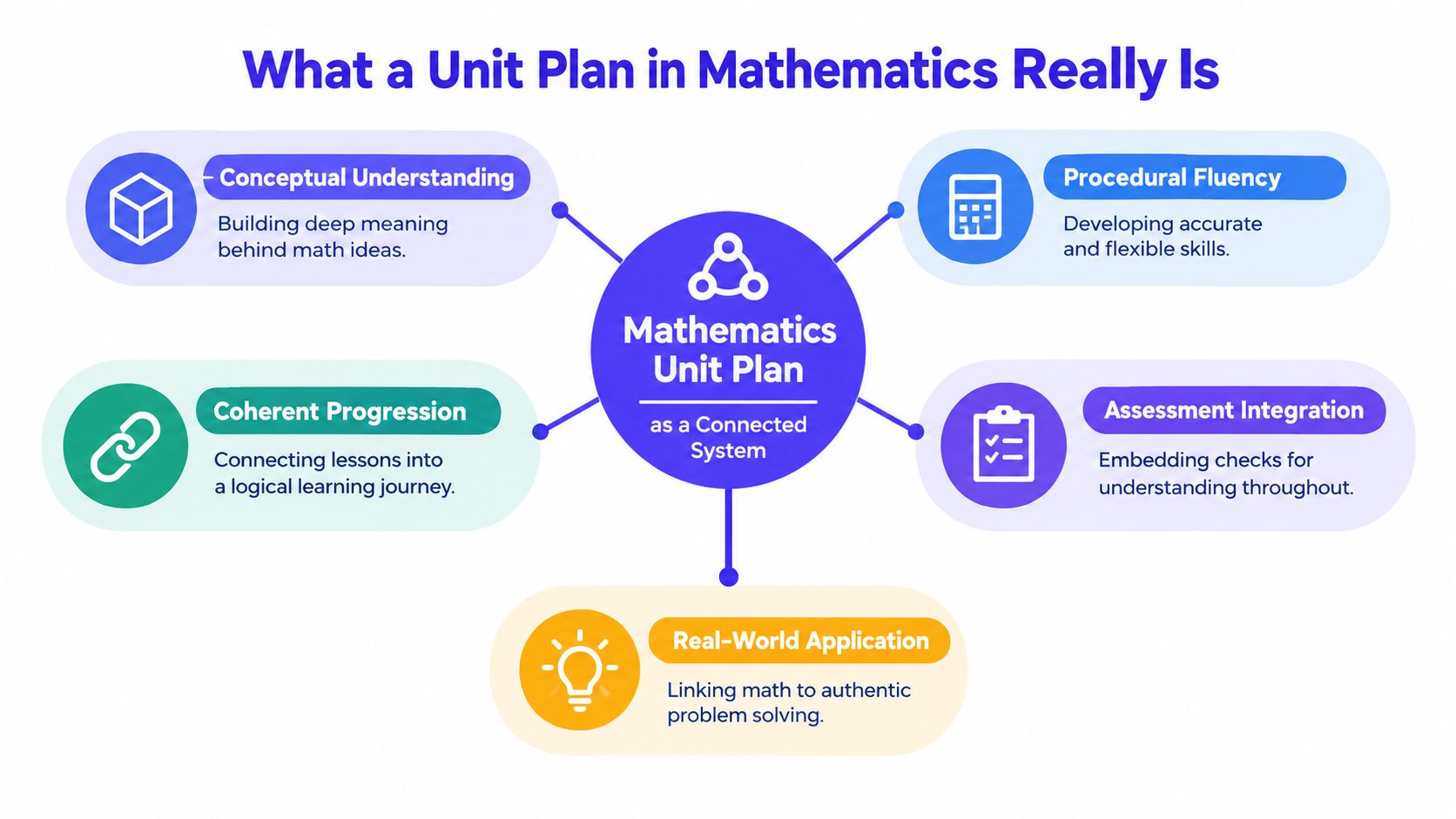
That's why a unit in mathematics works best as a system with parts that support one another:
- Conceptual understanding so students know what the math means
- Procedural fluency so they can work accurately and efficiently
- Coherent progression so each lesson grows out of the previous one
- Assessment integration so you can adjust before confusion hardens
- Application so the learning does something beyond the practice page
If you're trying to strengthen your planning tools or fund better curriculum work, it can help to browse education grants that support classroom and program needs.
The practical difference from a lesson plan
A lesson plan answers, “How will I teach this class period?”
A unit plan answers, “How will students move from where they are now to durable mastery across several connected lessons?”
That's the difference most new teachers feel before they can name it. A lesson can be strong and still fail the larger goal. A unit keeps the larger goal visible every day.
Core Components Every Strong Math Unit Needs
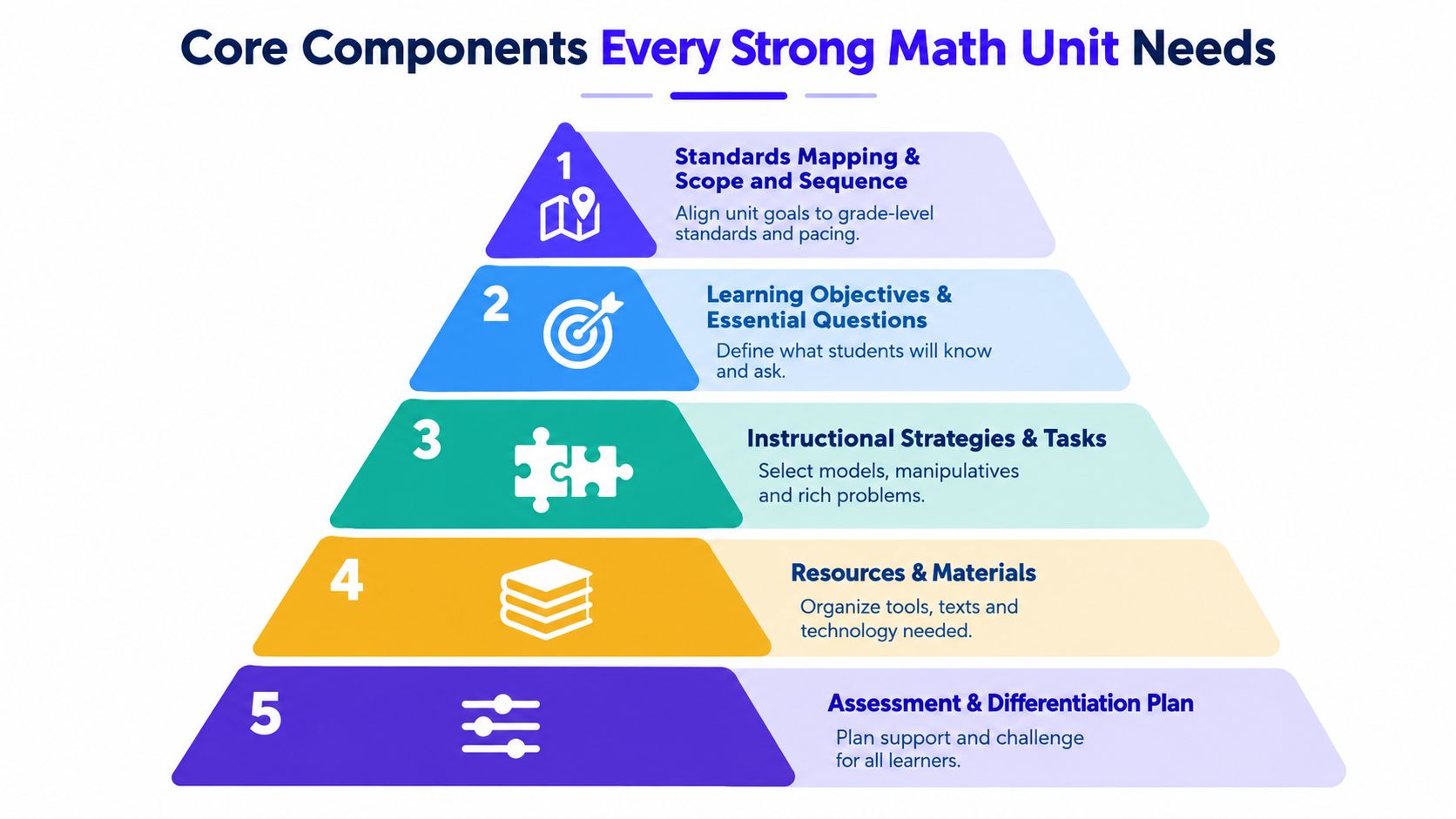
A strong unit doesn't start with activities. It starts with alignment. Then it builds the parts that keep the teaching coherent and the evidence usable.
One educational source notes that a single unit of lesson plans can last from a quarter of a year to an entire year depending on time allocation, and teacher-education materials commonly describe math unit planning with three or more overarching standards, three to six essential questions, a pre-test and post-test, and at least four connected lesson outlines, while standards-aligned assignments often require a 3 to 5 lesson sequence with at least two formative checks and one summative assessment (Living Math lesson planning overview).
Standards and scope come first
Start by choosing the standards that belong together. Not everything in the chapter has to live in the same unit.
A solid standards-aligned mathematics unit is expected to include three or more overarching standards and objectives, plus three to six essential questions or problems, along with a timeline that includes a pre-test, lessons, and a post-test. The same teacher-education handbook also says the pre-test and post-test should align to the same standards and mirror each other in problem type and difficulty (mathematics education handbook).
That matters because standards mapping does more than organize paperwork. It keeps you from drifting into interesting side roads that don't build the target understanding.
Objectives and essential questions do different jobs
New teachers often blend these together. They're related, but they're not the same.
- Objectives name what students should know or do.
- Essential questions keep the mathematical thinking open and connected.
For example, an objective might focus on solving systems of equations. An essential question might ask how different representations show the same relationship. One is a target. The other keeps the unit intellectually alive.
The lesson sequence has to be visible
A good unit plan lets you see the flow before you teach it. You should be able to point to the opening lesson, the midpoint check, and the task that asks students to transfer the idea.
Here's a quick contrast:
| Thin unit | Strong unit |
|---|---|
| Standards listed at top | Standards actually drive the sequence |
| Pacing calendar only | Clear progression across connected lessons |
| Final test only | Pre-test, formative checks, and summative task |
| Differentiation added later | Support and challenge built into the plan |
Coherence principle: Ideas and skills should connect within a lesson, across lessons, from unit to unit, and from year to year, while avoiding excessive repetition.
That coherence principle shows up in current curriculum guidance on mathematics, which describes coherence as the connectedness and sound development of ideas and skills across lessons and units (research on coherence in mathematics curriculum).
Assessment and differentiation belong inside the unit
Assessment shouldn't be bolted on at the end. Differentiation shouldn't mean one easier worksheet and one harder worksheet.
A strong unit plan includes:
- A pre-assessment that shows entry points
- Formative checks during lessons, not just after them
- A summative task that matches the standards and questions of the unit
- Differentiation moves for students who need support and students ready to extend
When those pieces work together, the unit becomes teachable. It becomes adjustable.
How to Sequence Lessons So Learning Actually Sticks
The order of lessons matters as much as the lessons themselves. A unit can include good materials and still feel flat if the sequence asks students to perform before they understand, or apply before they're fluent enough to think.
A clear planning sequence from math pedagogy materials is simple and useful: identify the unit content, state the general and specific objectives, plan suitable learning experiences, and then choose evaluation tools and techniques tied to content coverage, objective attainment, and teaching effectiveness (mathematics pedagogy guidance).
Build from prerequisite to transfer
That sequence works because it mirrors how students learn math.

A practical flow often looks like this:
- Check the floor first. Before teaching new content, find out whether students have the prerequisite ideas and fluency they'll need.
- Teach for meaning early. Use models, examples, and discussion before rushing to shortcuts.
- Move into procedure. Once the concept is stable enough, build accurate and flexible methods.
- Connect across lessons. Keep naming how today's work grows from yesterday's.
- End with application. Give students a chance to use the math in a less rehearsed setting.
Recent planning guidance also emphasizes checking prerequisite conceptual understanding and fluency, identifying what students must know and do, and embedding formative tasks that surface misconceptions along the way (lesson plan template with formative emphasis).
Where teachers usually overdo repetition
Repetition feels safe, especially when students struggle. But too much of the same kind of practice can stall the unit.
If three lessons in a row use nearly identical tasks, students often stop thinking and start mimicking. Instead, keep the concept steady and vary the representation, context, or demand.
Preserve the learning progression. Don't repeat yesterday just because a few students looked uncertain for five minutes.
Tools that help with sequencing
When I'm mapping a unit, I want one place to see objectives, lesson order, checks for understanding, and likely stumbling points. Some teachers do that in a spreadsheet. Others use a planning template shared across a department.
If you want digital help, Kuraplan's lesson planning guide is a useful starting point for thinking through lesson structure inside a broader sequence. Kuraplan can also map objectives and generate sequential lesson progressions, which is handy when you want the unit flow visible before you start writing each day's materials.
This short video is also worth a look if you're tightening how lessons build over time.
Measuring Mastery Without Drowning in Worksheets
You finish a lesson on ratios feeling pretty good. Students were talking, solving, and nodding along. Then you look at the stack of practice pages and realize you still cannot answer the question that matters most. Who understands the relationship, and who is copying a pattern?
That is the trap. A unit can feel busy and still leave you with weak evidence.
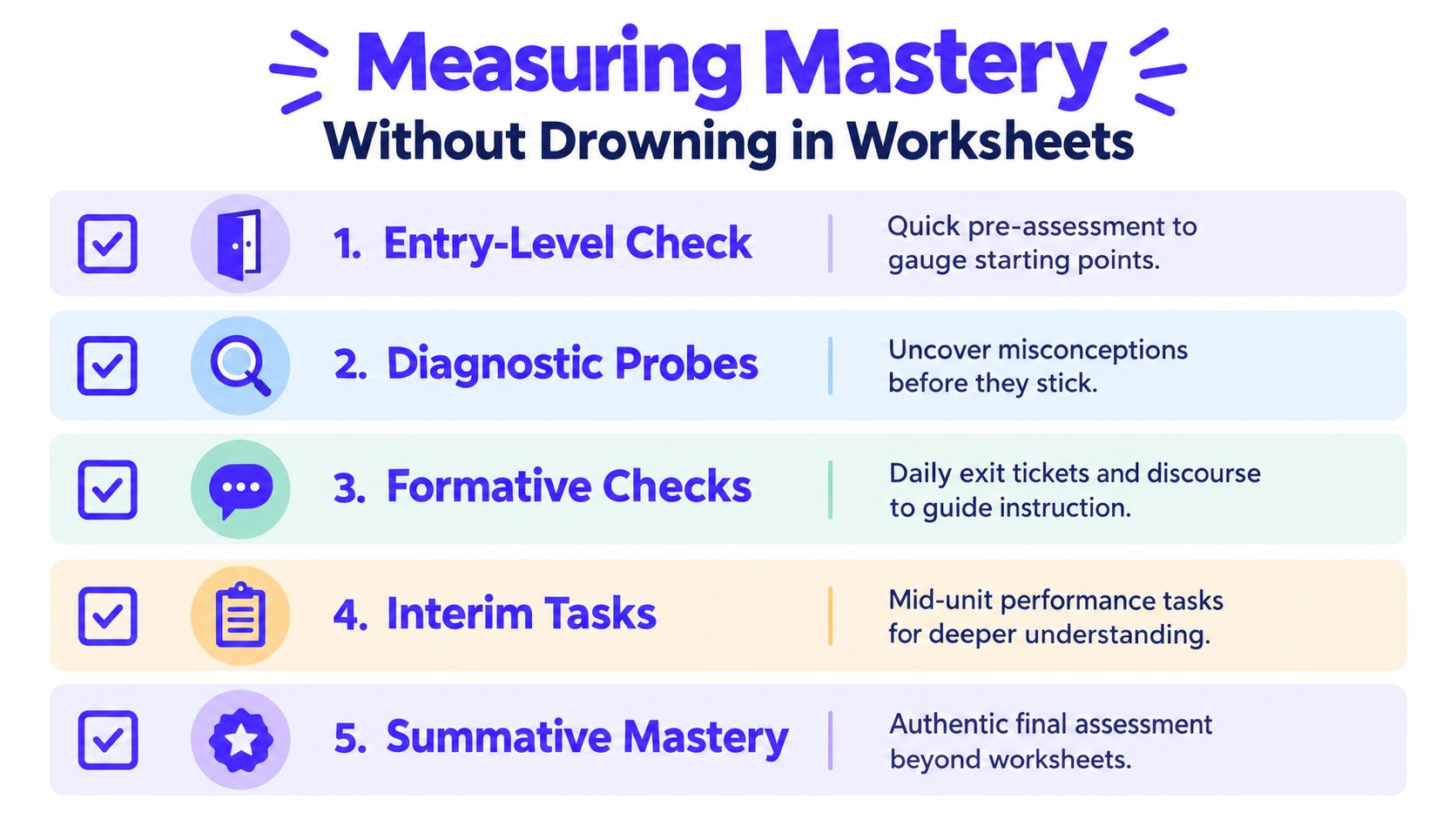
Current district guidance often expects math materials to include entry-level, diagnostic, formative, interim, skill-based, and summative assessments, plus clear direction for how teachers adjust instruction from what students show. That matters because many unit plans still name the standards, set the pacing, and save most of the evidence gathering for the final test (detailed mathematics planning guidance).
What enough evidence actually looks like
A strong math unit works like checking the temperature while you cook, not waiting until the meal is on the table. You do not need a gradebook entry every day. You do need frequent proof of thinking.
A practical pattern looks like this:
- Entry-level check to see what students already bring to the unit
- Diagnostic prompt right before a predictable misconception shows up
- Daily formative checks such as whiteboards, exit slips, quick writes, or a short teacher conference
- Mid-unit performance task that asks students to connect ideas across representations
- Summative assessment aligned to the unit goal
The key is variety. If every check is a worksheet, students learn that math class means filling space. If the checks include talk, visuals, annotations, short explanations, and worked examples, you see much more of their reasoning.
Use evidence to choose the next move
Assessment should help you plan tomorrow's lesson.
Suppose students can solve a proportion with cross multiplication but stumble when asked what the numbers mean in context. That does not call for three more pages of the same procedure. It calls for a different representation, a better question, or a chance to compare methods aloud.
Small gaps need small responses. A few students may need a quick prerequisite review during work time. Others may be ready to test the same idea in a less familiar setting. Both groups can stay aimed at the same grade-level destination.
That is the heart of an assessment-rich unit. Evidence flows through every lesson, and the class does not split into one track for intervention and another for real math.
Keep intervention and acceleration tied to the same goal
Many unit plans wobble. Teachers see mixed results and respond by sending one group backward and another group far ahead. The room gets busy, but the math goal gets blurry.
Keep one shared target. Change the support, not the destination.
- For students who need intervention: use clearer visuals, smaller numbers, sentence frames, partially worked examples, or a brief small-group review of the missing prerequisite
- For students ready for acceleration: raise the complexity, ask for justification across methods, add a new constraint, or shift to an application that requires transfer
- For the whole class: close the lesson by reconnecting everyone to the same mathematical idea
Students should feel that they are climbing the same hill by different paths, not being sent to different mountains.
If you want those checkpoints to stay clear for both you and your students, clear learning intentions and success criteria for math lessons can help you define what students are aiming for and what evidence will show real progress.
Mathematics Unit Plan Examples and Templates You Can Use
Let's make this concrete. Below are two versions of the same idea.
Example one versus example two
Thin unit plan
A teacher lists the standards, writes “fractions” across two weeks, assigns pages from the book, and gives a test at the end. The pacing is clear enough, but the learning path isn't. There's no pre-test, no clear essential questions, and no planned points for intervention or extension.
Strong unit plan
A teacher identifies the standards, drafts the unit goal, and writes essential questions students can revisit across the sequence. The unit includes a pre-test and post-test aligned to the same standards, a set of 3 to 5 connected lessons, at least two formative checks, and a summative task that asks students to apply the core idea, which matches common standards-aligned unit expectations described in teacher preparation materials already noted earlier.
The difference isn't polish. It's usability.
A template that actually helps in practice
A Key Stage 4 mathematics unit template requires teams to identify agreed objectives, the sequence of activities, teaching and learning approaches, resources and references, which teachers and classes will trial the unit, and when the team will meet to review outcomes and revise the unit. That turns planning into a collaborative test-and-improve cycle instead of a one-time document (Key Stage 4 unit planning template).
Here's the checklist I'd use:
- Unit overview with the big mathematical idea
- Standards and objectives grouped logically
- Essential questions that keep the unit focused
- Lesson sequence across connected class periods
- Pre-assessment and post-assessment aligned to the same goals
- Formative evidence plan built into the lessons
- Resources and materials including models, tech, and visuals
- Differentiation notes for intervention and acceleration
- Trial classes and team review date if you're planning collaboratively
If you want inspiration while building your own bank, it can be useful to look at free standards-aligned lesson plans and study how other teachers frame objectives and tasks, even if you adapt the ideas for math.
Turning the template into a ready-to-teach unit
Templates are helpful, but they still take time to fill. If you want a faster starting point, Kuraplan's unit plan generation tools can build standards-aligned unit frameworks, lesson sequences, worksheets, and visuals from a topic and year level. That's useful when you want the skeleton of the unit in place quickly and then tailor it to your students.
Putting Your Next Math Unit Into Action
The biggest shift is simple. Stop planning lessons as separate events. Start planning learning as a progression.
If your next unit feels messy, don't rebuild everything at once. Pick one upcoming topic and tighten these moves first:
- Choose the central goal clearly. What should students understand by the end?
- Check the prerequisite knowledge. Don't guess.
- Plan the sequence on purpose. Meaning first, then fluency, then application.
- Add formative evidence inside the lessons. Not just at the end.
- Design support and challenge toward the same grade-level idea. Don't split the math into unrelated tracks.
The common pitfalls are predictable. Too many standards in one unit. Too much practice before understanding. A final test that doesn't match what was taught. Intervention that replaces grade-level work instead of supporting access to it.
You don't need a perfect unit on the first pass. You need a teachable one. Then you revise it after real students show you where it holds and where it leaks.
If time is the barrier, use tools that reduce formatting and alignment work so you can spend your energy on the mathematics and the students in front of you.
If you want help building a stronger unit plan in mathematics, Kuraplan creates standards-aligned unit plans, connected lesson sequences, worksheets, visuals, and assessment pieces in one place. It's a practical way to move from scattered lesson planning to a coherent unit you can teach, revise, and reuse.