
At 7:14 on Monday morning, the classroom is quiet, the coffee is already getting cold, and a blank unit-plan template is open beside a pacing guide. Three standards are highlighted, last year's plan is sitting in another tab, and there are only 53 minutes of planning time before bus duty. The temptation is obvious: copy, adjust the dates, and hope the assessment still fits.
That approach usually creates the same problems later. The assessment measures something slightly different from the standards, the middle of the unit gets squeezed, and students need re-teaching because the original scope was never realistic. Unit planning in teaching is less a template problem than a workflow problem. The plan has to help you make the right decisions in the right order, within the time you have.
The Monday Morning Unit Plan Problem
A blank template looks harmless. It may even promise organization. But a template can't decide which standard deserves priority, what students must produce as evidence, or where a difficult prerequisite belongs in the sequence. Those decisions are the work.
Teachers often lose time in predictable places:
- Starting with activities: A clever project gets planned before anyone defines the learning it should demonstrate.
- Copying last year: The old sequence may reflect a different calendar, class profile, or assessment.
- Overloading the unit: Every related standard, text, vocabulary list, and enrichment idea gets added until the calendar can't hold it.
- Separating assessment from instruction: The final task appears at the end, but daily lessons don't build toward its demands.
- Planning alone: Several colleagues create similar resources while interventionists and co-teachers discover the unit's expectations too late.
The result isn't always a bad-looking plan. In fact, many overloaded plans look impressively complete. The problem appears during implementation, when a lesson takes longer than expected, an exit ticket shows a missing prerequisite, or students reach the final task without enough practice.
Practical rule: A usable unit plan should help you answer three questions quickly: What matters most, what evidence will show learning, and what must happen before that evidence is possible?
This article treats the unit as a practical operating system for instruction. You'll use backward design to establish the destination, scope and sequence to control the route, alignment mapping to connect standards with evidence, and team workflows to prevent duplicated effort. If you have classroom materials to organize while planning, teacher classroom supplies with InchBug offers a useful resource for preparing and labeling the physical side of classroom routines.
Don't test the process on an imaginary perfect unit. Use the next unit already on your calendar. Let its real standards, real students, and real interruptions show you where the workflow needs tightening.
What Unit Planning Actually Is in Teaching
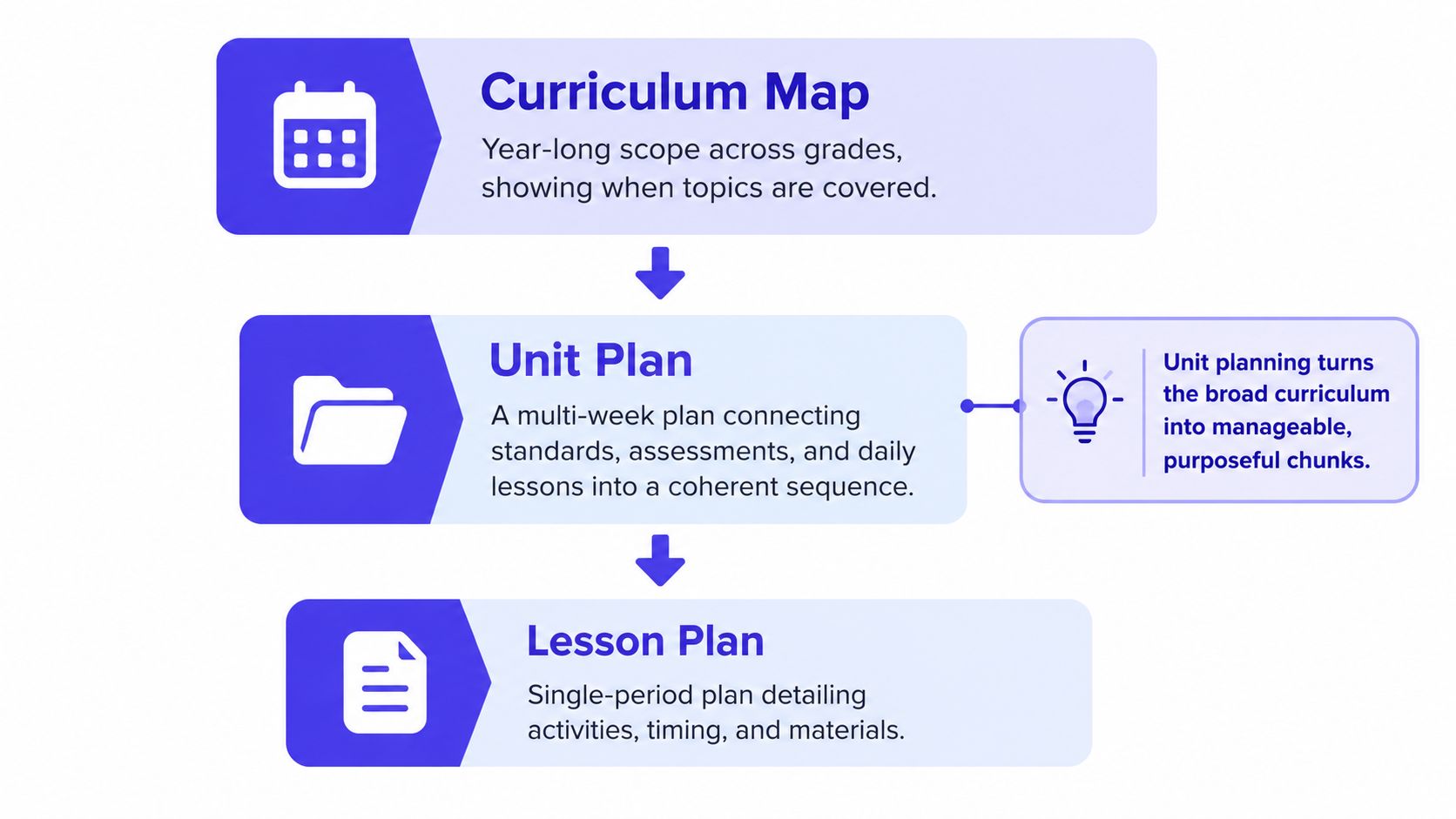
Unit planning is the middle layer between long-term curriculum planning and daily lesson planning. Curriculum maps show the year-long scope across grades and indicate when major topics appear. Daily lesson plans handle the immediate work of a class period, including activities, timing, questions, and materials. The unit plan connects those two views.
A useful analogy is a bridge. The curriculum map is the whole route across the year. The unit plan is one bridge segment carrying a coherent set of lessons toward a shared destination. Each daily lesson is a plank. A bridge made of unrelated planks may look busy, but it won't reliably carry students anywhere.
Historical and curriculum-planning guidance commonly places units in a medium-term window of about two to six weeks, followed by daily lessons, as described in this history methods module on unit planning. That length isn't a rule for every subject. It gives teachers a useful scale for grouping connected content, skills, questions, and assessments without reducing the year to isolated activities.
A complete unit plan usually contains:
- Priority standards: The outcomes that deserve sustained attention.
- Learning objectives: What students will know, understand, or do.
- Learning sequence: The order in which knowledge and skills develop.
- Formative checks: Small pieces of evidence that reveal whether students are ready to continue.
- Summative assessment: The larger performance or product that demonstrates the unit goal.
- Resources and supports: Texts, models, materials, scaffolds, and differentiation.
- Pacing notes: The realistic allocation of instructional time, including flexibility.
The middle layer is where teachers make the expensive decisions. A curriculum map can't tell you whether students need a vocabulary lesson before analysis. A daily lesson plan can't show whether three consecutive activities prepare students for the final performance. The unit plan can do both.
The Historical Association's planning guidance places long-term planning, medium-term unit planning, short-term lessons, and assessment inside one curriculum structure. That arrangement matters because the unit isn't an administrative outline. It's the place where broad goals become a teachable, assessable sequence.
Backward Design That Fits a Real Planning Day
Backward design can sound like another planning initiative until you see its logic. You aren't adding a new document. You're changing the order in which you make decisions: define the destination, decide what counts as evidence, then choose the route.
Stage one identifies the destination
Start with the priority standards. Unpack each one into the content students need, the thinking or performance they must demonstrate, and the conditions that matter. Then write three to five big understandings in language that will still matter after the unit ends.
Add one to three essential questions. For a history unit, those might include, “How do competing interests shape historical change?” or “What makes evidence convincing?” The questions should create a reason for students to connect lessons rather than treat each lesson as a separate task.
A teacher's note might read: Students will explain causes of the Civil War at the expected reasoning level, using evidence from several sources.
Stage two defines acceptable evidence
Decide what students will create, explain, solve, perform, or defend. Write the summative task before drafting lessons, then describe what proficiency looks like. Plan two or three formative checkpoints that give you time to respond, not merely record confusion.
The evidence should resemble the final demand. If students must explain causal relationships, a string of recall questions won't provide enough preparation or information. A short source analysis, an oral explanation, or a cause-and-effect organizer may reveal the exact misconception that needs attention.
Stage three plans the learning experiences
Only now should you choose the lessons. Sequence models, guided practice, collaborative work, independent performance, feedback, and re-teaching. Put materials beside the lesson where they are needed, not in a separate wish list that you may forget to prepare.
The ASCD explanation of Understanding by Design describes this progression as desired results, acceptable evidence, and learning experiences. The structure protects alignment between what the curriculum says, what you teach, and what students are asked to demonstrate.
A realistic planning day doesn't require finishing an entire polished unit. Use the first part of the window to identify results, the middle to draft evidence, and the final part to sketch the sequence. The exact minutes will vary by school schedule and unit complexity. The important constraint is that one planning period should produce decisions, not formatting.
For a ready-made daily structure after the unit decisions are clear, use this lesson plan template as a place to capture objectives, activities, and checks without letting the document drive the thinking.
This short video provides another visual explanation of the backward-design process:
Building a Scope and Sequence You Can Pace
Scope answers what belongs in the unit. Sequence answers what comes first. Pacing answers how much instructional time each piece can reasonably receive. Teachers get into trouble when they solve only the first question.
Begin with a raw inventory of the standards, topics, prerequisite skills, vocabulary, texts, and required performances. Then reduce it. A unit isn't stronger because it contains every interesting connection. It becomes stronger when each selected element supports the central learning.
Order knowledge for readiness
Sort the learning from concrete to abstract, familiar to unfamiliar, or simple to complex. In a mathematics unit, students may need a conceptual model before a procedure. In science, they may need observation and vocabulary before explanation. In writing, they may need to analyze a model before independently producing the same kind of text.
Use a simple two-column working document:
| Learning target | Day or block |
|---|---|
| Identify the central concept | Day 1 |
| Apply the concept to a familiar example | Day 2 |
| Explain the relationship using evidence | Day 3 |
| Formative check and response | Day 4 |
| Transfer the idea to a new context | Day 5 |
Leave an intentional blank row after several learning targets for a formative check. The blank isn't wasted space. It gives you a place to pause, inspect student work, and change the next lesson.
Pace the unit against evidence
When the learning targets overflow the available calendar, don't speed up. Cut or merge the lowest-priority items, shorten transitions, or move enrichment outside the core sequence. A crowded plan often creates more work because unfinished learning returns as re-teaching later.
Reserve a full class period mid-unit for response to exit-ticket evidence when the content warrants it. Add a flex lesson near the end for catch-up, extension, conferencing, or a final revision. This makes the unit finish on student evidence rather than on an arbitrary date.
The U.S. Department of Education curriculum toolkit connects scope and sequence with focused goals, conceptual understandings, vocabulary, connections, and an end-of-unit assessment. It also emphasizes adjusting the curriculum during implementation using formative and summative information. That is the difference between a calendar and a pacing system.
Aligning Standards, Lessons, and Assessments
Alignment is more precise than placing a standards code at the top of a document. The standard written on page one should describe the same learning students practice in lessons, demonstrate on exit tickets, and show in the final assessment.
Take one standard and unpack it into three layers:
- Content skill: What knowledge or action must students demonstrate?
- Reasoning skill: How must they think, justify, compare, analyze, or transfer?
- Proficiency expectation: What does meeting the target look like by the end?
A proficiency scale gives the team shared language. Students at level 3 meet the intended target. Students at level 4 transfer the skill to a new context. Students at level 2 need additional instruction before the unit closes. The scale doesn't have to become a complicated grading system. It needs to clarify the difference between partial performance, expected performance, and deeper transfer.
The Kansas standards-to-assessment guidance recommends unpacking standards, mapping content and lessons to outcomes, and connecting assessment tasks to proficiency expectations. That map makes gaps and overlaps visible before students encounter them.
| Standard | Lesson Targets | Formative Checks | Summative Item |
|---|---|---|---|
| Analyze how evidence supports a claim | Identify relevant evidence in a model | Annotated paragraph exit ticket | Evidence analysis in the final response |
| Explain reasoning between evidence and claim | Write a reasoning sentence | Partner explanation and teacher conference | Reasoning section of the rubric |
| Transfer the skill to a new issue | Apply the structure independently | On-demand paragraph | Independent argument or explanation |
The common mismatch is subtle. A teacher may teach students to analyze evidence, then assess only whether they can recall facts. Another teacher may teach explanation, then grade conventions more heavily than reasoning. The quick fix is to circle the verb in the standard and compare it with every major assessment demand. If the standard says analyze, the assessment must require analysis, not recognition.
For a practical way to phrase what students are learning and how they can show it, use these learning intentions and success criteria as a planning reference.
A Worked Example Unit From Start to Finish
Consider a Grade 5 persuasive writing unit planned across three weeks. The transfer goal is concrete: students will write a letter persuading the principal to change a real school rule. That audience and purpose immediately shape the evidence students need.
The destination and evidence
The essential questions are:
- How do writers make a position convincing?
- How do reasons and evidence support a claim?
- How can a writer respond fairly to another point of view?
Before drafting lessons, write the final rubric with four proficiency levels. The criteria cover a clear claim, relevant reasons and evidence, acknowledgment of another perspective, organization, and control of language. The rubric tells students what quality means and tells the teacher what instruction must address.
The evidence sequence begins with a cold-write pre-assessment. Students then complete two on-demand paragraphs during the middle of the unit, followed by the final letter. Each checkpoint answers a different question. The cold write reveals starting points, the paragraphs show developing control, and the letter demonstrates independent transfer.
The three-week sequence
| Week | Learning focus | Evidence and response |
|---|---|---|
| Week 1 | Model and analyze persuasive letters, identify claims, reasons, evidence, and audience | Cold write, model annotation, short claim-and-reason check |
| Week 2 | Draft claims and reasons, select evidence, address another viewpoint | Two on-demand paragraphs, conference notes, targeted re-teaching |
| Week 3 | Revise organization and reasoning, edit for audience, publish | Rubric-based peer review, final letter, reflection |
Across nine lessons, each cluster includes instruction, practice, and a checkpoint. The first cluster establishes the structure through models. The second moves students into drafting and conferencing. The third focuses on revision and publication. If the midpoint paragraphs show that students can state claims but can't connect evidence to reasoning, the next lesson changes. It doesn't blindly follow the original activity list.
This example demonstrates the full workflow: standards determine the writing demands, the rubric defines proficiency, checkpoints produce evidence, and the sequence builds toward an authentic performance. The plan is complete because the parts depend on one another, not because every box in a template is filled.
Team Planning and Workflows That Save Time
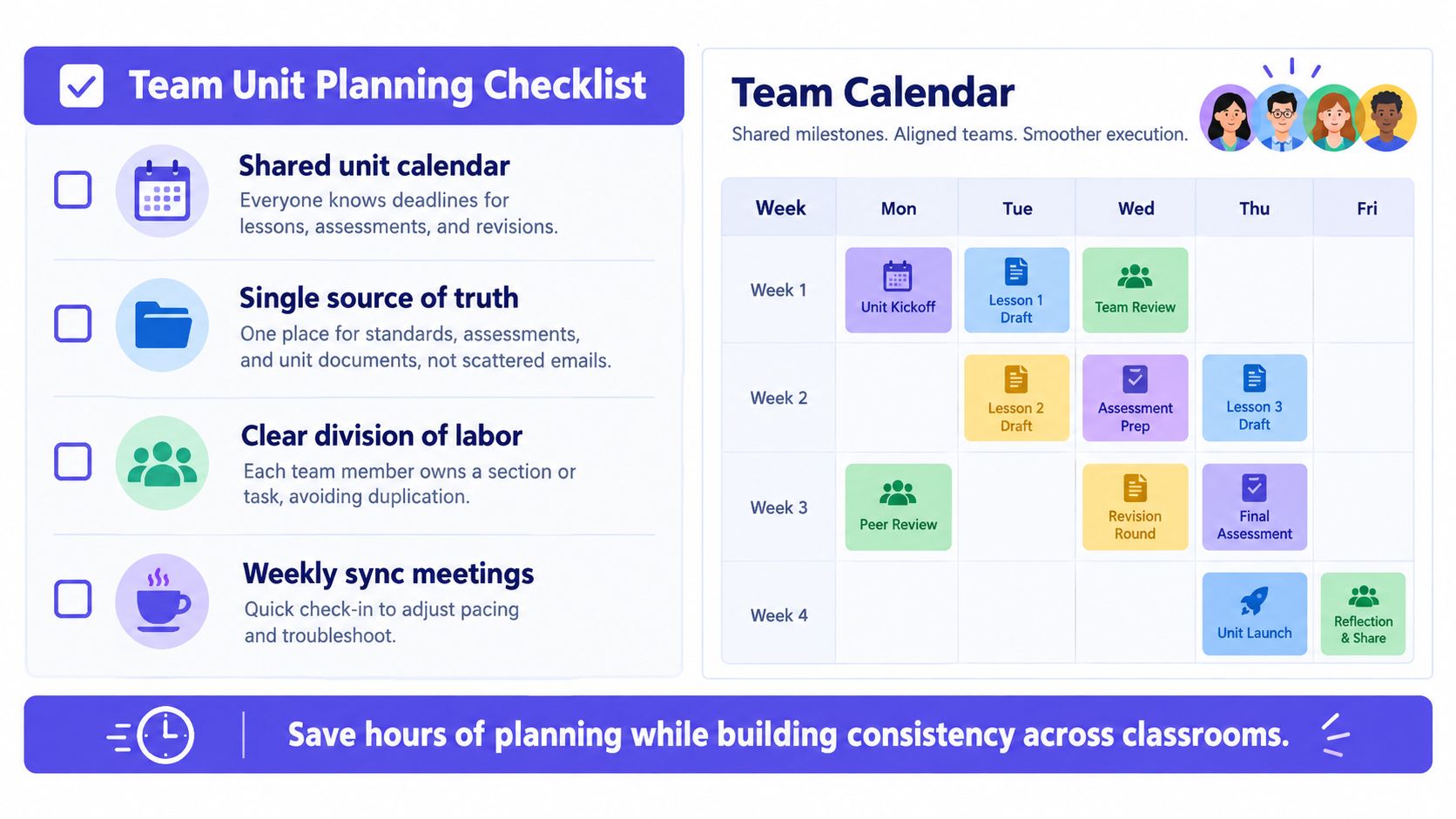
Unit planning gets lighter when it becomes a shared workflow rather than a weekend activity repeated by every teacher. Start with one shared calendar that shows lesson sequence, formative checks, assessment dates, resource needs, and planned flex time. Then keep the standards, assessment, rubric, and daily sequence in one source of truth.
A team can divide the work without dividing the unit:
- Driver: Builds the first sequence and records the core decisions.
- Reviewer: Checks that objectives, tasks, and assessment demands match.
- Assessor: Reviews the rubric, exemplars, and formative checks for usable evidence.
- Adaptation partners: Identify supports, extensions, language needs, and intervention points.
The roles can rotate. What matters is that someone owns each decision and everyone can see the current version.
Make short collaboration count
A focused weekly huddle can replace scattered messages when the agenda stays narrow:
- What evidence did students produce?
- Which learning target needs another pass?
- Is the next lesson still realistic?
- What resource or adaptation does each teacher need?
Co-teachers, specialists, and interventionists should see the unit before a lesson fails. A reading support teacher may identify a vocabulary barrier. A special education teacher may suggest a more accessible way to show the same understanding. A specials teacher may need the calendar for a connected project. These dependencies belong in the plan, not in last-minute hallway conversations.
Teachers also need to acknowledge the structural constraint. A 2025 Grattan Institute survey found that 50% of teachers spend six or more hours each week creating and sourcing lesson materials, while a quarter spend ten hours or more. The same source reports that schools with a common materials bank save teachers about three hours each week. Separately, a 2025 NCTQ analysis reports that public school teachers receive about 53 minutes of planning time per day, or under 4.5 hours per week.
Those figures explain why a polished template isn't enough. The workflow must reduce searching, duplication, and formatting. A platform such as Kuraplan's unit plan generation tool can fit at the drafting stage by helping organize interconnected lessons, progression, and assessment planning. Teachers still need to review the standards, adapt examples, and use professional judgment, but they don't have to begin every sequence from an empty page.
Bringing It All Together in Your Next Unit
A polished template can hide weak decisions. A usable unit plan does something more demanding: it protects the important learning when the calendar shifts, students need more time, and the teacher's planning window disappears.
The core shifts are straightforward:
- Start with evidence: Decide what students must produce before choosing activities.
- Sequence for readiness: Put prerequisite knowledge before complex performance.
- Align the verbs: Make sure lessons and assessments demand the same thinking as the standards.
- Build response points: Schedule formative checks while there is still time to adjust.
- Protect flexibility: Leave room for re-teaching, catch-up, and extension.
- Share the workload: Give colleagues one current plan instead of several competing copies.
Use this checklist on Monday morning:
- Choose the priority standards. Remove standards that don't serve the unit's central learning.
- Write the transfer goal. Describe what students should do with the learning beyond a worksheet.
- Draft the final evidence. Create the task and rubric before listing lessons.
- Plan the checkpoints. Place formative checks where they can change instruction.
- Map the sequence. Order prerequisite skills, modeling, guided practice, and independent work.
- Reserve a flex point. Protect time for re-teaching or extension instead of pretending pacing will be perfect.
- Ask a colleague to review alignment. A fresh reader often spots a mismatch faster than the plan's author.
The next unit doesn't need more decoration. It needs fewer disconnected decisions and a sequence you can teach.
Kuraplan helps educators create standards-aligned unit plans with connected lessons, pacing, assessments, rubrics, worksheets, and classroom visuals in one workflow. Visit Kuraplan to turn your next unit's standards and end task into a workable sequence, then adapt it for the students in front of you.