Exploring Our Cosmic Neighborhood
A free science worksheet ready for your classroom. Open in Kuraplan to grab the print-ready PDF, customize it for your students, or generate a fresh version in seconds.
Exploring Our Cosmic Neighborhood
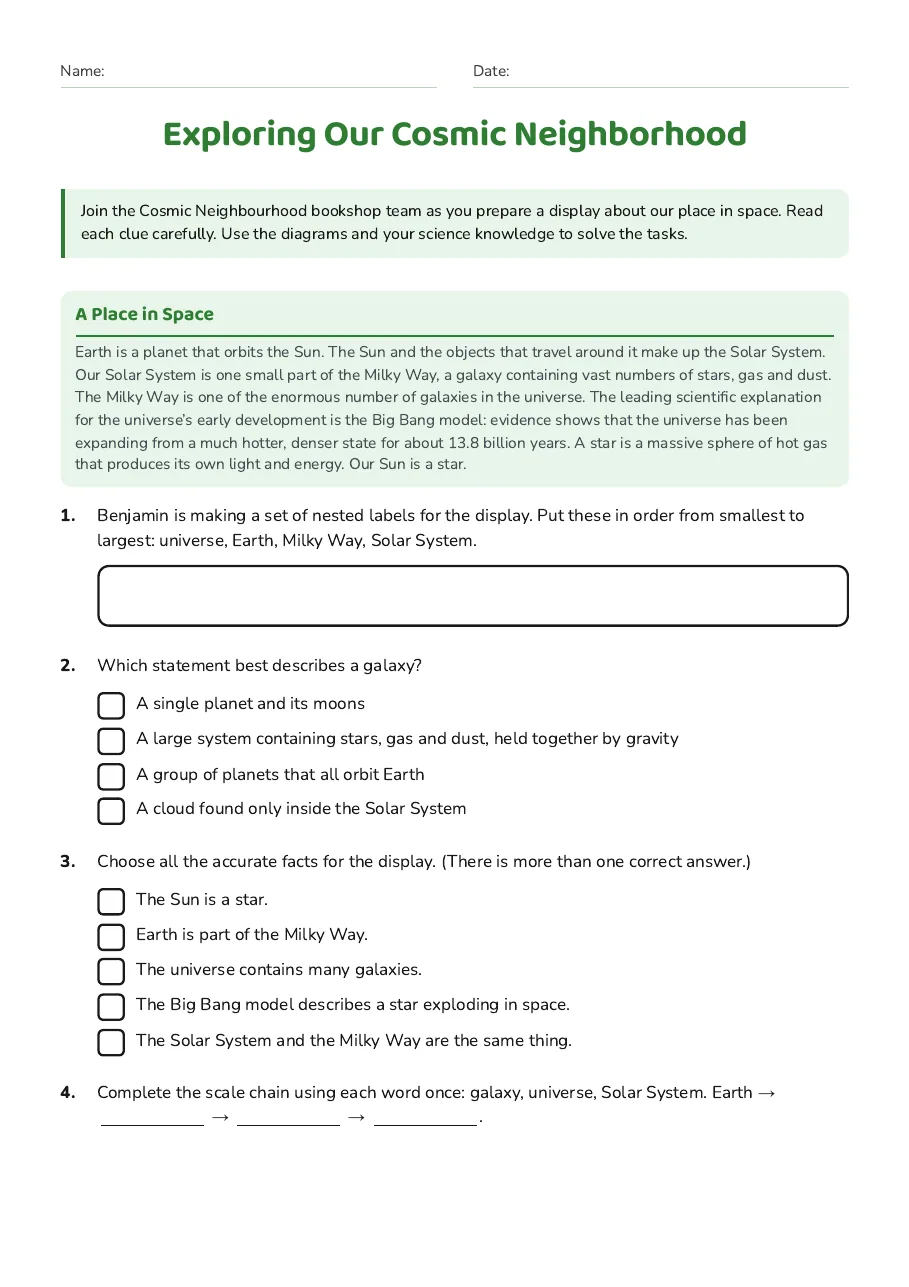
A Place in Space
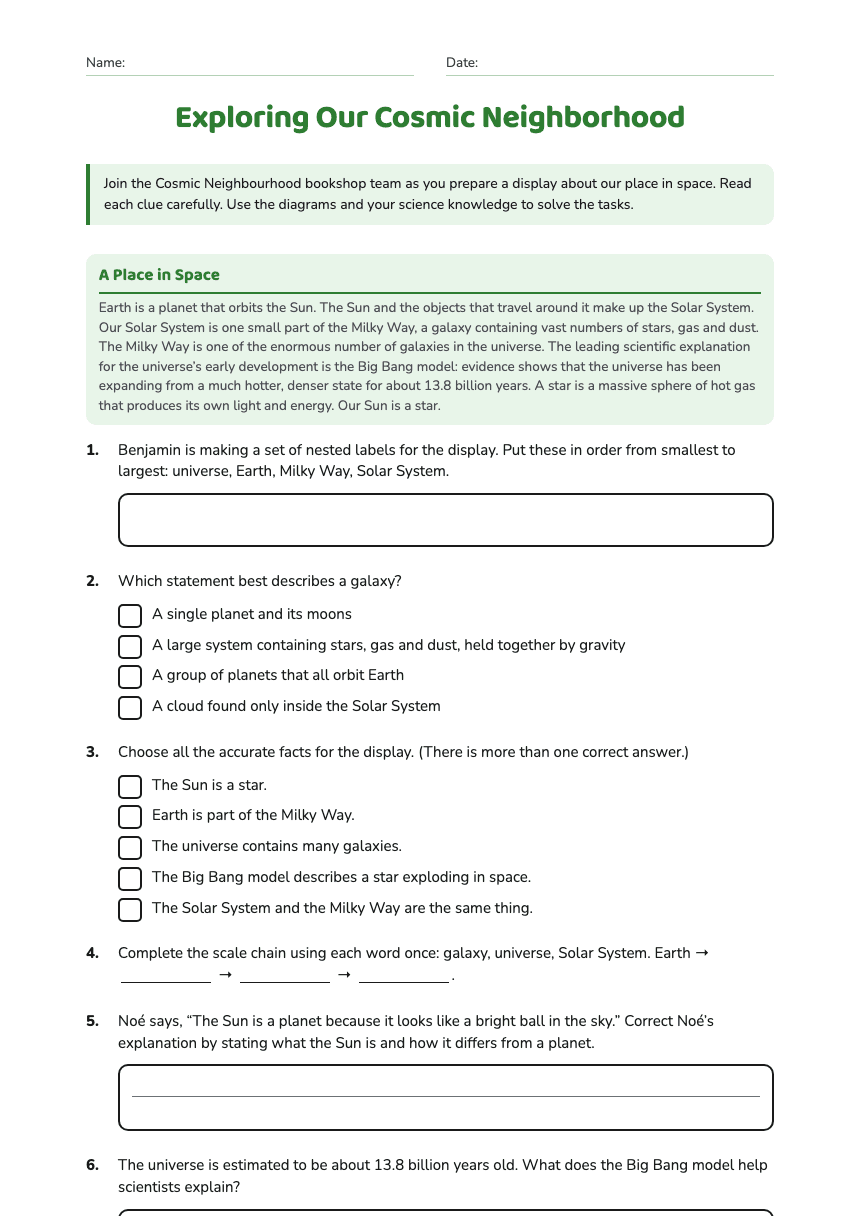
Earth is a planet that orbits the Sun. The Sun and the objects that travel around it make up the Solar System. Our Solar System is one small part of the Milky Way, a galaxy containing vast numbers of stars, gas and dust. The Milky Way is one of the enormous number of galaxies in the universe. The leading scientific explanation for the universe’s early development is the Big Bang model: evidence shows that the universe has been expanding from a much hotter, denser state for about 13.8 billion years. A star is a massive sphere of hot gas that produces its own light and energy. Our Sun is a star.
- A single planet and its moons
- A large system containing stars, gas and dust, held together by gravity
- A group of planets that all orbit Earth
- A cloud found only inside the Solar System
- The Sun is a star.
- Earth is part of the Milky Way.
- The universe contains many galaxies.
- The Big Bang model describes a star exploding in space.
- The Solar System and the Milky Way are the same thing.
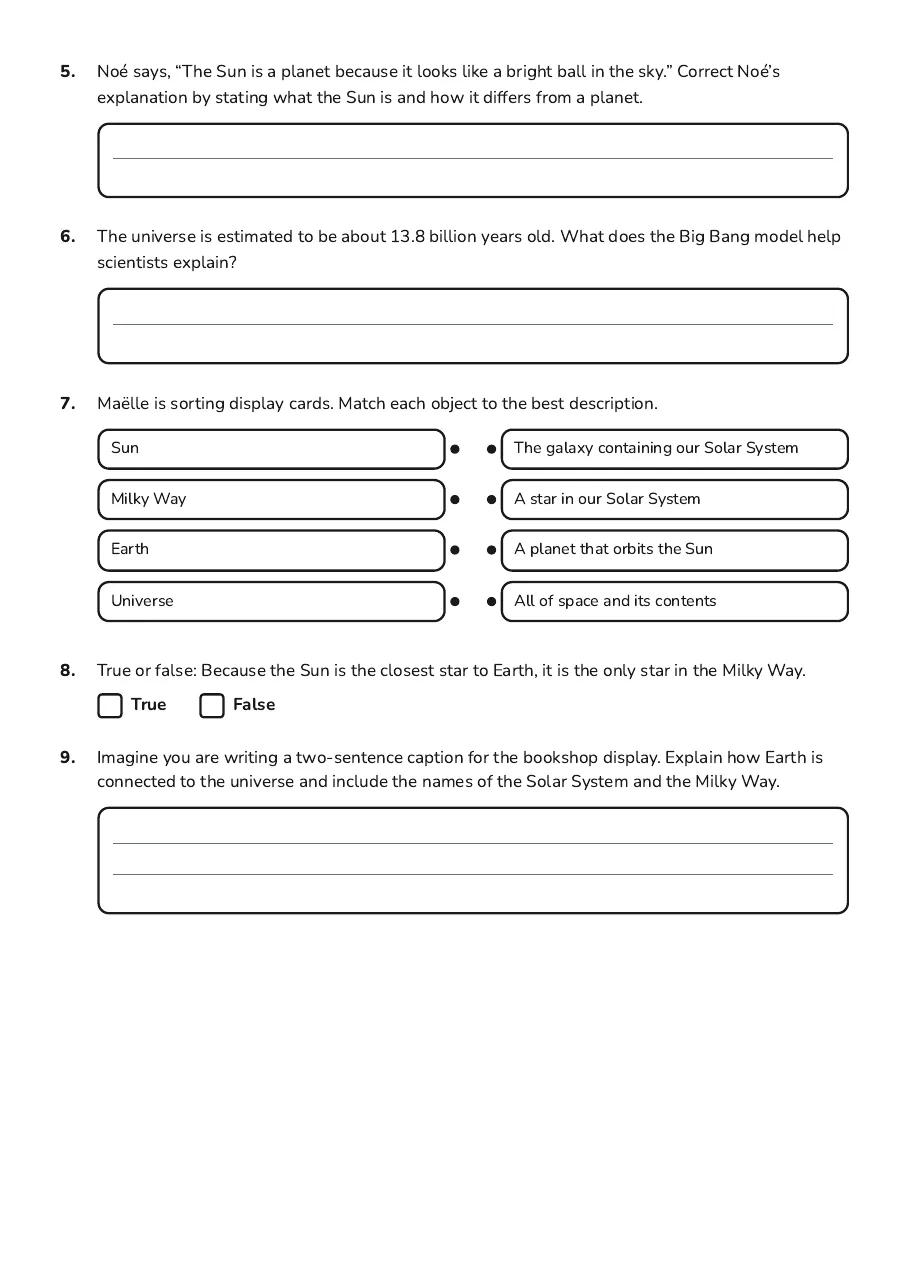
- Sun
- Milky Way
- Earth
- Universe
- The galaxy containing our Solar System
- A star in our Solar System
- A planet that orbits the Sun
- All of space and its contents
2 printable pages
Page 1
Page 2
About This Worksheet
Free in Kuraplan
Sign up free, grab the PDF, and customize it for your class.
Print-Ready
Formatted for standard paper. Clean layout, easy to read.
AI-Generated
Created with Kuraplan's AI, designed for real classroom use.
For Teachers & Parents
Use in classrooms, for homework, tutoring, or homeschool.
Need a custom version of this worksheet?
Kuraplan's AI generates custom worksheets in seconds — differentiated for every learner, aligned to your curriculum.
Generate Custom Worksheets — Free