Pentagonal Prism (3D) — free printable diagram
Free maths resource for teachers · CC BY-NC 4.0
About this illustration
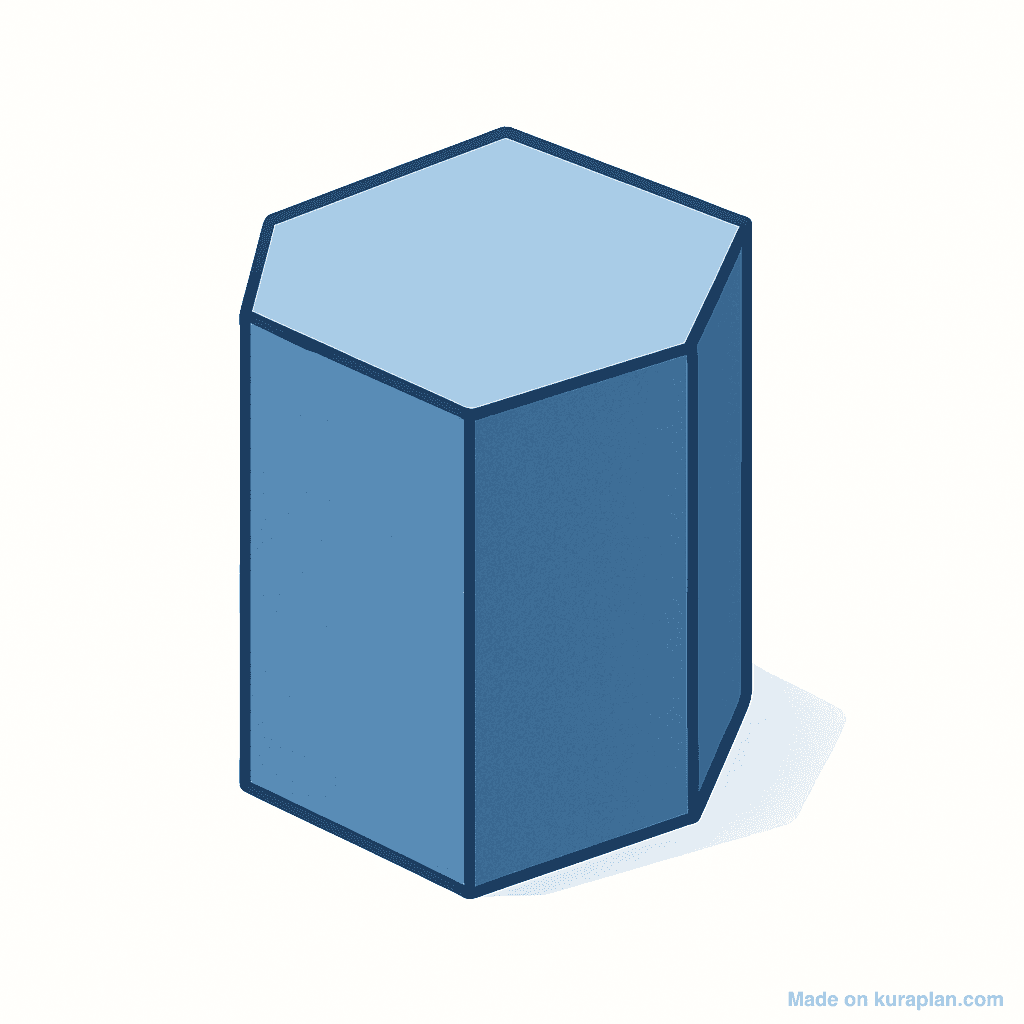
3D illustration of a pentagonal prism. A 3D pentagonal prism with two pentagonal ends and five rectangular sides, three-quarter view. For teaching solid shapes, geometry, properties of 3D shapes, surface area, volume.
How many faces, edges and vertices a pentagonal prism has
A pentagonal prism is a 3D solid with 7 faces, 15 edges and 10 vertices. Every face is flat, so it is a polyhedron and Euler's formula applies to it.
- Solid
- Pentagonal prism
- Faces
- 7
- Edges
- 15
- Vertices (corners)
- 10
- Shape of each end
- Pentagon
- Joining faces
- 5 rectangles
- Volume
- V = area of the pentagonal end × length
- Surface area
- SA = 2 × (area of the pentagon) + (perimeter of the pentagon × length)
- A prism has the same cross-section all the way along. This one has a pentagon at each end joined by 5 rectangles, so 5 + 2 = 7 faces altogether.
- Every pentagonal prism has 15 edges (3 × 5) and 10 vertices (2 × 5), whatever size it is drawn at and whichever way up it is standing.
- Euler's formula holds for every solid with flat faces: faces + vertices − edges = 2. It is the quickest way to check a count you are unsure of. Here that is 7 + 10 − 15 = 2.
How to use
- 1Right-click the image and choose “Save image as”, or use the download button.
- 2Use it in your classroom worksheets, slides or printables — free under CC BY-NC 4.0.
- 3Attribute as “Image by Kuraplan” or link back to kuraplan.com. Not for commercial resale.
Turn this image into a worksheet
This illustration is already in Kuraplan's editor — describe the worksheet you need and the AI builds it around the image in seconds.
Related illustrations
More free maths illustrations
Free worksheets on Pentagonal Prism (3D)
All free worksheetsBrowse by subject
21 subjects · 3,773 free illustrations
Cross-Curricular
835 free illustrations
Science
814 free illustrations
English
612 free illustrations
Geography
549 free illustrations
Health
200 free illustrations
Social Studies
177 free illustrations
Religious Education
139 free illustrations
Music
128 free illustrations
Art
66 free illustrations
Drama
56 free illustrations
Social Sciences
48 free illustrations
History
47 free illustrations
Arts
26 free illustrations
PE
25 free illustrations
Te Reo Māori
24 free illustrations
Technology
16 free illustrations
Culture
7 free illustrations
Business
1 free illustrations
English
1 free illustrations
English (ELA)
1 free illustrations
Languages
1 free illustrations