Parts of speech chart (six tiles) — free printable diagram
Free english resource for teachers · CC BY-NC 4.0

About this illustration
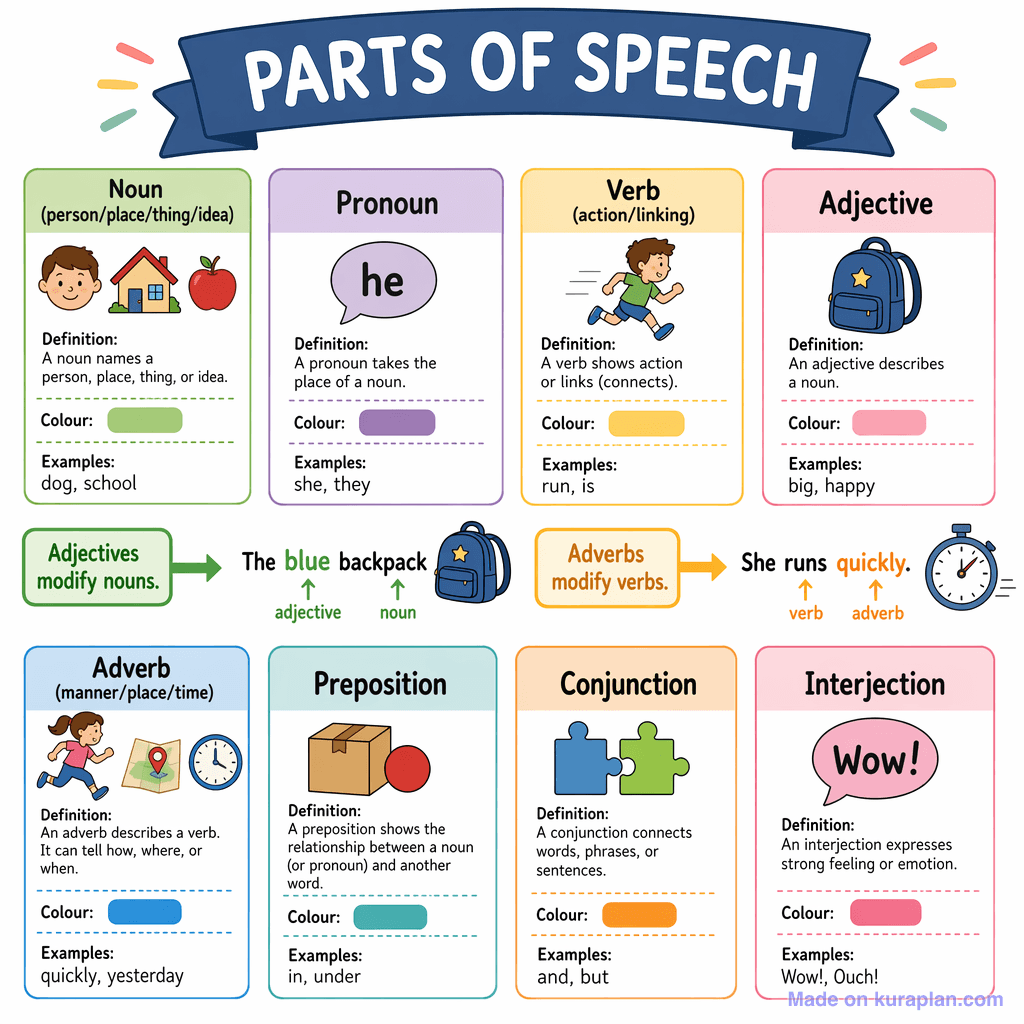
This image is a clear, high-contrast educational infographic titled "Parts of Speech", designed to teach the six main parts of speech. It features six distinct cards, each labeled with a part of speech (Noun, Verb, Adjective, Adverb, Pronoun, Preposition) and accompanied by a simple, flat illustration and an example word. For instance, 'Noun' shows a dog icon with the word 'dog', and 'Verb' shows a running figure with 'run'. This resource is ideal for English language arts lessons, suitable for display on classroom slides, as part of worksheets for identifying parts of speech, or as a reference chart for students learning basic grammar. The overall visual style is a clean, flat illustration with clear text.
The six parts of speech on this chart, and what each one does
A part of speech is the job a word does in a sentence. This chart covers six of them — noun, verb, adjective, adverb, pronoun and preposition — which between them account for most of the words in an ordinary sentence.
- Parts of speech on the chart
- 6
- Noun
- Names a person, place, thing or idea. For example: teacher, playground, pencil, kindness
- Verb
- Says what someone or something does, or is. For example: run, write, think, is
- Adjective
- Describes a noun. For example: red, enormous, three, careful
- Adverb
- Tells you more about a verb — how, when or where. For example: quickly, yesterday, outside, very
- Pronoun
- Stands in for a noun so you need not repeat it. For example: she, they, it, we, him
- Preposition
- Shows where or when something is in relation to something else. For example: on, under, before, between
- The same word can be a different part of speech in a different sentence, which is why the job matters more than the word. In "water the plants" water is a verb; in "drink the water" it is a noun. Always ask what the word is doing here.
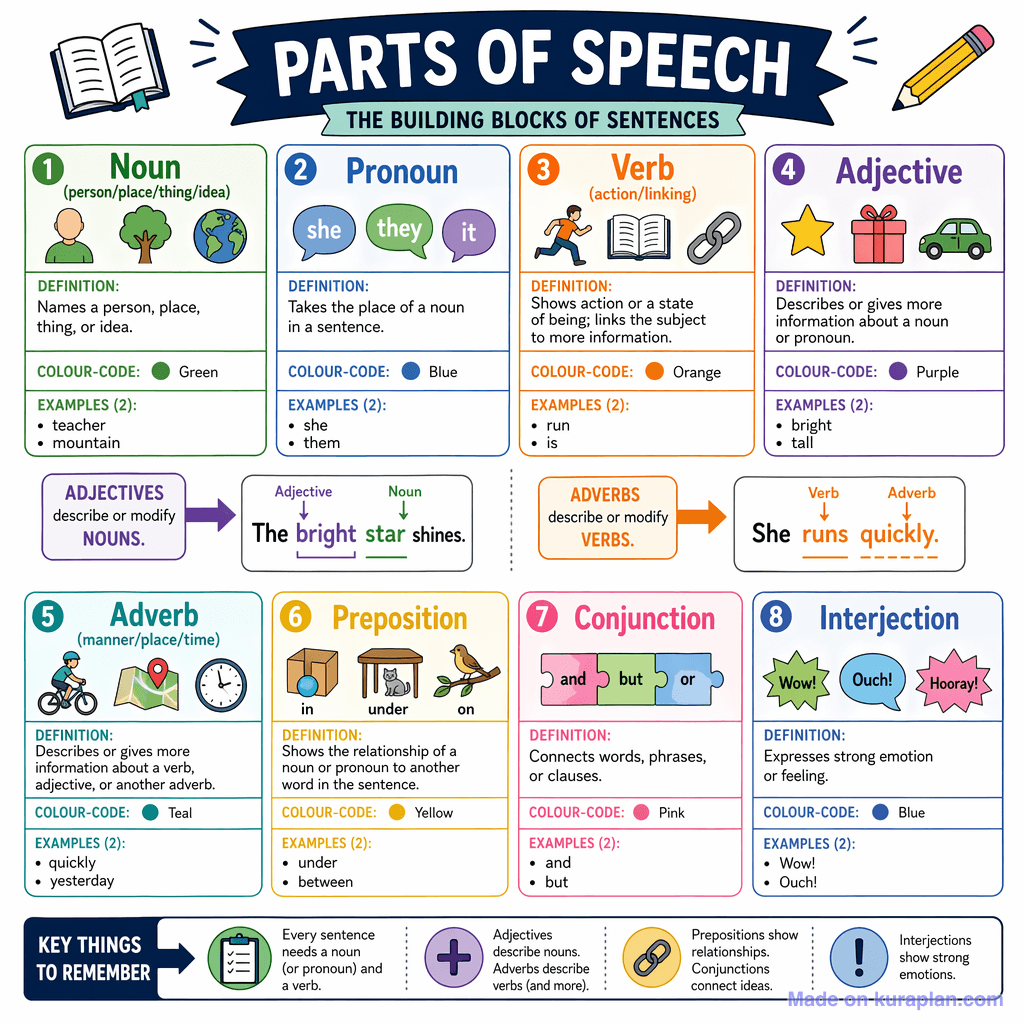
- The traditional set is eight rather than six: the two this chart leaves off are conjunctions, which join words or clauses together (and, but, because, although), and interjections, which stand apart from the sentence to carry feeling (oh, wow, ouch). Some grammars also separate out determiners — the, a, this, my — which otherwise get grouped with adjectives.
- A quick way to test a word is to try moving or replacing it. If it can take an -s or an -ing and follow "to", it is likely a verb; if "the" can go in front of it, it is likely a noun; if it answers "what kind?" it is an adjective, and if it answers "how?" it is an adverb.
- Identifying parts of speech is not an end in itself — it is the shared vocabulary for talking about sentences, which is what makes it possible to explain why a sentence is unclear rather than only feeling that it is.
How to use
- 1Right-click the image and choose “Save image as”, or use the download button.
- 2Use it in your classroom worksheets, slides or printables — free under CC BY-NC 4.0.
- 3Attribute as “Image by Kuraplan” or link back to kuraplan.com. Not for commercial resale.
Turn this image into a worksheet
This illustration is already in Kuraplan's editor — describe the worksheet you need and the AI builds it around the image in seconds.
Related illustrations
More free english illustrations
Free worksheets on Parts of speech chart (six tiles)
All free worksheetsBrowse by subject
21 subjects · 5,055 free illustrations
Maths
1,894 free illustrations
Cross-Curricular
835 free illustrations
Science
814 free illustrations
Geography
549 free illustrations
Health
200 free illustrations
Social Studies
177 free illustrations
Religious Education
139 free illustrations
Music
128 free illustrations
Art
66 free illustrations
Drama
56 free illustrations
Social Sciences
48 free illustrations
History
47 free illustrations
Arts
26 free illustrations
PE
25 free illustrations
Te Reo Māori
24 free illustrations
Technology
16 free illustrations
Culture
7 free illustrations
Business
1 free illustrations
English
1 free illustrations
English (ELA)
1 free illustrations
Languages
1 free illustrations