Punnett Square Basics (simple) — free printable clipart
Free science resource for teachers · CC BY-NC 4.0
About this illustration
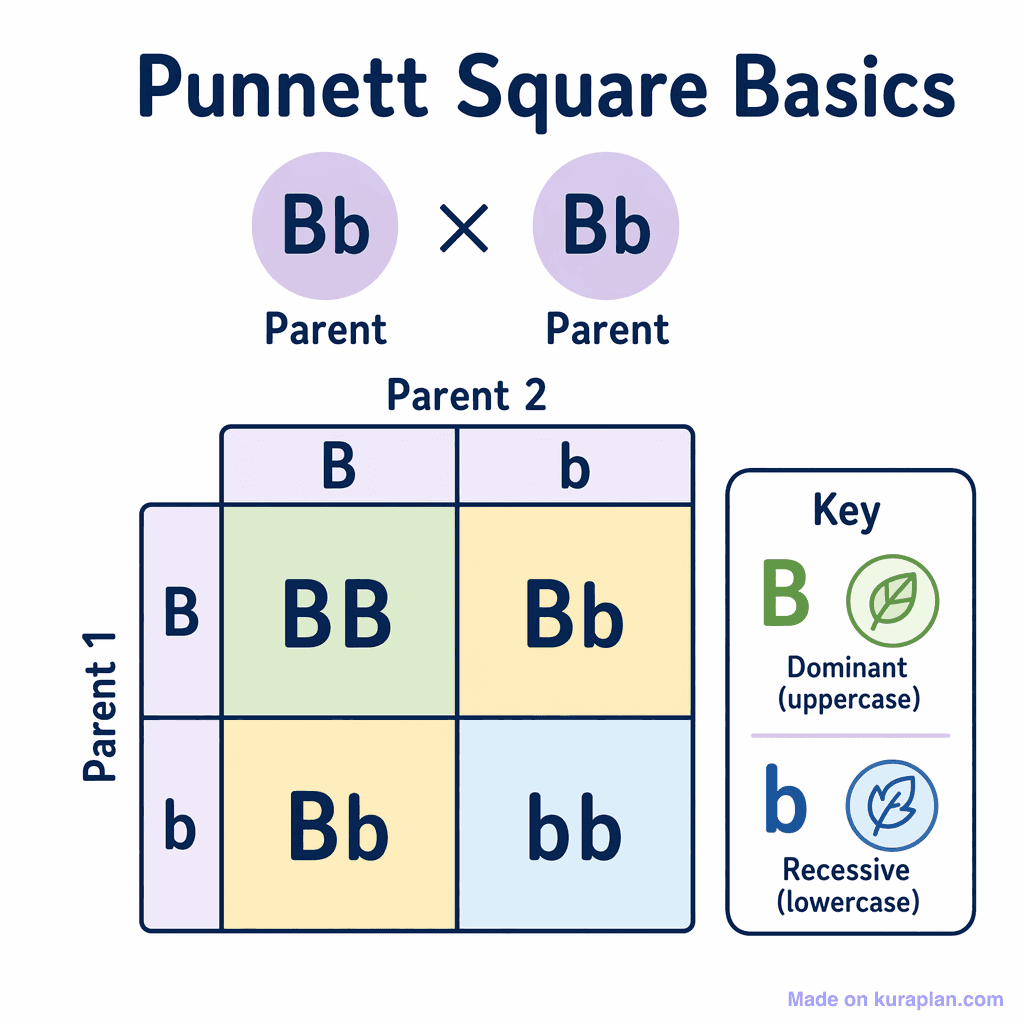
A labelled Punnett Square diagram showing a monohybrid cross between two heterozygous parents (Bb × Bb). The 2×2 grid displays the four possible offspring genotypes: BB, Bb, Bb, and bb. Parent alleles (B and b) are shown along the top (Parent 2) and left side (Parent 1). A key on the right identifies B as dominant (uppercase) and b as recessive (lowercase), each illustrated with a leaf icon in green or blue respectively. Parent genotypes are shown as circles at the top labelled 'Parent'.
How to read a Punnett square
A Punnett square is a grid for working out what offspring a cross between two parents could produce, and in what proportions. One parent's alleles go along the top, the other's down the side, and each cell is filled in with the pair of alleles an offspring would inherit — one from each parent. A two-by-two grid handles one gene, which is the standard case.
- What it is for
- Predicting the possible offspring of a genetic cross
- Set-up
- One parent's alleles along the top, the other's down the side
- A 2×2 grid
- One gene — a monohybrid cross
- Allele
- A version of a gene, written as a letter
- Dominant allele
- Capital letter — shows in the offspring if present at all
- Recessive allele
- Lower-case letter — shows only if both copies are recessive
- Genotype
- The pair of alleles an individual carries, such as Bb
- Phenotype
- The characteristic you can actually observe
- Bb × Bb gives
- 1 BB : 2 Bb : 1 bb — a 3:1 ratio of phenotypes
- Each parent passes on one allele of its pair, so the four cells of a 2×2 grid are simply every possible combination of one allele from each side. Nothing more complicated is happening.
- The capital and lower-case convention carries the genetics. BB and Bb both show the dominant characteristic because one dominant allele is enough; only bb shows the recessive one.
- Genotype and phenotype are different answers to different questions, and the grid gives both. Bb × Bb produces three genotypes in a 1:2:1 ratio but only two phenotypes, in a 3:1 ratio.
- A cross between a heterozygous and a homozygous recessive parent — Bb × bb — gives a 1:1 phenotype ratio instead. Those two crosses cover most of what is asked at this level.
- The result is a probability, not a promise. A 3:1 ratio means each offspring has a three-in-four chance of showing the dominant characteristic; four actual offspring can easily come out 4:0.
- A four-by-four grid does the same job for two genes at once, a dihybrid cross. The method is identical — every combination of one allele per gene from each parent.
How to use
- 1Right-click the image and choose “Save image as”, or use the download button.
- 2Use it in your classroom worksheets, slides or printables — free under CC BY-NC 4.0.
- 3Attribute as “Image by Kuraplan” or link back to kuraplan.com. Not for commercial resale.
Turn this image into a worksheet
This illustration is already in Kuraplan's editor — describe the worksheet you need and the AI builds it around the image in seconds.
Related illustrations
More free science illustrations


Free worksheets on Punnett Square Basics (simple)
All free worksheetsBrowse by subject
21 subjects · 4,853 free illustrations
Maths
1,894 free illustrations
Cross-Curricular
835 free illustrations
English
612 free illustrations
Geography
549 free illustrations
Health
200 free illustrations
Social Studies
177 free illustrations
Religious Education
139 free illustrations
Music
128 free illustrations
Art
66 free illustrations
Drama
56 free illustrations
Social Sciences
48 free illustrations
History
47 free illustrations
Arts
26 free illustrations
PE
25 free illustrations
Te Reo Māori
24 free illustrations
Technology
16 free illustrations
Culture
7 free illustrations
Business
1 free illustrations
English
1 free illustrations
English (ELA)
1 free illustrations
Languages
1 free illustrations