Isoceles Triangle — free printable diagram
Free maths resource for teachers · CC BY-NC 4.0
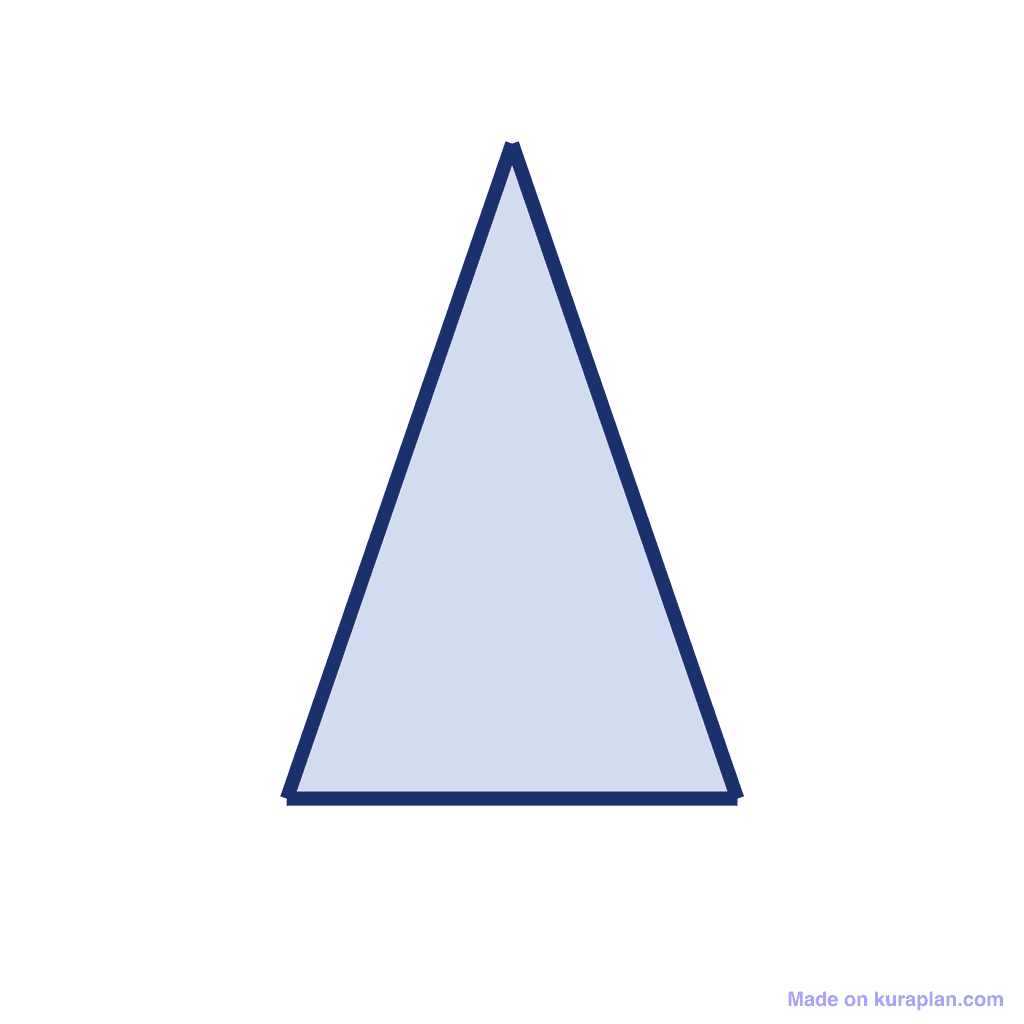
About this illustration
Triangle with two equal sides and two equal base angles. For teaching triangle properties.
What is an isosceles triangle?
An isosceles triangle has at least two sides of equal length. The two angles opposite those equal sides — the base angles — are equal as well. The third angle can be anything, as long as all three still add to 180°.
- Sides
- 3
- Equal sides
- At least 2
- Equal angles
- At least 2 (the base angles)
- Angles add up to
- 180°
- Lines of symmetry
- 1 (3 if equilateral)
- Rotational symmetry
- Order 1 (order 3 if equilateral)
- The equal angles sit opposite the equal sides. That is the fact most isosceles questions turn on: given the apex angle a, each base angle is (180° − a) ÷ 2.
- Working backwards, if you know one base angle b, the apex angle is 180° − 2b.
- It has one line of symmetry, running from the apex down to the midpoint of the base, which means folding along that line matches the two halves exactly.
- Definitions differ here, so check your syllabus: most define isosceles as “at least two equal sides”, which makes every equilateral triangle isosceles as well. Some primary schemes teach “exactly two”, which excludes the equilateral case.
- An isosceles triangle can also be right-angled — a right isosceles triangle has angles of 90°, 45° and 45°.
How to use
- 1Right-click the image and choose “Save image as”, or use the download button.
- 2Use it in your classroom worksheets, slides or printables — free under CC BY-NC 4.0.
- 3Attribute as “Image by Kuraplan” or link back to kuraplan.com. Not for commercial resale.
Turn this image into a worksheet
This illustration is already in Kuraplan's editor — describe the worksheet you need and the AI builds it around the image in seconds.
Related illustrations
More free maths illustrations
Free worksheets on Isoceles Triangle
All free worksheetsBrowse by subject
18 subjects · 3,771 free illustrations
Cross-Curricular
835 free illustrations
Science
815 free illustrations
English
612 free illustrations
Geography
549 free illustrations
Health
200 free illustrations
Social Studies
177 free illustrations
Religious Education
139 free illustrations
Music
128 free illustrations
Art
66 free illustrations
Drama
56 free illustrations
Social Sciences
48 free illustrations
History
47 free illustrations
Arts
26 free illustrations
PE
25 free illustrations
Te Reo Māori
24 free illustrations
Technology
16 free illustrations
Culture
7 free illustrations
Languages
1 free illustrations