Volcano Cinder Cone — free printable diagram
Free geography resource for teachers · CC BY-NC 4.0

About this illustration
This cartoon-style illustration depicts a small, steep, conical pile of diverse rock fragments and pebbles, ranging in color from brown to grey and reddish-brown. A puff of white smoke emerges from the vent at the cone's apex, signifying volcanic activity. The image explicitly teaches the concept of a cinder cone volcano, specifically highlighting its formation from 'pyroclastic fragments' through the text present. This visual aid is ideal for earth science and geology lessons, suitable for slides, worksheets, or as a visual reference for understanding different volcano types. The style is a clear, high-contrast illustration, making it easily distinguishable for students.
What a cinder cone volcano diagram shows
A cinder cone is the smallest and simplest of the main volcano types. It is not built from lava flows at all, but from loose fragments — cinders, scoria and ash — thrown out of a single vent by gassy eruptions and falling back around it. The result is a small, strikingly steep and symmetrical cone with a bowl-shaped crater at the top.
- Shape
- Small, steep, symmetrical cone
- Built from
- Loose fragments — cinders, scoria and ash
- Collective name for the fragments
- Tephra
- Eruption style
- Gas-driven, explosive but small and often short-lived
- Lava type
- Usually basaltic
- Crater
- A bowl-shaped hollow at the summit
- Size
- The smallest of the main volcano types
- Often found
- On the flanks of larger volcanoes, or in clusters
- The building material is the whole point of this diagram. Fragments of frothy, gas-filled lava are blasted out, cool in the air and land around the vent, so the cone is a pile of loose rubble rather than a stack of solidified flows.
- Loose material can only pile so steeply before it slides, which is what sets both the cone's steep angle and its limited height. The slope is steeper than a shield volcano's but the volcano is far smaller.
- Many cinder cones are built in a single eruptive episode lasting weeks to a few years, and then never erupt again — unlike a composite volcano, which is constructed over many eruptions.
- Lava can still escape, but it usually leaks from the base of the cone rather than overflowing the crater, because the loose walls are too weak to hold a column of molten rock.
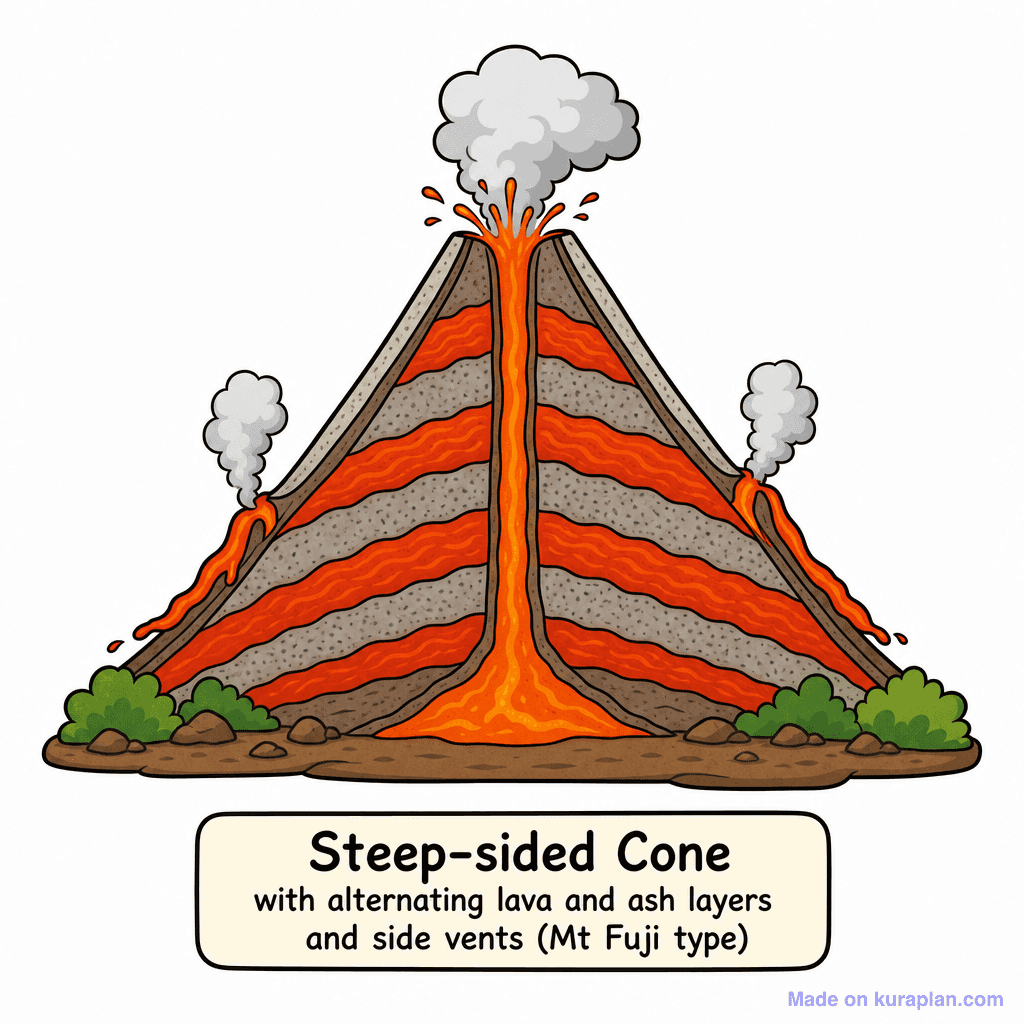
- The three types are best compared together: cinder cone — fragments, small, very steep; composite — layers of lava and ash, large and steep; shield — runny lava, very broad and gentle.
- Because they are made of unconsolidated material, cinder cones erode comparatively quickly, which is why old ones are far less distinct than old lava structures.
How to use
- 1Right-click the image and choose “Save image as”, or use the download button.
- 2Use it in your classroom worksheets, slides or printables — free under CC BY-NC 4.0.
- 3Attribute as “Image by Kuraplan” or link back to kuraplan.com. Not for commercial resale.
Turn this image into a worksheet
This illustration is already in Kuraplan's editor — describe the worksheet you need and the AI builds it around the image in seconds.
Related illustrations
More from Mountains & Tectonics
Free worksheets on Volcano Cinder Cone
All free worksheetsBrowse by subject
21 subjects · 5,118 free illustrations
Maths
1,894 free illustrations
Cross-Curricular
835 free illustrations
Science
814 free illustrations
English
612 free illustrations
Health
200 free illustrations
Social Studies
177 free illustrations
Religious Education
139 free illustrations
Music
128 free illustrations
Art
66 free illustrations
Drama
56 free illustrations
Social Sciences
48 free illustrations
History
47 free illustrations
Arts
26 free illustrations
PE
25 free illustrations
Te Reo Māori
24 free illustrations
Technology
16 free illustrations
Culture
7 free illustrations
Business
1 free illustrations
English
1 free illustrations
English (ELA)
1 free illustrations
Languages
1 free illustrations