Volcano Composite Stratovolcano — free printable diagram
Free geography resource for teachers · CC BY-NC 4.0
About this illustration
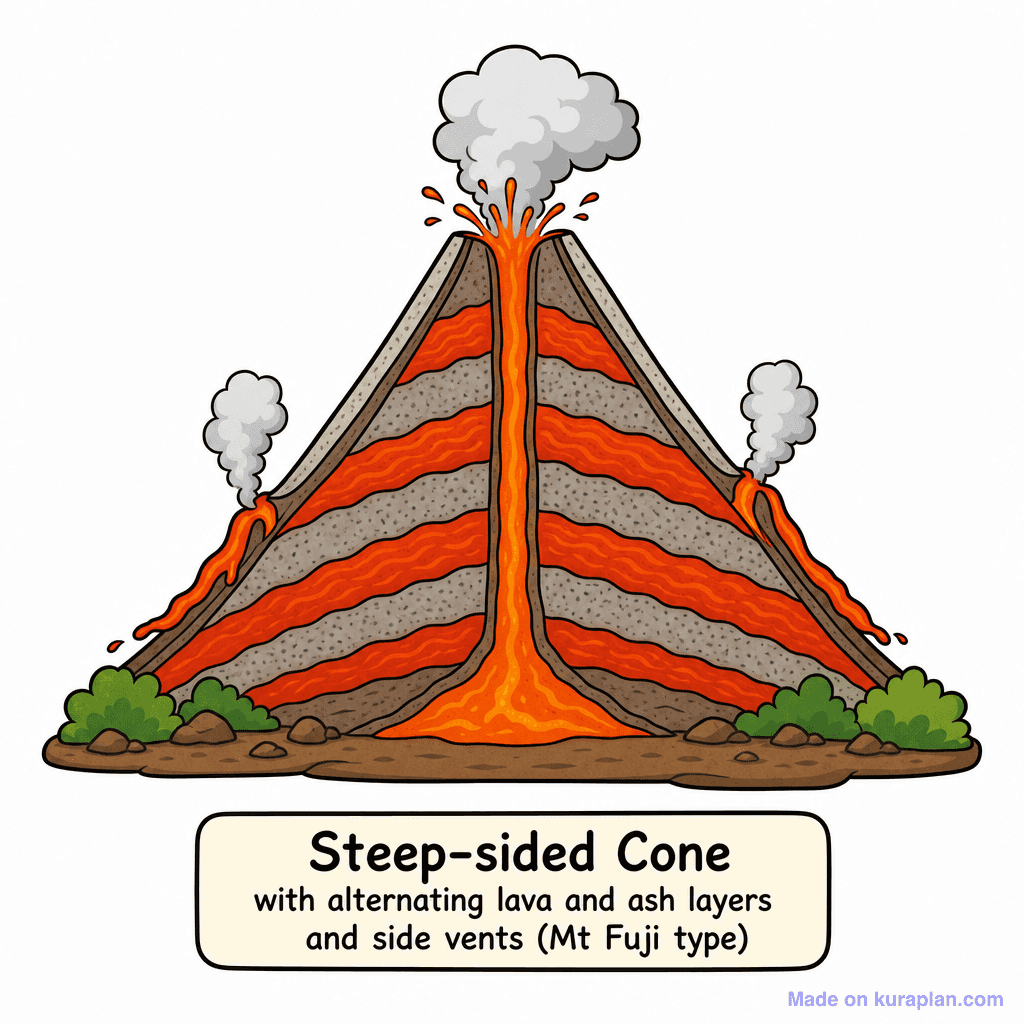
This flat illustration depicts a cross-section of a steep-sided cone volcano, also known as a stratovolcano. The diagram clearly shows alternating layers of solidified orange lava and grey ash that build up the cone's structure, a key characteristic of this volcano type. A central vent is actively erupting lava and a plume of smoke, while two smaller side vents also show eruptive activity. The image includes a text box label that reads: "Steep-sided Cone with alternating lava and ash layers and side vents (Mt Fuji type)". This visual aid is perfect for teaching geology or Earth science concepts related to volcanic structures and eruptions, suitable for use in slides, worksheets, or as a reference for labelling activities.
What a composite volcano diagram shows
A composite volcano, also called a stratovolcano, is the steep-sided cone most people picture when they think of a volcano. The name describes how it is built: in layers, alternating between lava and ash from successive eruptions. Its shape and its explosive eruptions both come from one property of its lava — it is thick and sticky, so it does not flow far before it sets.
- Also called
- A stratovolcano
- Shape
- Tall, steep-sided, symmetrical cone
- Built from
- Alternating layers of lava and ash
- Lava
- Thick and sticky (viscous), rich in silica
- Eruptions
- Explosive, and less frequent than at a shield volcano
- Features labelled
- Magma chamber, main vent, crater, side vents, layers
- Found at
- Destructive plate margins, where one plate subducts beneath another
- "Composite" and "strato" both mean built in layers. Each eruption adds a layer of lava or a layer of ash, and the alternating bands are what the cross-section is drawn to show.
- Thick lava cannot travel far before it cools and solidifies, so the material piles up close to the vent. That is what gives the volcano its steep sides and height.
- The same thickness traps gas inside the magma. Pressure builds until it is released suddenly, which is why eruptions are violent and can produce ash clouds and fast-moving pyroclastic flows.
- Compare it with a shield volcano, which is the standard contrast: runny basaltic lava that flows a long way, producing a broad, gently sloping dome and much less explosive eruptions.
- Composite volcanoes form where an oceanic plate is subducted. Water and sediment carried down with the plate change the chemistry of the magma produced, which is why the lava is silica-rich in the first place.
- They can stay dormant for long periods between eruptions, which is one reason large populations end up living on their fertile slopes.
How to use
- 1Right-click the image and choose “Save image as”, or use the download button.
- 2Use it in your classroom worksheets, slides or printables — free under CC BY-NC 4.0.
- 3Attribute as “Image by Kuraplan” or link back to kuraplan.com. Not for commercial resale.
Turn this image into a worksheet
This illustration is already in Kuraplan's editor — describe the worksheet you need and the AI builds it around the image in seconds.
Related illustrations
More from Mountains & Tectonics
Free worksheets on Volcano Composite Stratovolcano
All free worksheetsBrowse by subject
21 subjects · 5,118 free illustrations
Maths
1,894 free illustrations
Cross-Curricular
835 free illustrations
Science
814 free illustrations
English
612 free illustrations
Health
200 free illustrations
Social Studies
177 free illustrations
Religious Education
139 free illustrations
Music
128 free illustrations
Art
66 free illustrations
Drama
56 free illustrations
Social Sciences
48 free illustrations
History
47 free illustrations
Arts
26 free illustrations
PE
25 free illustrations
Te Reo Māori
24 free illustrations
Technology
16 free illustrations
Culture
7 free illustrations
Business
1 free illustrations
English
1 free illustrations
English (ELA)
1 free illustrations
Languages
1 free illustrations