Evaporation & Condensation (simple) — free printable diagram
Free science resource for teachers · CC BY-NC 4.0
About this illustration
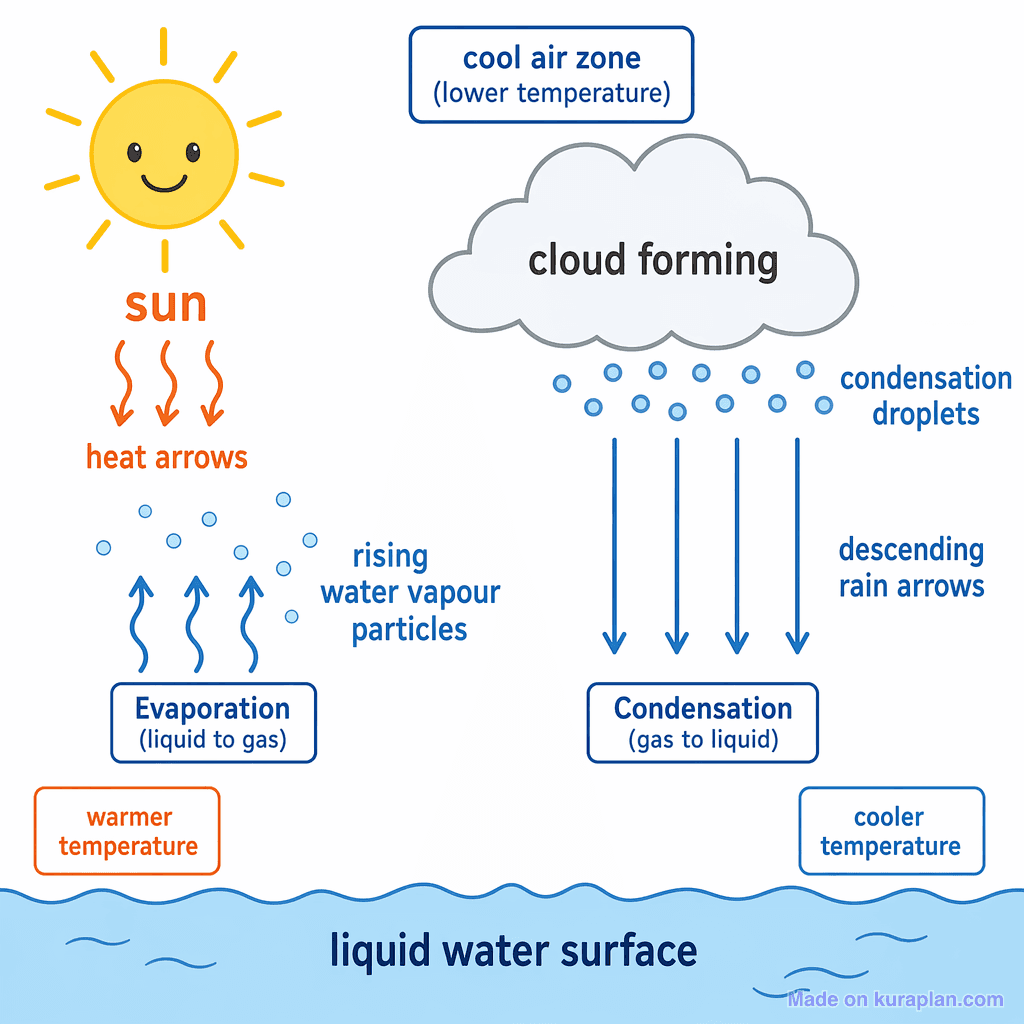
A simple two-panel diagram illustrating the water cycle processes of evaporation and condensation. On the left, a cartoon sun emits heat arrows downward onto a liquid water surface, causing rising water vapour particles to ascend (labelled Evaporation – liquid to gas) in a warmer temperature zone. On the right, rising vapour enters a cool air zone (lower temperature) where a cloud forms; condensation droplets collect and fall as rain via descending rain arrows (labelled Condensation – gas to liquid) in a cooler temperature zone. All key elements carry text labels.
Evaporation and condensation explained
Evaporation and condensation are the two changes of state that move water between liquid and gas. Heating a liquid gives its particles enough energy to escape as a gas, which is evaporation; cooling a gas takes that energy away so it becomes a liquid again, which is condensation. They are opposites, they are reversible, and between them they drive the water cycle.
- Evaporation
- Liquid turning into a gas
- Condensation
- Gas turning into a liquid
- Drives evaporation
- Heat energy
- Causes condensation
- Cooling
- Both are
- Changes of state — reversible, with no new substance made
- Everyday evaporation
- A puddle drying up, washing drying on a line
- Everyday condensation
- Mist on a cold window, dew on grass
- Neither is a chemical change. The water is still water throughout; only the arrangement and energy of its particles change, which is why the process can run both ways.
- Evaporation and boiling are not the same thing, and this is the distinction most often lost. Evaporation happens from the surface of a liquid at any temperature; boiling happens throughout the liquid and only at its boiling point.
- Evaporation is faster when it is warmer, windier, or the liquid has a larger surface area. Those three factors make a good fair-test investigation.
- Condensation happens when water vapour meets a surface, or air, that is cold enough. That is why a cold drink makes the outside of the glass wet — the water comes out of the air, not through the glass.
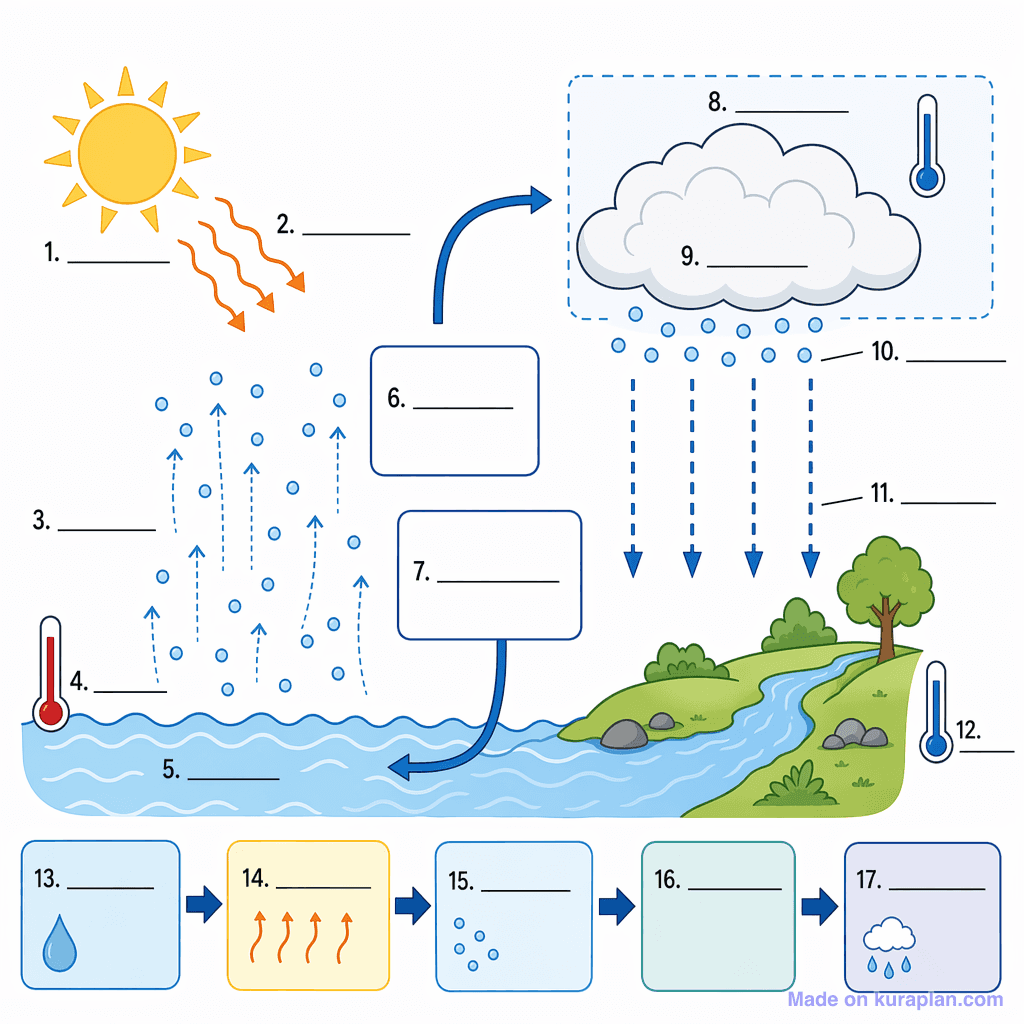
- The two processes together are what the water cycle runs on: evaporation lifts water into the air and condensation forms the clouds that return it.
- Mass is conserved. A puddle that evaporates has not disappeared; the same water is in the air as vapour, invisible because the particles are far apart.
How to use
- 1Right-click the image and choose “Save image as”, or use the download button.
- 2Use it in your classroom worksheets, slides or printables — free under CC BY-NC 4.0.
- 3Attribute as “Image by Kuraplan” or link back to kuraplan.com. Not for commercial resale.
Turn this image into a worksheet
This illustration is already in Kuraplan's editor — describe the worksheet you need and the AI builds it around the image in seconds.
Related illustrations
More free science illustrations


Free worksheets on Evaporation & Condensation (simple)
All free worksheetsBrowse by subject
21 subjects · 4,853 free illustrations
Maths
1,894 free illustrations
Cross-Curricular
835 free illustrations
English
612 free illustrations
Geography
549 free illustrations
Health
200 free illustrations
Social Studies
177 free illustrations
Religious Education
139 free illustrations
Music
128 free illustrations
Art
66 free illustrations
Drama
56 free illustrations
Social Sciences
48 free illustrations
History
47 free illustrations
Arts
26 free illustrations
PE
25 free illustrations
Te Reo Māori
24 free illustrations
Technology
16 free illustrations
Culture
7 free illustrations
Business
1 free illustrations
English
1 free illustrations
English (ELA)
1 free illustrations
Languages
1 free illustrations