Atoms and Mixtures Worksheet
A free science worksheet ready for your classroom. Open in Kuraplan to grab the print-ready PDF, customize it for your students, or generate a fresh version in seconds.

Atoms and Mixtures Worksheet
🎯 WALT (We Are Learning To)
Today we are learning to:
• Identify the structure of atoms and their components
• Distinguish between elements, compounds, and mixtures
• Classify different types of matter based on their properties
Success Criteria:
🟢 I can name the three main parts of an atom
🟡 I can explain the difference between compounds and mixtures
🔴 I can analyse particle diagrams to classify matter
📝 Do Now Task (5 minutes)
The nucleus of an atom contains __________ and __________.
The particles that orbit around the nucleus are called __________.
🔬 Part 1: Atomic Structure
Draw a simple atom with nucleus and electron shells. Label: nucleus, protons, neutrons, electrons, electron shell
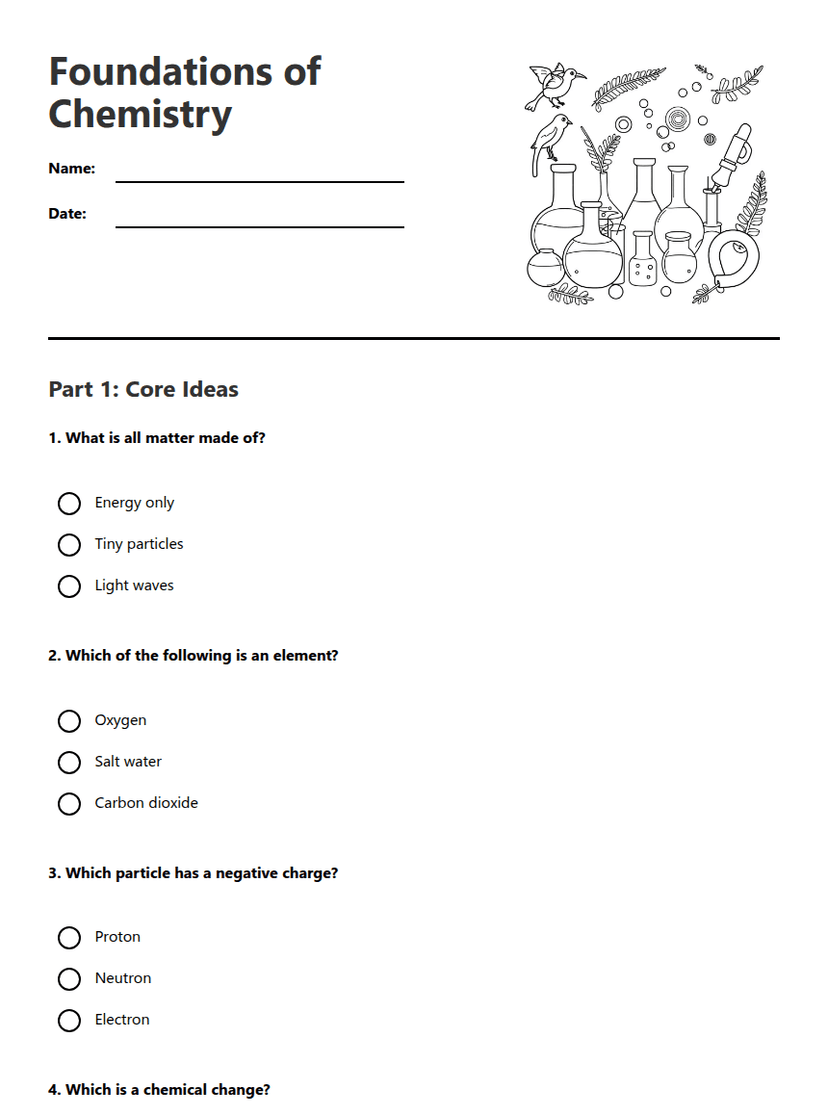
Which particle has a positive charge?
Electron Proton Neutron🧪 Part 2: Elements, Compounds, and Mixtures
Word Bank: element, compound, mixture, chemically, physically, oxygen, water, air
_____ Salt water
_____ Carbon dioxide (CO₂)
_____ Iron (Fe)
_____ Fruit salad
_____ Methane (CH₄)
_____ Sand and water
Discuss with your partner: How could you separate a mixture of sand and salt? Write your method below:
🚀 Extension Activities & Differentiation
Research and explain why noble gases (like helium) rarely form compounds. Use your knowledge of atomic structure.
📚 Dyslexia-Friendly Options:
• Use the word bank provided for all fill-in-the-blank questions
• Work with a partner for reading-heavy questions
• Focus on the practical activities and diagrams
• Use different coloured pens for different particle types
🎯 Hands-On Activity (Group Work):
Particle Model Activity: Use different coloured beads or balls to create models of:
• An element (all same colour)
• A compound (different colours joined together)
• A mixture (different colours separate)
In one sentence, explain the main difference between a compound and a mixture:
About This Worksheet
Free in Kuraplan
Sign up free, grab the PDF, and customize it for your class.
Print-Ready
Formatted for standard paper. Clean layout, easy to read.
AI-Generated
Created with Kuraplan's AI, designed for real classroom use.
For Teachers & Parents
Use in classrooms, for homework, tutoring, or homeschool.
Need a custom version of this worksheet?
Kuraplan's AI generates custom worksheets in seconds — differentiated for every learner, aligned to your curriculum.
Generate Custom Worksheets — Free