Autonomic Nervous System Worksheet
A free science worksheet ready for your classroom. Open in Kuraplan to grab the print-ready PDF, customize it for your students, or generate a fresh version in seconds.
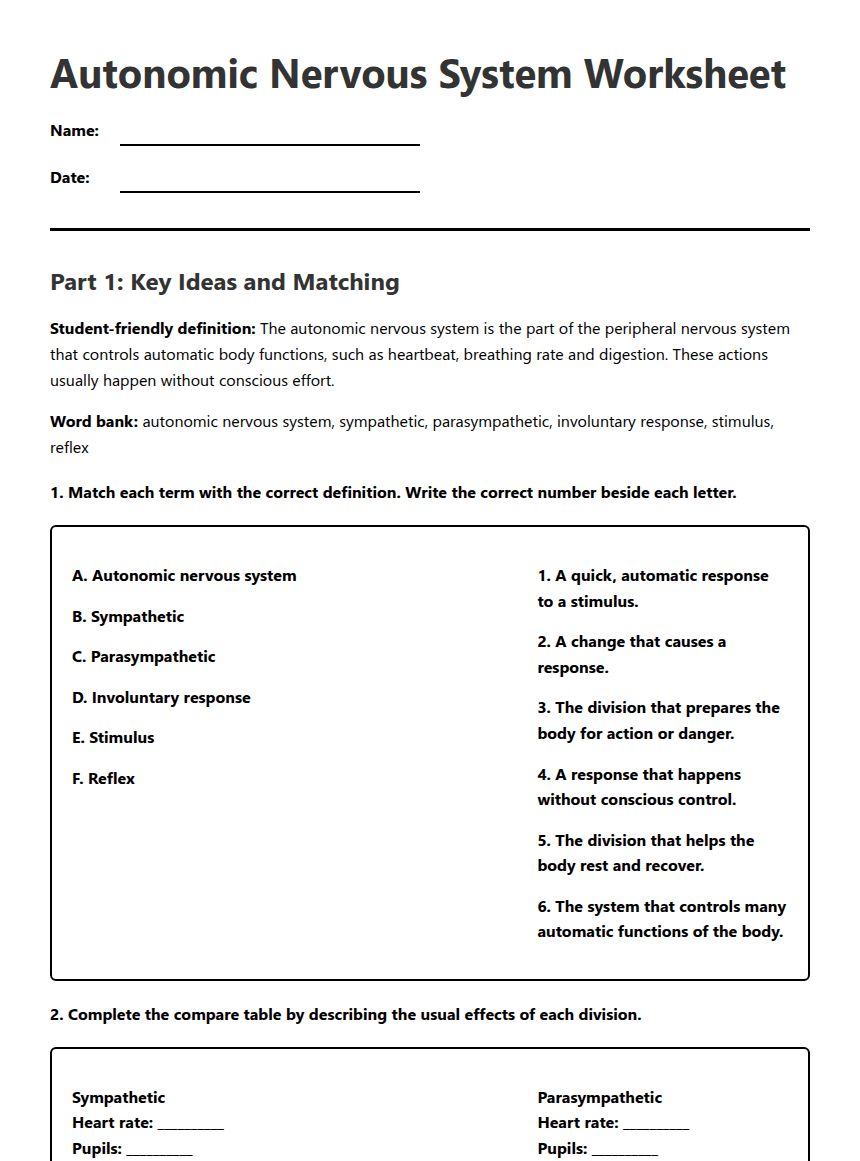
Autonomic Nervous System Worksheet
Part 1: Key Ideas and Matching
Student-friendly definition: The autonomic nervous system is the part of the peripheral nervous system that controls automatic body functions, such as heartbeat, breathing rate and digestion. These actions usually happen without conscious effort.
Word bank: autonomic nervous system, sympathetic, parasympathetic, involuntary response, stimulus, reflex
Heart rate: __________
Pupils: __________
Digestion: __________
Heart rate: __________
Pupils: __________
Digestion: __________
Part 2: Video Follow-up
Answer Key
1. A–6, B–3, C–5, D–4, E–2, F–1.
2. Sympathetic: heart rate increases, pupils widen, digestion slows. Parasympathetic: heart rate decreases, pupils return to normal or narrow, digestion increases or continues normally.
3. A voluntary response is consciously controlled; an involuntary response happens automatically.
4. A stimulus is detected and causes the nervous system to send signals that produce a response. Answers may vary.
5. It automatically adjusts body functions such as heart rate, breathing and digestion to keep internal conditions balanced.
6. Sympathetic. The loud bang is a stimulus that may signal danger, so the body prepares for action by increasing heart rate.
About This Worksheet
Free in Kuraplan
Sign up free, grab the PDF, and customize it for your class.
Print-Ready
Formatted for standard paper. Clean layout, easy to read.
AI-Generated
Created with Kuraplan's AI, designed for real classroom use.
For Teachers & Parents
Use in classrooms, for homework, tutoring, or homeschool.
Need a custom version of this worksheet?
Kuraplan's AI generates custom worksheets in seconds — differentiated for every learner, aligned to your curriculum.
Generate Custom Worksheets — Free