ScienceFreePrintable

Muscles and Movement Basics

A free science worksheet ready for your classroom. Open in Kuraplan to grab the print-ready PDF, customize it for your students, or generate a fresh version in seconds.
Muscles and Movement Basics worksheet preview
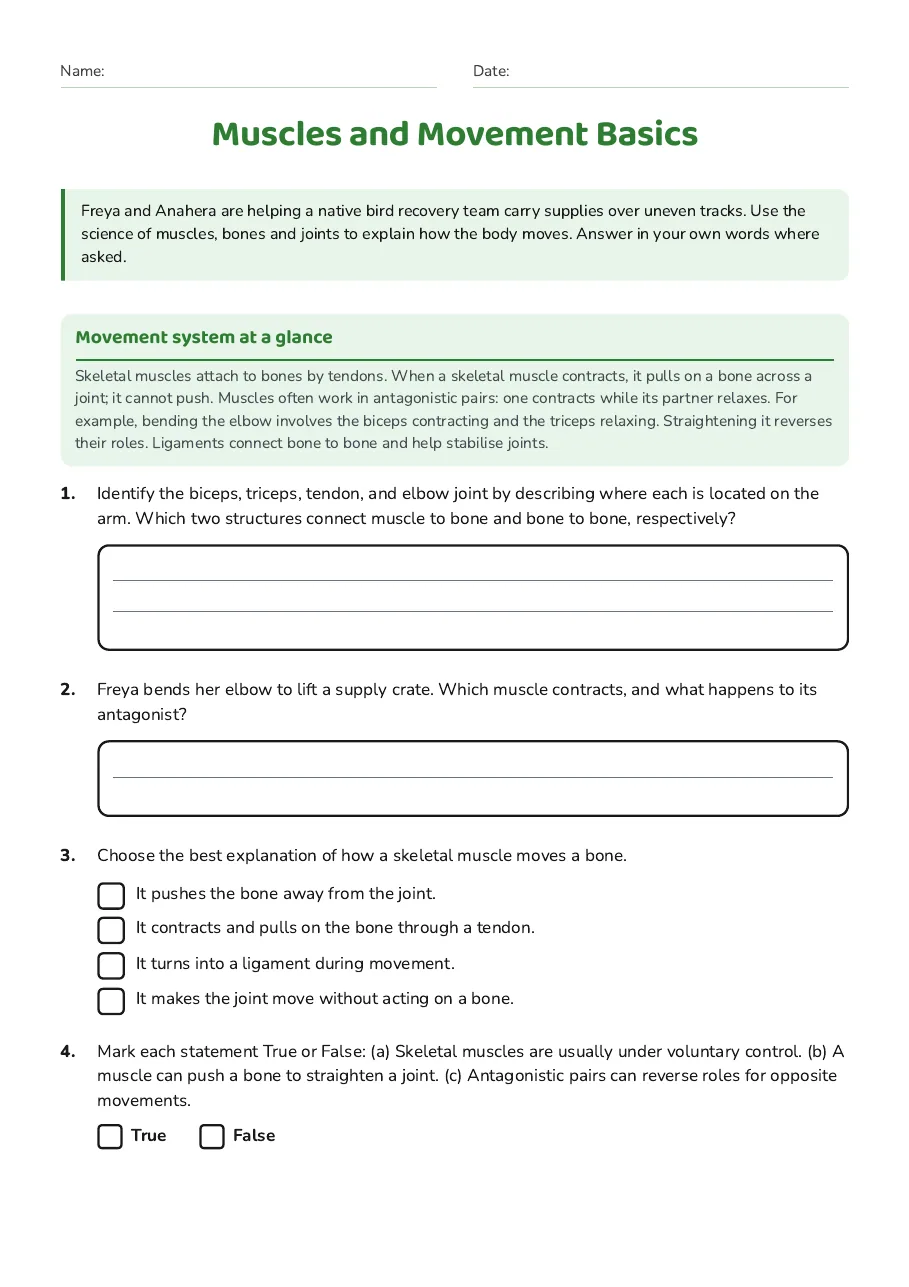
Name:Date:

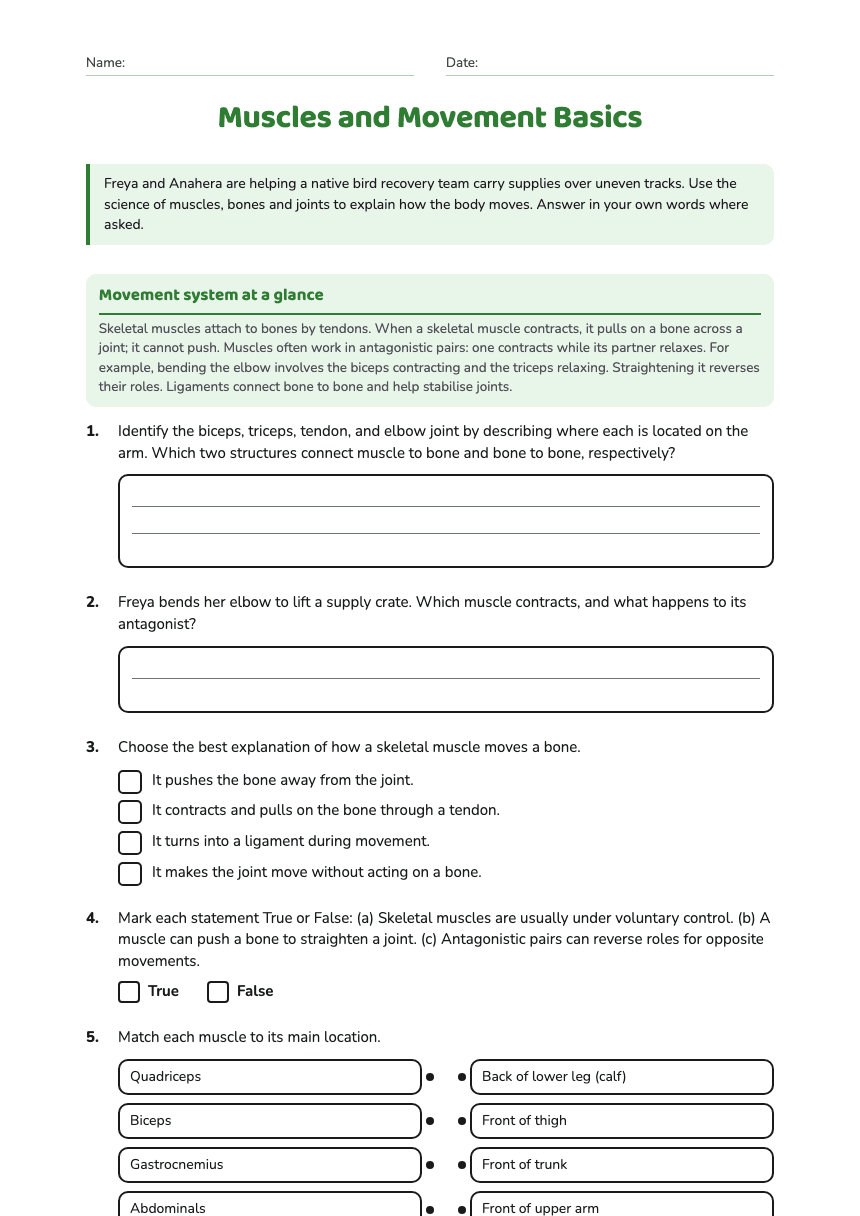
Muscles and Movement Basics

Freya and Anahera are helping a native bird recovery team carry supplies over uneven tracks. Use the science of muscles, bones and joints to explain how the body moves. Answer in your own words where asked.

Movement system at a glance

Skeletal muscles attach to bones by tendons. When a skeletal muscle contracts, it pulls on a bone across a joint; it cannot push. Muscles often work in antagonistic pairs: one contracts while its partner relaxes. For example, bending the elbow involves the biceps contracting and the triceps relaxing. Straightening it reverses their roles. Ligaments connect bone to bone and help stabilise joints.

1.Identify the biceps, triceps, tendon, and elbow joint by describing where each is located on the arm. Which two structures connect muscle to bone and bone to bone, respectively?
2.Freya bends her elbow to lift a supply crate. Which muscle contracts, and what happens to its antagonist?
3.Choose the best explanation of how a skeletal muscle moves a bone.
  • It pushes the bone away from the joint.
  • It contracts and pulls on the bone through a tendon.
  • It turns into a ligament during movement.
  • It makes the joint move without acting on a bone.
4.Mark each statement True or False: (a) Skeletal muscles are usually under voluntary control. (b) A muscle can push a bone to straighten a joint. (c) Antagonistic pairs can reverse roles for opposite movements.
TrueFalse
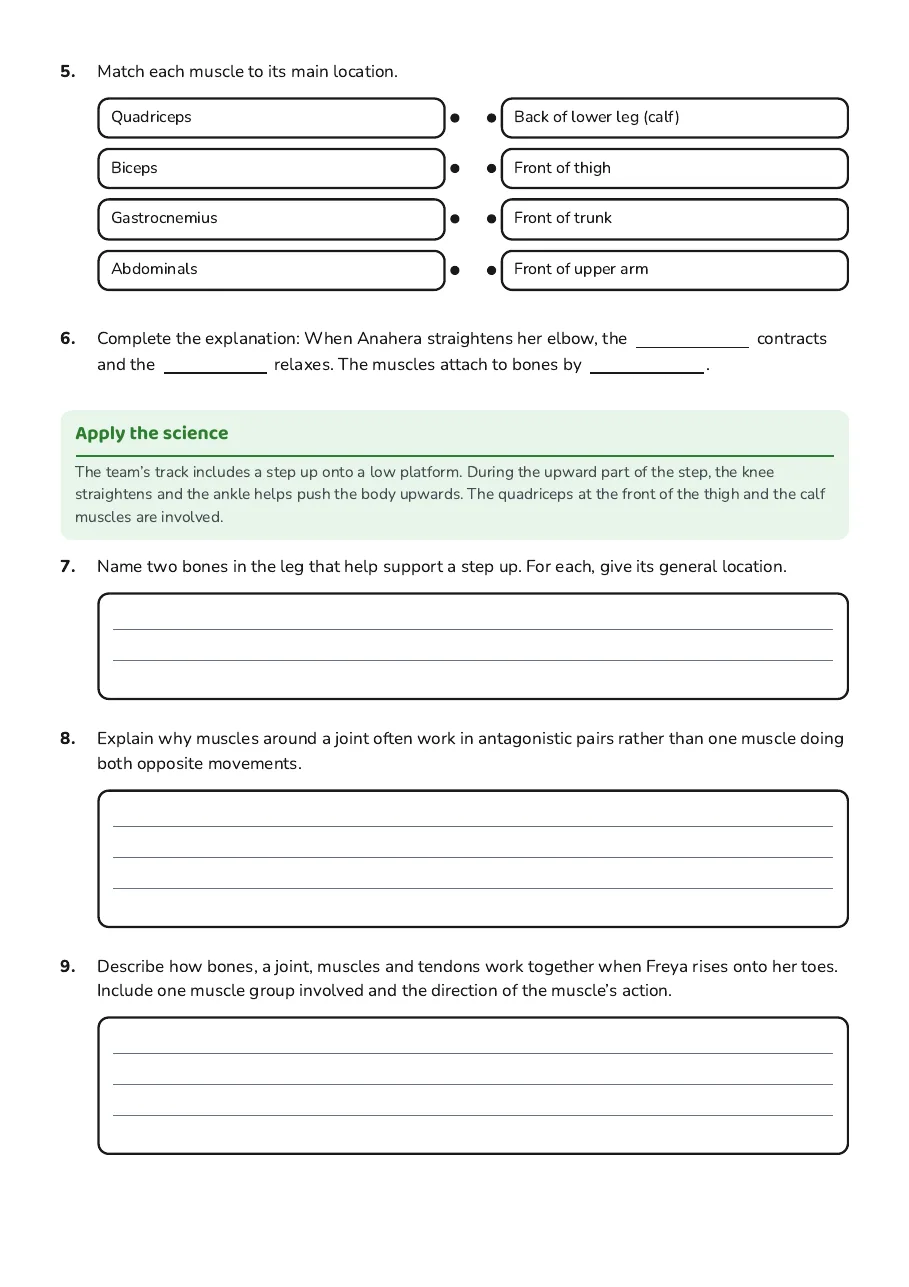
5.Match each muscle to its main location.
  • Quadriceps
  • Biceps
  • Gastrocnemius
  • Abdominals
  • Back of lower leg (calf)
  • Front of thigh
  • Front of trunk
  • Front of upper arm
6.Complete the explanation: When Anahera straightens her elbow, the contracts and the relaxes. The muscles attach to bones by .

Apply the science

The team’s track includes a step up onto a low platform. During the upward part of the step, the knee straightens and the ankle helps push the body upwards. The quadriceps at the front of the thigh and the calf muscles are involved.

7.Name two bones in the leg that help support a step up. For each, give its general location.
8.Explain why muscles around a joint often work in antagonistic pairs rather than one muscle doing both opposite movements.
9.Describe how bones, a joint, muscles and tendons work together when Freya rises onto her toes. Include one muscle group involved and the direction of the muscle’s action.
10.A teammate says, “Ligaments attach muscles to bones.” Correct the statement and explain why mixing up tendons and ligaments matters when describing movement.

3 printable pages

  • Muscles and Movement Basics, page 1 of 3: Movement system at a glance

    Page 1

  • Muscles and Movement Basics, page 2 of 3: Apply the science

    Page 2

  • Muscles and Movement Basics, page 3 of 3: 10. A teammate says, “Ligaments attach muscles to bones.” Correct the statement and…

    Page 3

About This Worksheet

Free in Kuraplan

Sign up free, grab the PDF, and customize it for your class.

Print-Ready

Formatted for standard paper. Clean layout, easy to read.

AI-Generated

Created with Kuraplan's AI, designed for real classroom use.

For Teachers & Parents

Use in classrooms, for homework, tutoring, or homeschool.

Need a custom version of this worksheet?

Kuraplan's AI generates custom worksheets in seconds — differentiated for every learner, aligned to your curriculum.

Generate Custom Worksheets — Free
No credit card Curriculum-aligned Under 60 seconds