ScienceFreePrintable

Human Body Joints Worksheet

A free science worksheet ready for your classroom. Open in Kuraplan to grab the print-ready PDF, customize it for your students, or generate a fresh version in seconds.
Human Body Joints Worksheet worksheet preview
Name:Date:

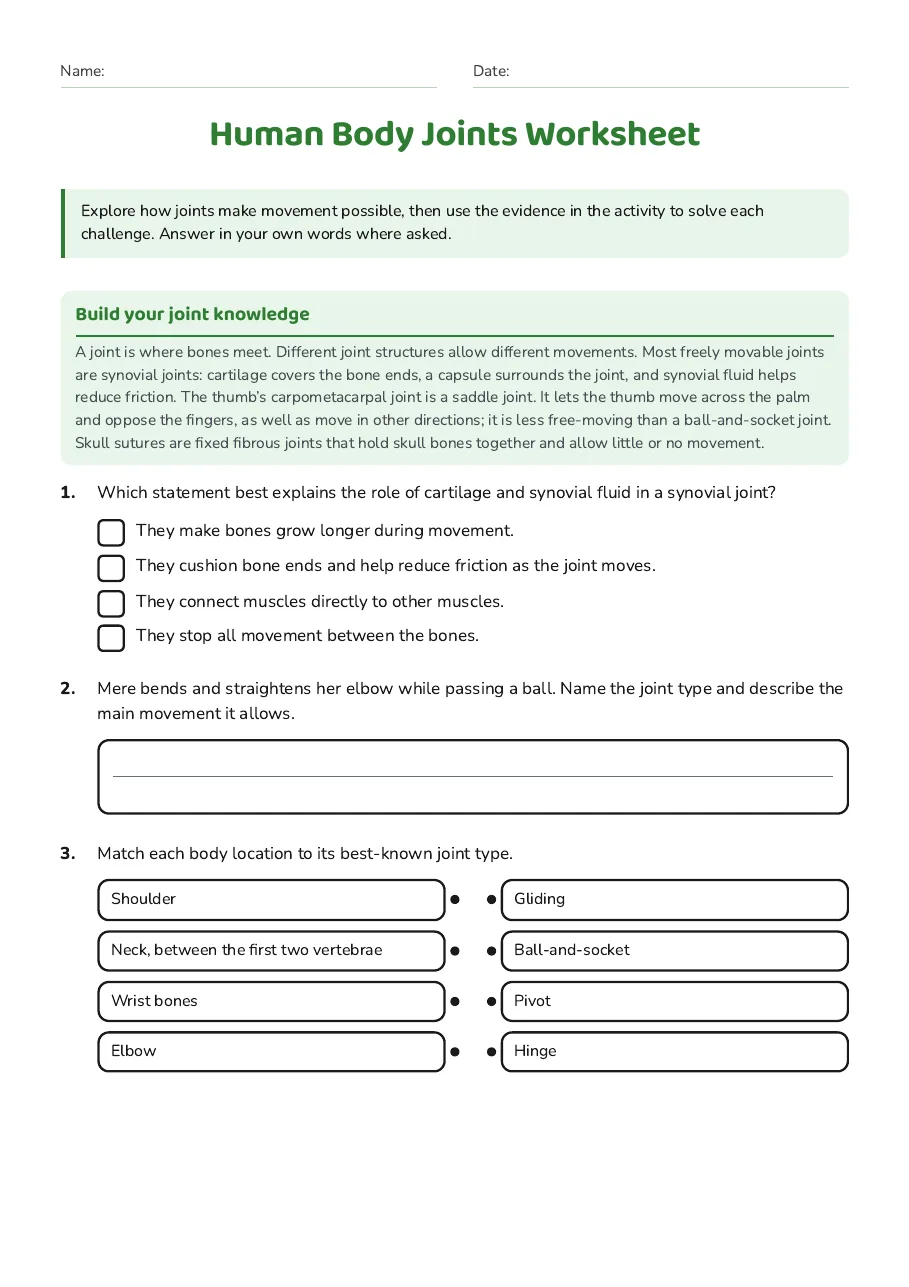
Human Body Joints Worksheet

Explore how joints make movement possible, then use the evidence in the activity to solve each challenge. Answer in your own words where asked.

Build your joint knowledge

A joint is where bones meet. Different joint structures allow different movements. Most freely movable joints are synovial joints: cartilage covers the bone ends, a capsule surrounds the joint, and synovial fluid helps reduce friction. The thumb’s carpometacarpal joint is a saddle joint. It lets the thumb move across the palm and oppose the fingers, as well as move in other directions; it is less free-moving than a ball-and-socket joint. Skull sutures are fixed fibrous joints that hold skull bones together and allow little or no movement.

1.Which statement best explains the role of cartilage and synovial fluid in a synovial joint?
  • They make bones grow longer during movement.
  • They cushion bone ends and help reduce friction as the joint moves.
  • They connect muscles directly to other muscles.
  • They stop all movement between the bones.
2.Mere bends and straightens her elbow while passing a ball. Name the joint type and describe the main movement it allows.
3.Match each body location to its best-known joint type.
  • Shoulder
  • Neck, between the first two vertebrae
  • Wrist bones
  • Elbow
  • Gliding
  • Ball-and-socket
  • Pivot
  • Hinge
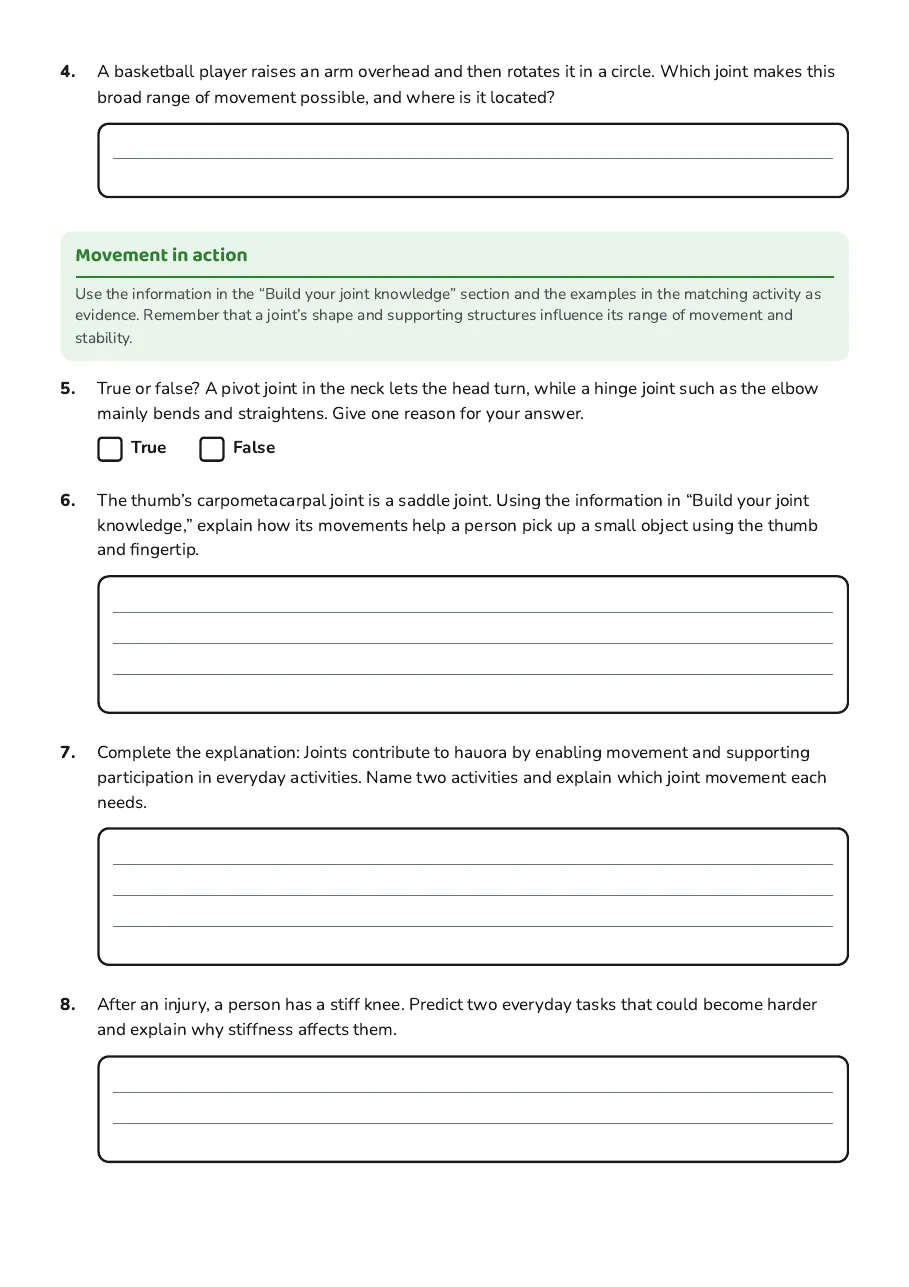
4.A basketball player raises an arm overhead and then rotates it in a circle. Which joint makes this broad range of movement possible, and where is it located?

Movement in action

Use the information in the “Build your joint knowledge” section and the examples in the matching activity as evidence. Remember that a joint’s shape and supporting structures influence its range of movement and stability.

5.True or false? A pivot joint in the neck lets the head turn, while a hinge joint such as the elbow mainly bends and straightens. Give one reason for your answer.
TrueFalse
6.The thumb’s carpometacarpal joint is a saddle joint. Using the information in “Build your joint knowledge,” explain how its movements help a person pick up a small object using the thumb and fingertip.
7.Complete the explanation: Joints contribute to hauora by enabling movement and supporting participation in everyday activities. Name two activities and explain which joint movement each needs.
8.After an injury, a person has a stiff knee. Predict two everyday tasks that could become harder and explain why stiffness affects them.
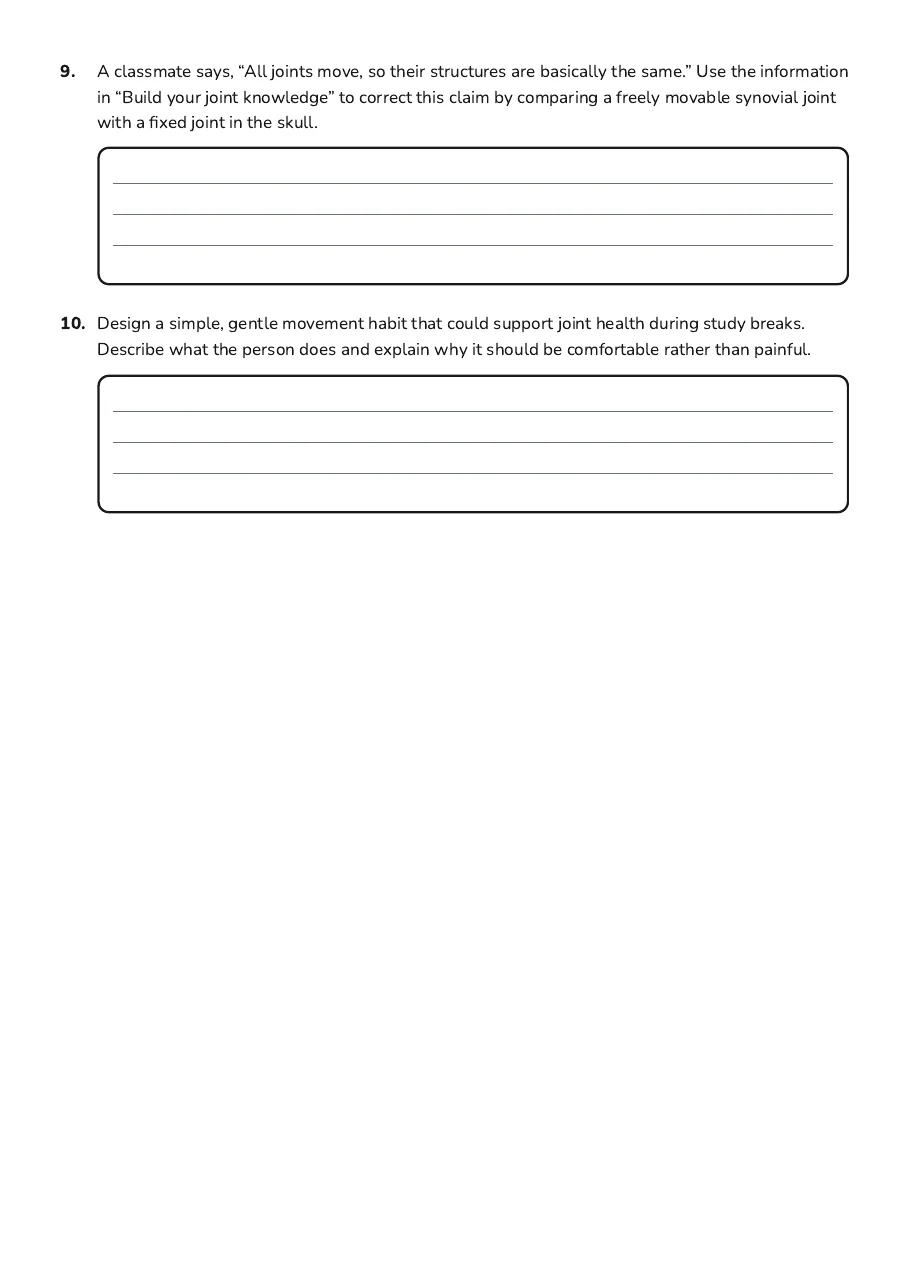
9.A classmate says, “All joints move, so their structures are basically the same.” Use the information in “Build your joint knowledge” to correct this claim by comparing a freely movable synovial joint with a fixed joint in the skull.
10.Design a simple, gentle movement habit that could support joint health during study breaks. Describe what the person does and explain why it should be comfortable rather than painful.

3 printable pages

  • Human Body Joints Worksheet, page 1 of 3: Build your joint knowledge

    Page 1

  • Human Body Joints Worksheet, page 2 of 3: Build your joint knowledge, Movement in action

    Page 2

  • Human Body Joints Worksheet, page 3 of 3: Build your joint knowledge

    Page 3

About This Worksheet

Free in Kuraplan

Sign up free, grab the PDF, and customize it for your class.

Print-Ready

Formatted for standard paper. Clean layout, easy to read.

AI-Generated

Created with Kuraplan's AI, designed for real classroom use.

For Teachers & Parents

Use in classrooms, for homework, tutoring, or homeschool.

Need a custom version of this worksheet?

Kuraplan's AI generates custom worksheets in seconds — differentiated for every learner, aligned to your curriculum.

Generate Custom Worksheets — Free
No credit card Curriculum-aligned Under 60 seconds