ScienceFreePrintable
Chemical Reactions Introduction
A free science worksheet ready for your classroom. Open in Kuraplan to grab the print-ready PDF, customize it for your students, or generate a fresh version in seconds.
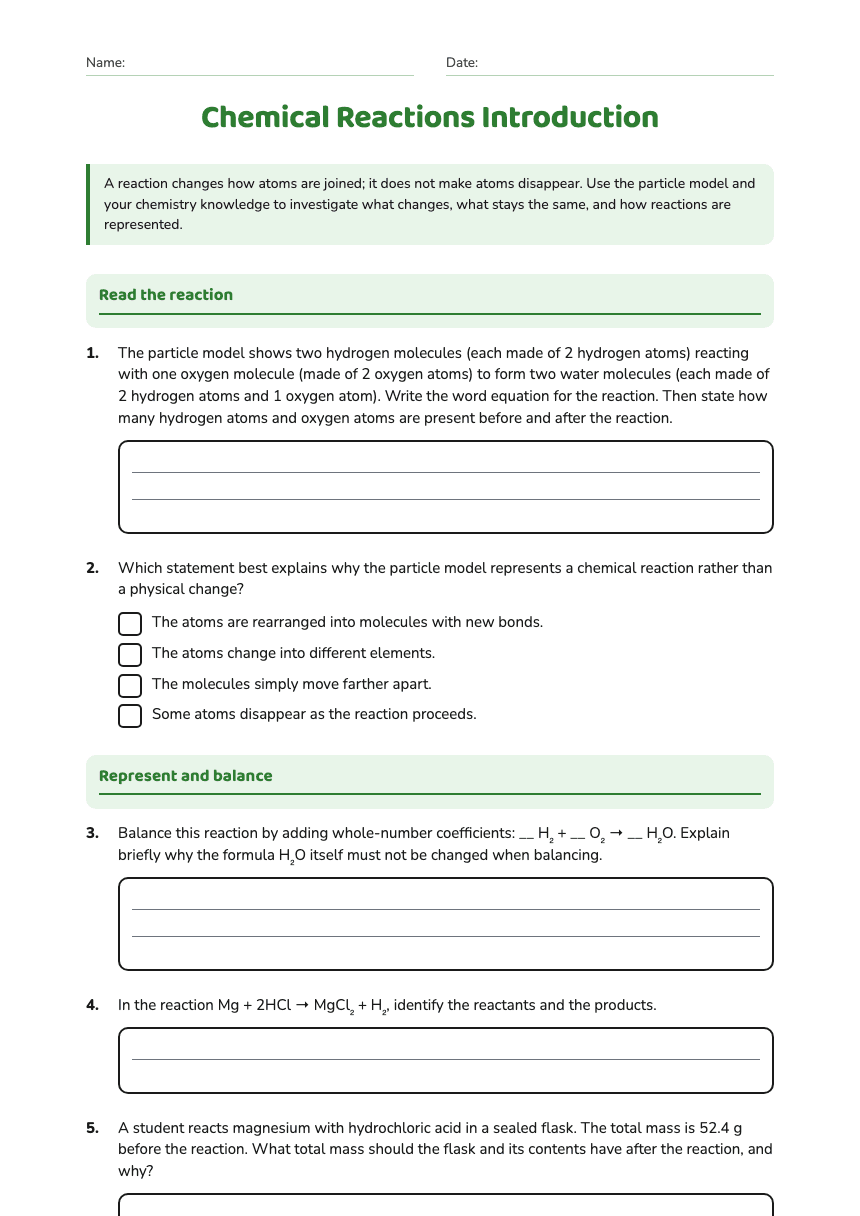
Name:Date:
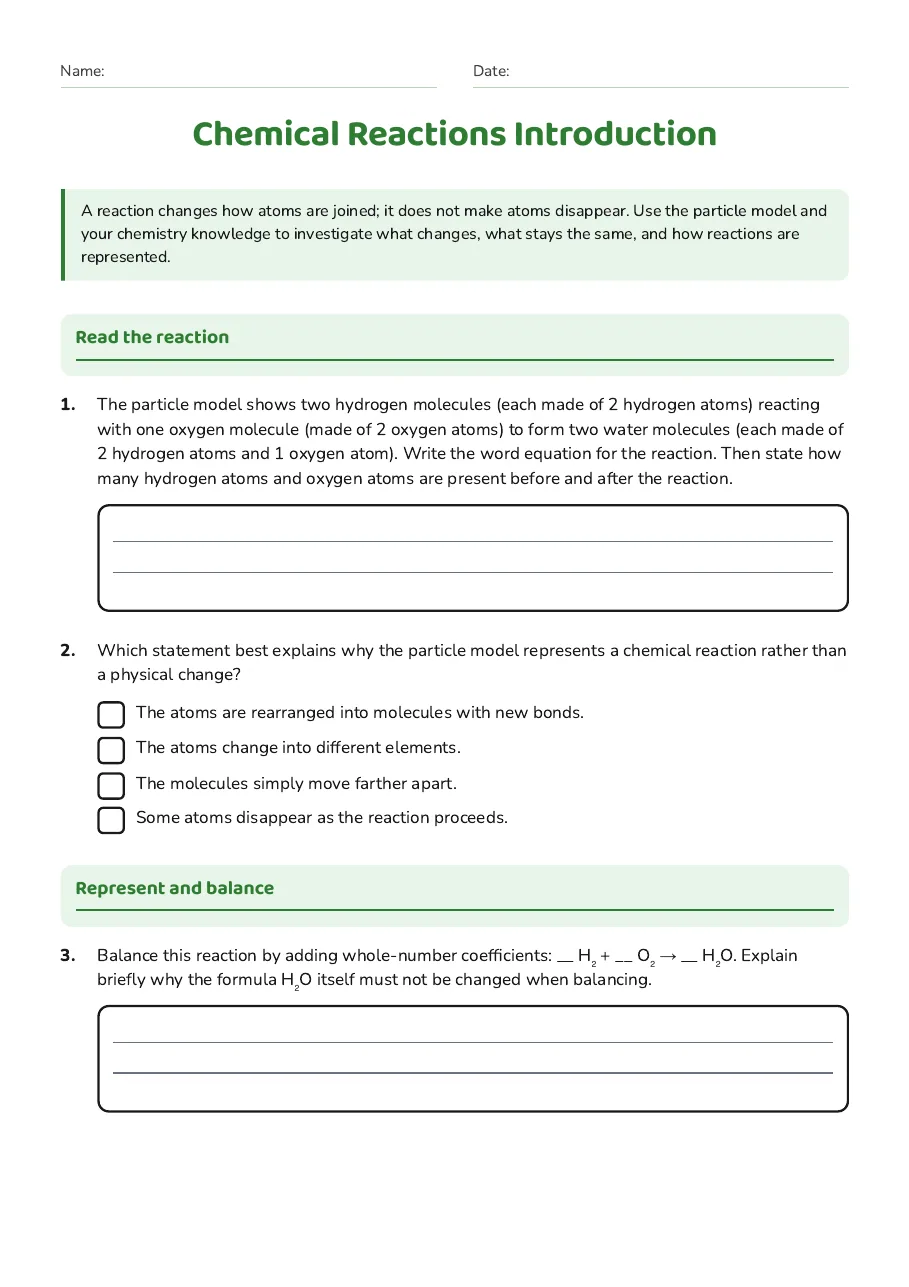
Chemical Reactions Introduction
A reaction changes how atoms are joined; it does not make atoms disappear. Use the particle model and your chemistry knowledge to investigate what changes, what stays the same, and how reactions are represented.
Read the reaction
1.The particle model shows two hydrogen molecules (each made of 2 hydrogen atoms) reacting with one oxygen molecule (made of 2 oxygen atoms) to form two water molecules (each made of 2 hydrogen atoms and 1 oxygen atom). Write the word equation for the reaction. Then state how many hydrogen atoms and oxygen atoms are present before and after the reaction.
2.Which statement best explains why the particle model represents a chemical reaction rather than a physical change?
- The atoms are rearranged into molecules with new bonds.
- The atoms change into different elements.
- The molecules simply move farther apart.
- Some atoms disappear as the reaction proceeds.
Represent and balance
3.Balance this reaction by adding whole-number coefficients: __ H₂ + __ O₂ → __ H₂O. Explain briefly why the formula H₂O itself must not be changed when balancing.
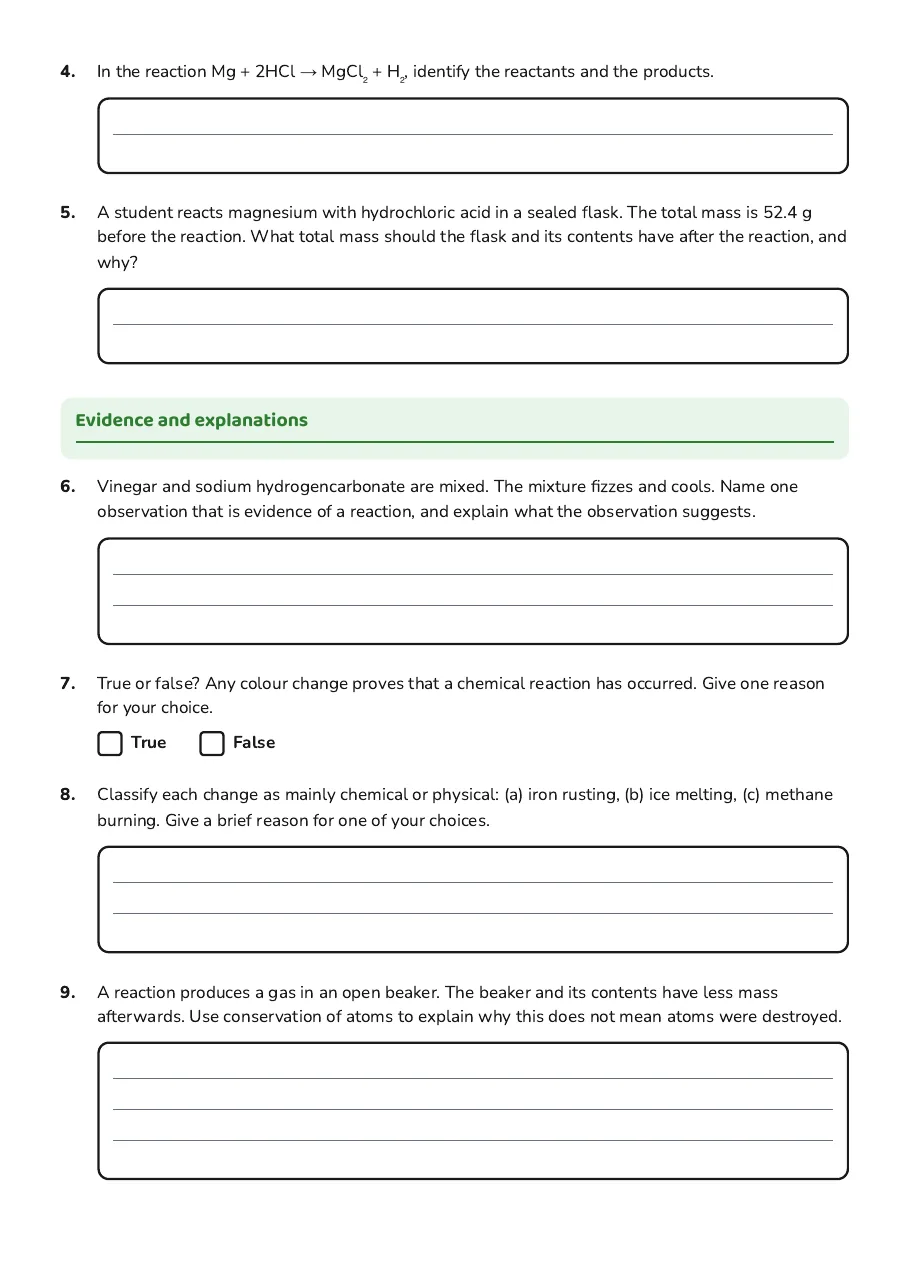
4.In the reaction Mg + 2HCl → MgCl₂ + H₂, identify the reactants and the products.
5.A student reacts magnesium with hydrochloric acid in a sealed flask. The total mass is 52.4 g before the reaction. What total mass should the flask and its contents have after the reaction, and why?
Evidence and explanations
6.Vinegar and sodium hydrogencarbonate are mixed. The mixture fizzes and cools. Name one observation that is evidence of a reaction, and explain what the observation suggests.
7.True or false? Any colour change proves that a chemical reaction has occurred. Give one reason for your choice.
TrueFalse
8.Classify each change as mainly chemical or physical: (a) iron rusting, (b) ice melting, (c) methane burning. Give a brief reason for one of your choices.
9.A reaction produces a gas in an open beaker. The beaker and its contents have less mass afterwards. Use conservation of atoms to explain why this does not mean atoms were destroyed.
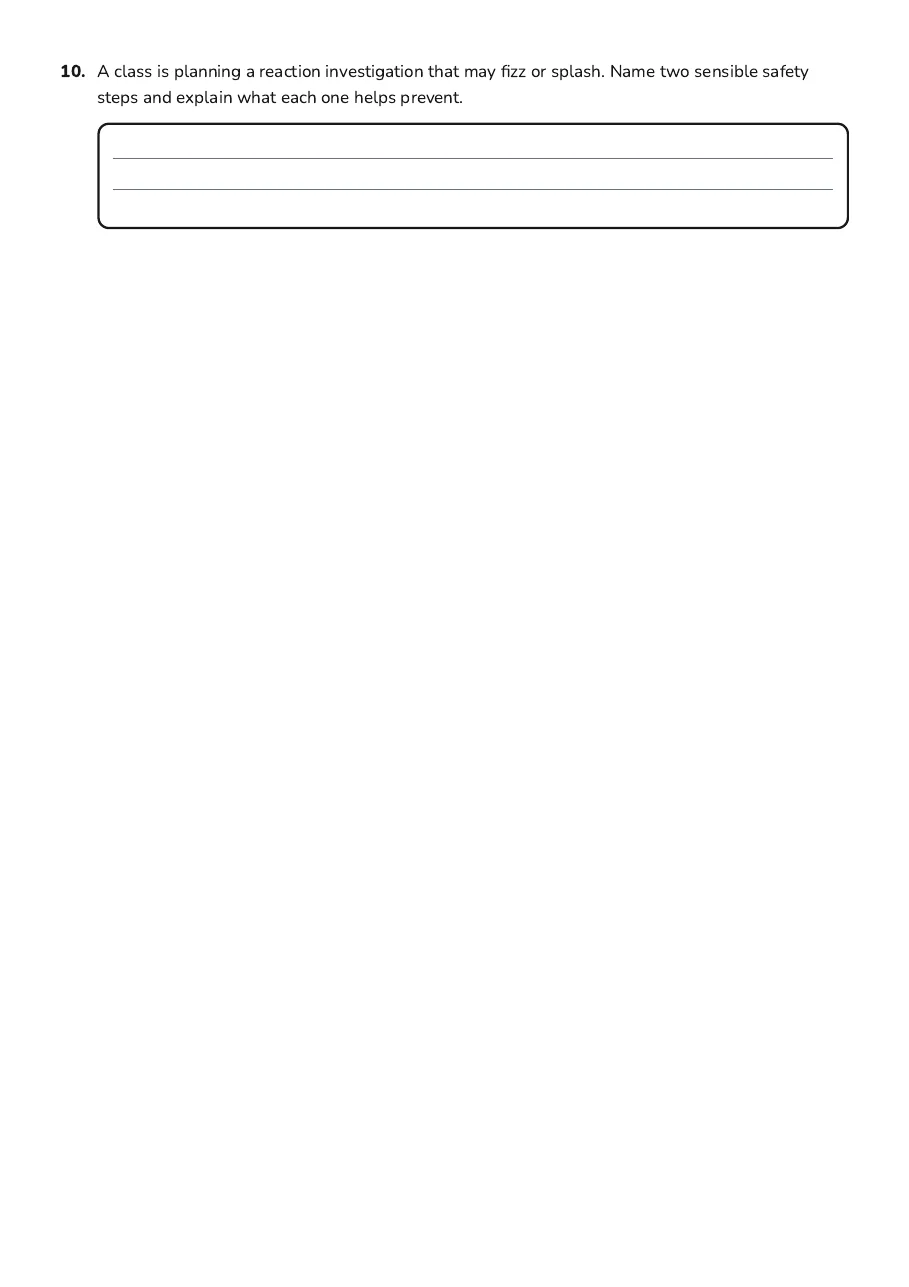
10.A class is planning a reaction investigation that may fizz or splash. Name two sensible safety steps and explain what each one helps prevent.
3 printable pages
Page 1
Page 2
Page 3
About This Worksheet
Free in Kuraplan
Sign up free, grab the PDF, and customize it for your class.
Print-Ready
Formatted for standard paper. Clean layout, easy to read.
AI-Generated
Created with Kuraplan's AI, designed for real classroom use.
For Teachers & Parents
Use in classrooms, for homework, tutoring, or homeschool.
Need a custom version of this worksheet?
Kuraplan's AI generates custom worksheets in seconds — differentiated for every learner, aligned to your curriculum.
Generate Custom Worksheets — Free No credit card Curriculum-aligned Under 60 seconds
More Science Worksheets
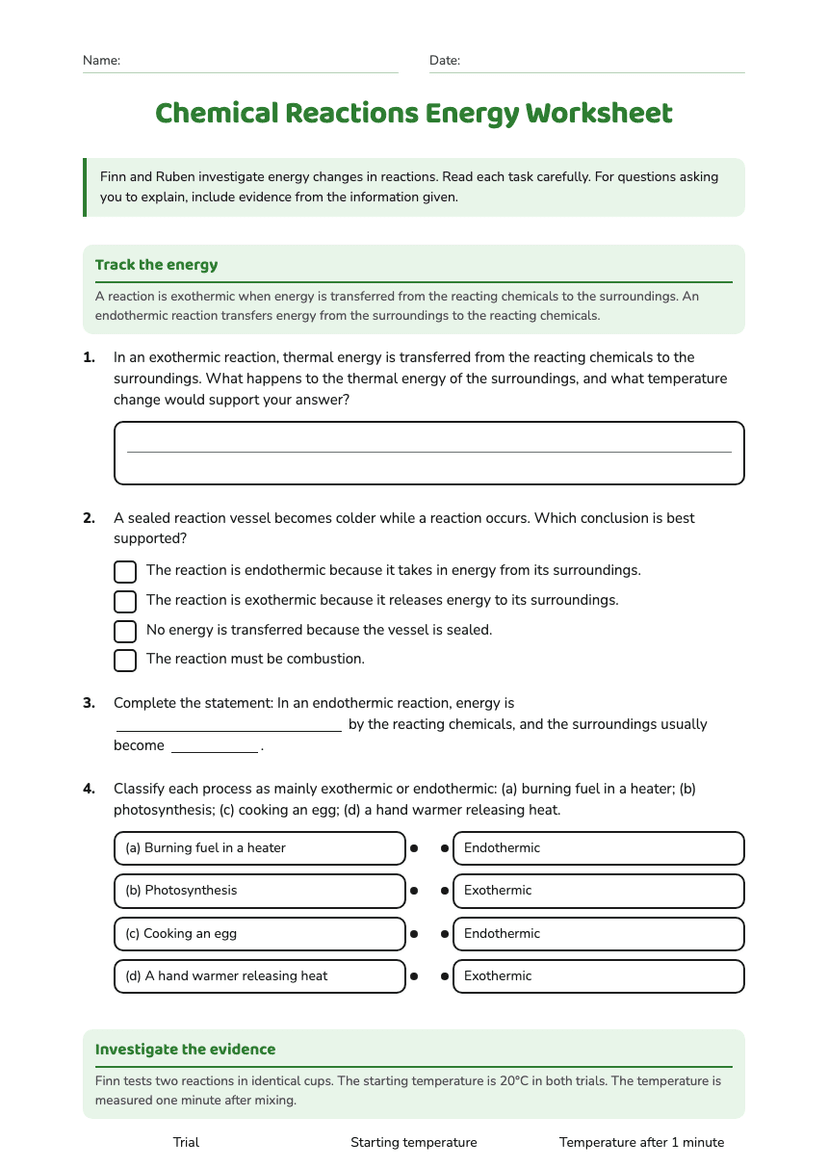
Chemical Reactions Energy Worksheet
Free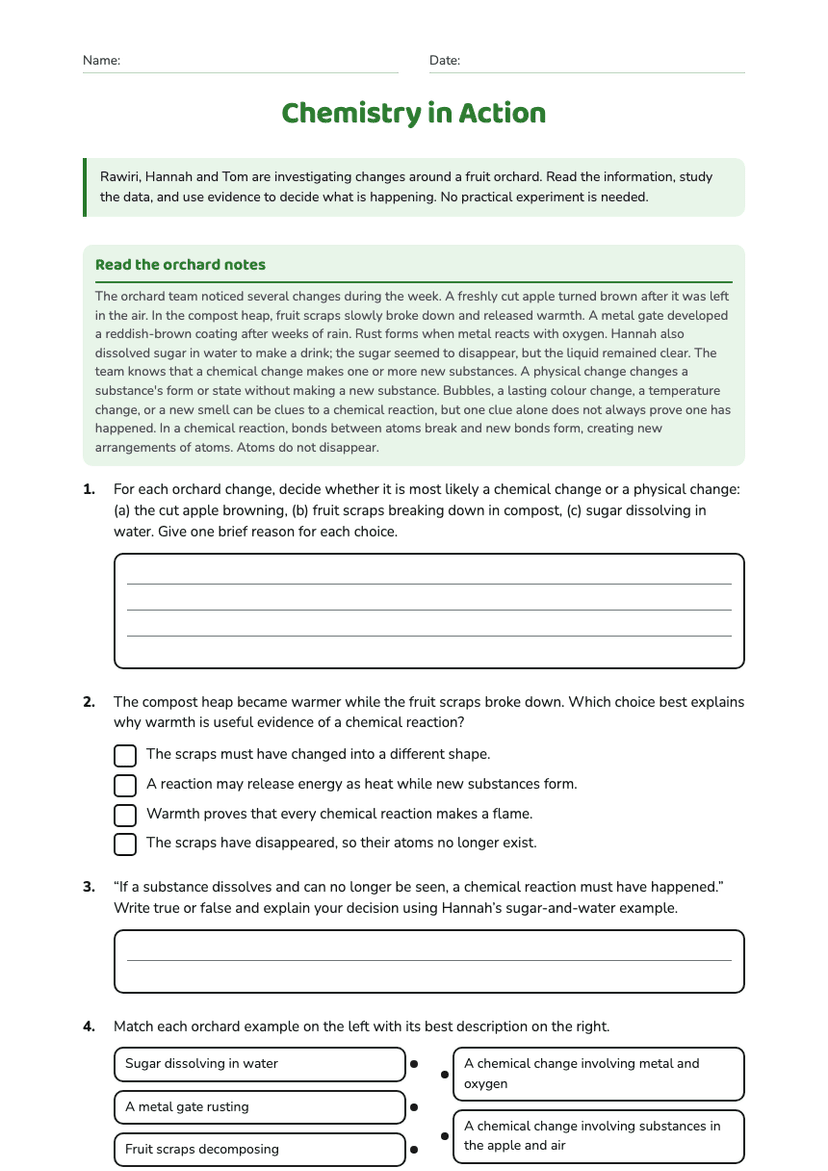
Year 7
Chemistry in Action
Free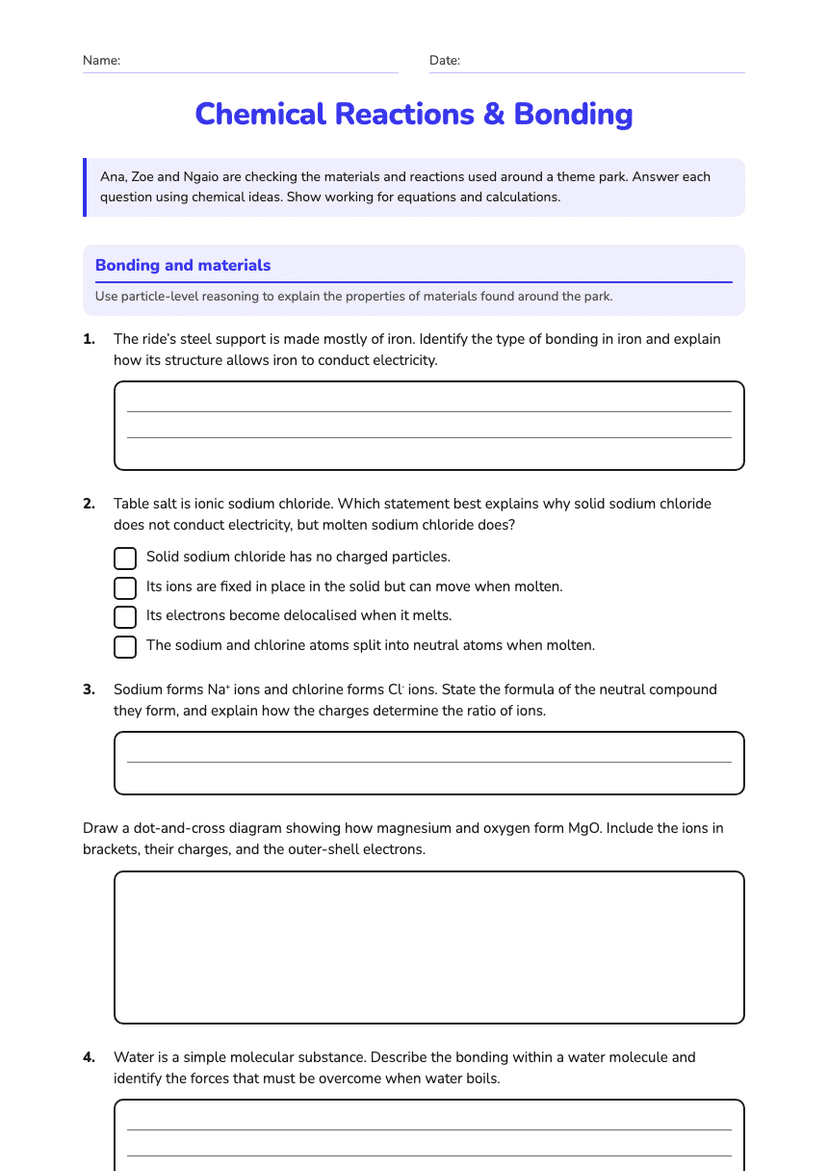
Year 11
Chemical Reactions & Bonding
Free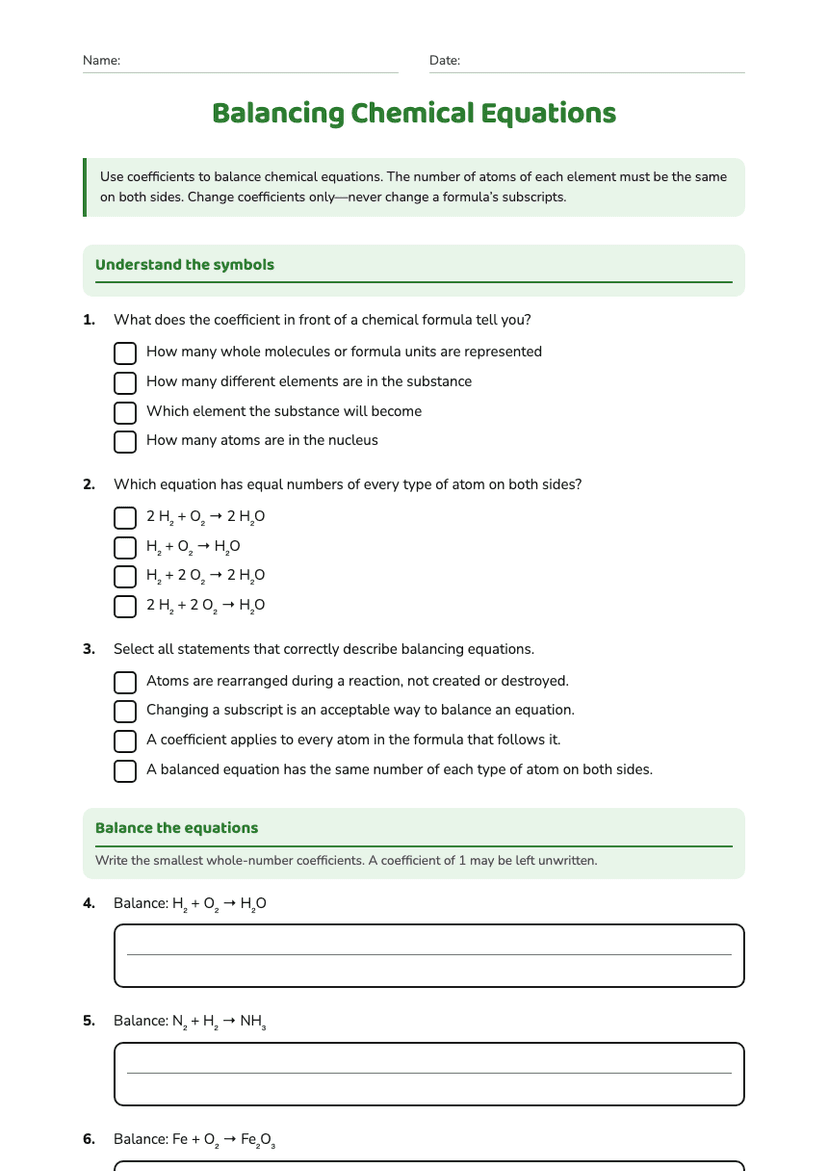
Year 7–8
Balancing Chemical Equations
Free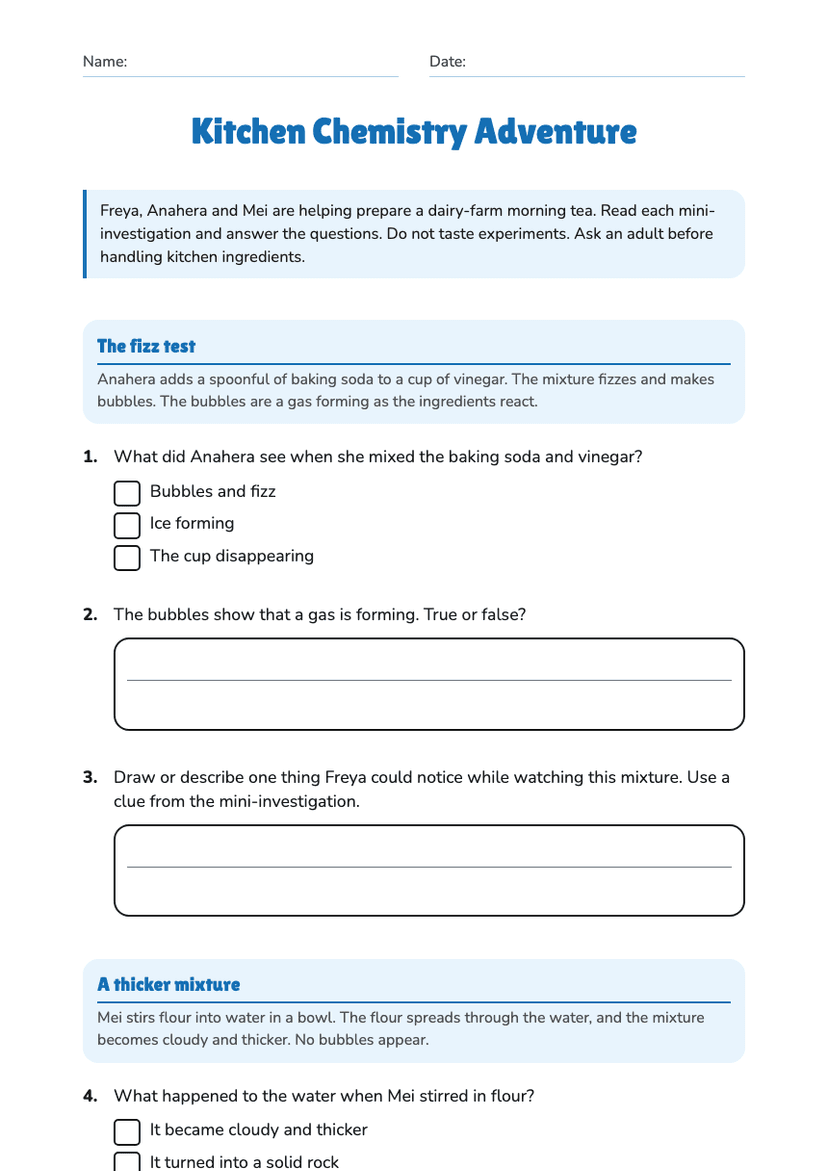
Year 2
Kitchen Chemistry Adventure
Free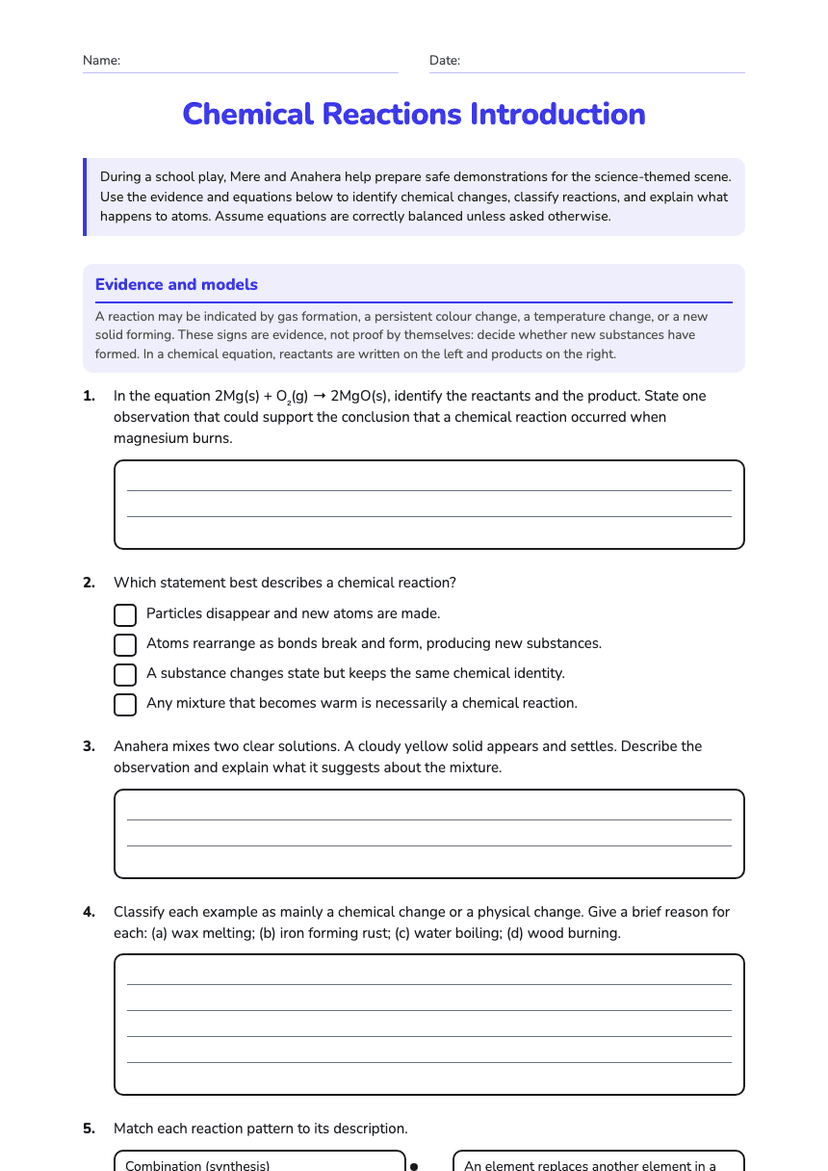
Year 11
Chemical Reactions Introduction
Free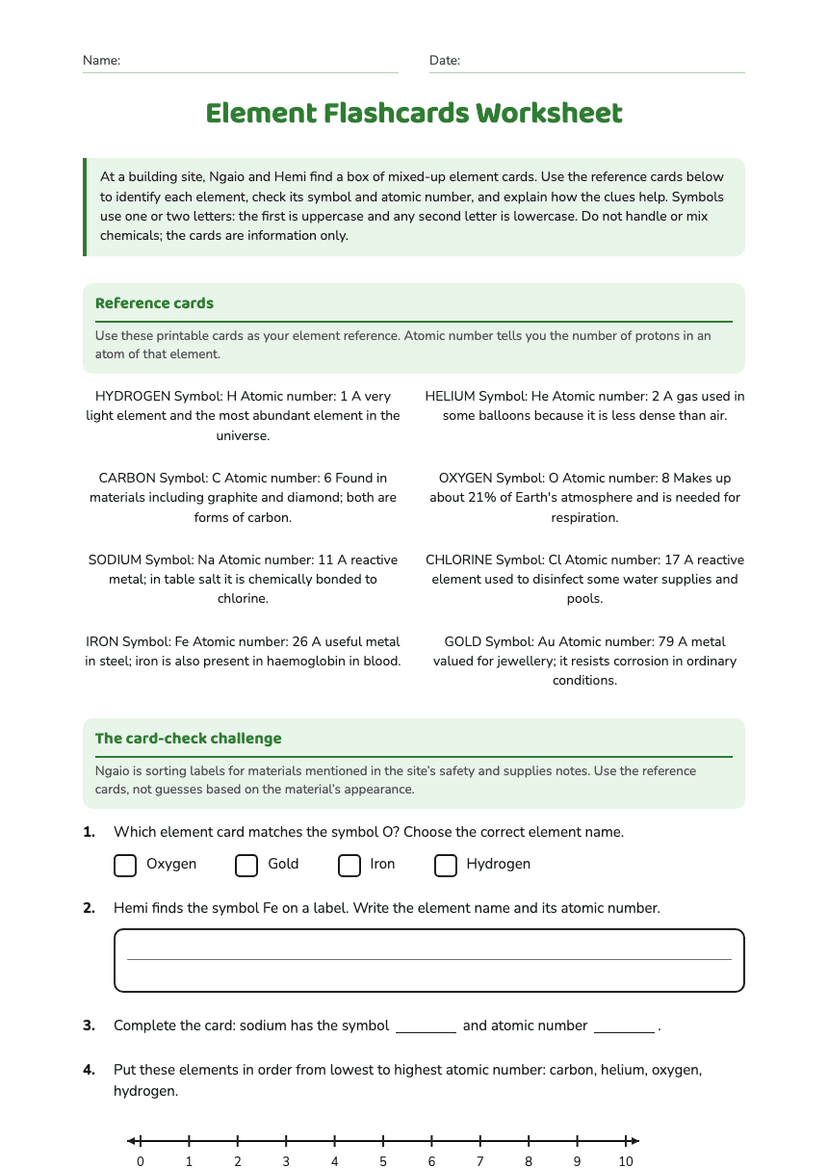
Year 9
Element Flashcards Worksheet
Free
Year 7–8