ScienceFreePrintable

Conductivity Circuits Exploration

A free science worksheet ready for your classroom. Open in Kuraplan to grab the print-ready PDF, customize it for your students, or generate a fresh version in seconds.
Conductivity Circuits Exploration worksheet preview
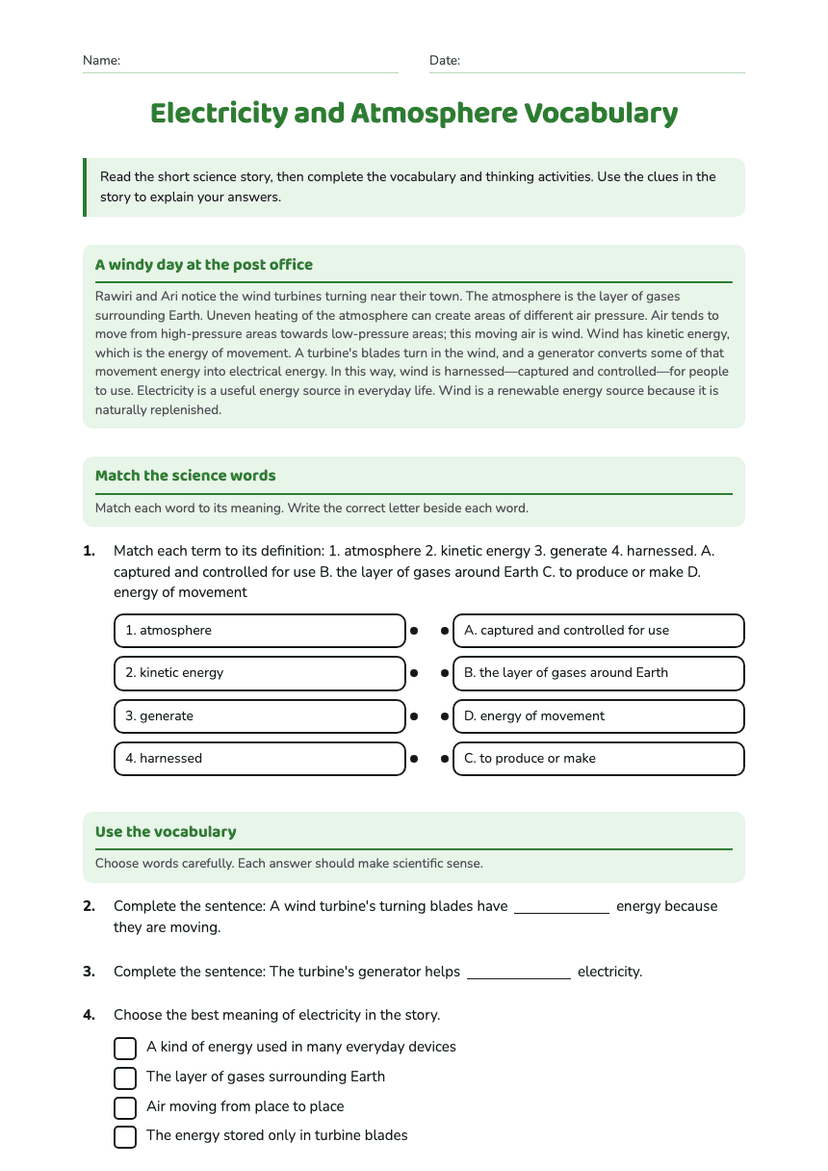
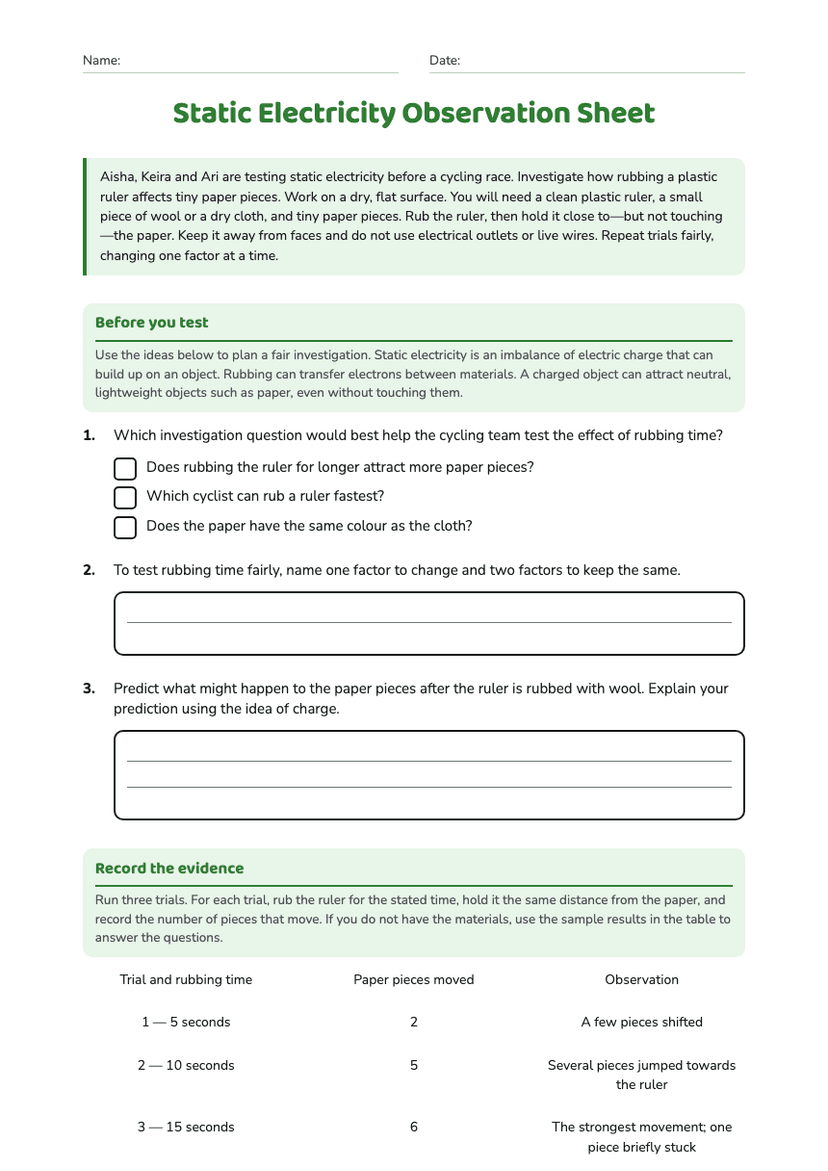
Name:Date:

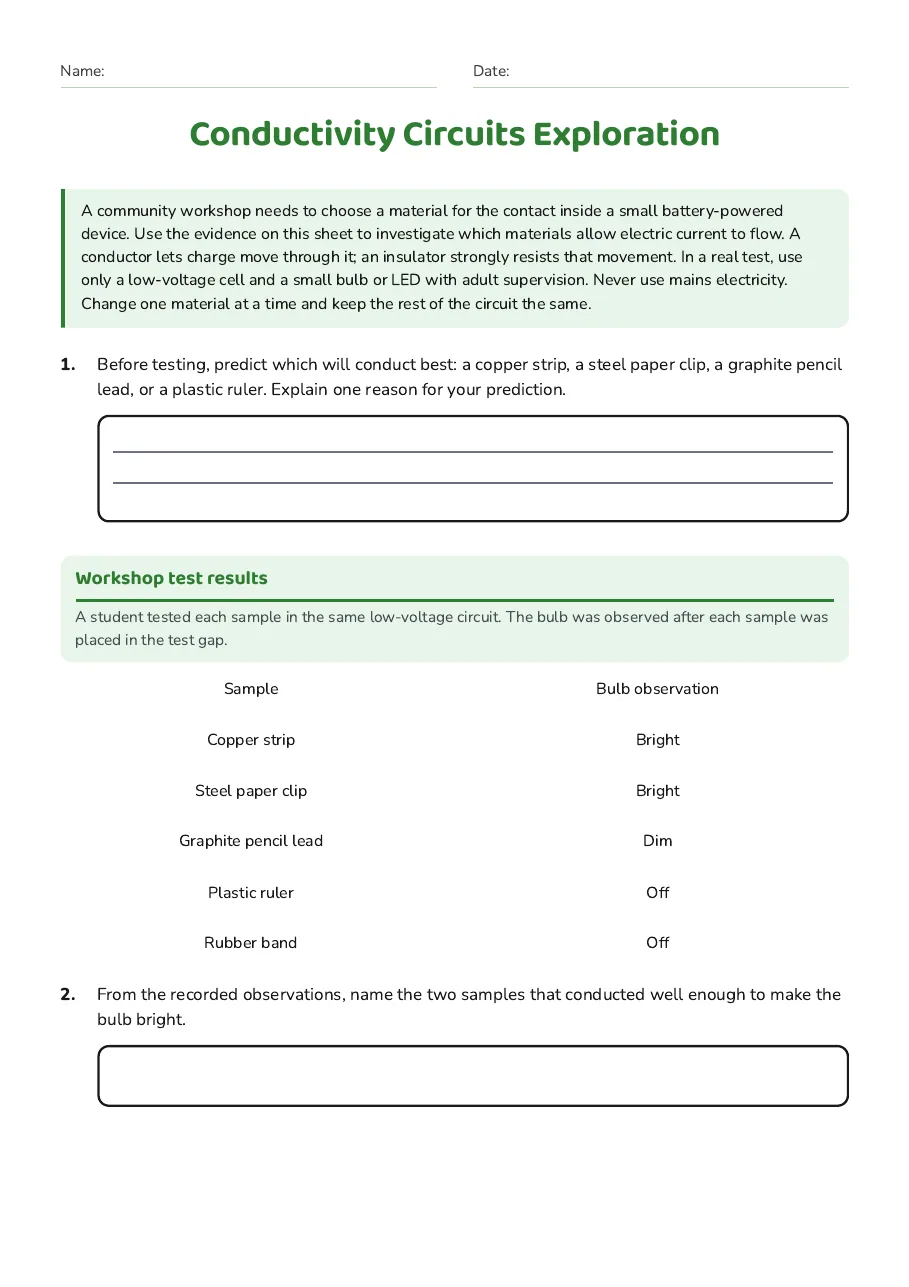
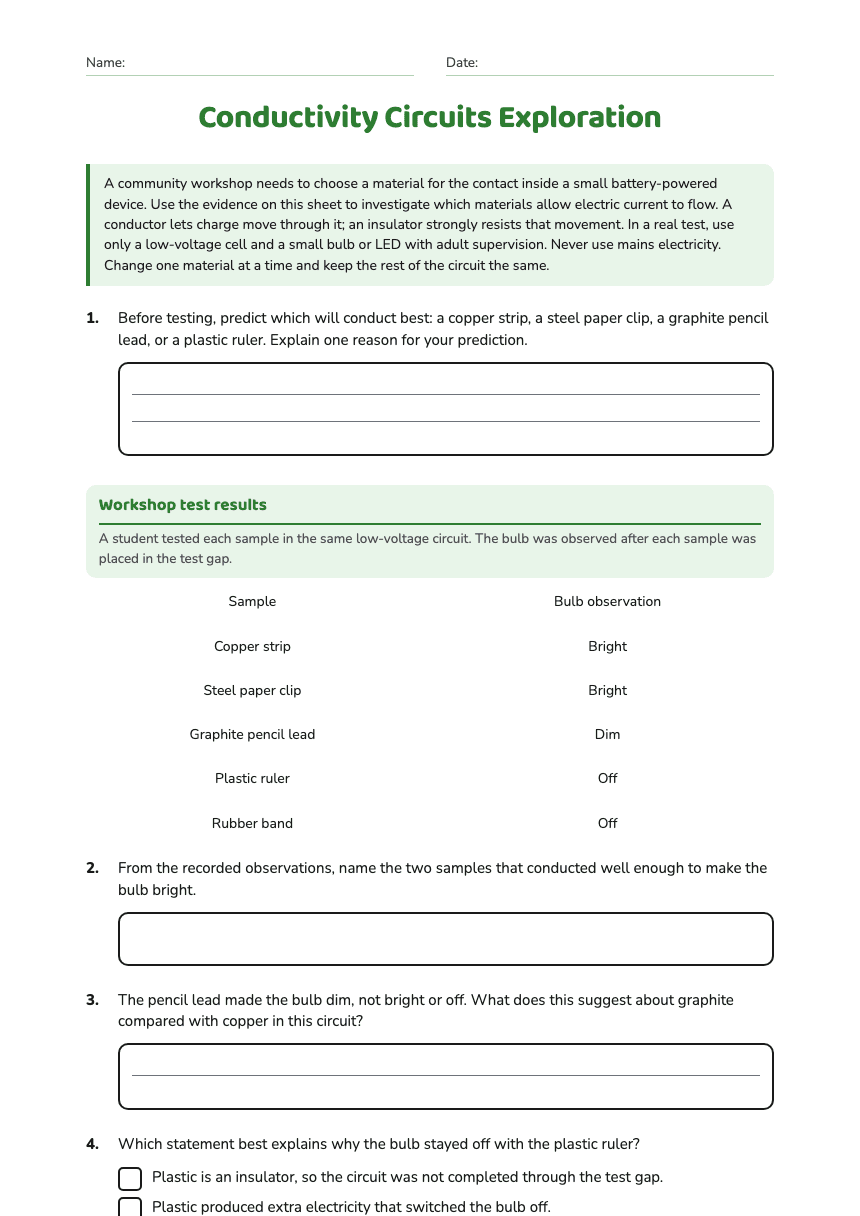
Conductivity Circuits Exploration

A community workshop needs to choose a material for the contact inside a small battery-powered device. Use the evidence on this sheet to investigate which materials allow electric current to flow. A conductor lets charge move through it; an insulator strongly resists that movement. In a real test, use only a low-voltage cell and a small bulb or LED with adult supervision. Never use mains electricity. Change one material at a time and keep the rest of the circuit the same.
1.Before testing, predict which will conduct best: a copper strip, a steel paper clip, a graphite pencil lead, or a plastic ruler. Explain one reason for your prediction.

Workshop test results

A student tested each sample in the same low-voltage circuit. The bulb was observed after each sample was placed in the test gap.

Sample

Bulb observation

Copper strip

Bright

Steel paper clip

Bright

Graphite pencil lead

Dim

Plastic ruler

Off

Rubber band

Off

2.From the recorded observations, name the two samples that conducted well enough to make the bulb bright.
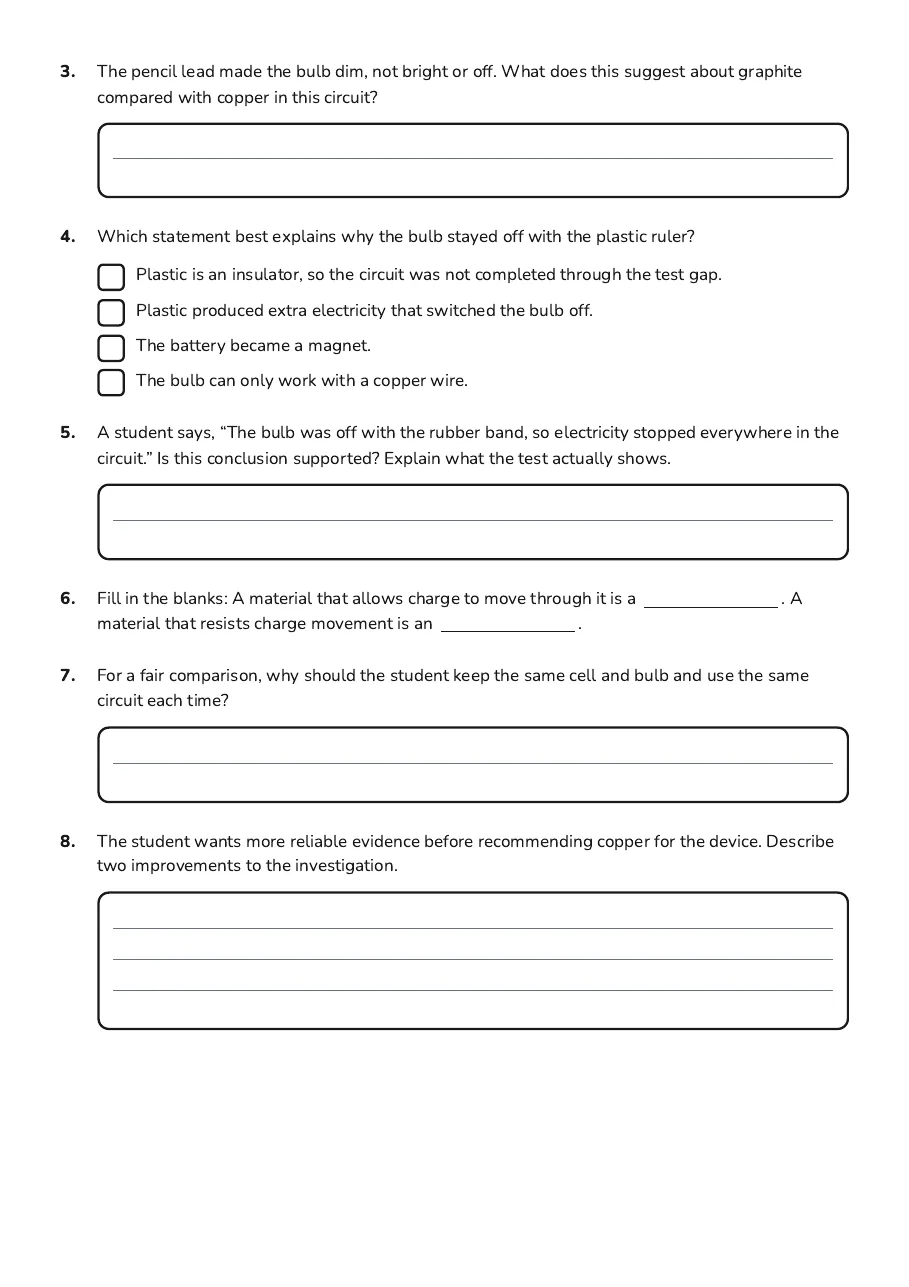
3.The pencil lead made the bulb dim, not bright or off. What does this suggest about graphite compared with copper in this circuit?
4.Which statement best explains why the bulb stayed off with the plastic ruler?
  • Plastic is an insulator, so the circuit was not completed through the test gap.
  • Plastic produced extra electricity that switched the bulb off.
  • The battery became a magnet.
  • The bulb can only work with a copper wire.
5.A student says, “The bulb was off with the rubber band, so electricity stopped everywhere in the circuit.” Is this conclusion supported? Explain what the test actually shows.
6.Fill in the blanks: A material that allows charge to move through it is a . A material that resists charge movement is an .
7.For a fair comparison, why should the student keep the same cell and bulb and use the same circuit each time?
8.The student wants more reliable evidence before recommending copper for the device. Describe two improvements to the investigation.
9.Write a short recommendation for the workshop: choose a material for the electrical contact and support your choice with evidence from the observations.

3 printable pages

  • Conductivity Circuits Exploration, page 1 of 3: Workshop test results

    Page 1

  • Conductivity Circuits Exploration, page 2 of 3: 3. The pencil lead made the bulb dim, not bright or off. What does this suggest about…

    Page 2

  • Conductivity Circuits Exploration, page 3 of 3: 9. Write a short recommendation for the workshop: choose a material for the electrical…

    Page 3

About This Worksheet

Free in Kuraplan

Sign up free, grab the PDF, and customize it for your class.

Print-Ready

Formatted for standard paper. Clean layout, easy to read.

AI-Generated

Created with Kuraplan's AI, designed for real classroom use.

For Teachers & Parents

Use in classrooms, for homework, tutoring, or homeschool.

Need a custom version of this worksheet?

Kuraplan's AI generates custom worksheets in seconds — differentiated for every learner, aligned to your curriculum.

Generate Custom Worksheets — Free
No credit card Curriculum-aligned Under 60 seconds