ScienceFreePrintable

Material Properties Investigation

A free science worksheet ready for your classroom. Open in Kuraplan to grab the print-ready PDF, customize it for your students, or generate a fresh version in seconds.
Material Properties Investigation worksheet preview
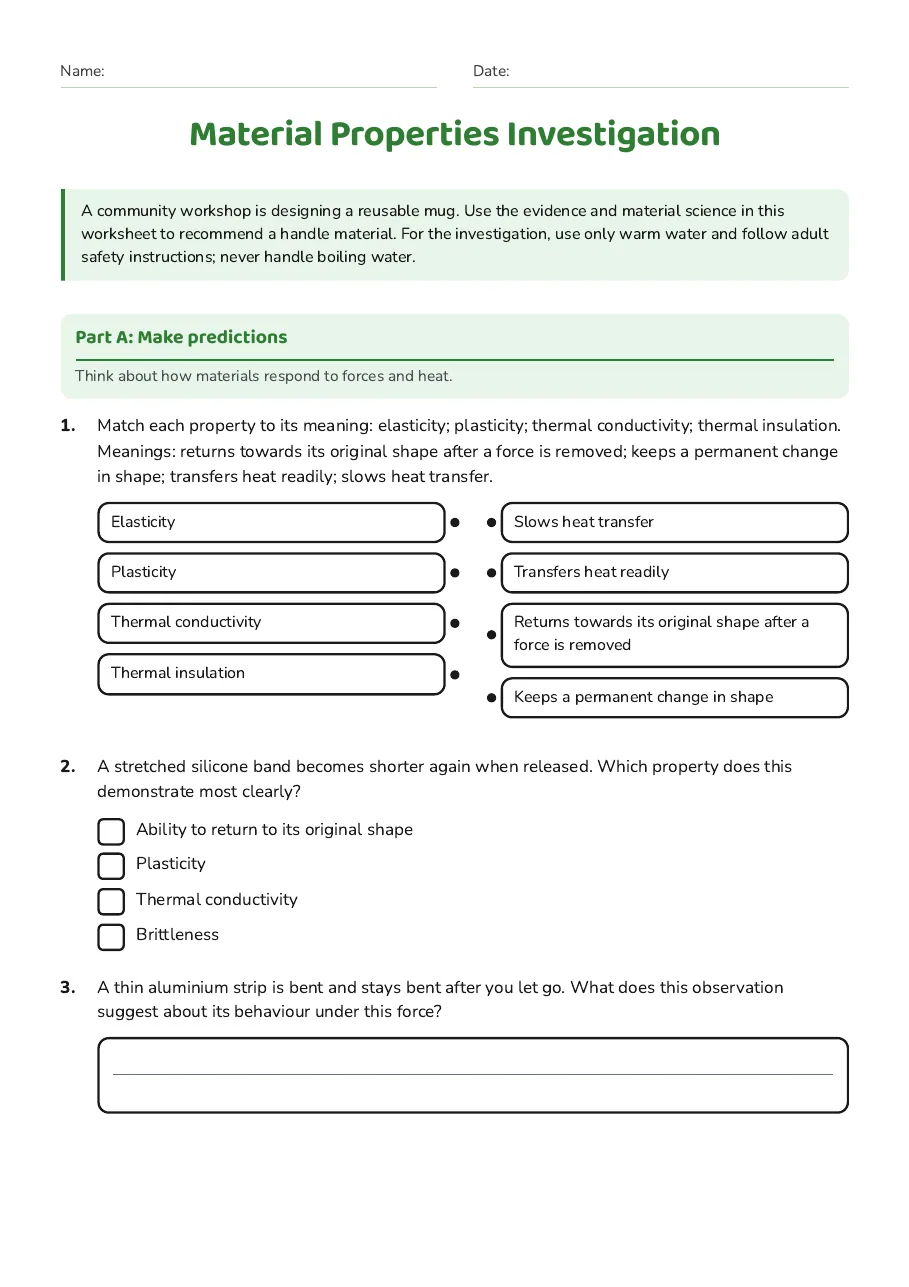
Name:Date:

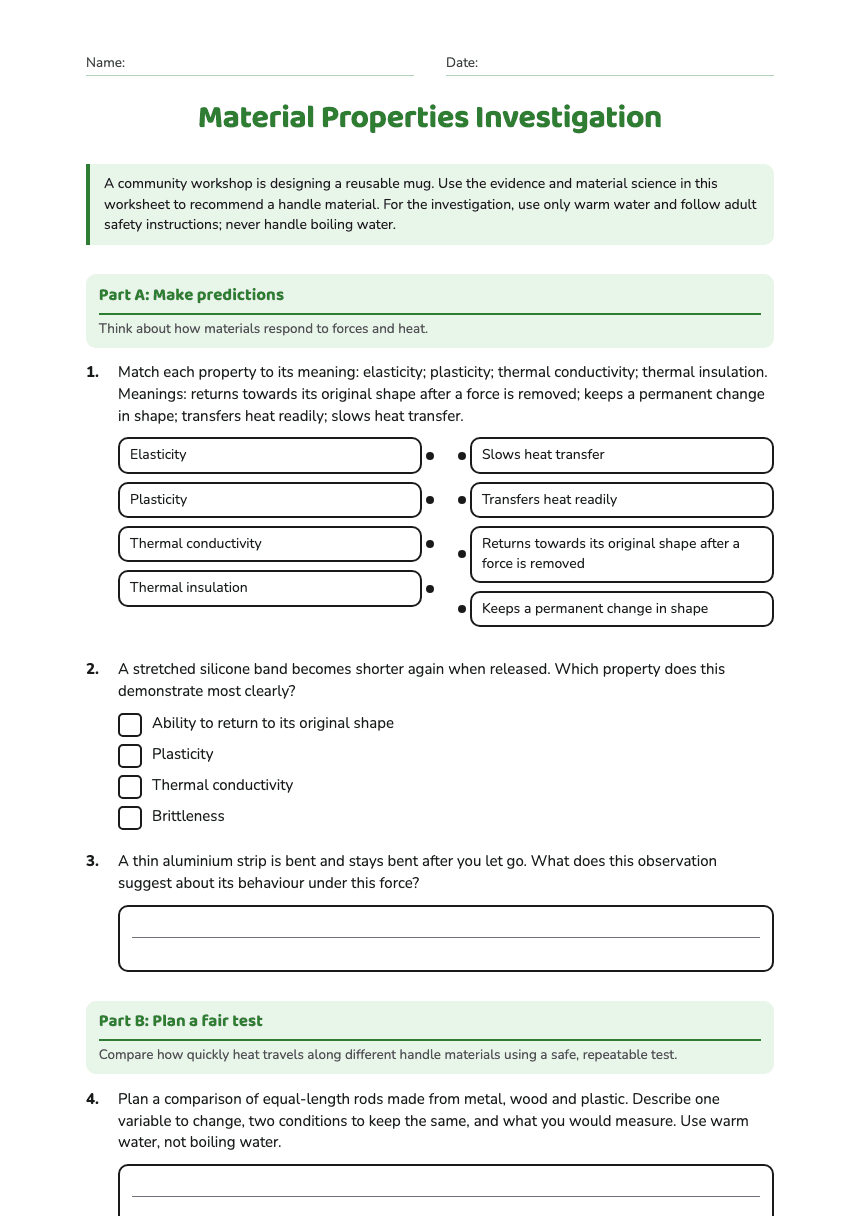
Material Properties Investigation

A community workshop is designing a reusable mug. Use the evidence and material science in this worksheet to recommend a handle material. For the investigation, use only warm water and follow adult safety instructions; never handle boiling water.

Part A: Make predictions

Think about how materials respond to forces and heat.

1.Match each property to its meaning: elasticity; plasticity; thermal conductivity; thermal insulation. Meanings: returns towards its original shape after a force is removed; keeps a permanent change in shape; transfers heat readily; slows heat transfer.
  • Elasticity
  • Plasticity
  • Thermal conductivity
  • Thermal insulation
  • Slows heat transfer
  • Transfers heat readily
  • Returns towards its original shape after a force is removed
  • Keeps a permanent change in shape
2.A stretched silicone band becomes shorter again when released. Which property does this demonstrate most clearly?
  • Ability to return to its original shape
  • Plasticity
  • Thermal conductivity
  • Brittleness
3.A thin aluminium strip is bent and stays bent after you let go. What does this observation suggest about its behaviour under this force?

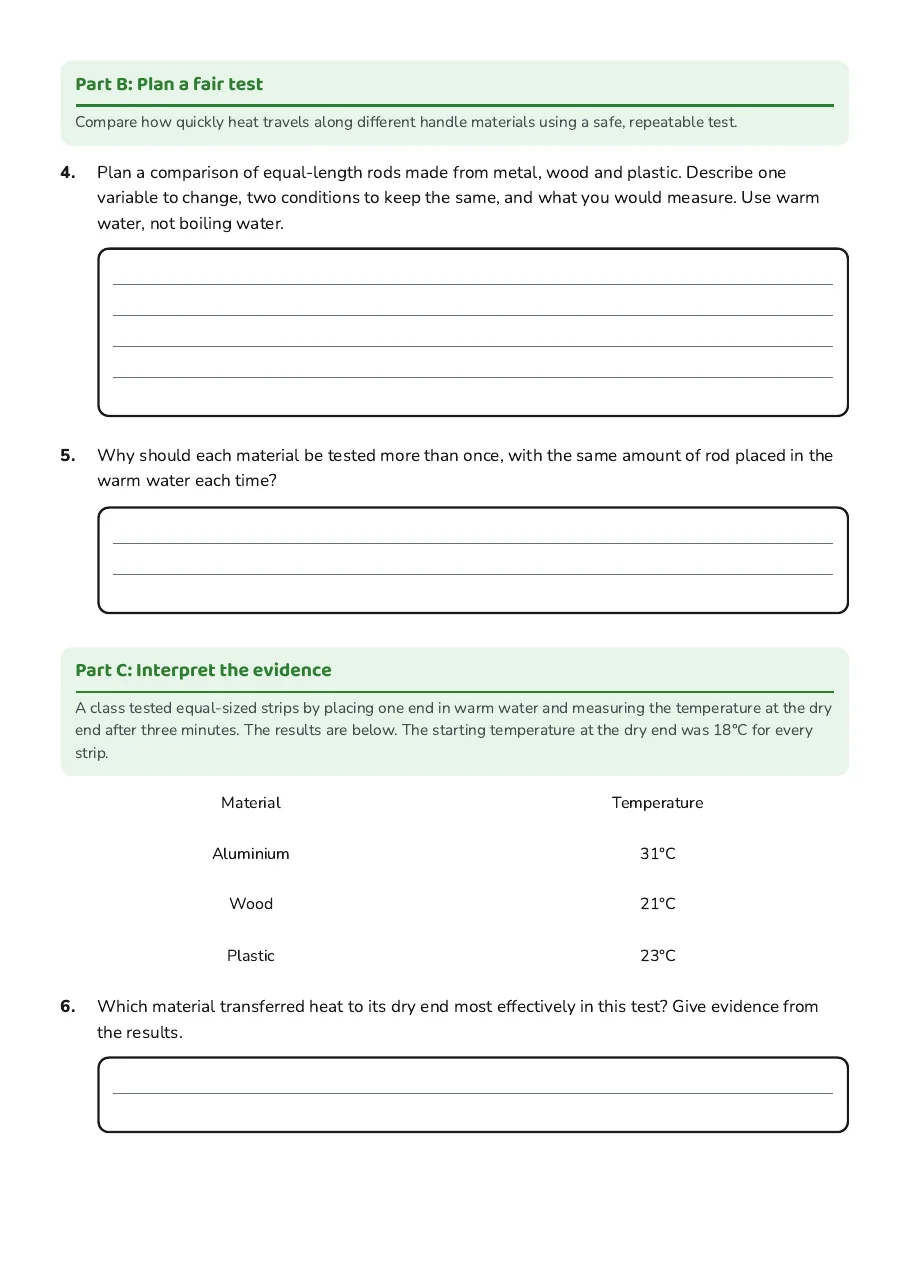
Part B: Plan a fair test

Compare how quickly heat travels along different handle materials using a safe, repeatable test.

4.Plan a comparison of equal-length rods made from metal, wood and plastic. Describe one variable to change, two conditions to keep the same, and what you would measure. Use warm water, not boiling water.
5.Why should each material be tested more than once, with the same amount of rod placed in the warm water each time?

Part C: Interpret the evidence

A class tested equal-sized strips by placing one end in warm water and measuring the temperature at the dry end after three minutes. The results are below. The starting temperature at the dry end was 18°C for every strip.

Material

Temperature

Aluminium

31°C

Wood

21°C

Plastic

23°C

6.Which material transferred heat to its dry end most effectively in this test? Give evidence from the results.
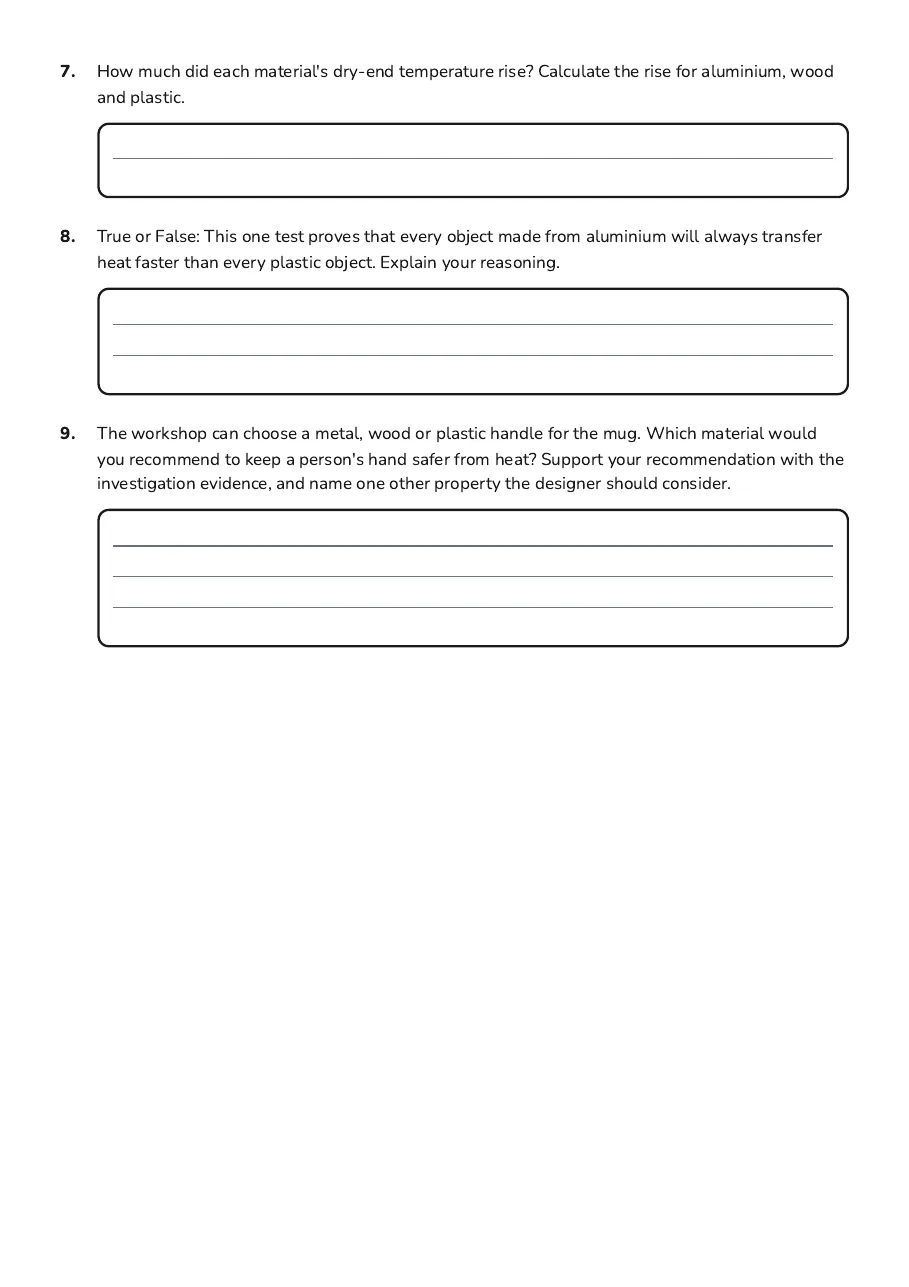
7.How much did each material's dry-end temperature rise? Calculate the rise for aluminium, wood and plastic.
8.True or False: This one test proves that every object made from aluminium will always transfer heat faster than every plastic object. Explain your reasoning.
9.The workshop can choose a metal, wood or plastic handle for the mug. Which material would you recommend to keep a person's hand safer from heat? Support your recommendation with the investigation evidence, and name one other property the designer should consider.

3 printable pages

  • Material Properties Investigation, page 1 of 3: Part A: Make predictions

    Page 1

  • Material Properties Investigation, page 2 of 3: Part B: Plan a fair test, Part C: Interpret the evidence

    Page 2

  • Material Properties Investigation, page 3 of 3: 7. How much did each material's dry-end temperature rise? Calculate the rise for…

    Page 3

About This Worksheet

Free in Kuraplan

Sign up free, grab the PDF, and customize it for your class.

Print-Ready

Formatted for standard paper. Clean layout, easy to read.

AI-Generated

Created with Kuraplan's AI, designed for real classroom use.

For Teachers & Parents

Use in classrooms, for homework, tutoring, or homeschool.

Need a custom version of this worksheet?

Kuraplan's AI generates custom worksheets in seconds — differentiated for every learner, aligned to your curriculum.

Generate Custom Worksheets — Free
No credit card Curriculum-aligned Under 60 seconds