ScienceFreePrintable

Crushing Can Gas Demo

A free science worksheet ready for your classroom. Open in Kuraplan to grab the print-ready PDF, customize it for your students, or generate a fresh version in seconds.
Crushing Can Gas Demo worksheet preview
Name:Date:

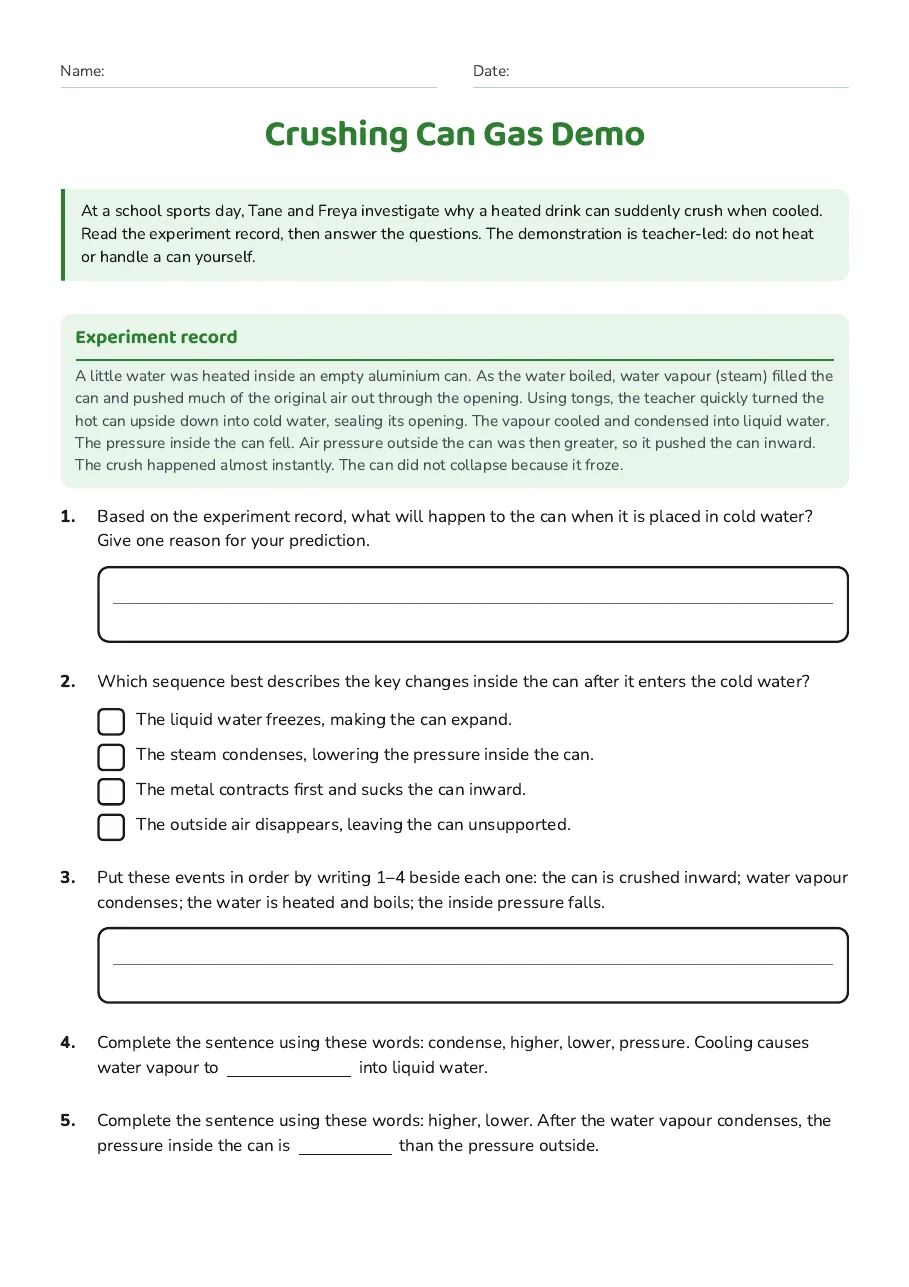
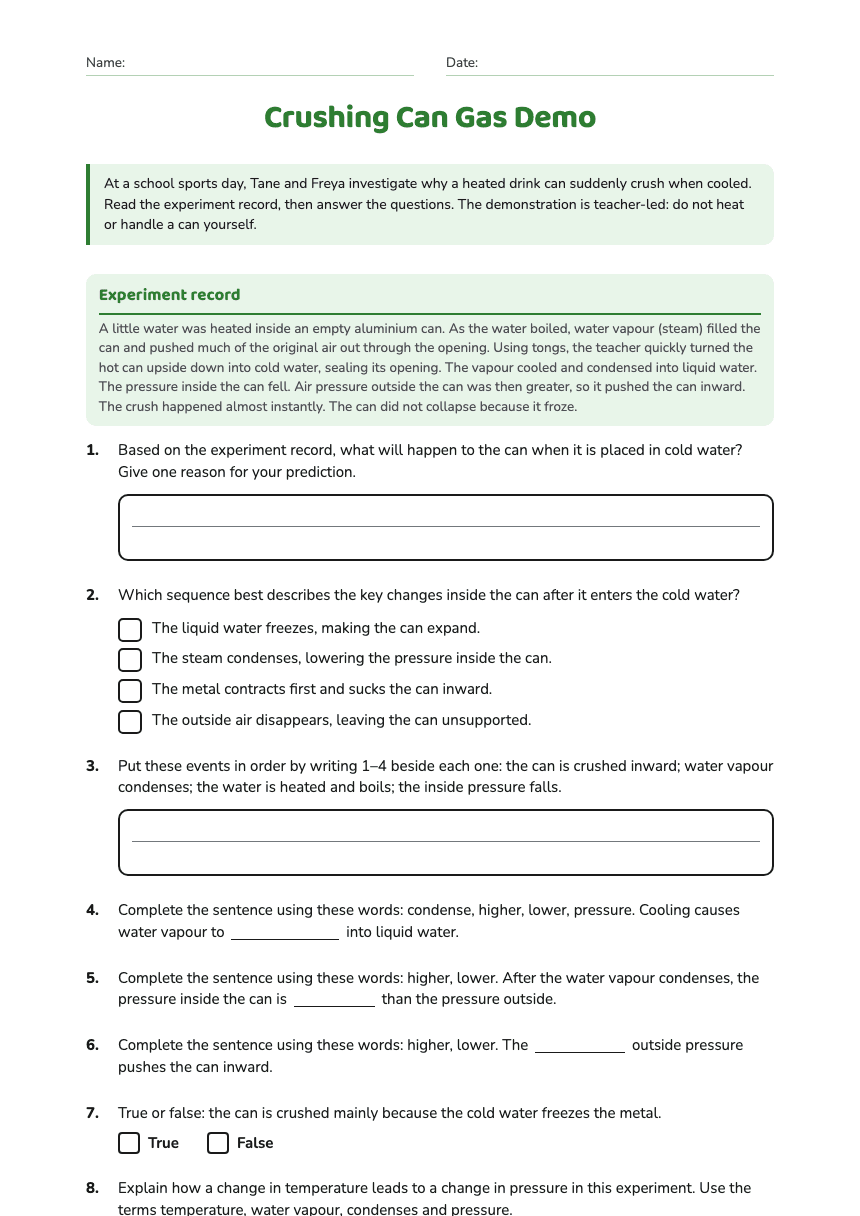
Crushing Can Gas Demo

At a school sports day, Tane and Freya investigate why a heated drink can suddenly crush when cooled. Read the experiment record, then answer the questions. The demonstration is teacher-led: do not heat or handle a can yourself.

Experiment record

A little water was heated inside an empty aluminium can. As the water boiled, water vapour (steam) filled the can and pushed much of the original air out through the opening. Using tongs, the teacher quickly turned the hot can upside down into cold water, sealing its opening. The vapour cooled and condensed into liquid water. The pressure inside the can fell. Air pressure outside the can was then greater, so it pushed the can inward. The crush happened almost instantly. The can did not collapse because it froze.

1.Based on the experiment record, what will happen to the can when it is placed in cold water? Give one reason for your prediction.
2.Which sequence best describes the key changes inside the can after it enters the cold water?
  • The liquid water freezes, making the can expand.
  • The steam condenses, lowering the pressure inside the can.
  • The metal contracts first and sucks the can inward.
  • The outside air disappears, leaving the can unsupported.
3.Put these events in order by writing 1–4 beside each one: the can is crushed inward; water vapour condenses; the water is heated and boils; the inside pressure falls.
4.Complete the sentence using these words: condense, higher, lower, pressure. Cooling causes water vapour to into liquid water.
5.Complete the sentence using these words: higher, lower. After the water vapour condenses, the pressure inside the can is than the pressure outside.
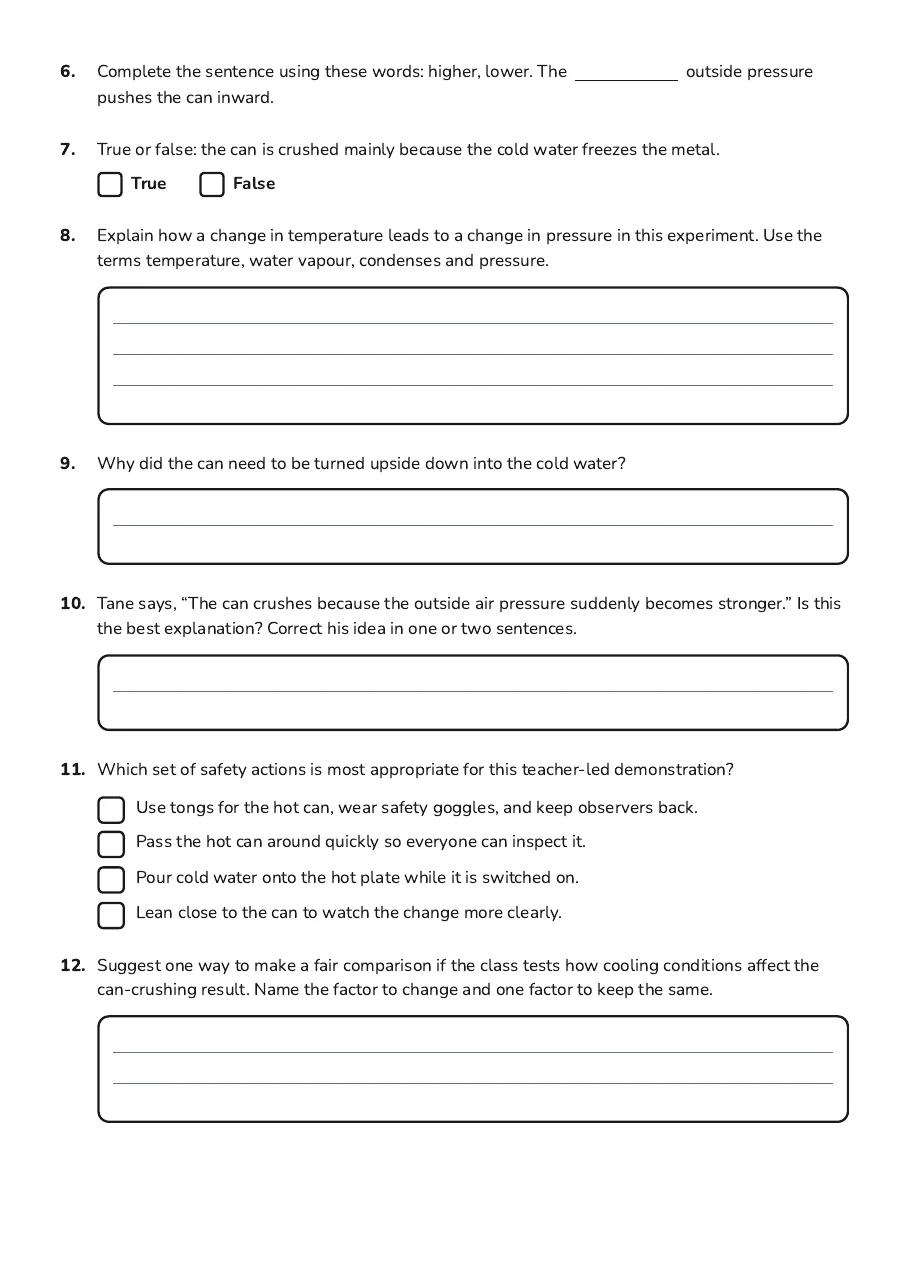
6.Complete the sentence using these words: higher, lower. The outside pressure pushes the can inward.
7.True or false: the can is crushed mainly because the cold water freezes the metal.
TrueFalse
8.Explain how a change in temperature leads to a change in pressure in this experiment. Use the terms temperature, water vapour, condenses and pressure.
9.Why did the can need to be turned upside down into the cold water?
10.Tane says, “The can crushes because the outside air pressure suddenly becomes stronger.” Is this the best explanation? Correct his idea in one or two sentences.
11.Which set of safety actions is most appropriate for this teacher-led demonstration?
  • Use tongs for the hot can, wear safety goggles, and keep observers back.
  • Pass the hot can around quickly so everyone can inspect it.
  • Pour cold water onto the hot plate while it is switched on.
  • Lean close to the can to watch the change more clearly.
12.Suggest one way to make a fair comparison if the class tests how cooling conditions affect the can-crushing result. Name the factor to change and one factor to keep the same.

2 printable pages

  • Crushing Can Gas Demo, page 1 of 2: Experiment record

    Page 1

  • Crushing Can Gas Demo, page 2 of 2: 6. Complete the sentence using these words: higher, lower. The outside pressure

    Page 2

About This Worksheet

Free in Kuraplan

Sign up free, grab the PDF, and customize it for your class.

Print-Ready

Formatted for standard paper. Clean layout, easy to read.

AI-Generated

Created with Kuraplan's AI, designed for real classroom use.

For Teachers & Parents

Use in classrooms, for homework, tutoring, or homeschool.

Need a custom version of this worksheet?

Kuraplan's AI generates custom worksheets in seconds — differentiated for every learner, aligned to your curriculum.

Generate Custom Worksheets — Free
No credit card Curriculum-aligned Under 60 seconds