ScienceFreePrintable

Material Properties Fair Test

A free science worksheet ready for your classroom. Open in Kuraplan to grab the print-ready PDF, customize it for your students, or generate a fresh version in seconds.
Material Properties Fair Test worksheet preview
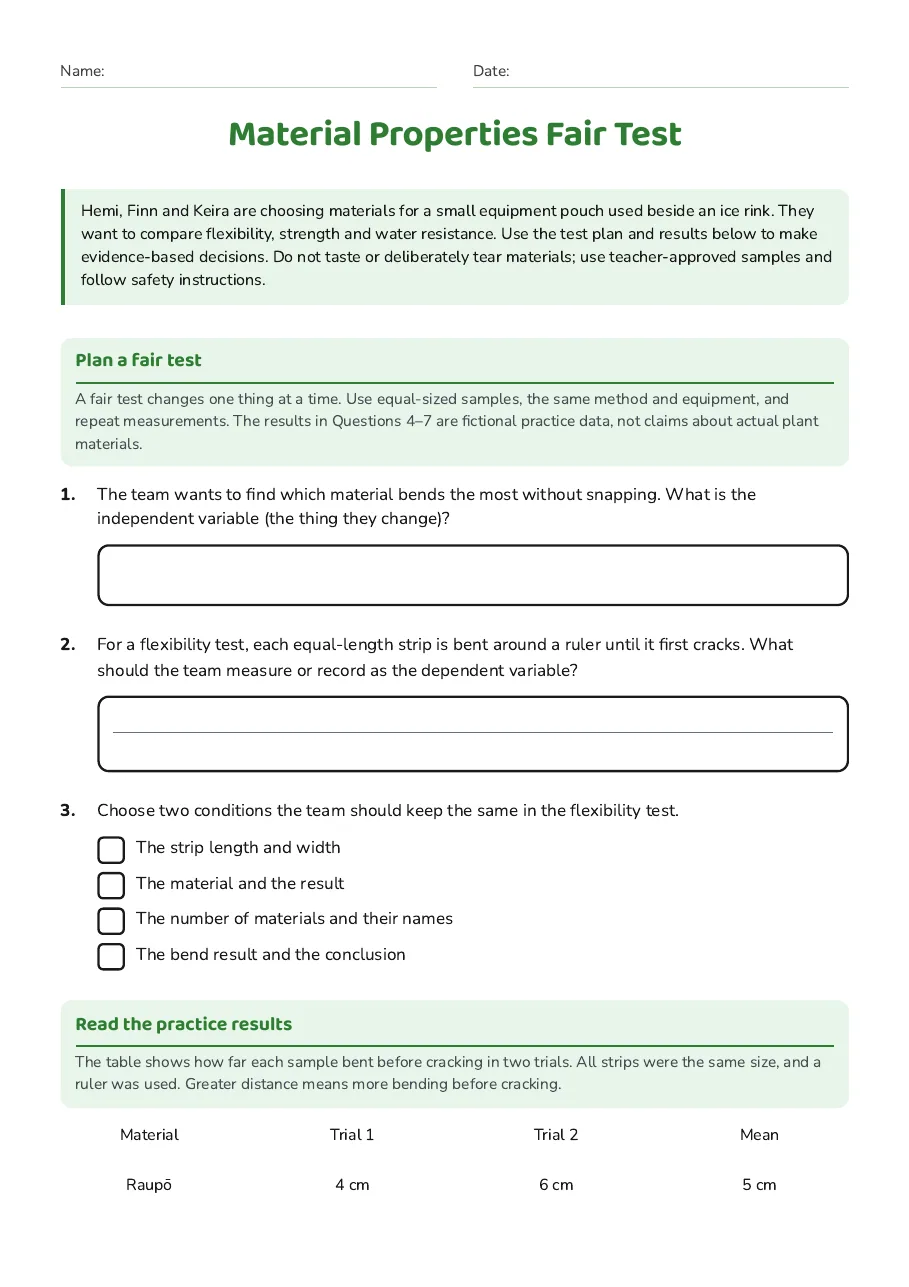
Name:Date:

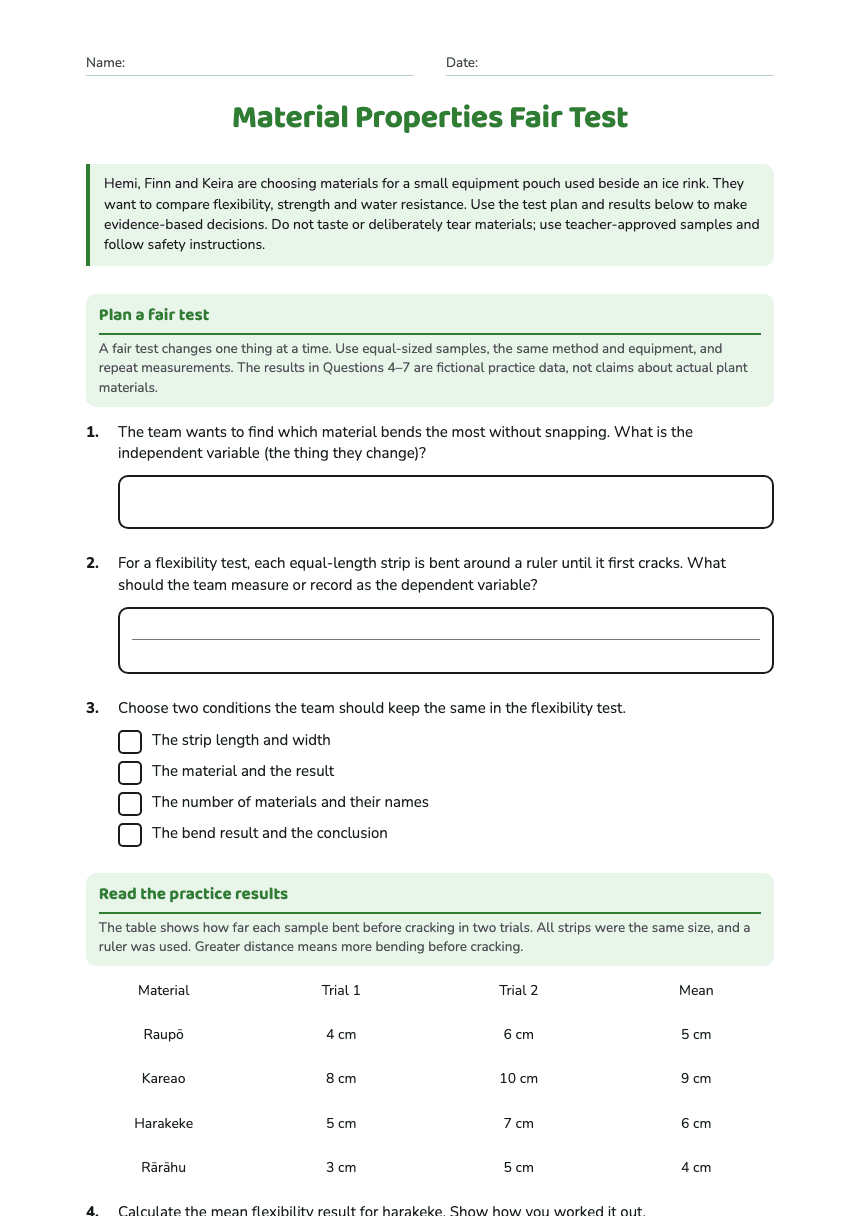
Material Properties Fair Test

Hemi, Finn and Keira are choosing materials for a small equipment pouch used beside an ice rink. They want to compare flexibility, strength and water resistance. Use the test plan and results below to make evidence-based decisions. Do not taste or deliberately tear materials; use teacher-approved samples and follow safety instructions.

Plan a fair test

A fair test changes one thing at a time. Use equal-sized samples, the same method and equipment, and repeat measurements. The results in Questions 4–7 are fictional practice data, not claims about actual plant materials.

1.The team wants to find which material bends the most without snapping. What is the independent variable (the thing they change)?
2.For a flexibility test, each equal-length strip is bent around a ruler until it first cracks. What should the team measure or record as the dependent variable?
3.Choose two conditions the team should keep the same in the flexibility test.
  • The strip length and width
  • The material and the result
  • The number of materials and their names
  • The bend result and the conclusion

Read the practice results

The table shows how far each sample bent before cracking in two trials. All strips were the same size, and a ruler was used. Greater distance means more bending before cracking.

Material

Trial 1

Trial 2

Mean

Raupō

4 cm

6 cm

5 cm

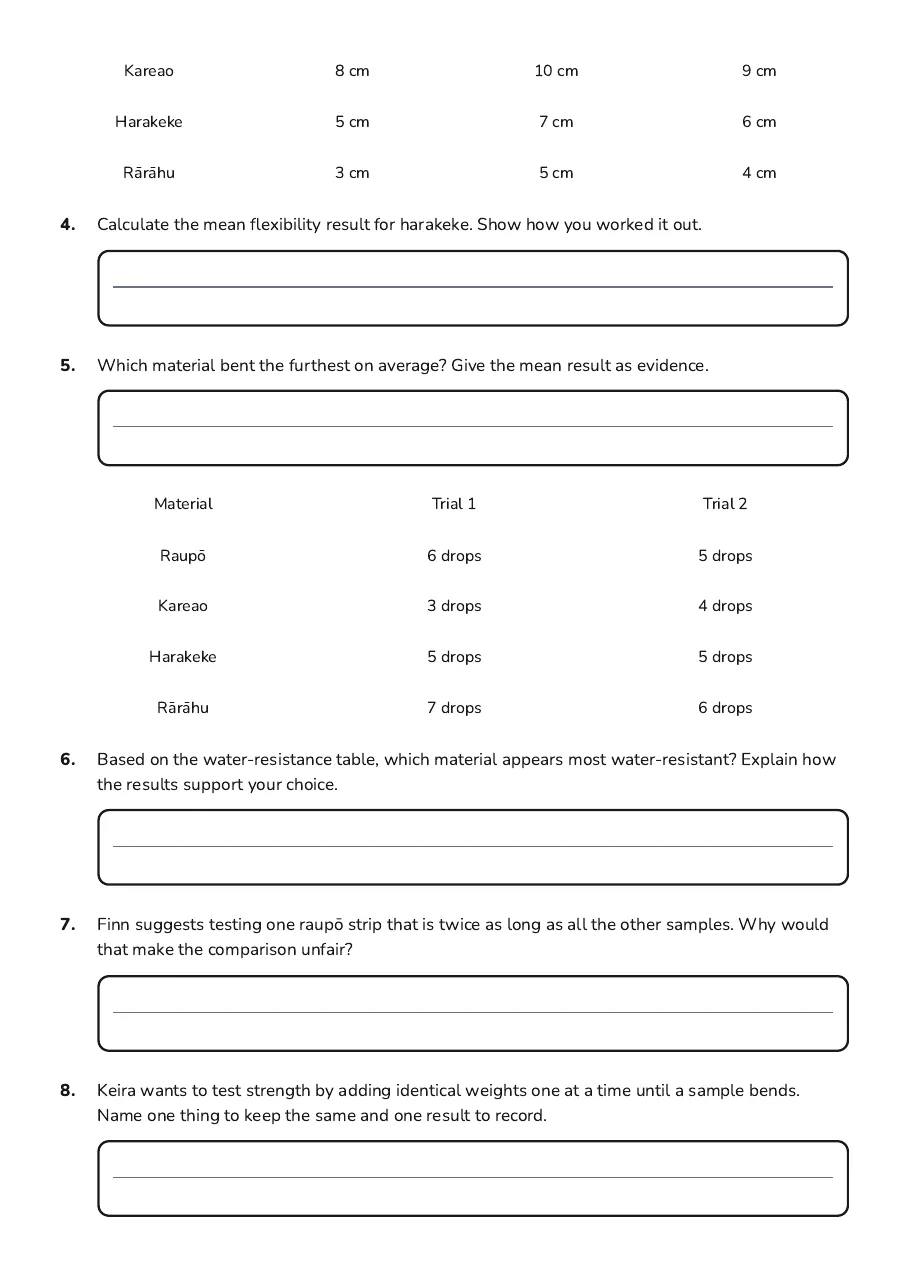
Kareao

8 cm

10 cm

9 cm

Harakeke

5 cm

7 cm

6 cm

Rārāhu

3 cm

5 cm

4 cm

4.Calculate the mean flexibility result for harakeke. Show how you worked it out.
5.Which material bent the furthest on average? Give the mean result as evidence.

Material

Trial 1

Trial 2

Raupō

6 drops

5 drops

Kareao

3 drops

4 drops

Harakeke

5 drops

5 drops

Rārāhu

7 drops

6 drops

6.Based on the water-resistance table, which material appears most water-resistant? Explain how the results support your choice.
7.Finn suggests testing one raupō strip that is twice as long as all the other samples. Why would that make the comparison unfair?
8.Keira wants to test strength by adding identical weights one at a time until a sample bends. Name one thing to keep the same and one result to record.
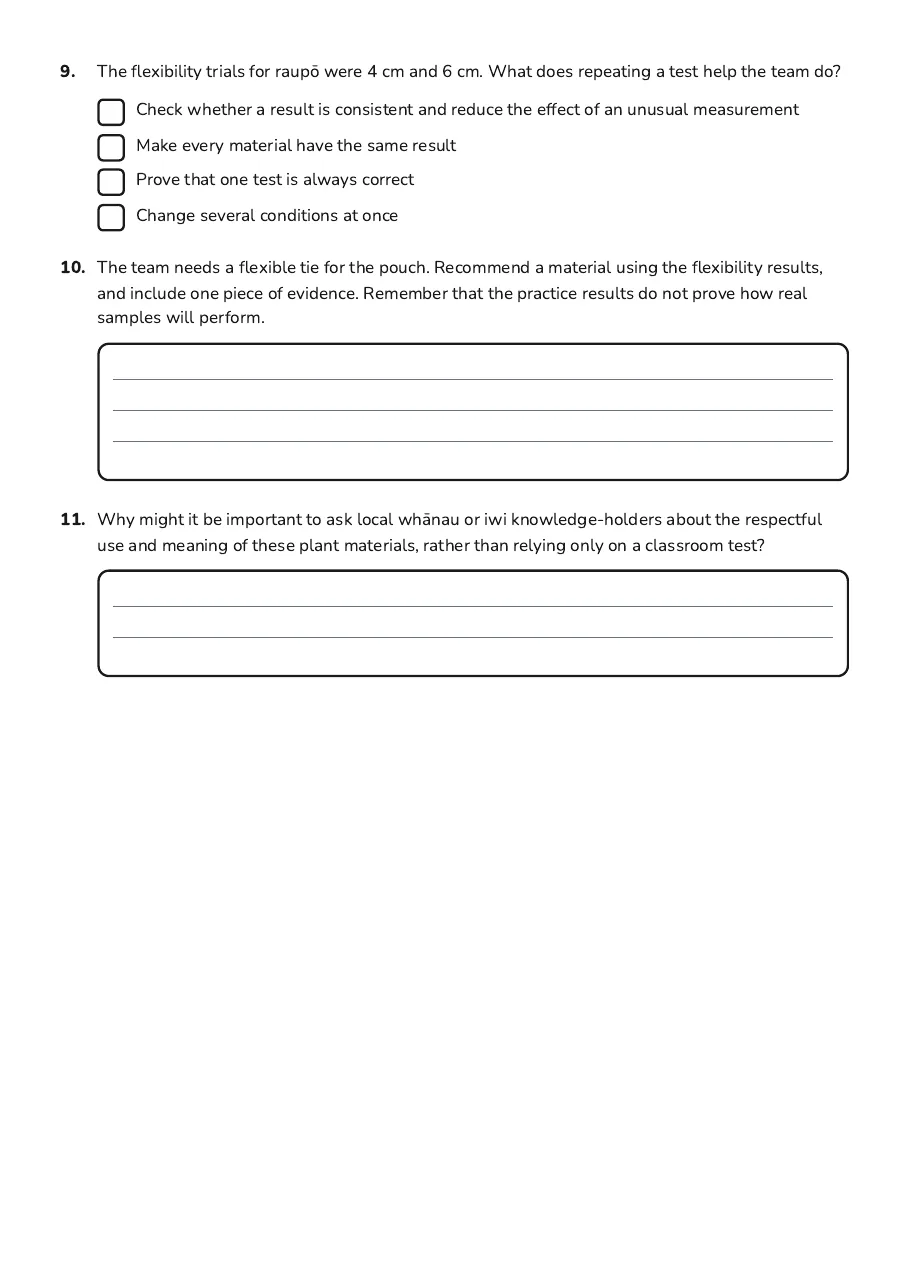
9.The flexibility trials for raupō were 4 cm and 6 cm. What does repeating a test help the team do?
  • Check whether a result is consistent and reduce the effect of an unusual measurement
  • Make every material have the same result
  • Prove that one test is always correct
  • Change several conditions at once
10.The team needs a flexible tie for the pouch. Recommend a material using the flexibility results, and include one piece of evidence. Remember that the practice results do not prove how real samples will perform.
11.Why might it be important to ask local whānau or iwi knowledge-holders about the respectful use and meaning of these plant materials, rather than relying only on a classroom test?

3 printable pages

  • Material Properties Fair Test, page 1 of 3: Plan a fair test, Read the practice results

    Page 1

  • Material Properties Fair Test, page 2 of 3: Kareao 8 cm 10 cm 9 cm

    Page 2

  • Material Properties Fair Test, page 3 of 3: 9. The flexibility trials for raupō were 4 cm and 6 cm. What does repeating a test help…

    Page 3

About This Worksheet

Free in Kuraplan

Sign up free, grab the PDF, and customize it for your class.

Print-Ready

Formatted for standard paper. Clean layout, easy to read.

AI-Generated

Created with Kuraplan's AI, designed for real classroom use.

For Teachers & Parents

Use in classrooms, for homework, tutoring, or homeschool.

Need a custom version of this worksheet?

Kuraplan's AI generates custom worksheets in seconds — differentiated for every learner, aligned to your curriculum.

Generate Custom Worksheets — Free
No credit card Curriculum-aligned Under 60 seconds