ScienceFreePrintable

Electromagnetism Equations and Forces

A free science worksheet ready for your classroom. Open in Kuraplan to grab the print-ready PDF, customize it for your students, or generate a fresh version in seconds.
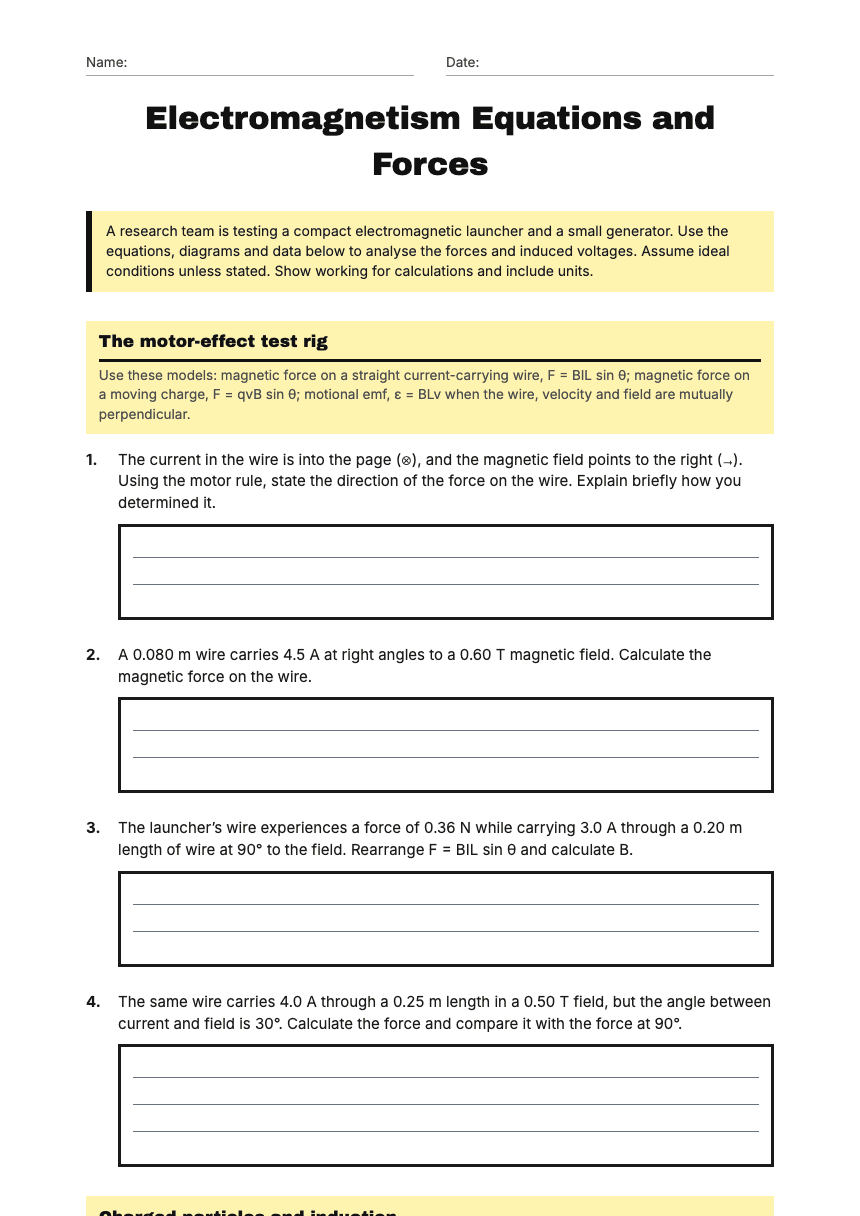
Electromagnetism Equations and Forces worksheet preview
Name:Date:

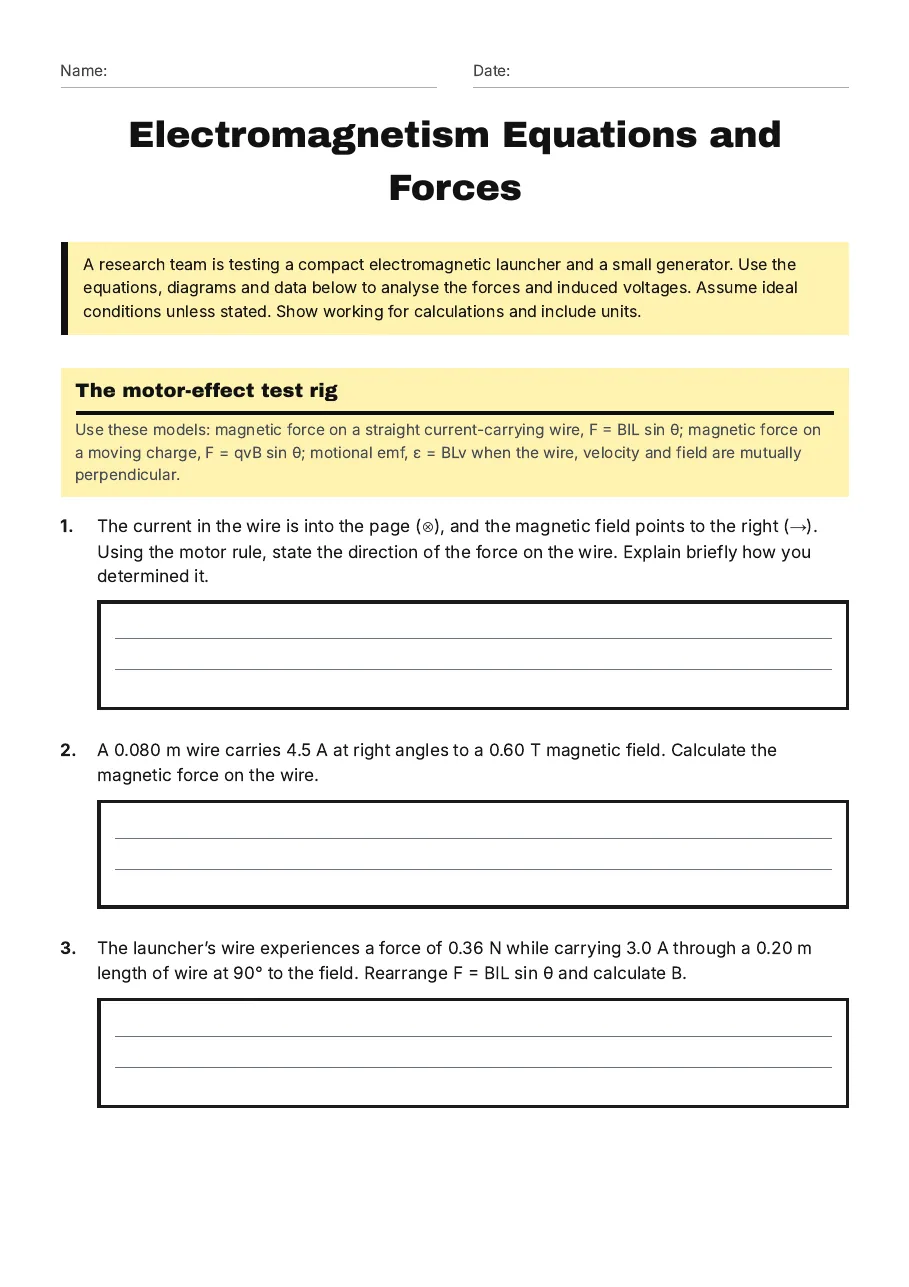
Electromagnetism Equations and Forces

A research team is testing a compact electromagnetic launcher and a small generator. Use the equations, diagrams and data below to analyse the forces and induced voltages. Assume ideal conditions unless stated. Show working for calculations and include units.

The motor-effect test rig

Use these models: magnetic force on a straight current-carrying wire, F = BIL sin θ; magnetic force on a moving charge, F = qvB sin θ; motional emf, ε = BLv when the wire, velocity and field are mutually perpendicular.

1.The current in the wire is into the page (⊗), and the magnetic field points to the right (→). Using the motor rule, state the direction of the force on the wire. Explain briefly how you determined it.
2.A 0.080 m wire carries 4.5 A at right angles to a 0.60 T magnetic field. Calculate the magnetic force on the wire.
3.The launcher’s wire experiences a force of 0.36 N while carrying 3.0 A through a 0.20 m length of wire at 90° to the field. Rearrange F = BIL sin θ and calculate B.
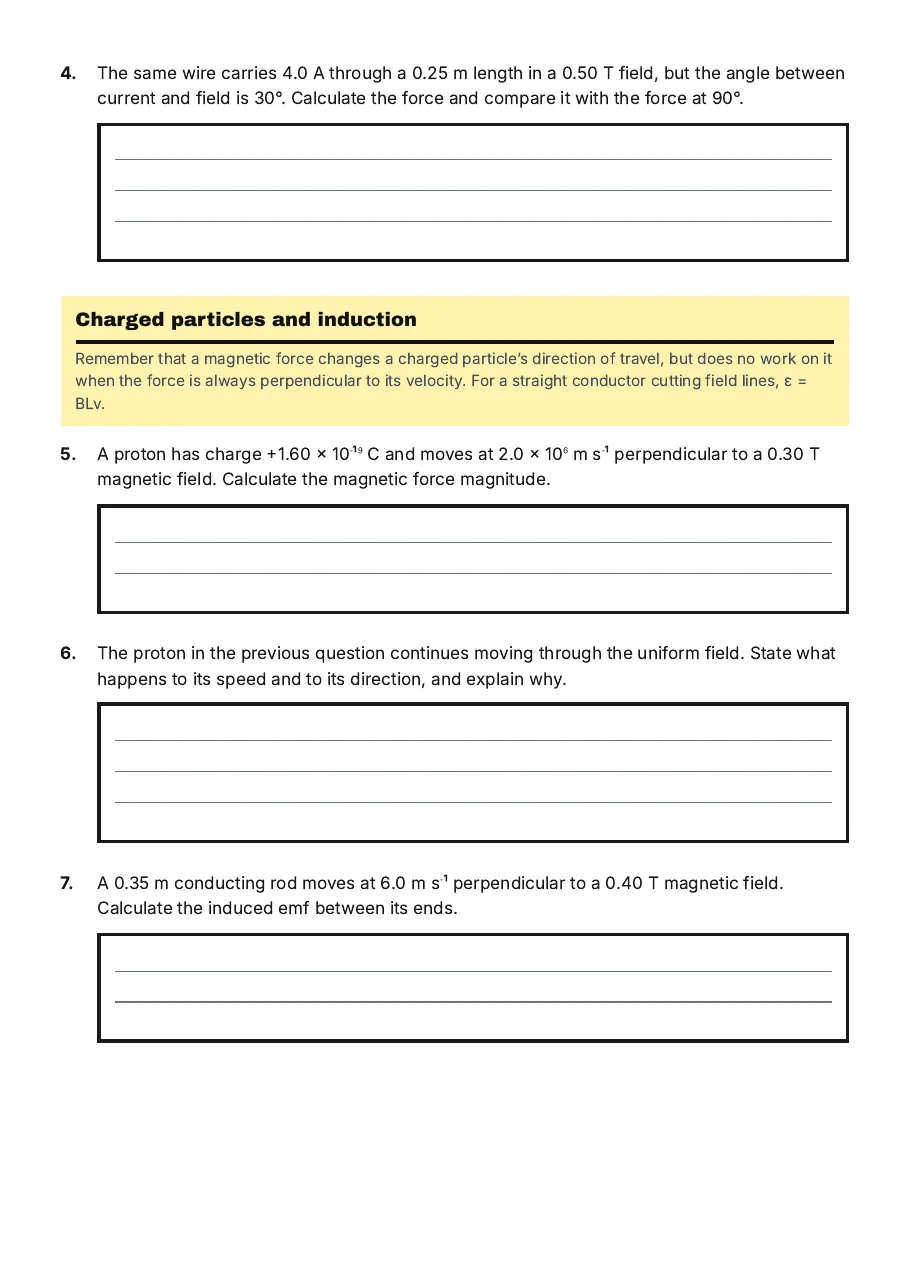
4.The same wire carries 4.0 A through a 0.25 m length in a 0.50 T field, but the angle between current and field is 30°. Calculate the force and compare it with the force at 90°.

Charged particles and induction

Remember that a magnetic force changes a charged particle’s direction of travel, but does no work on it when the force is always perpendicular to its velocity. For a straight conductor cutting field lines, ε = BLv.

5.A proton has charge +1.60 × 10⁻¹⁹ C and moves at 2.0 × 10⁶ m s⁻¹ perpendicular to a 0.30 T magnetic field. Calculate the magnetic force magnitude.
6.The proton in the previous question continues moving through the uniform field. State what happens to its speed and to its direction, and explain why.
7.A 0.35 m conducting rod moves at 6.0 m s⁻¹ perpendicular to a 0.40 T magnetic field. Calculate the induced emf between its ends.
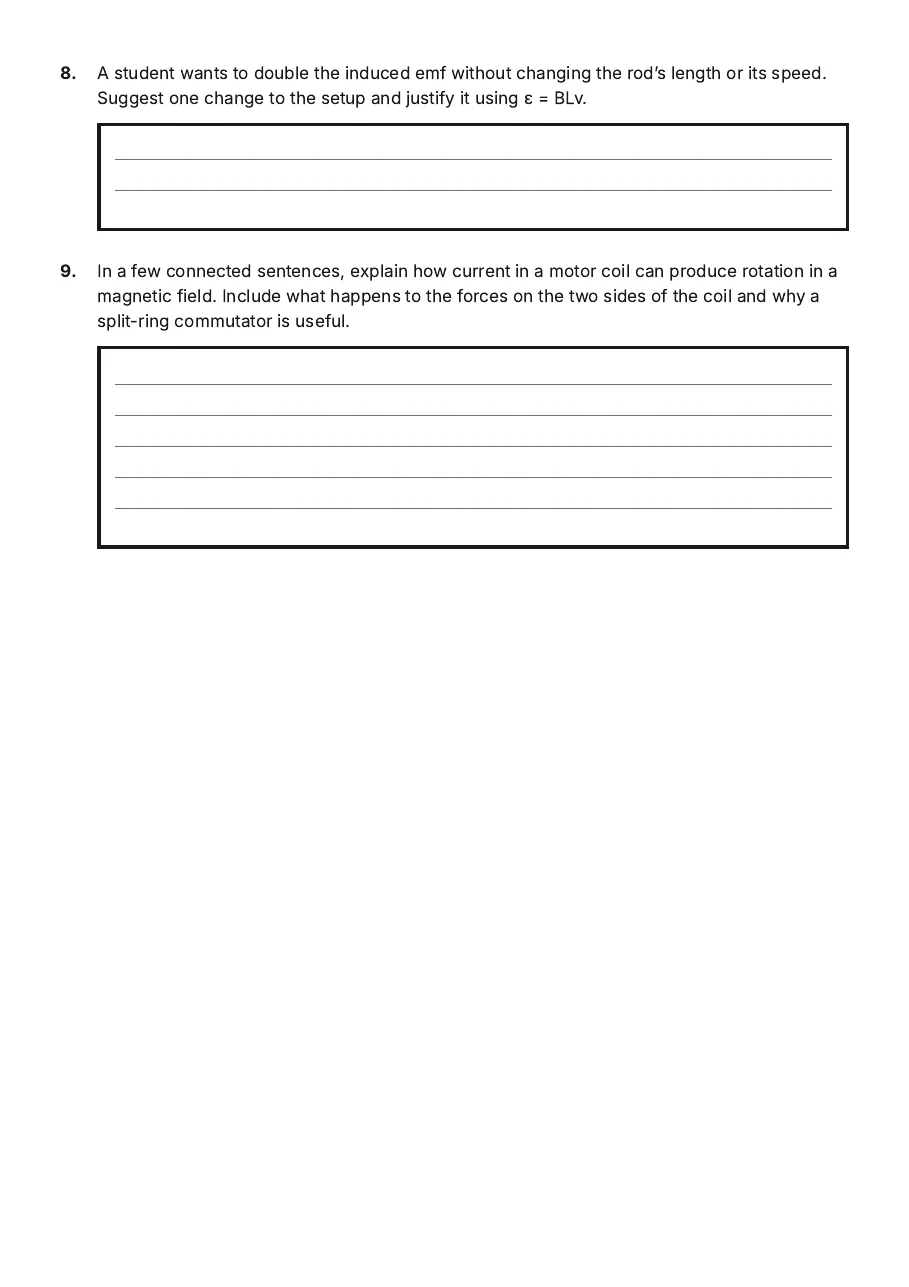
8.A student wants to double the induced emf without changing the rod’s length or its speed. Suggest one change to the setup and justify it using ε = BLv.
9.In a few connected sentences, explain how current in a motor coil can produce rotation in a magnetic field. Include what happens to the forces on the two sides of the coil and why a split-ring commutator is useful.

3 printable pages

  • Electromagnetism Equations and Forces, page 1 of 3: The motor-effect test rig

    Page 1

  • Electromagnetism Equations and Forces, page 2 of 3: Charged particles and induction

    Page 2

  • Electromagnetism Equations and Forces, page 3 of 3: 8. A student wants to double the induced emf without changing the rod’s length or its…

    Page 3

About This Worksheet

Free in Kuraplan

Sign up free, grab the PDF, and customize it for your class.

Print-Ready

Formatted for standard paper. Clean layout, easy to read.

AI-Generated

Created with Kuraplan's AI, designed for real classroom use.

For Teachers & Parents

Use in classrooms, for homework, tutoring, or homeschool.

Need a custom version of this worksheet?

Kuraplan's AI generates custom worksheets in seconds — differentiated for every learner, aligned to your curriculum.

Generate Custom Worksheets — Free
No credit card Curriculum-aligned Under 60 seconds