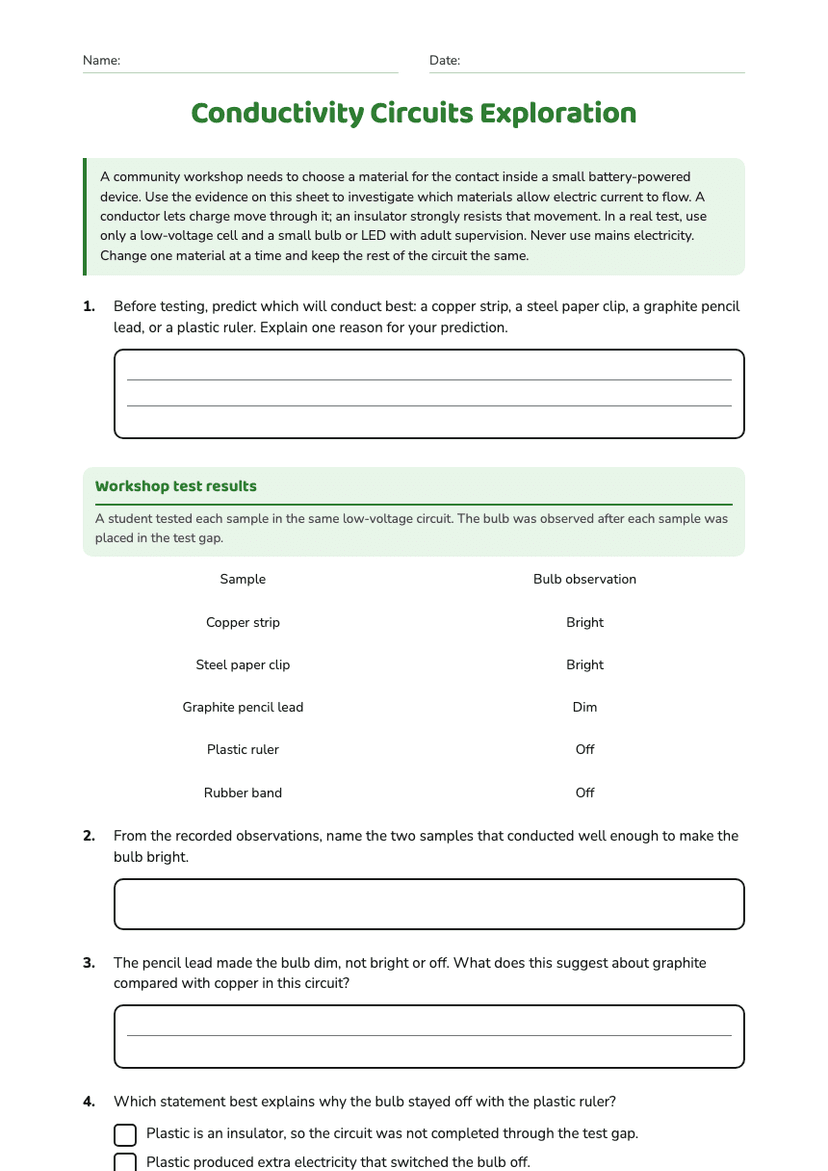
Introduction to Electricity
A free science worksheet ready for your classroom. Open in Kuraplan to grab the print-ready PDF, customize it for your students, or generate a fresh version in seconds.

Introduction to Electricity
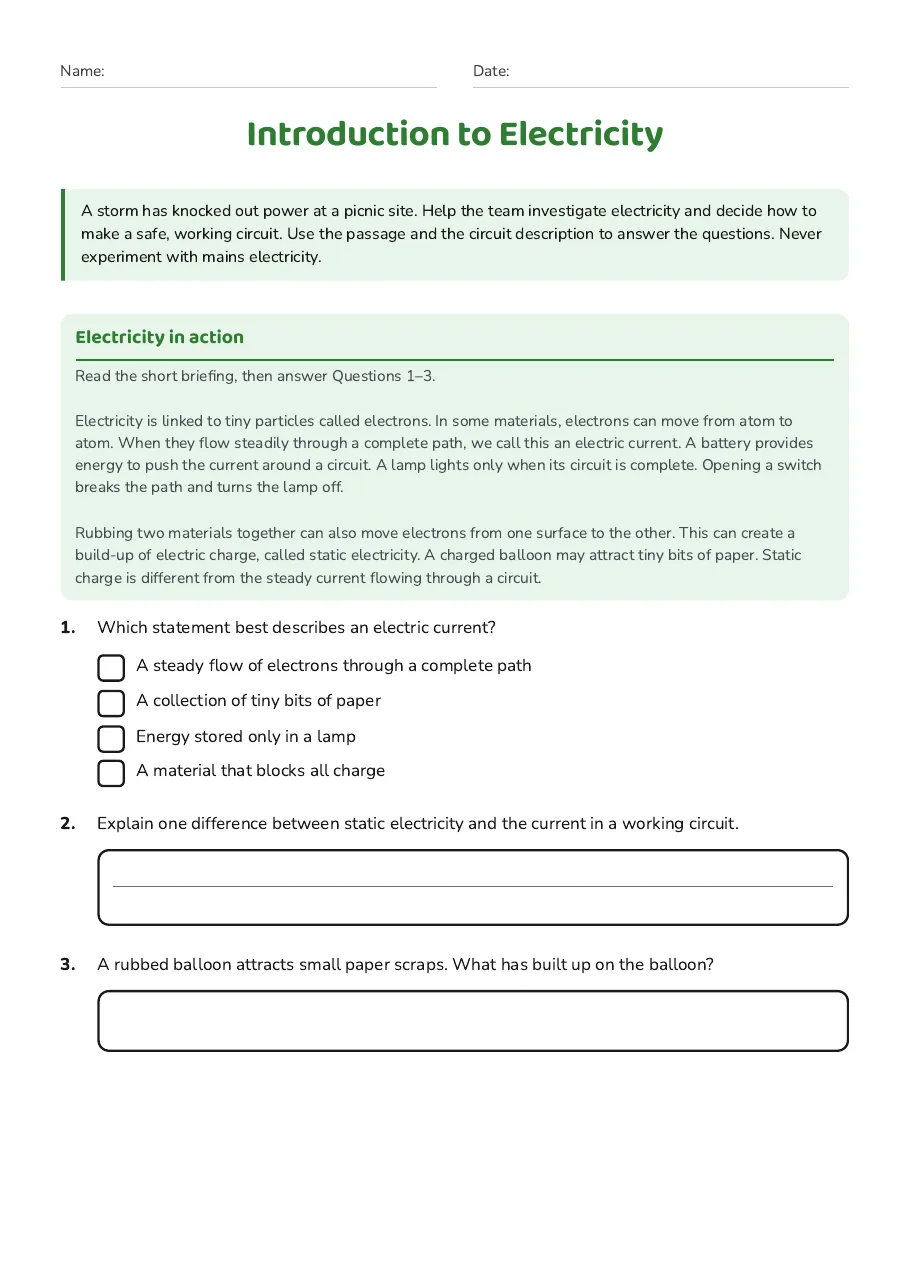
Electricity in action
Read the short briefing, then answer Questions 1–3. Electricity is linked to tiny particles called electrons. In some materials, electrons can move from atom to atom. When they flow steadily through a complete path, we call this an electric current. A battery provides energy to push the current around a circuit. A lamp lights only when its circuit is complete. Opening a switch breaks the path and turns the lamp off. Rubbing two materials together can also move electrons from one surface to the other. This can create a build-up of electric charge, called static electricity. A charged balloon may attract tiny bits of paper. Static charge is different from the steady current flowing through a circuit.
- A steady flow of electrons through a complete path
- A collection of tiny bits of paper
- Energy stored only in a lamp
- A material that blocks all charge
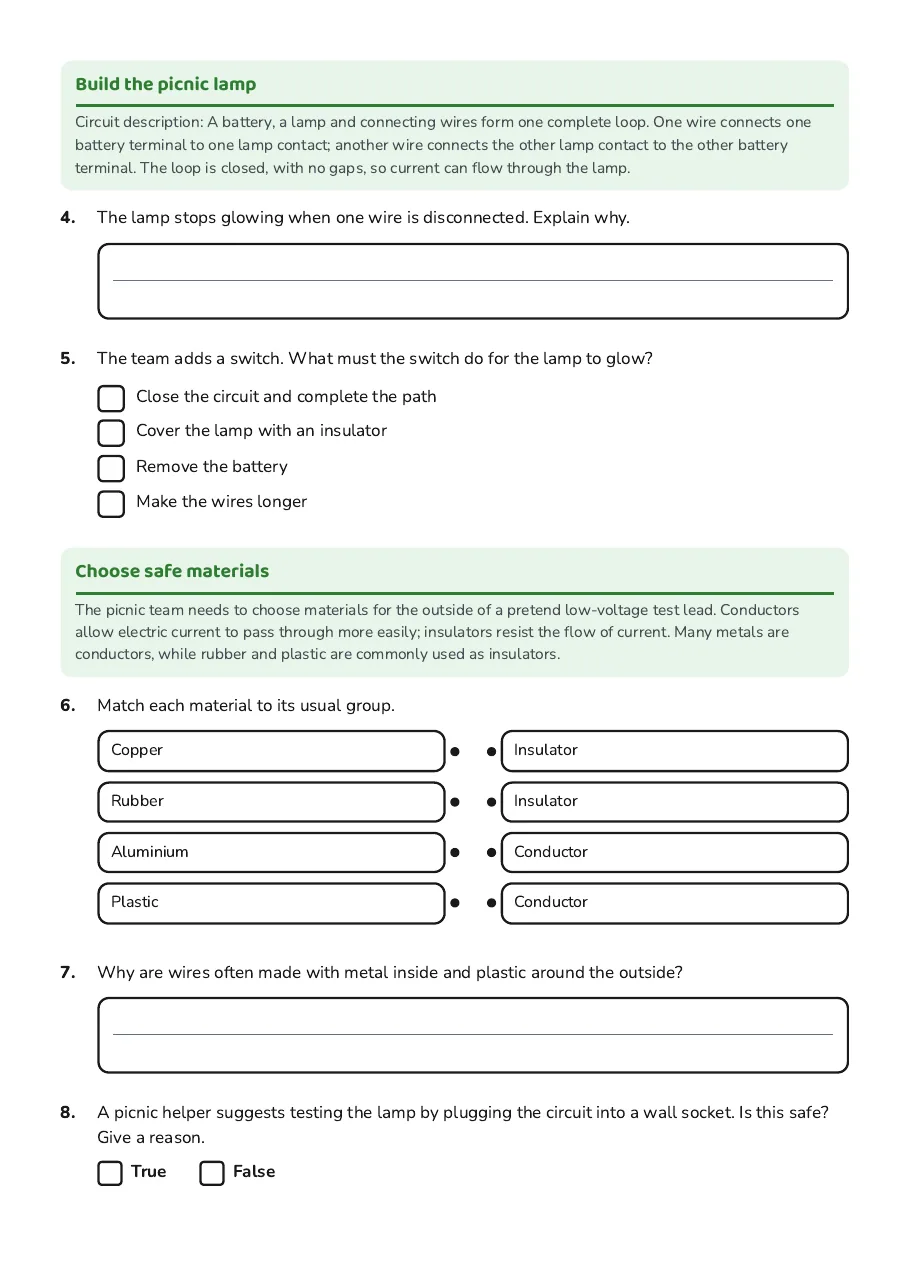
Build the picnic lamp
Circuit description: A battery, a lamp and connecting wires form one complete loop. One wire connects one battery terminal to one lamp contact; another wire connects the other lamp contact to the other battery terminal. The loop is closed, with no gaps, so current can flow through the lamp.
- Close the circuit and complete the path
- Cover the lamp with an insulator
- Remove the battery
- Make the wires longer
Choose safe materials
The picnic team needs to choose materials for the outside of a pretend low-voltage test lead. Conductors allow electric current to pass through more easily; insulators resist the flow of current. Many metals are conductors, while rubber and plastic are commonly used as insulators.
- Copper
- Rubber
- Aluminium
- Plastic
- Insulator
- Insulator
- Conductor
- Conductor
3 printable pages
Page 1
Page 2
Page 3
About This Worksheet
Free in Kuraplan
Sign up free, grab the PDF, and customize it for your class.
Print-Ready
Formatted for standard paper. Clean layout, easy to read.
AI-Generated
Created with Kuraplan's AI, designed for real classroom use.
For Teachers & Parents
Use in classrooms, for homework, tutoring, or homeschool.
Need a custom version of this worksheet?
Kuraplan's AI generates custom worksheets in seconds — differentiated for every learner, aligned to your curriculum.
Generate Custom Worksheets — FreeMore Science Worksheets
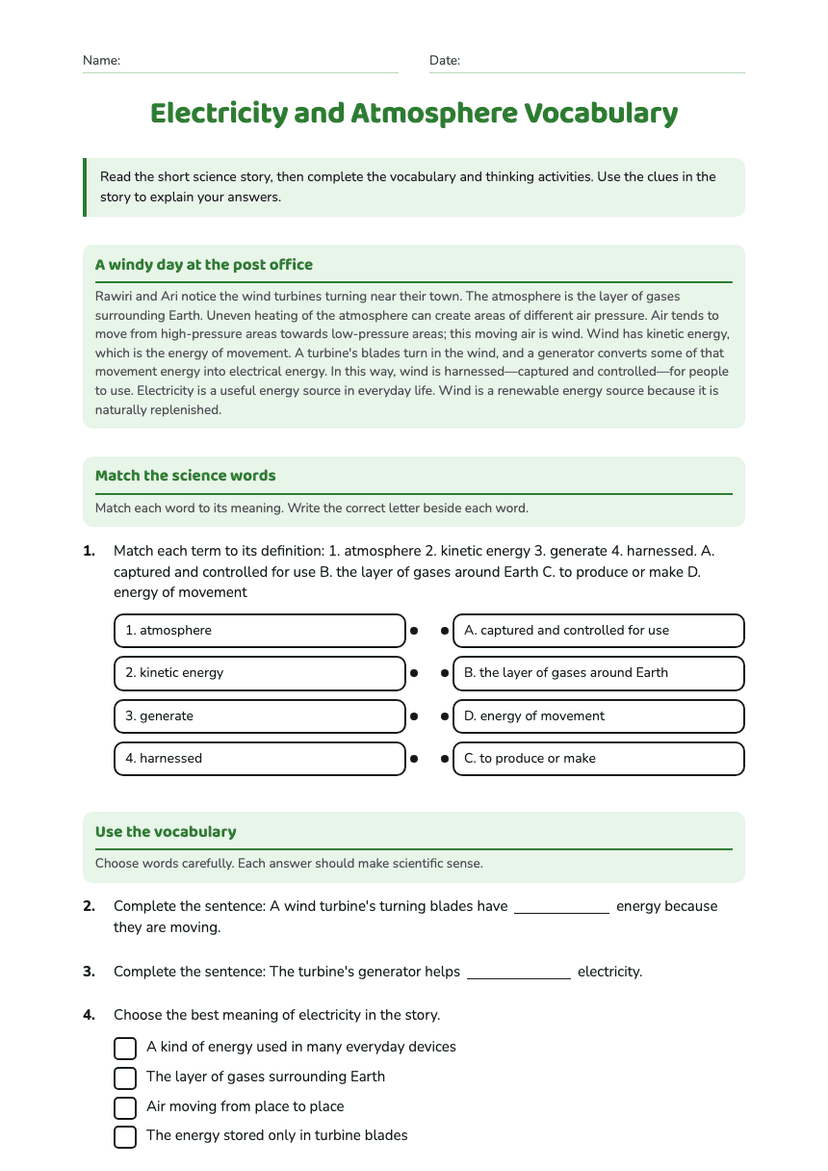
Electricity and Atmosphere Vocabulary
Free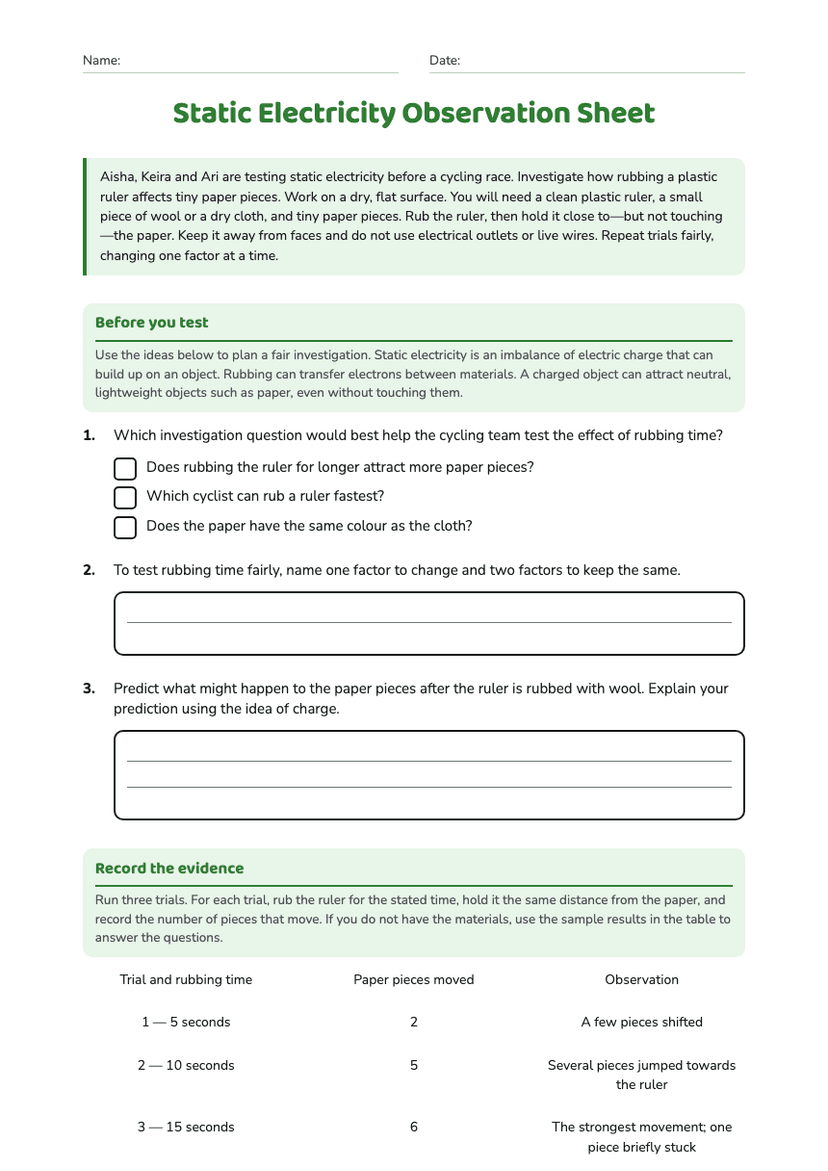
Static Electricity Observation Sheet
Free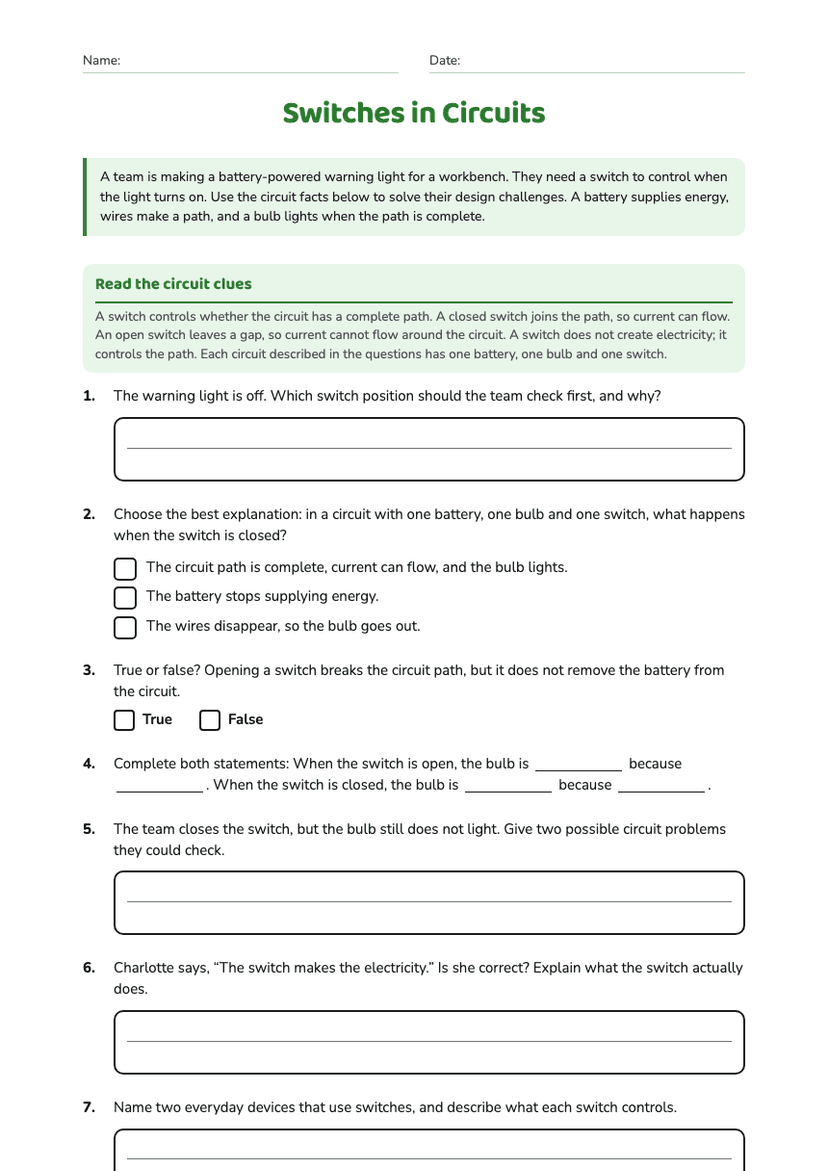
Switches in Circuits
Free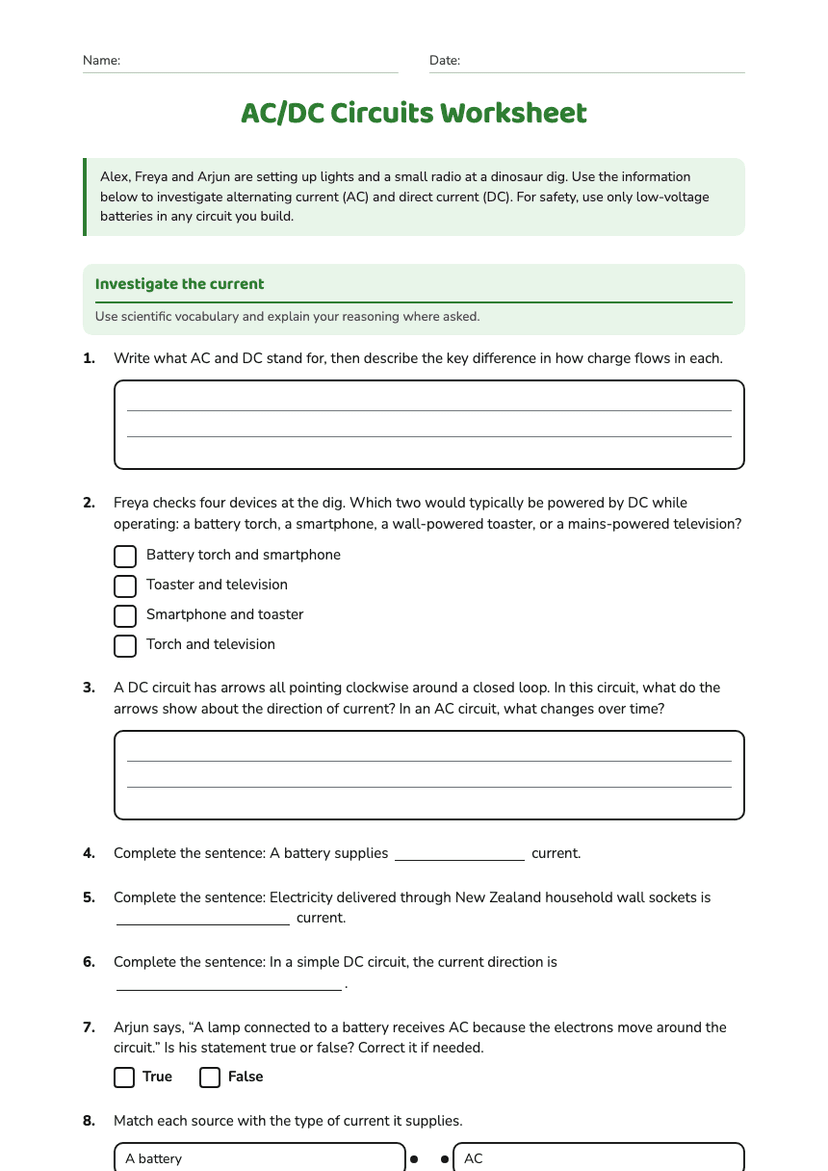
AC/DC Circuits Worksheet
Free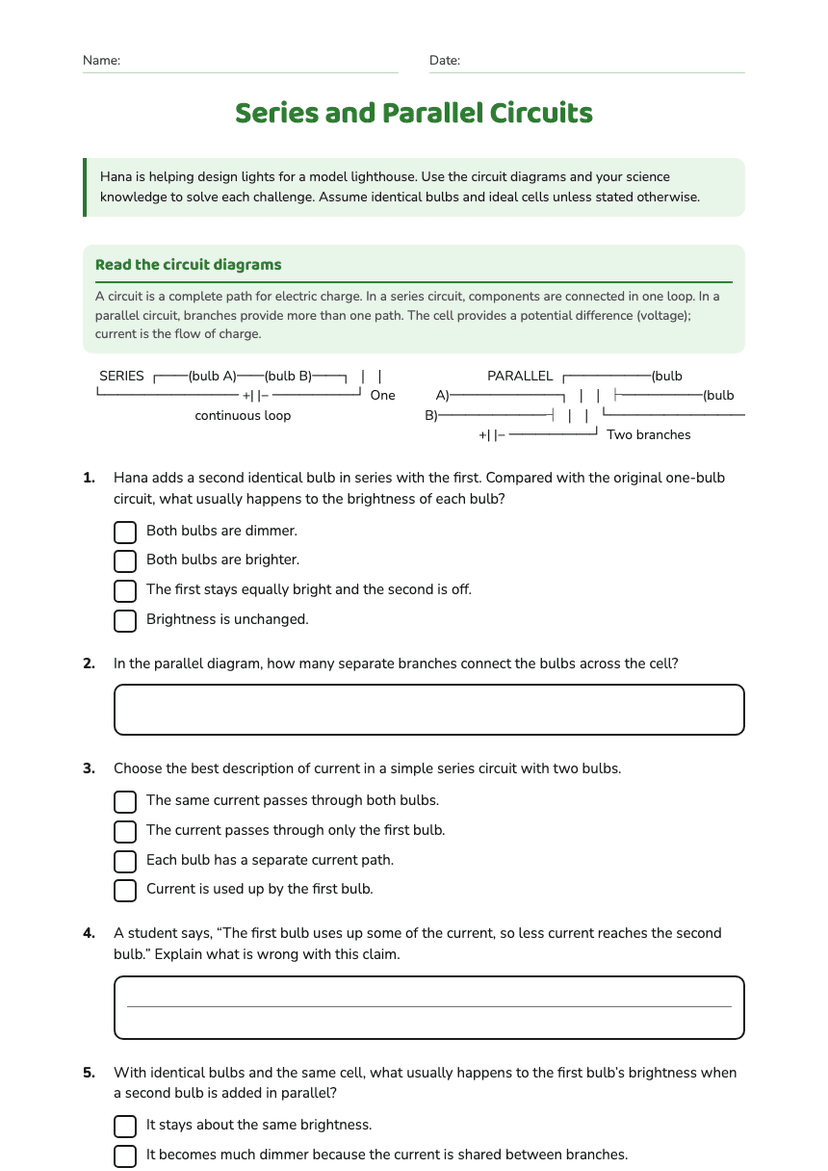
Series and Parallel Circuits
Free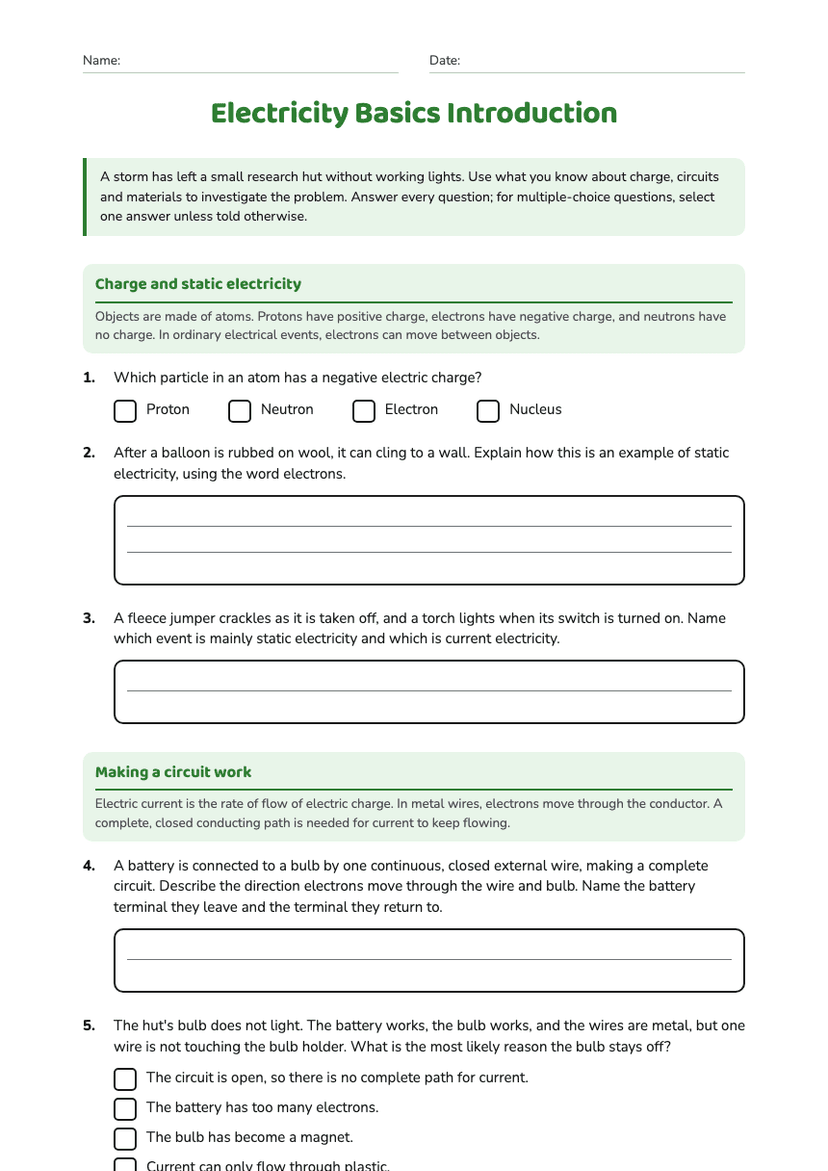
Electricity Basics Introduction
Free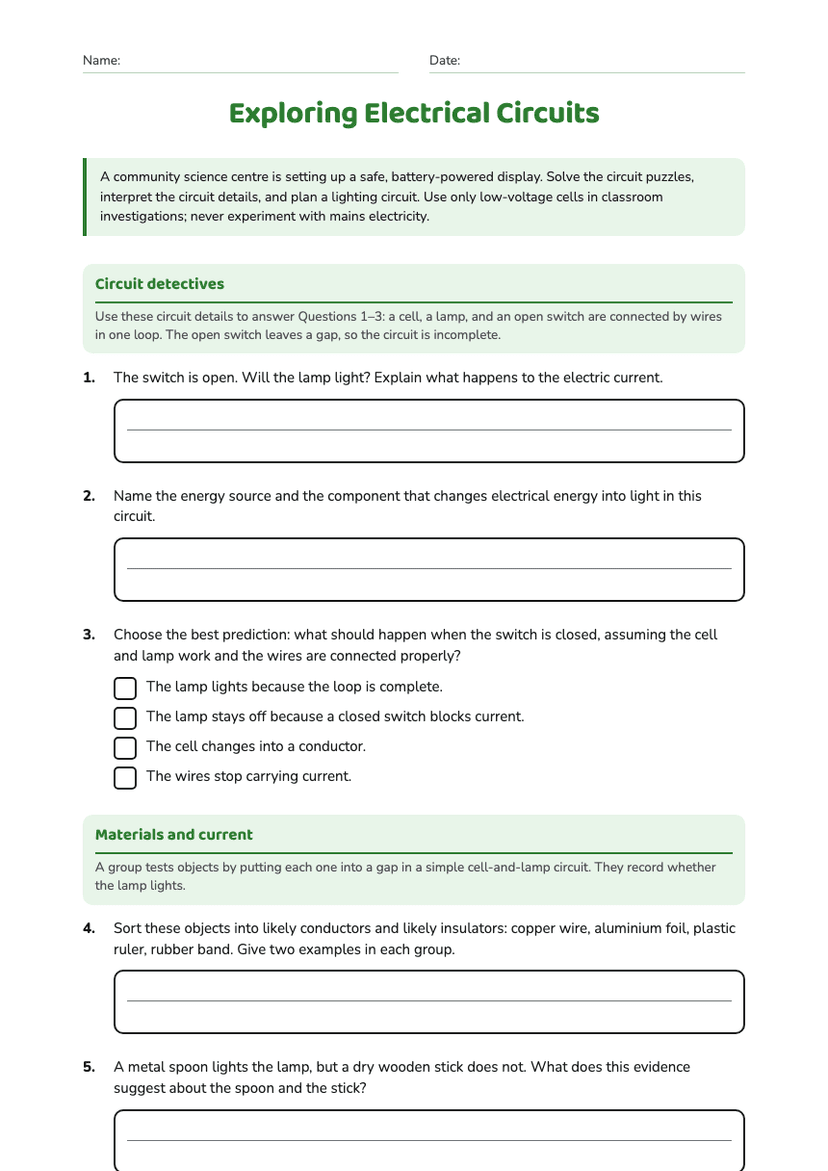
Exploring Electrical Circuits
Free