ScienceFreePrintable
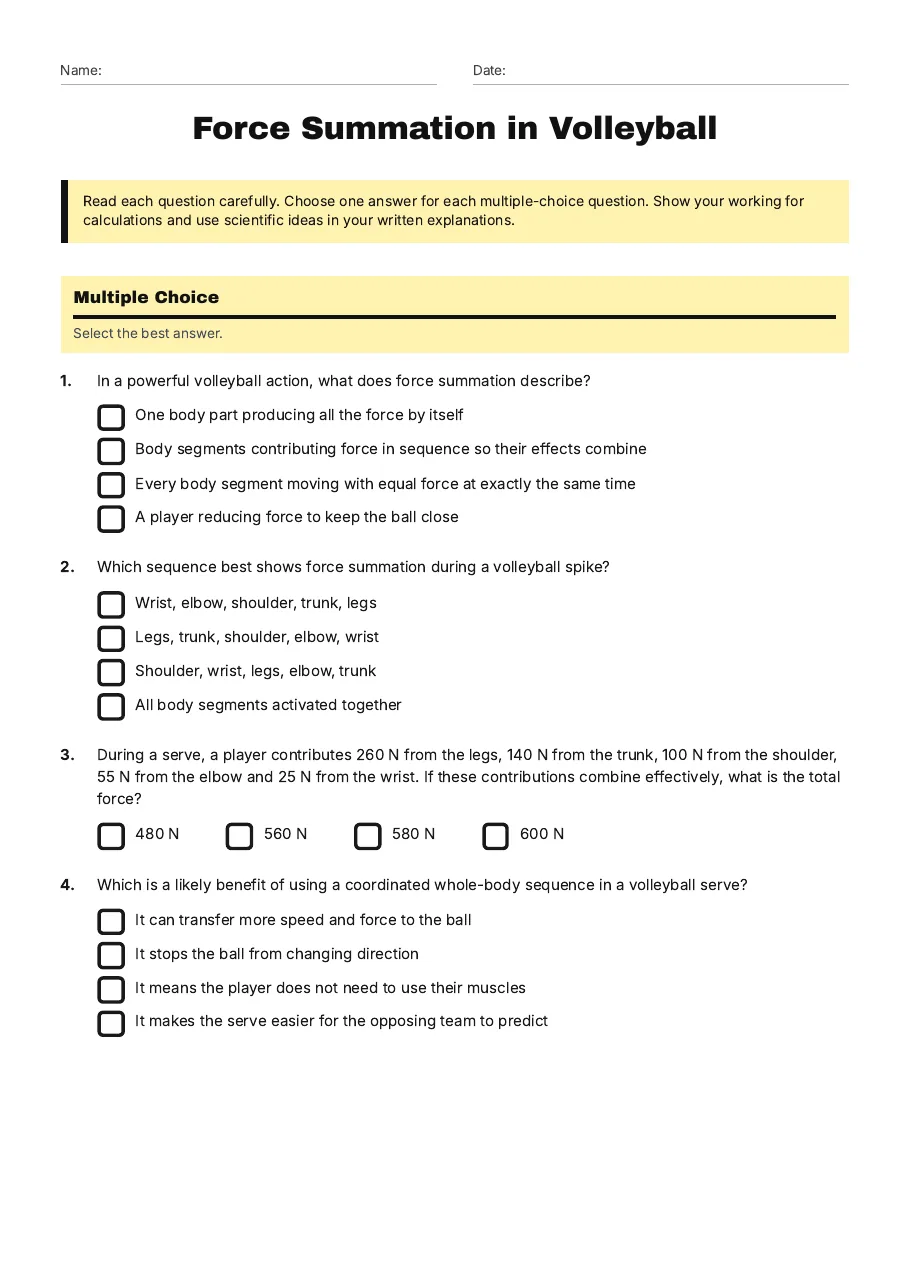
Force Summation in Volleyball
A free science worksheet ready for your classroom. Open in Kuraplan to grab the print-ready PDF, customize it for your students, or generate a fresh version in seconds.
Name:Date:
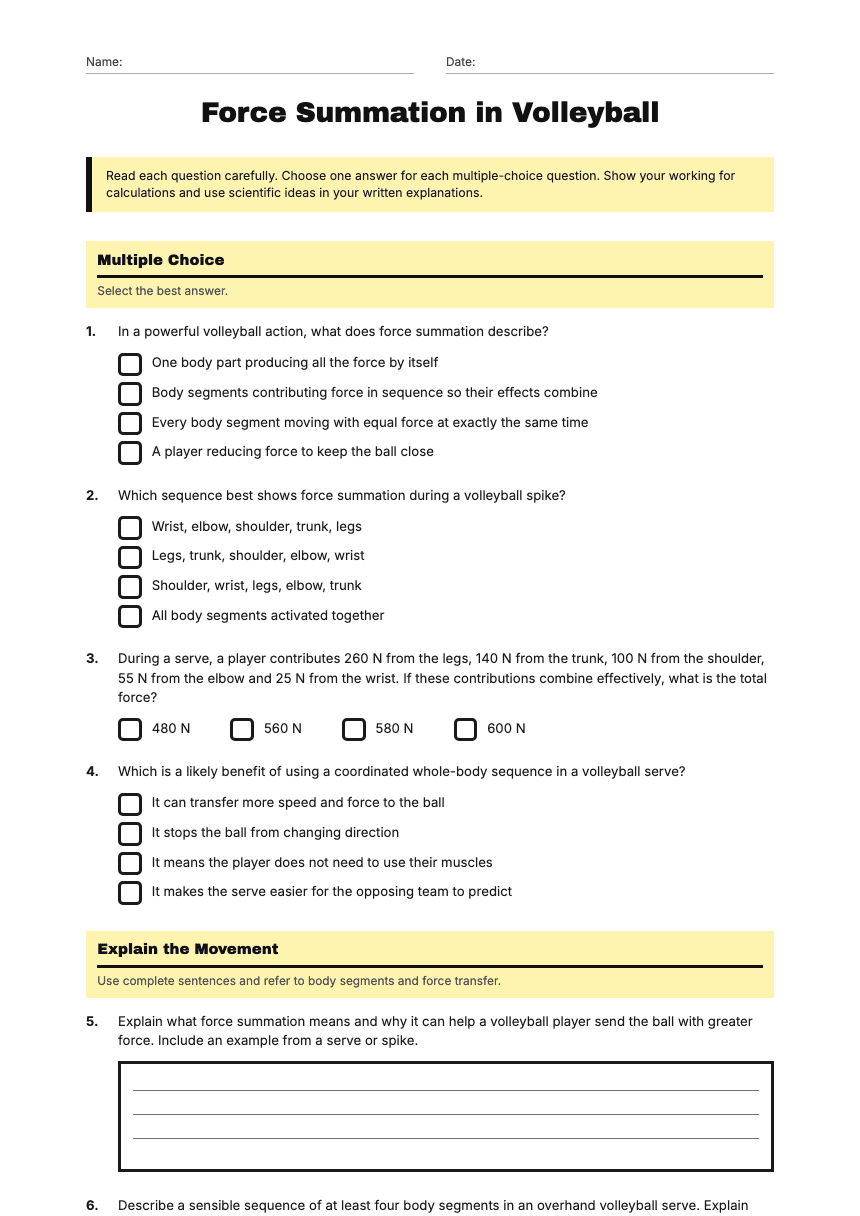
Force Summation in Volleyball
Read each question carefully. Choose one answer for each multiple-choice question. Show your working for calculations and use scientific ideas in your written explanations.
Multiple Choice
Select the best answer.
1.In a powerful volleyball action, what does force summation describe?
- One body part producing all the force by itself
- Body segments contributing force in sequence so their effects combine
- Every body segment moving with equal force at exactly the same time
- A player reducing force to keep the ball close
2.Which sequence best shows force summation during a volleyball spike?
- Wrist, elbow, shoulder, trunk, legs
- Legs, trunk, shoulder, elbow, wrist
- Shoulder, wrist, legs, elbow, trunk
- All body segments activated together
3.During a serve, a player contributes 260 N from the legs, 140 N from the trunk, 100 N from the shoulder, 55 N from the elbow and 25 N from the wrist. If these contributions combine effectively, what is the total force?
- 480 N
- 560 N
- 580 N
- 600 N
4.Which is a likely benefit of using a coordinated whole-body sequence in a volleyball serve?
- It can transfer more speed and force to the ball
- It stops the ball from changing direction
- It means the player does not need to use their muscles
- It makes the serve easier for the opposing team to predict
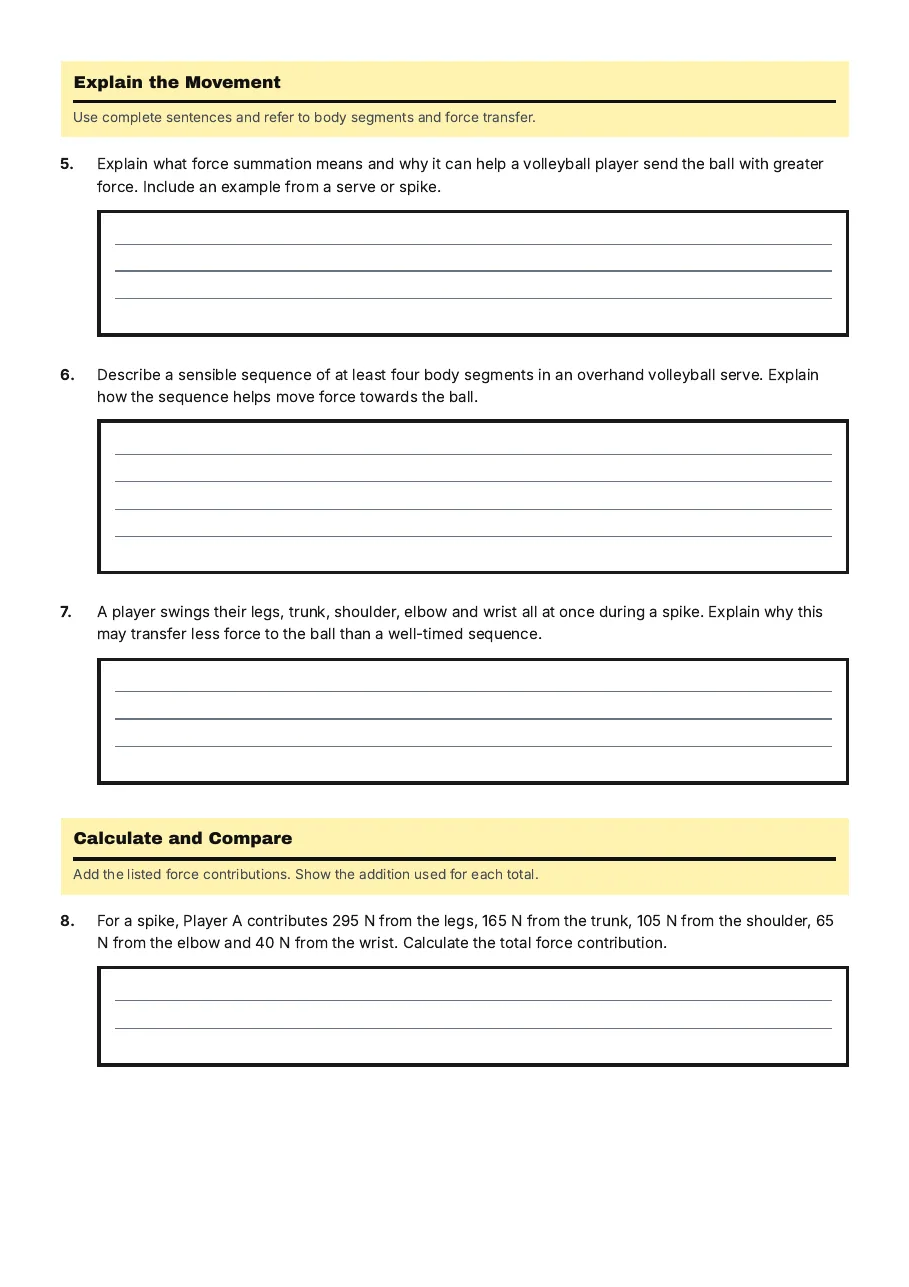
Explain the Movement
Use complete sentences and refer to body segments and force transfer.
5.Explain what force summation means and why it can help a volleyball player send the ball with greater force. Include an example from a serve or spike.
6.Describe a sensible sequence of at least four body segments in an overhand volleyball serve. Explain how the sequence helps move force towards the ball.
7.A player swings their legs, trunk, shoulder, elbow and wrist all at once during a spike. Explain why this may transfer less force to the ball than a well-timed sequence.
Calculate and Compare
Add the listed force contributions. Show the addition used for each total.
8.For a spike, Player A contributes 295 N from the legs, 165 N from the trunk, 105 N from the shoulder, 65 N from the elbow and 40 N from the wrist. Calculate the total force contribution.
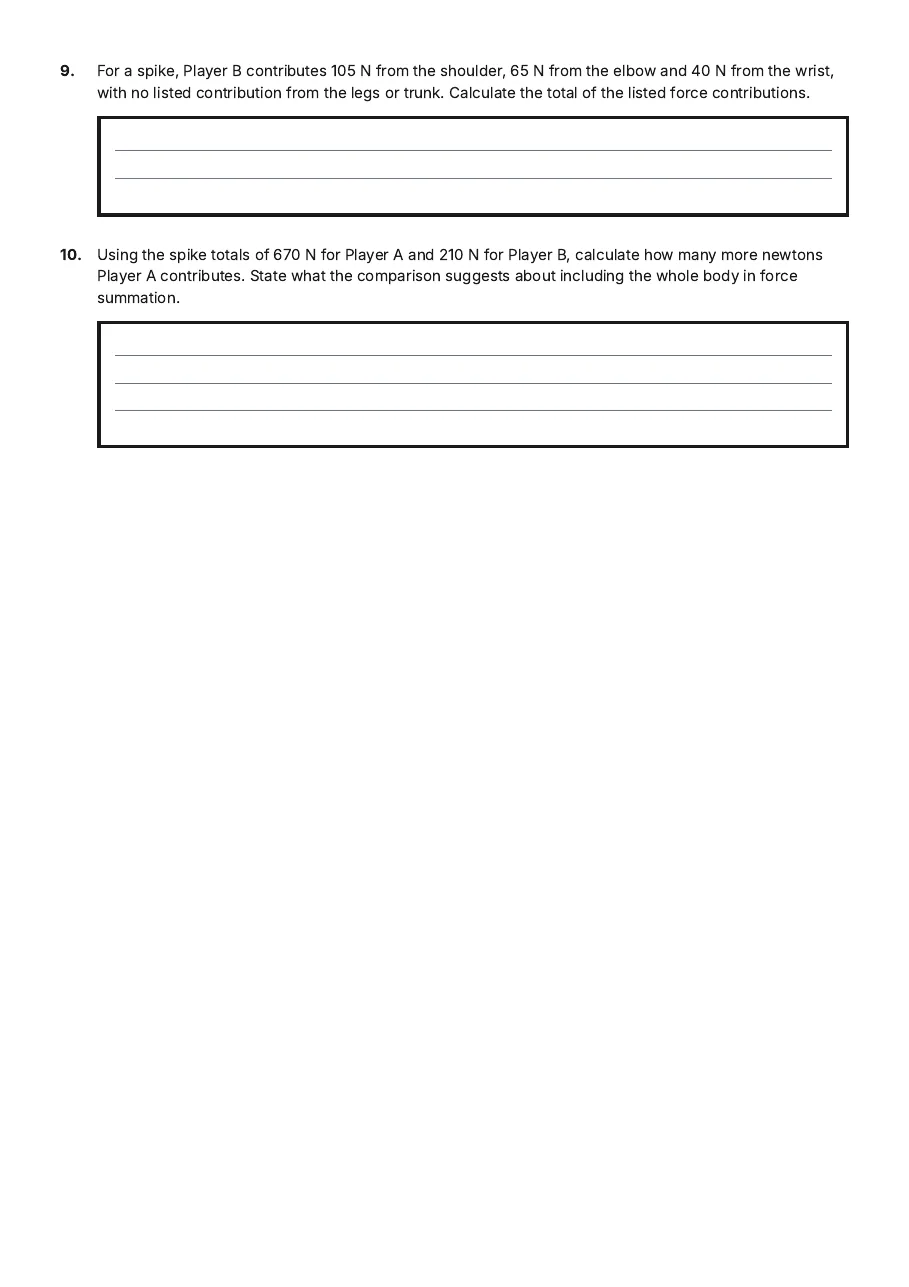
9.For a spike, Player B contributes 105 N from the shoulder, 65 N from the elbow and 40 N from the wrist, with no listed contribution from the legs or trunk. Calculate the total of the listed force contributions.
10.Using the spike totals of 670 N for Player A and 210 N for Player B, calculate how many more newtons Player A contributes. State what the comparison suggests about including the whole body in force summation.
3 printable pages
Page 1
Page 2
Page 3
About This Worksheet
Free in Kuraplan
Sign up free, grab the PDF, and customize it for your class.
Print-Ready
Formatted for standard paper. Clean layout, easy to read.
AI-Generated
Created with Kuraplan's AI, designed for real classroom use.
For Teachers & Parents
Use in classrooms, for homework, tutoring, or homeschool.
Need a custom version of this worksheet?
Kuraplan's AI generates custom worksheets in seconds — differentiated for every learner, aligned to your curriculum.
Generate Custom Worksheets — Free No credit card Curriculum-aligned Under 60 seconds