ScienceFreePrintable
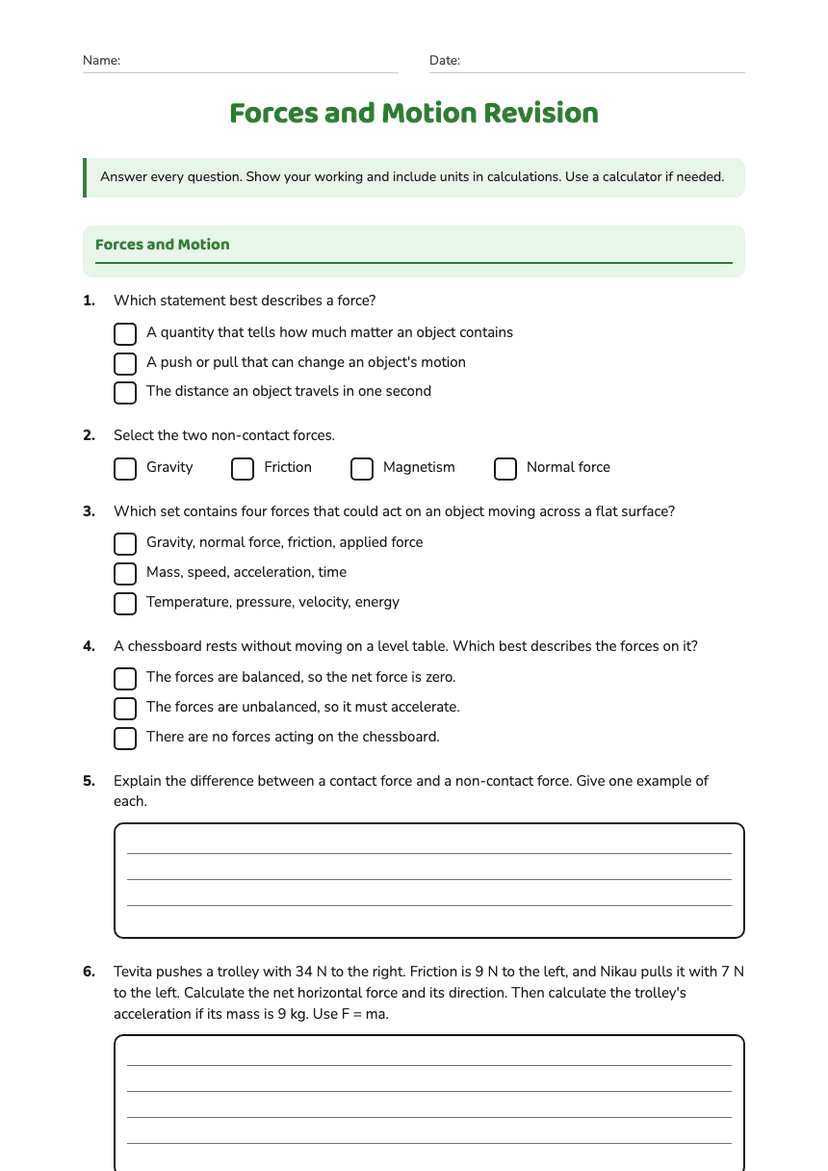
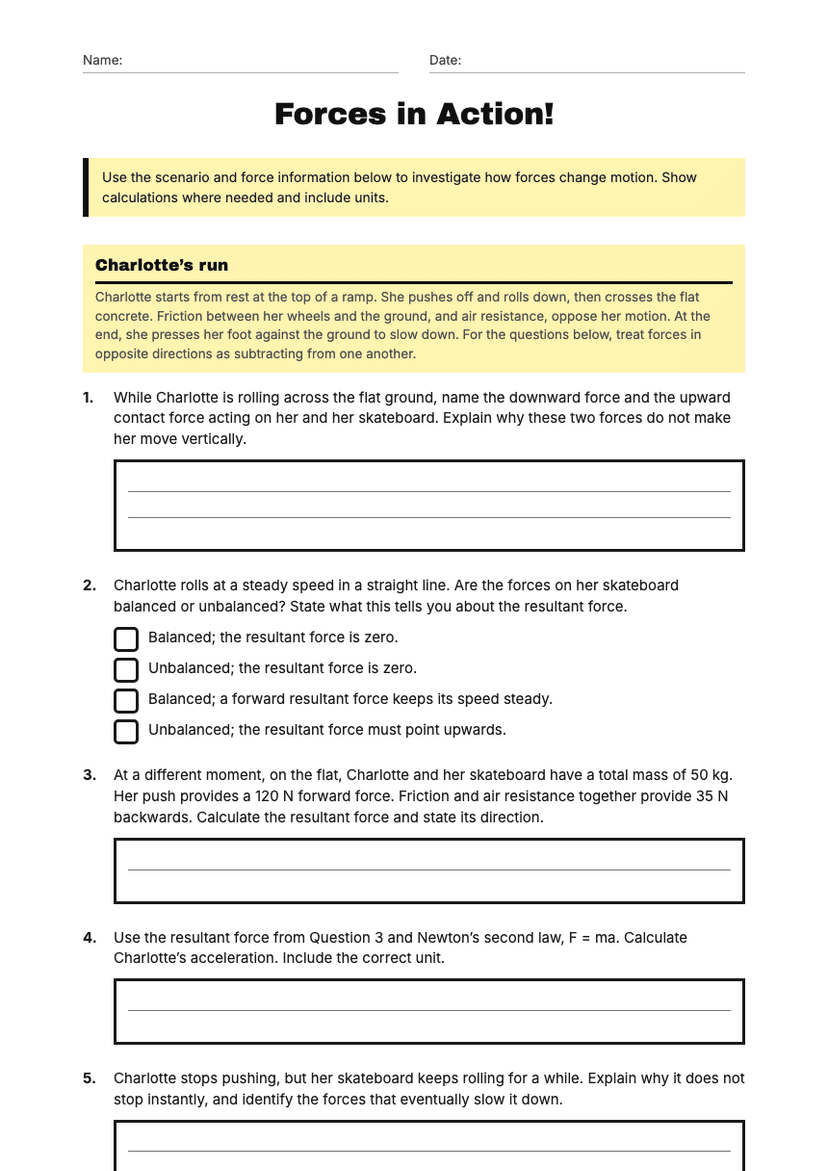
Forces and Their Effects
A free science worksheet ready for your classroom. Open in Kuraplan to grab the print-ready PDF, customize it for your students, or generate a fresh version in seconds.
Name:Date:
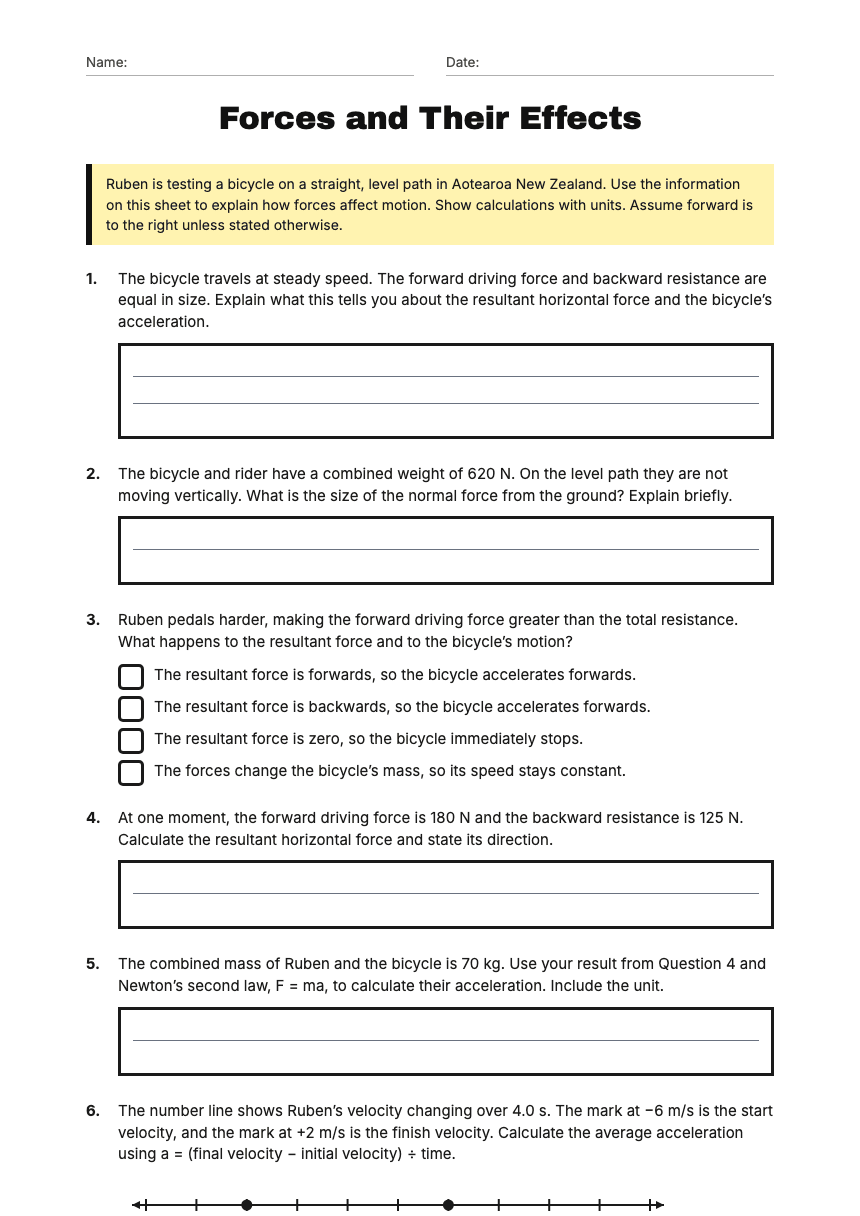
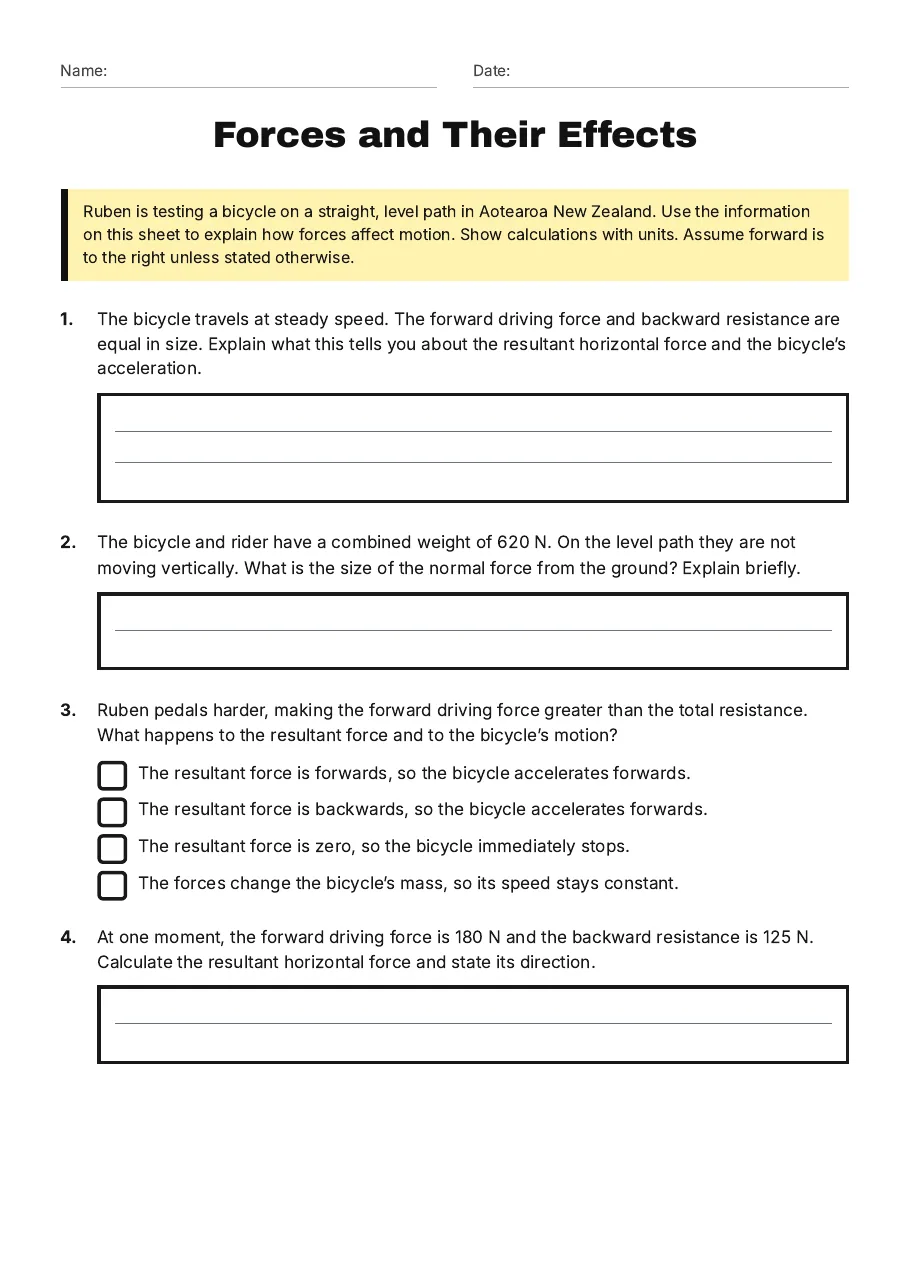
Forces and Their Effects
Ruben is testing a bicycle on a straight, level path in Aotearoa New Zealand. Use the information on this sheet to explain how forces affect motion. Show calculations with units. Assume forward is to the right unless stated otherwise.
1.The bicycle travels at steady speed. The forward driving force and backward resistance are equal in size. Explain what this tells you about the resultant horizontal force and the bicycle’s acceleration.
2.The bicycle and rider have a combined weight of 620 N. On the level path they are not moving vertically. What is the size of the normal force from the ground? Explain briefly.
3.Ruben pedals harder, making the forward driving force greater than the total resistance. What happens to the resultant force and to the bicycle’s motion?
- The resultant force is forwards, so the bicycle accelerates forwards.
- The resultant force is backwards, so the bicycle accelerates forwards.
- The resultant force is zero, so the bicycle immediately stops.
- The forces change the bicycle’s mass, so its speed stays constant.
4.At one moment, the forward driving force is 180 N and the backward resistance is 125 N. Calculate the resultant horizontal force and state its direction.
5.The combined mass of Ruben and the bicycle is 70 kg. Use your result from Question 4 and Newton’s second law, F = ma, to calculate their acceleration. Include the unit.
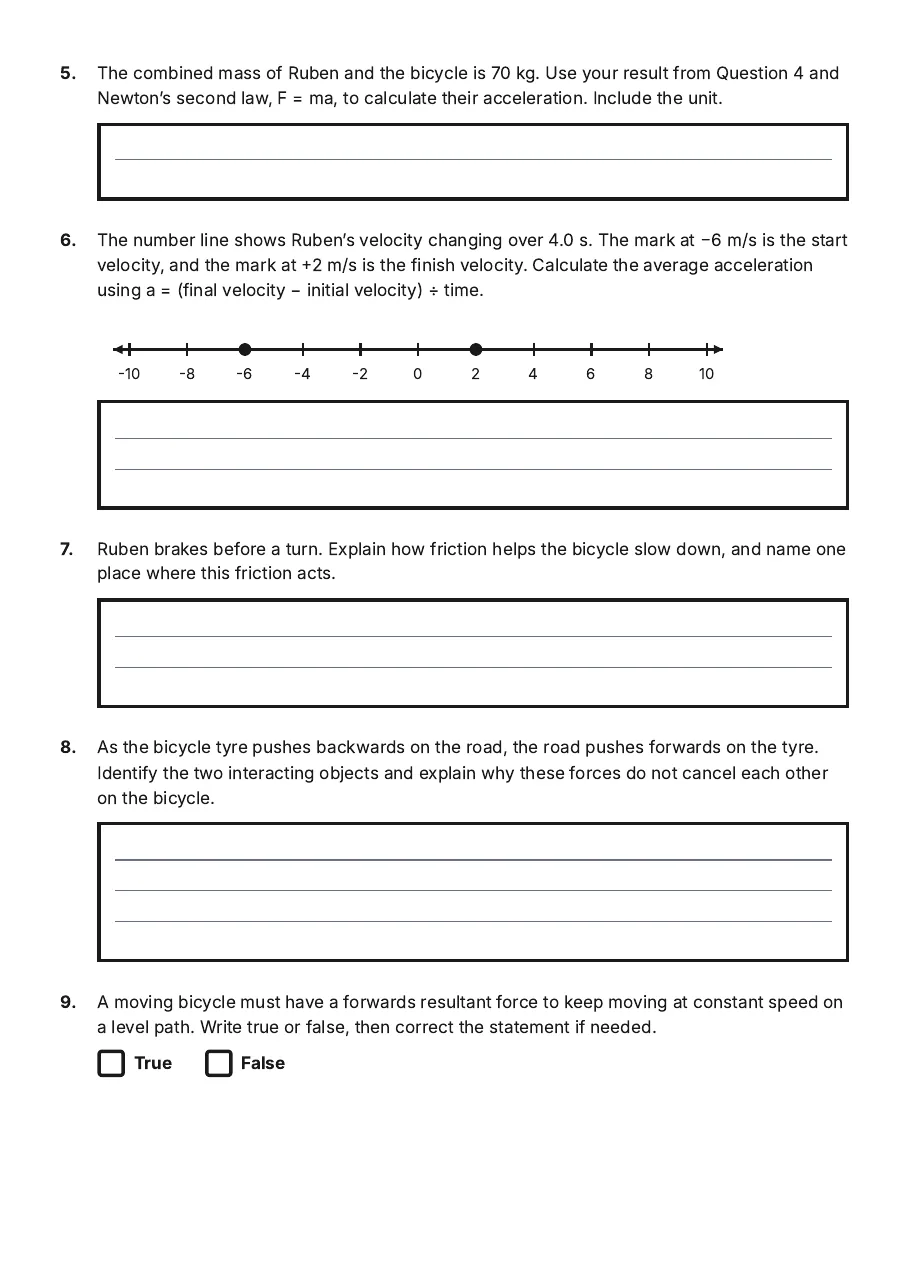
6.The number line shows Ruben’s velocity changing over 4.0 s. The mark at −6 m/s is the start velocity, and the mark at +2 m/s is the finish velocity. Calculate the average acceleration using a = (final velocity − initial velocity) ÷ time.
7.Ruben brakes before a turn. Explain how friction helps the bicycle slow down, and name one place where this friction acts.
8.As the bicycle tyre pushes backwards on the road, the road pushes forwards on the tyre. Identify the two interacting objects and explain why these forces do not cancel each other on the bicycle.
9.A moving bicycle must have a forwards resultant force to keep moving at constant speed on a level path. Write true or false, then correct the statement if needed.
TrueFalse
10.Ruben starts from rest, pedals along the level path at steady speed during the middle stage, then brakes to a stop. Describe how the resultant force changes during these three stages and link each stage to the bicycle’s motion.
3 printable pages
Page 1
Page 2

Page 3
About This Worksheet
Free in Kuraplan
Sign up free, grab the PDF, and customize it for your class.
Print-Ready
Formatted for standard paper. Clean layout, easy to read.
AI-Generated
Created with Kuraplan's AI, designed for real classroom use.
For Teachers & Parents
Use in classrooms, for homework, tutoring, or homeschool.
Need a custom version of this worksheet?
Kuraplan's AI generates custom worksheets in seconds — differentiated for every learner, aligned to your curriculum.
Generate Custom Worksheets — Free No credit card Curriculum-aligned Under 60 seconds