ScienceFreePrintable

How Plants Make Food

A free science worksheet ready for your classroom. Open in Kuraplan to grab the print-ready PDF, customize it for your students, or generate a fresh version in seconds.
How Plants Make Food worksheet preview
Name:Date:

How Plants Make Food

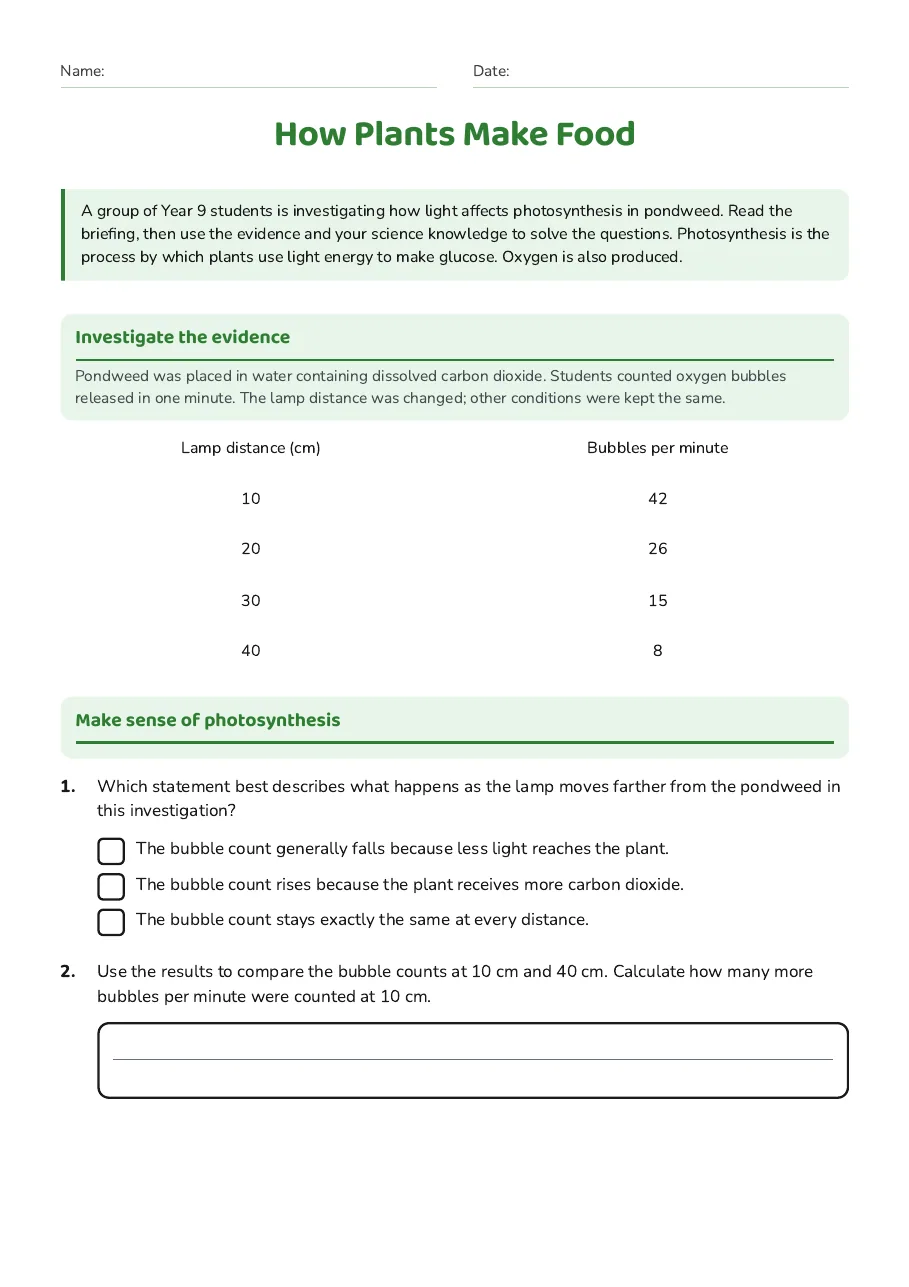
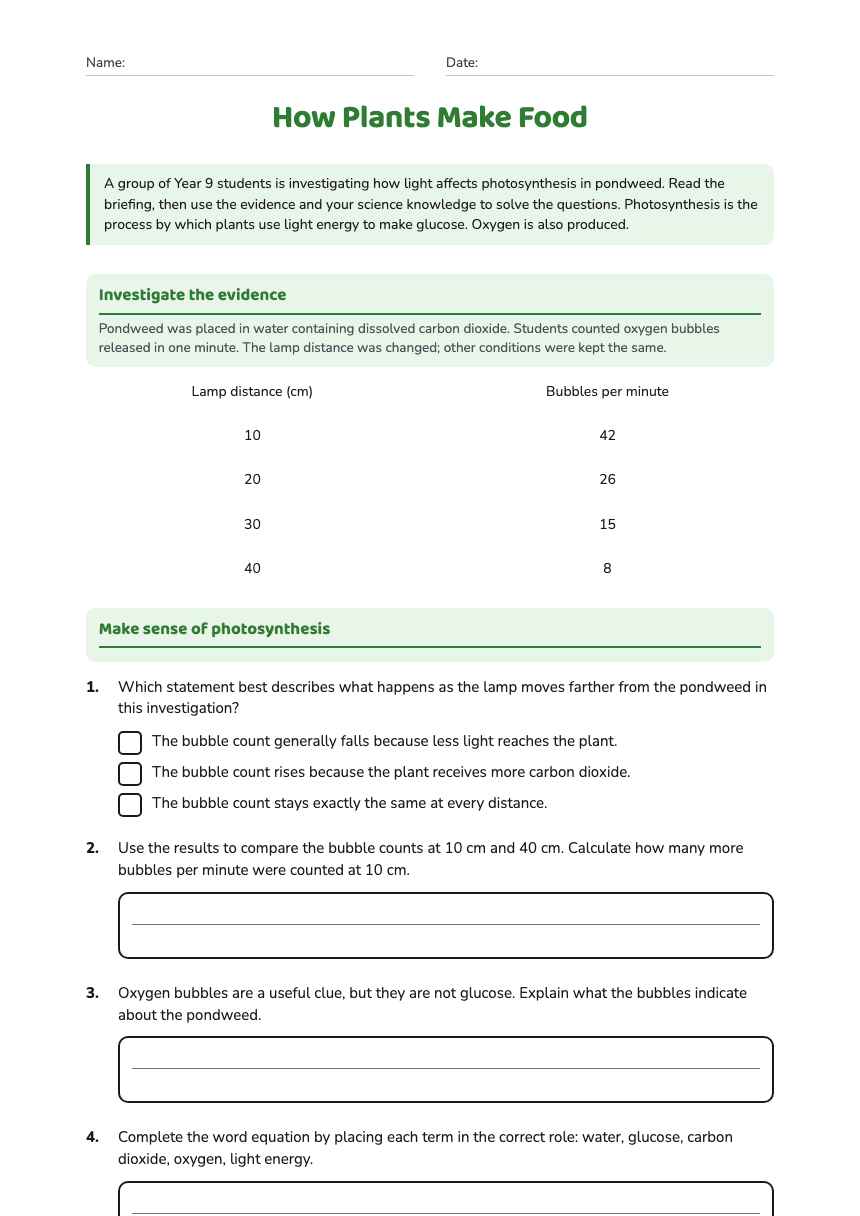
A group of Year 9 students is investigating how light affects photosynthesis in pondweed. Read the briefing, then use the evidence and your science knowledge to solve the questions. Photosynthesis is the process by which plants use light energy to make glucose. Oxygen is also produced.

Investigate the evidence

Pondweed was placed in water containing dissolved carbon dioxide. Students counted oxygen bubbles released in one minute. The lamp distance was changed; other conditions were kept the same.

Lamp distance (cm)

Bubbles per minute

10

42

20

26

30

15

40

8

Make sense of photosynthesis

1.Which statement best describes what happens as the lamp moves farther from the pondweed in this investigation?
  • The bubble count generally falls because less light reaches the plant.
  • The bubble count rises because the plant receives more carbon dioxide.
  • The bubble count stays exactly the same at every distance.
2.Use the results to compare the bubble counts at 10 cm and 40 cm. Calculate how many more bubbles per minute were counted at 10 cm.
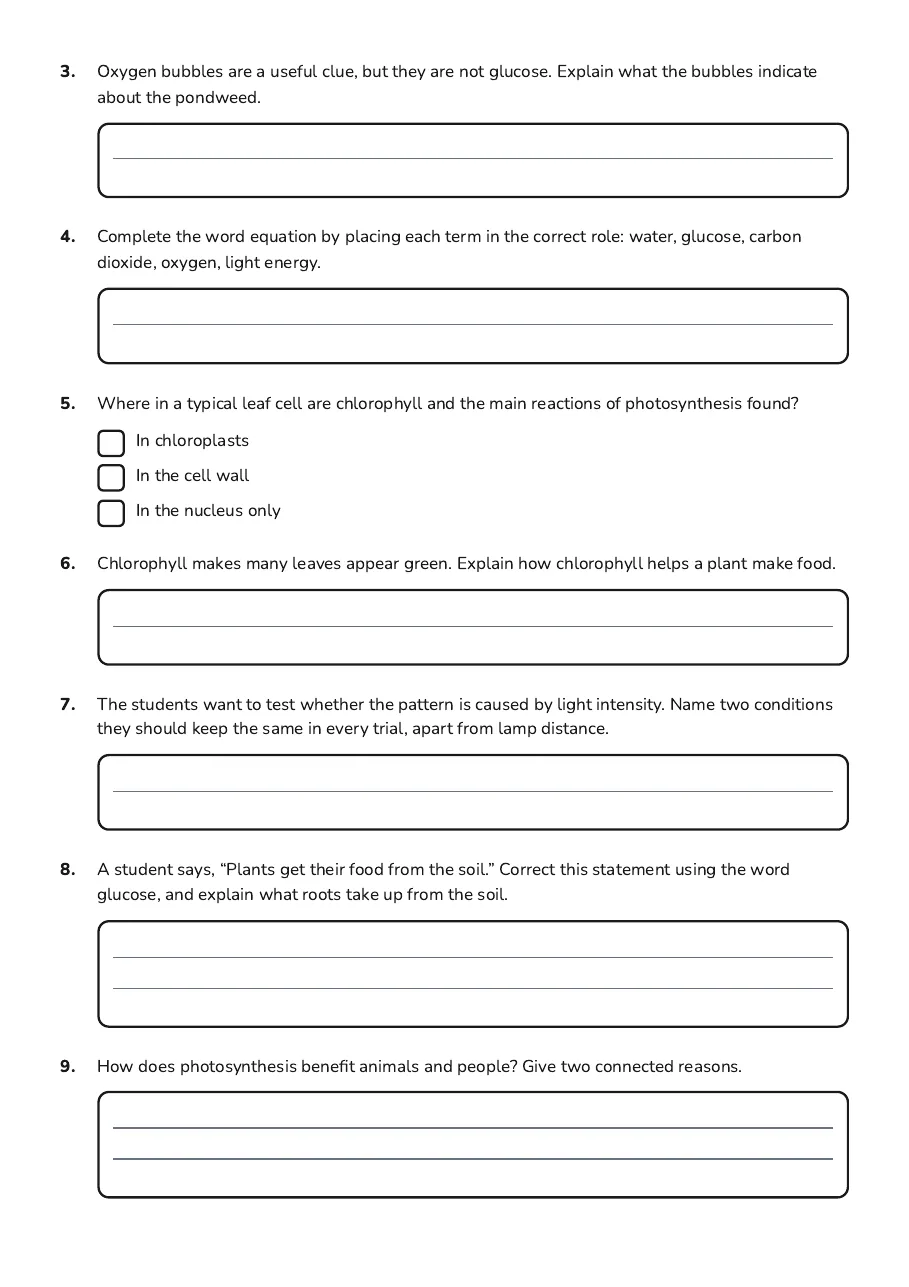
3.Oxygen bubbles are a useful clue, but they are not glucose. Explain what the bubbles indicate about the pondweed.
4.Complete the word equation by placing each term in the correct role: water, glucose, carbon dioxide, oxygen, light energy.
5.Where in a typical leaf cell are chlorophyll and the main reactions of photosynthesis found?
  • In chloroplasts
  • In the cell wall
  • In the nucleus only
6.Chlorophyll makes many leaves appear green. Explain how chlorophyll helps a plant make food.
7.The students want to test whether the pattern is caused by light intensity. Name two conditions they should keep the same in every trial, apart from lamp distance.
8.A student says, “Plants get their food from the soil.” Correct this statement using the word glucose, and explain what roots take up from the soil.
9.How does photosynthesis benefit animals and people? Give two connected reasons.
10.At 40 cm, the group counted only 8 bubbles per minute. Suggest one reason the bubble count might not represent the exact rate of photosynthesis.

3 printable pages

  • How Plants Make Food, page 1 of 3: Investigate the evidence, Make sense of photosynthesis

    Page 1

  • How Plants Make Food, page 2 of 3: 3. Oxygen bubbles are a useful clue, but they are not glucose. Explain what the bubbles…

    Page 2

  • How Plants Make Food, page 3 of 3: 10. At 40 cm, the group counted only 8 bubbles per minute. Suggest one reason the bubble…

    Page 3

About This Worksheet

Free in Kuraplan

Sign up free, grab the PDF, and customize it for your class.

Print-Ready

Formatted for standard paper. Clean layout, easy to read.

AI-Generated

Created with Kuraplan's AI, designed for real classroom use.

For Teachers & Parents

Use in classrooms, for homework, tutoring, or homeschool.

Need a custom version of this worksheet?

Kuraplan's AI generates custom worksheets in seconds — differentiated for every learner, aligned to your curriculum.

Generate Custom Worksheets — Free
No credit card Curriculum-aligned Under 60 seconds