Glitter Trace Evidence Worksheet
A free science worksheet ready for your classroom. Open in Kuraplan to grab the print-ready PDF, customize it for your students, or generate a fresh version in seconds.
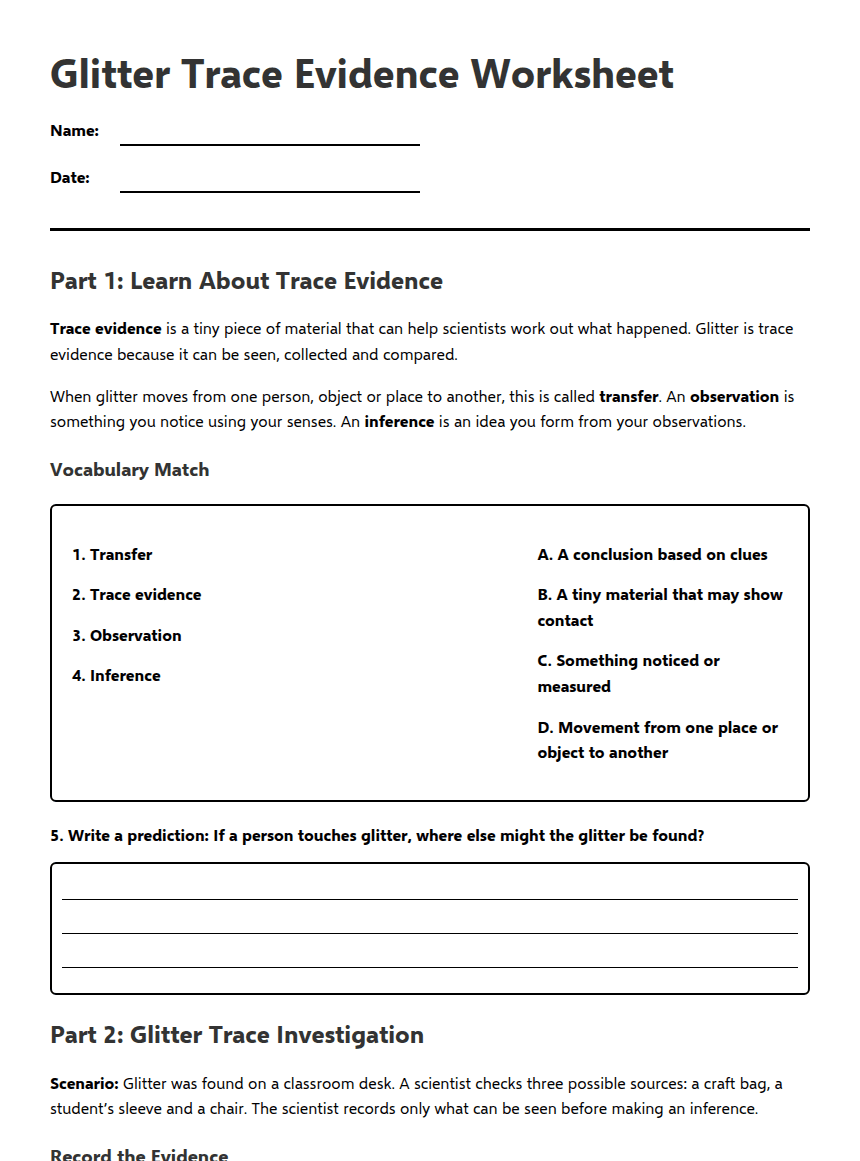
Glitter Trace Evidence Worksheet
Part 1: Learn About Trace Evidence
Trace evidence is a tiny piece of material that can help scientists work out what happened. Glitter is trace evidence because it can be seen, collected and compared.
When glitter moves from one person, object or place to another, this is called transfer. An observation is something you notice using your senses. An inference is an idea you form from your observations.
Vocabulary Match
Part 2: Glitter Trace Investigation
Scenario: Glitter was found on a classroom desk. A scientist checks three possible sources: a craft bag, a student’s sleeve and a chair. The scientist records only what can be seen before making an inference.
Record the Evidence
Sample A: Craft bag
Observation: ________________________________________________
Possible source or connection: _________________________________
Sample B: Student’s sleeve
Observation: ________________________________________________
Possible source or connection: _________________________________
Sample C: Chair
Observation: ________________________________________________
Possible source or connection: _________________________________
______ Glitter sticks to a sleeve.
______ The sleeve touches the desk.
______ Glitter is found on the desk.
Part 3: Conclusion and Extension
Conclusion
What do you think happened in the scenario? Use at least one observation and one inference.
Extension Challenge
Design a fair test to investigate which materials collect the most glitter. Name three materials, describe what you would keep the same, and explain what you would measure.
Teacher Answer Key
Vocabulary: 1–D, 2–B, 3–C, 4–A.
Question 1: Glitter is visible on the left sleeve.
Question 2: Glitter was transferred from the sleeve to the desk.
Question 3: A hand touches glitter; glitter sticks to clothing; a bag brushes against a chair.
Question 4: Sleeve gets glitter: 1; sleeve touches desk: 2; glitter is found on desk: 3.
Question 5: Answers will vary. Accept predictions such as glitter may be found on hands, clothing, furniture or other objects.
Question 6: Observations are recorded evidence, while inferences are explanations based on that evidence. Separating them helps scientists avoid treating guesses as facts.
Conclusion: Answers will vary. Look for a sensible explanation supported by an observation, such as glitter on a sleeve and an inference that the sleeve may have touched the desk.
Extension: Answers should include a clear test, three materials, controlled conditions and a measurement such as the number of glitter pieces collected.
About This Worksheet
Free in Kuraplan
Sign up free, grab the PDF, and customize it for your class.
Print-Ready
Formatted for standard paper. Clean layout, easy to read.
AI-Generated
Created with Kuraplan's AI, designed for real classroom use.
For Teachers & Parents
Use in classrooms, for homework, tutoring, or homeschool.
Need a custom version of this worksheet?
Kuraplan's AI generates custom worksheets in seconds — differentiated for every learner, aligned to your curriculum.
Generate Custom Worksheets — FreeMore Science Worksheets
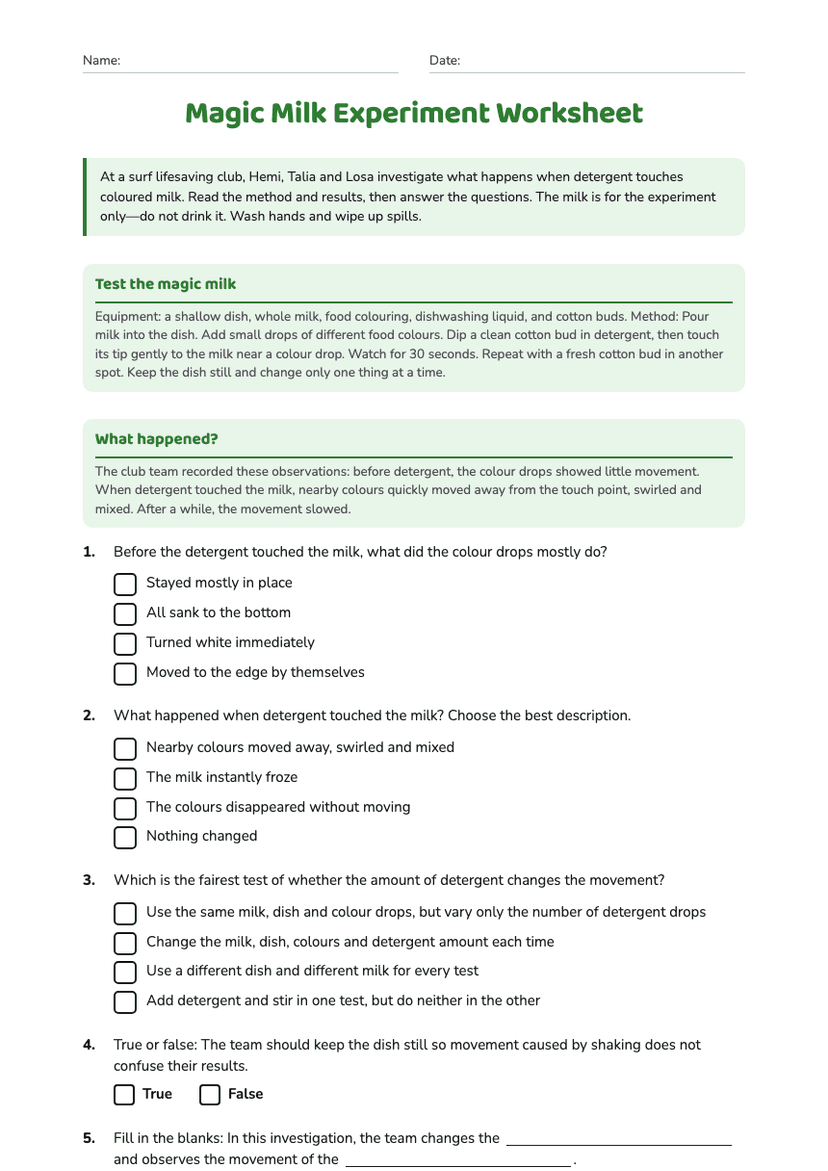
Magic Milk Experiment Worksheet
Free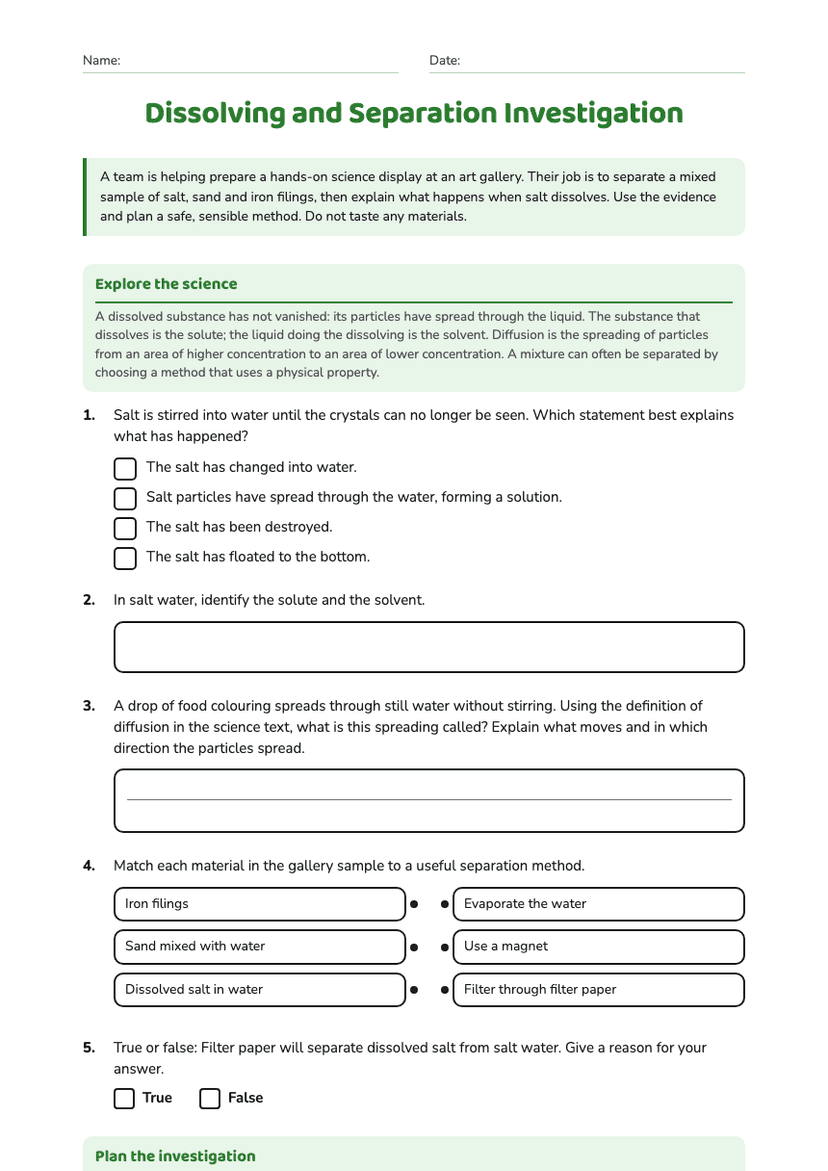
Dissolving and Separation Investigation
Free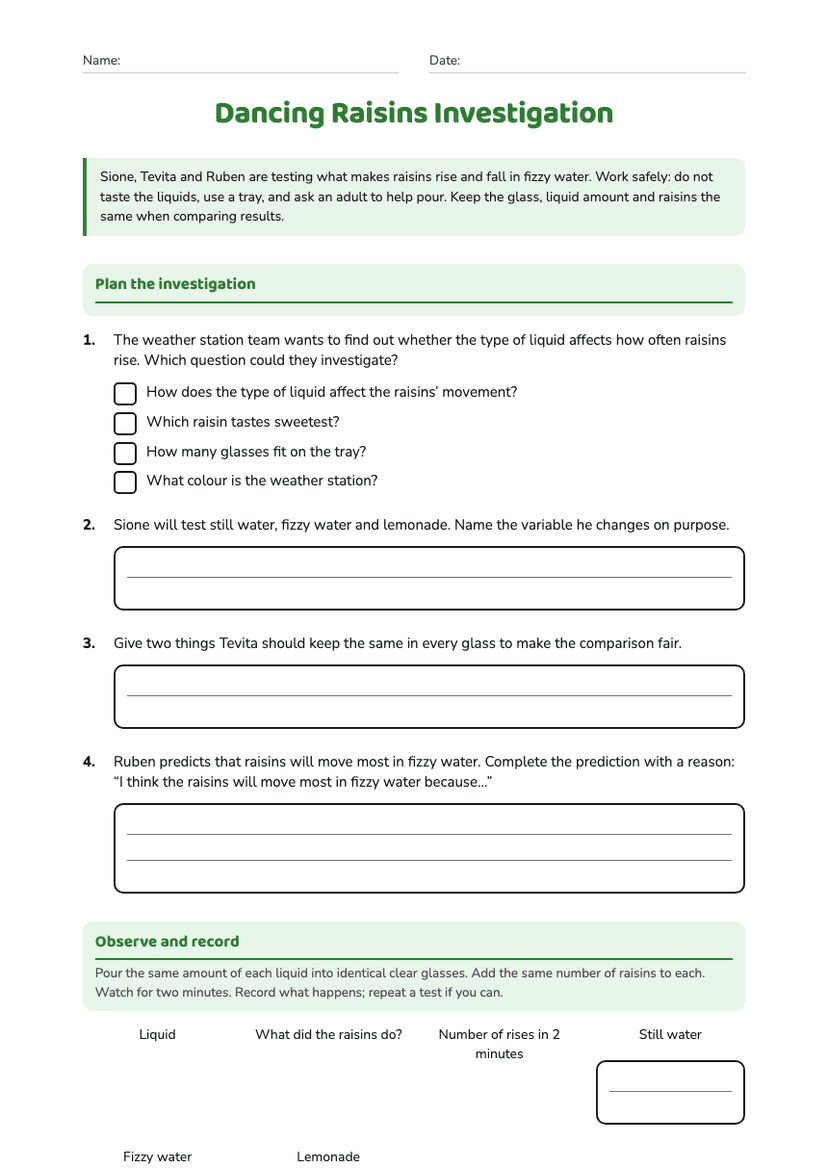
Dancing Raisins Investigation
Free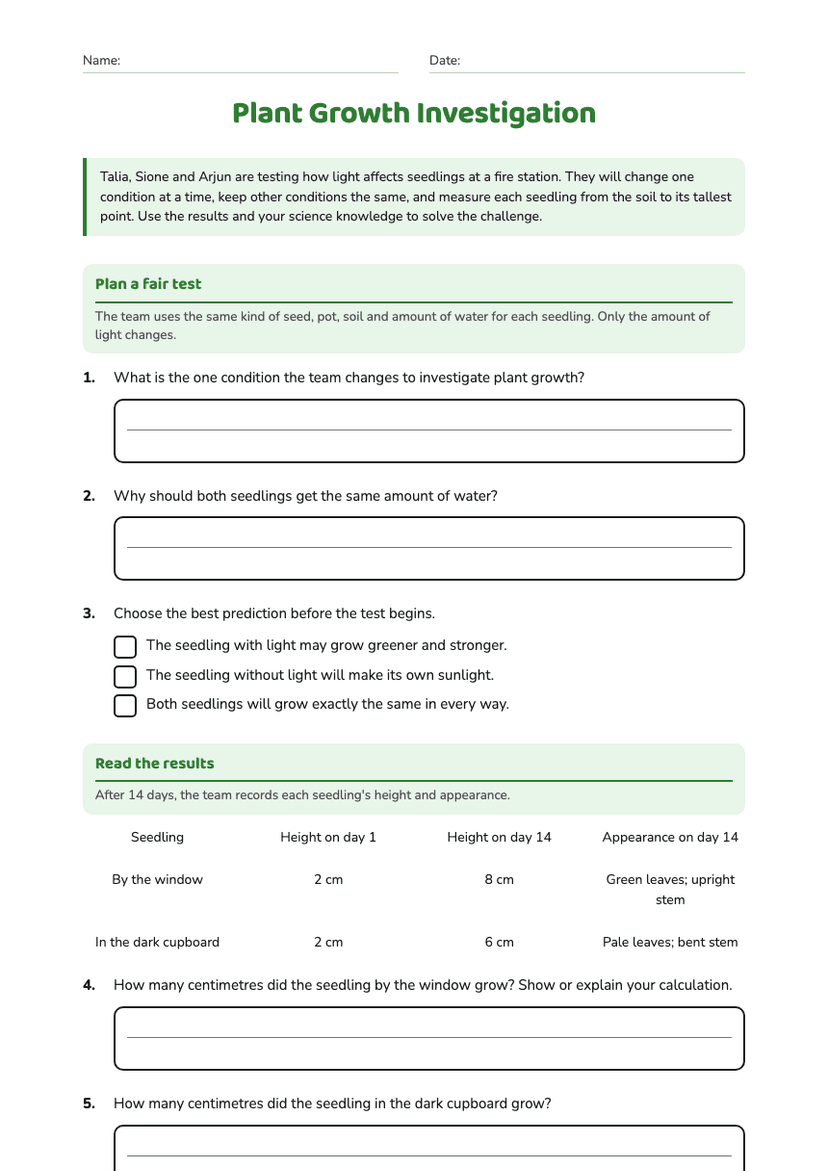
Plant Growth Investigation
Free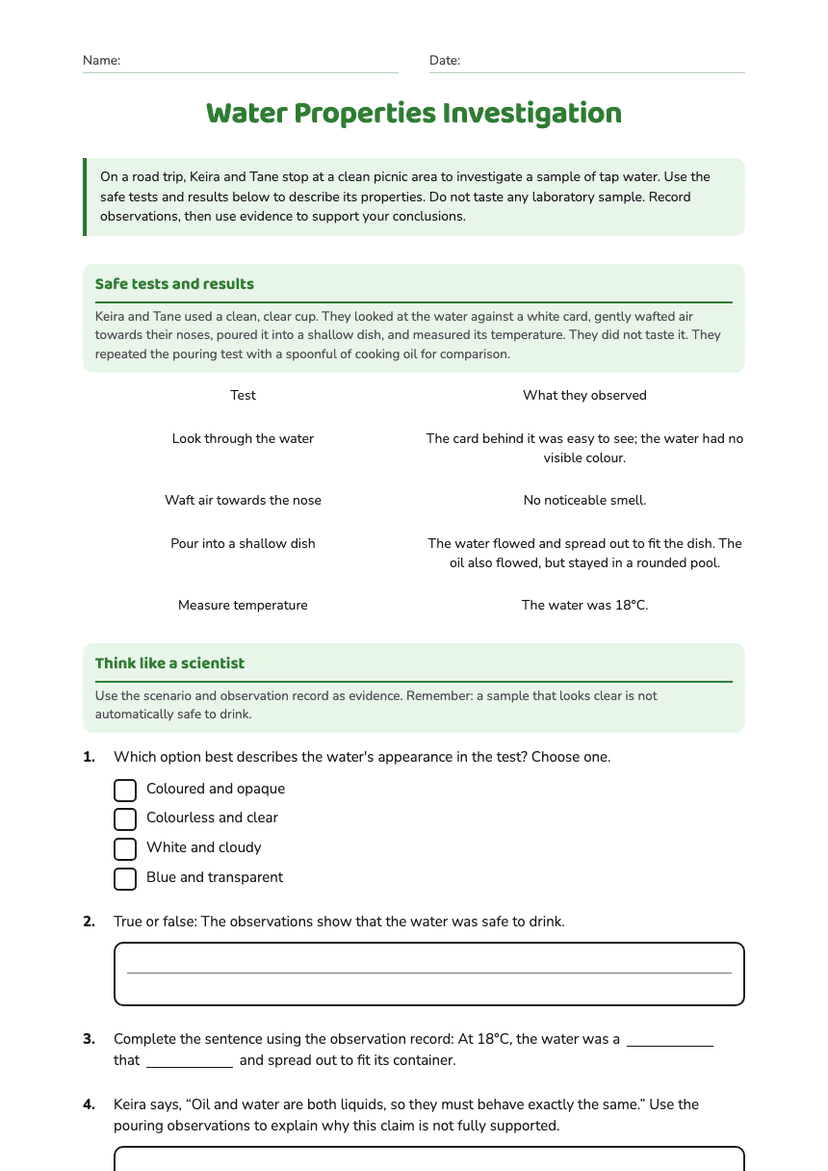
Water Properties Investigation
Free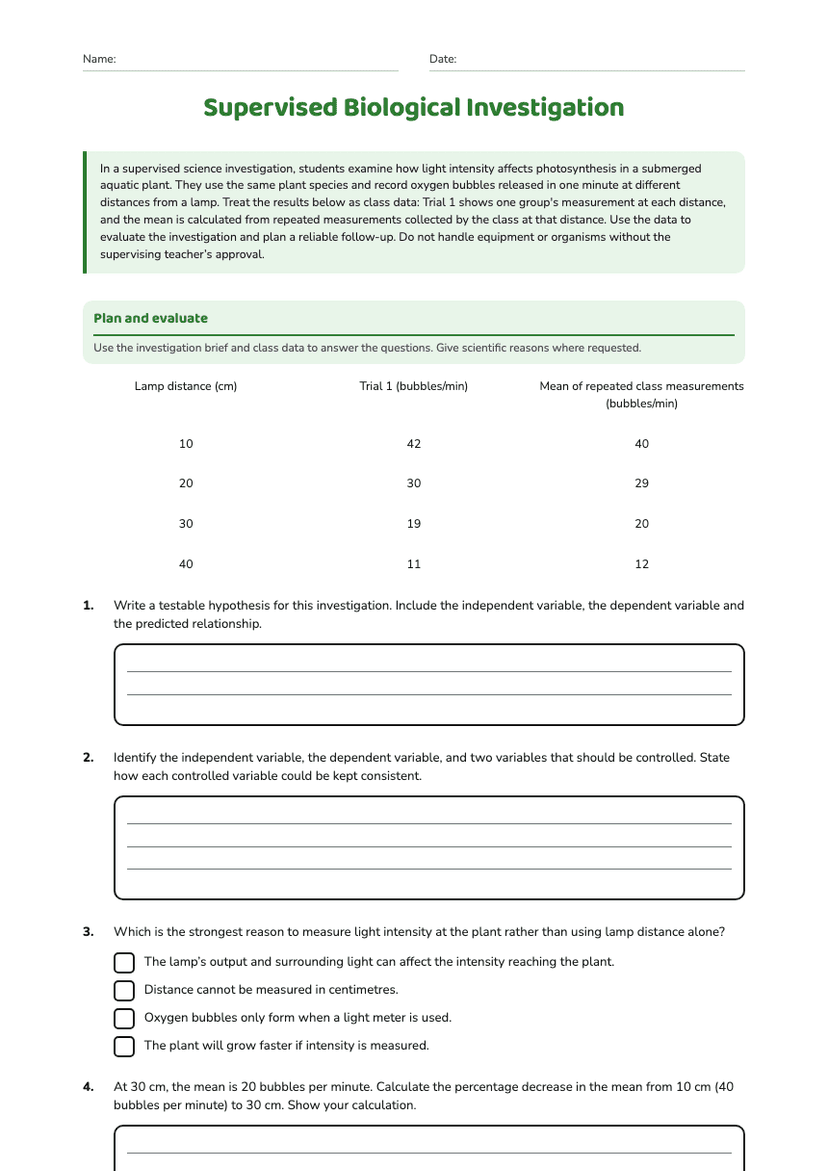
Supervised Biological Investigation
Free
Experiment Design Planner
Free