Haka Party Incident Context
A free te reo māori worksheet ready for your classroom. Open in Kuraplan to grab the print-ready PDF, customize it for your students, or generate a fresh version in seconds.
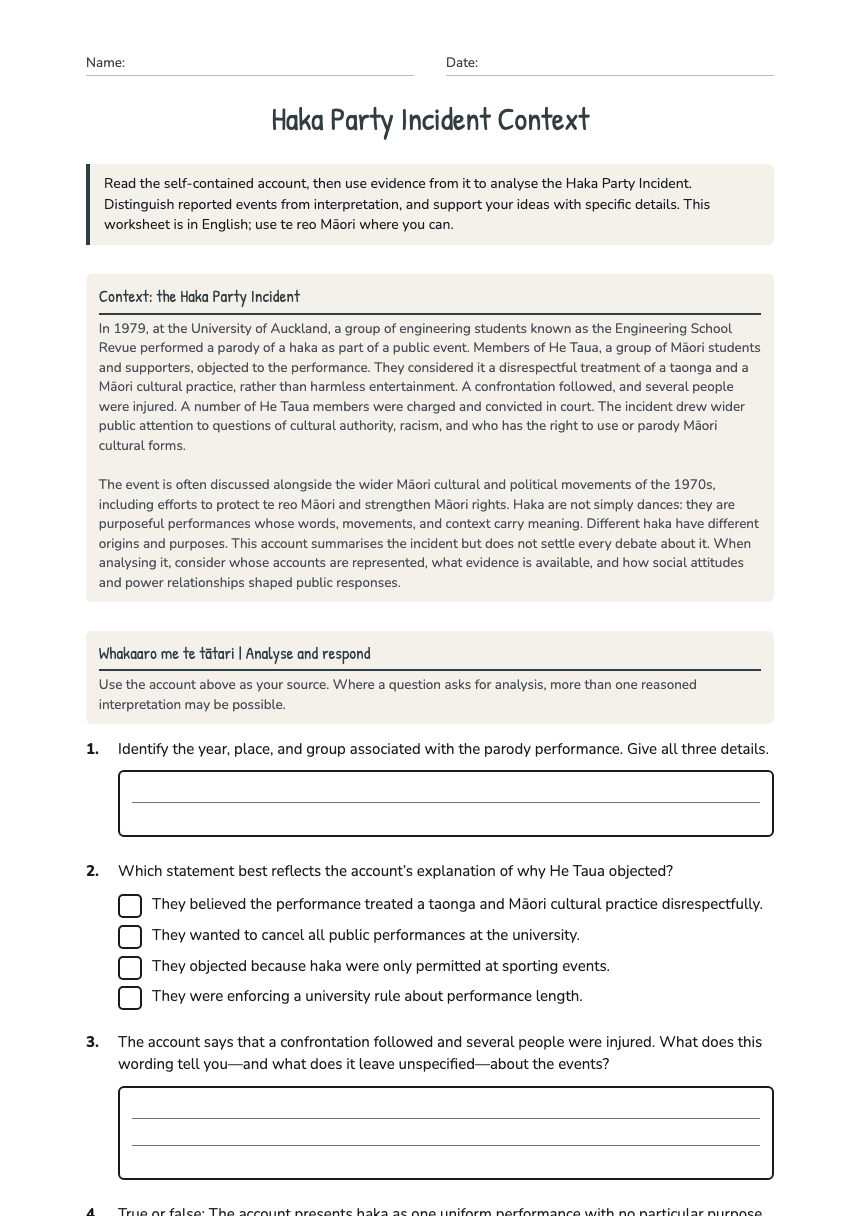
Haka Party Incident Context
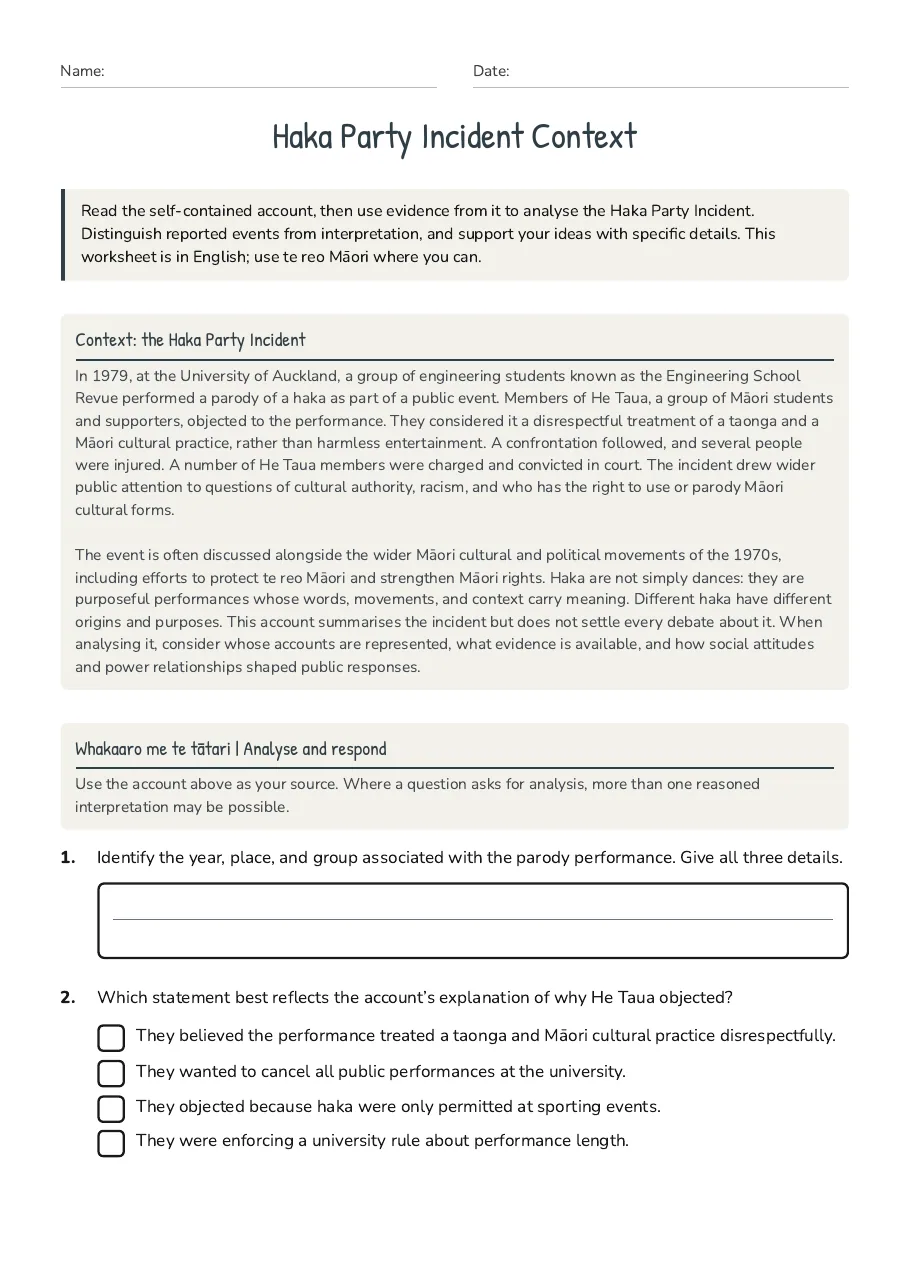
Context: the Haka Party Incident
In 1979, at the University of Auckland, a group of engineering students known as the Engineering School Revue performed a parody of a haka as part of a public event. Members of He Taua, a group of Māori students and supporters, objected to the performance. They considered it a disrespectful treatment of a taonga and a Māori cultural practice, rather than harmless entertainment. A confrontation followed, and several people were injured. A number of He Taua members were charged and convicted in court. The incident drew wider public attention to questions of cultural authority, racism, and who has the right to use or parody Māori cultural forms. The event is often discussed alongside the wider Māori cultural and political movements of the 1970s, including efforts to protect te reo Māori and strengthen Māori rights. Haka are not simply dances: they are purposeful performances whose words, movements, and context carry meaning. Different haka have different origins and purposes. This account summarises the incident but does not settle every debate about it. When analysing it, consider whose accounts are represented, what evidence is available, and how social attitudes and power relationships shaped public responses.
Whakaaro me te tātari | Analyse and respond
Use the account above as your source. Where a question asks for analysis, more than one reasoned interpretation may be possible.
- They believed the performance treated a taonga and Māori cultural practice disrespectfully.
- They wanted to cancel all public performances at the university.
- They objected because haka were only permitted at sporting events.
- They were enforcing a university rule about performance length.
3 printable pages
Page 1
Page 2
Page 3
About This Worksheet
Free in Kuraplan
Sign up free, grab the PDF, and customize it for your class.
Print-Ready
Formatted for standard paper. Clean layout, easy to read.
AI-Generated
Created with Kuraplan's AI, designed for real classroom use.
For Teachers & Parents
Use in classrooms, for homework, tutoring, or homeschool.
Need a custom version of this worksheet?
Kuraplan's AI generates custom worksheets in seconds — differentiated for every learner, aligned to your curriculum.
Generate Custom Worksheets — Free