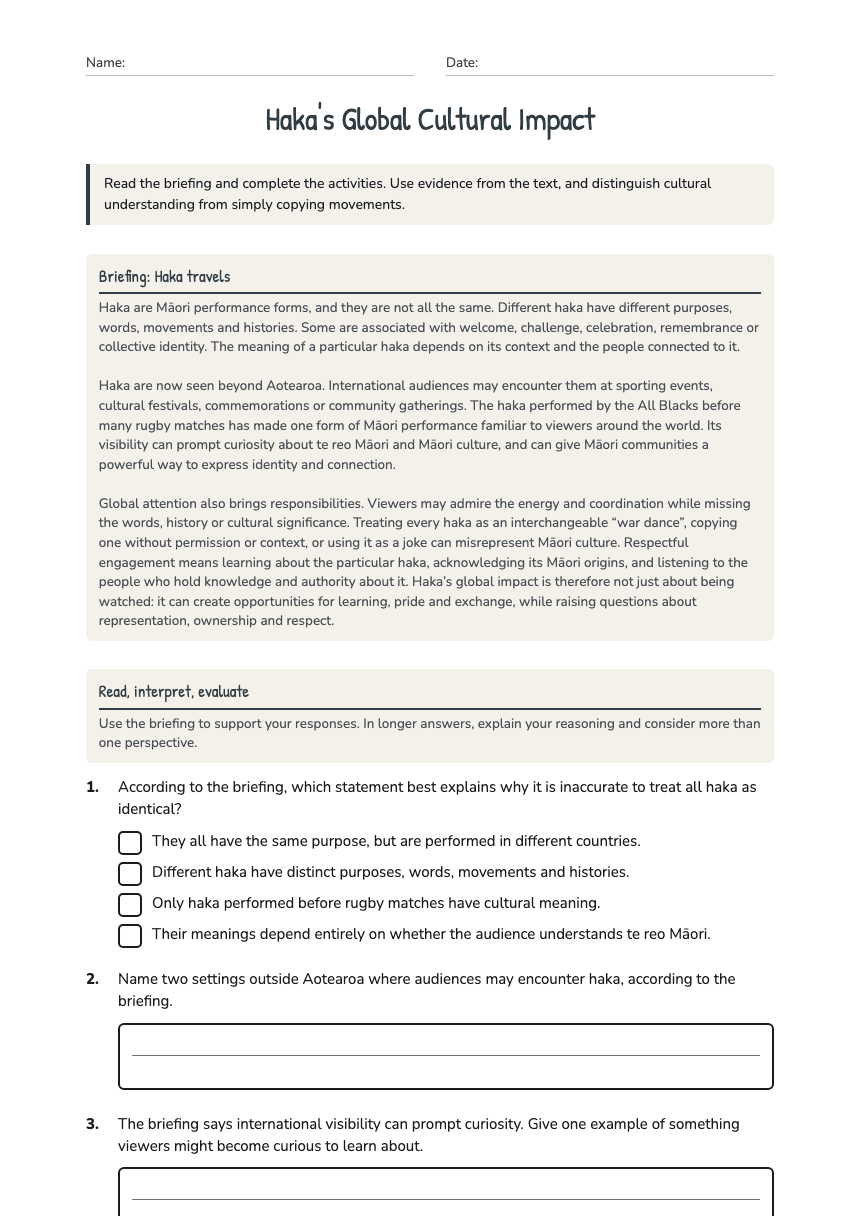
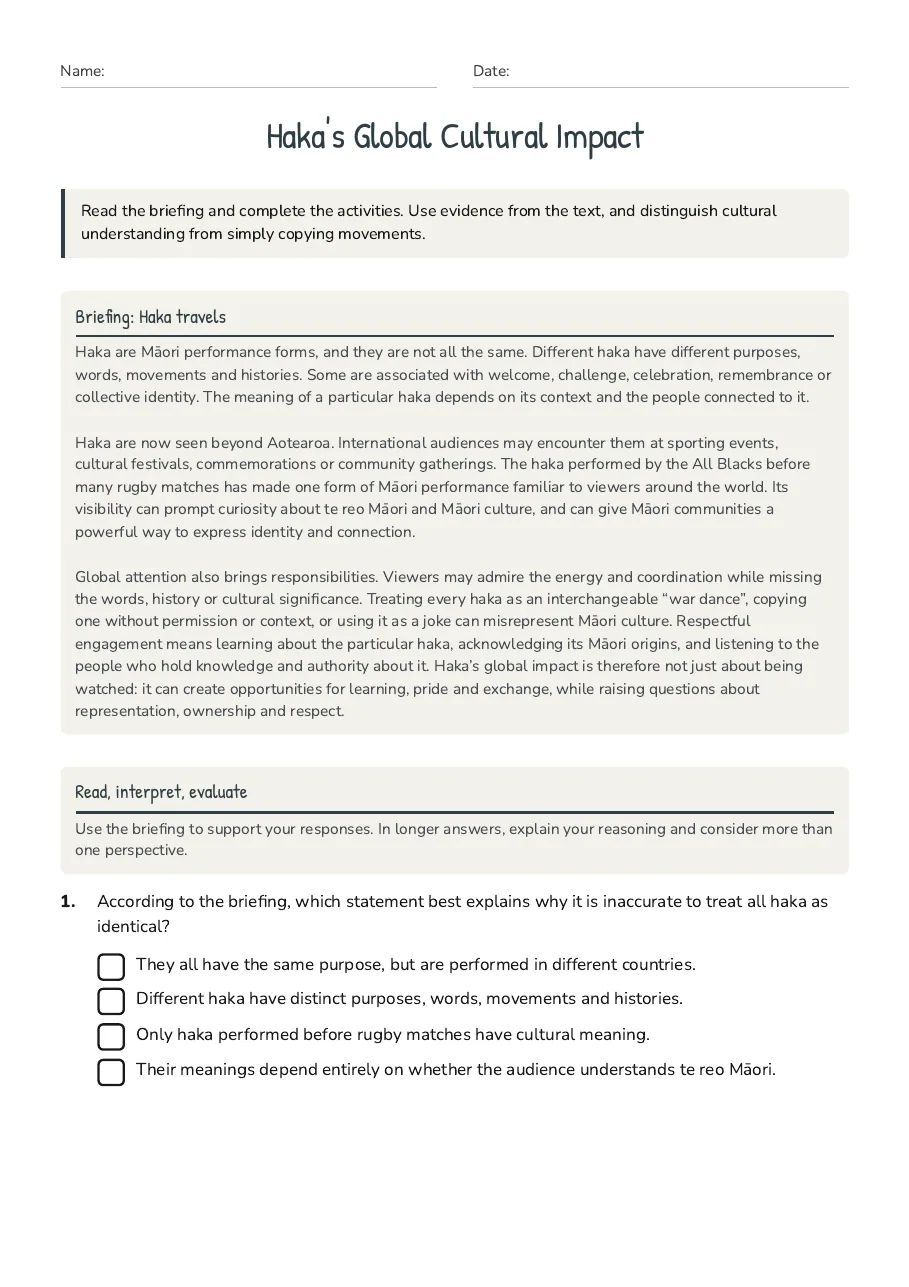
Haka's Global Cultural Impact
A free te reo māori worksheet ready for your classroom. Open in Kuraplan to grab the print-ready PDF, customize it for your students, or generate a fresh version in seconds.
Haka's Global Cultural Impact
Briefing: Haka travels
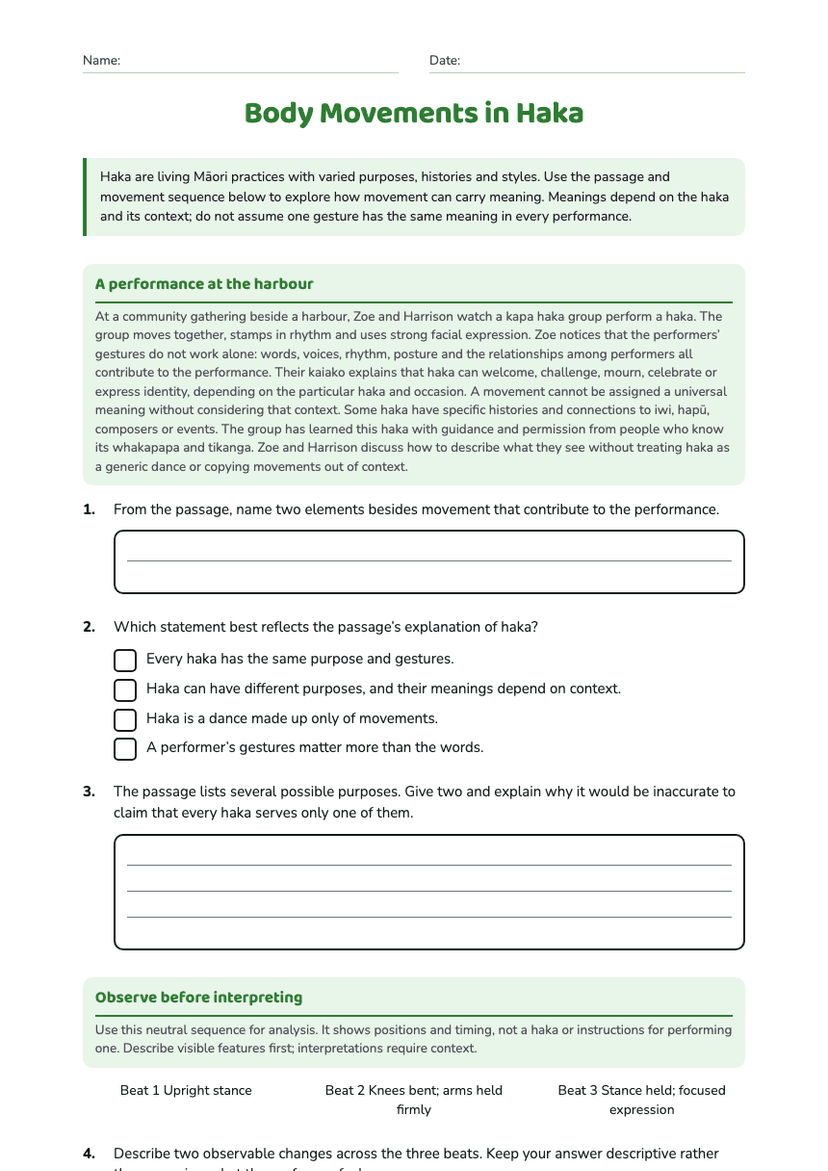
Haka are Māori performance forms, and they are not all the same. Different haka have different purposes, words, movements and histories. Some are associated with welcome, challenge, celebration, remembrance or collective identity. The meaning of a particular haka depends on its context and the people connected to it. Haka are now seen beyond Aotearoa. International audiences may encounter them at sporting events, cultural festivals, commemorations or community gatherings. The haka performed by the All Blacks before many rugby matches has made one form of Māori performance familiar to viewers around the world. Its visibility can prompt curiosity about te reo Māori and Māori culture, and can give Māori communities a powerful way to express identity and connection. Global attention also brings responsibilities. Viewers may admire the energy and coordination while missing the words, history or cultural significance. Treating every haka as an interchangeable “war dance”, copying one without permission or context, or using it as a joke can misrepresent Māori culture. Respectful engagement means learning about the particular haka, acknowledging its Māori origins, and listening to the people who hold knowledge and authority about it. Haka’s global impact is therefore not just about being watched: it can create opportunities for learning, pride and exchange, while raising questions about representation, ownership and respect.
Read, interpret, evaluate
Use the briefing to support your responses. In longer answers, explain your reasoning and consider more than one perspective.
- They all have the same purpose, but are performed in different countries.
- Different haka have distinct purposes, words, movements and histories.
- Only haka performed before rugby matches have cultural meaning.
- Their meanings depend entirely on whether the audience understands te reo Māori.
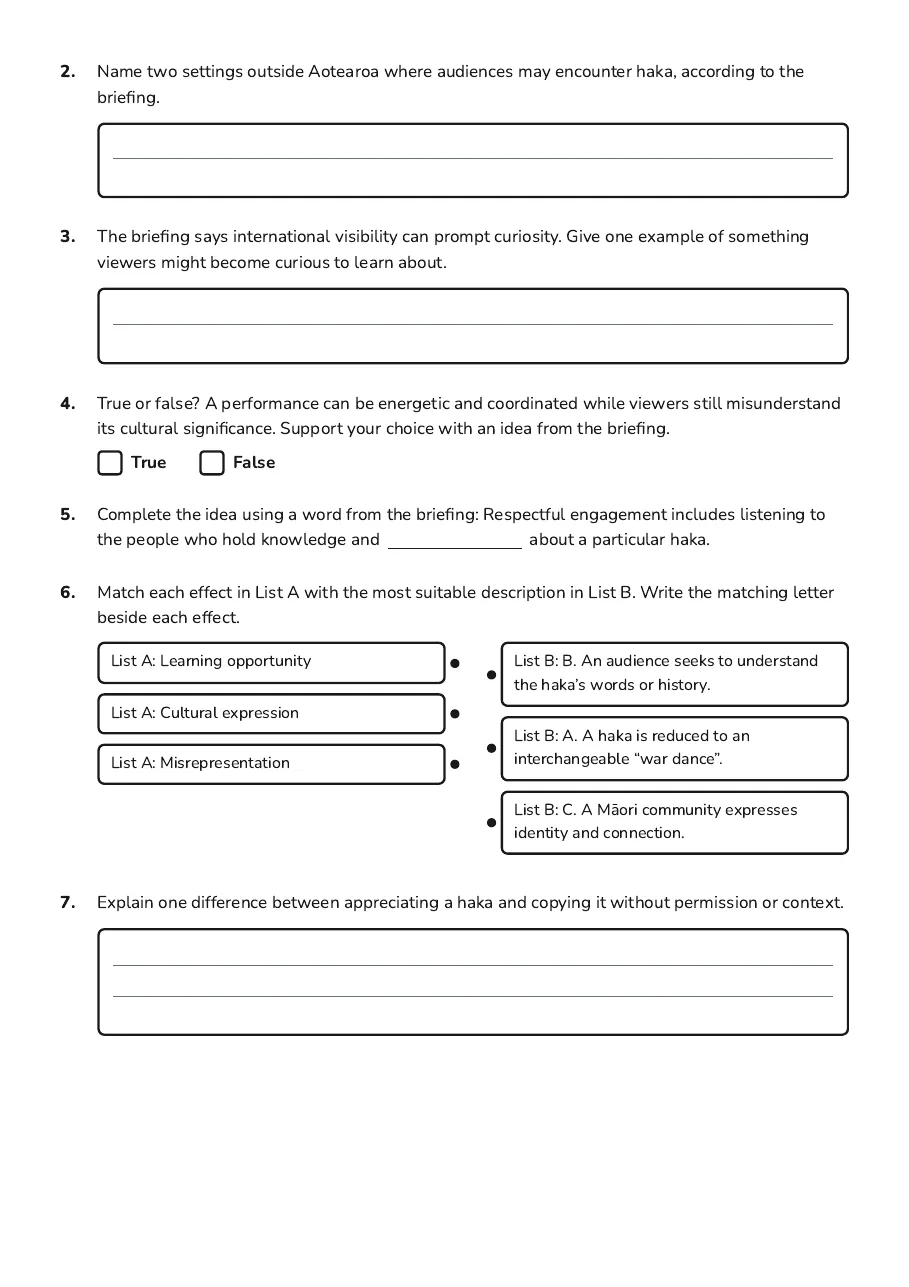
- List A: Learning opportunity
- List A: Cultural expression
- List A: Misrepresentation
- List B: B. An audience seeks to understand the haka’s words or history.
- List B: A. A haka is reduced to an interchangeable “war dance”.
- List B: C. A Māori community expresses identity and connection.
3 printable pages
Page 1
Page 2
Page 3
About This Worksheet
Free in Kuraplan
Sign up free, grab the PDF, and customize it for your class.
Print-Ready
Formatted for standard paper. Clean layout, easy to read.
AI-Generated
Created with Kuraplan's AI, designed for real classroom use.
For Teachers & Parents
Use in classrooms, for homework, tutoring, or homeschool.
Need a custom version of this worksheet?
Kuraplan's AI generates custom worksheets in seconds — differentiated for every learner, aligned to your curriculum.
Generate Custom Worksheets — Free