ScienceFreePrintable
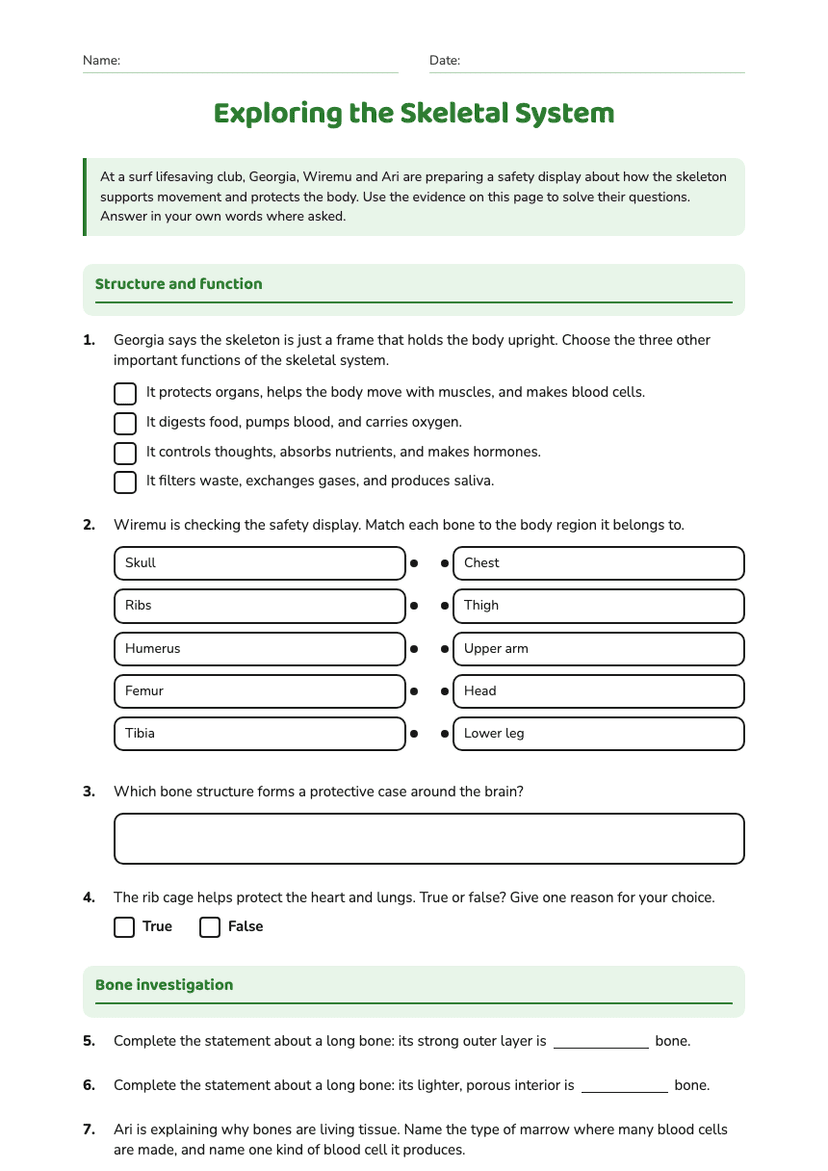
Human Skeleton: Structure and Movement
A free science worksheet ready for your classroom. Open in Kuraplan to grab the print-ready PDF, customize it for your students, or generate a fresh version in seconds.
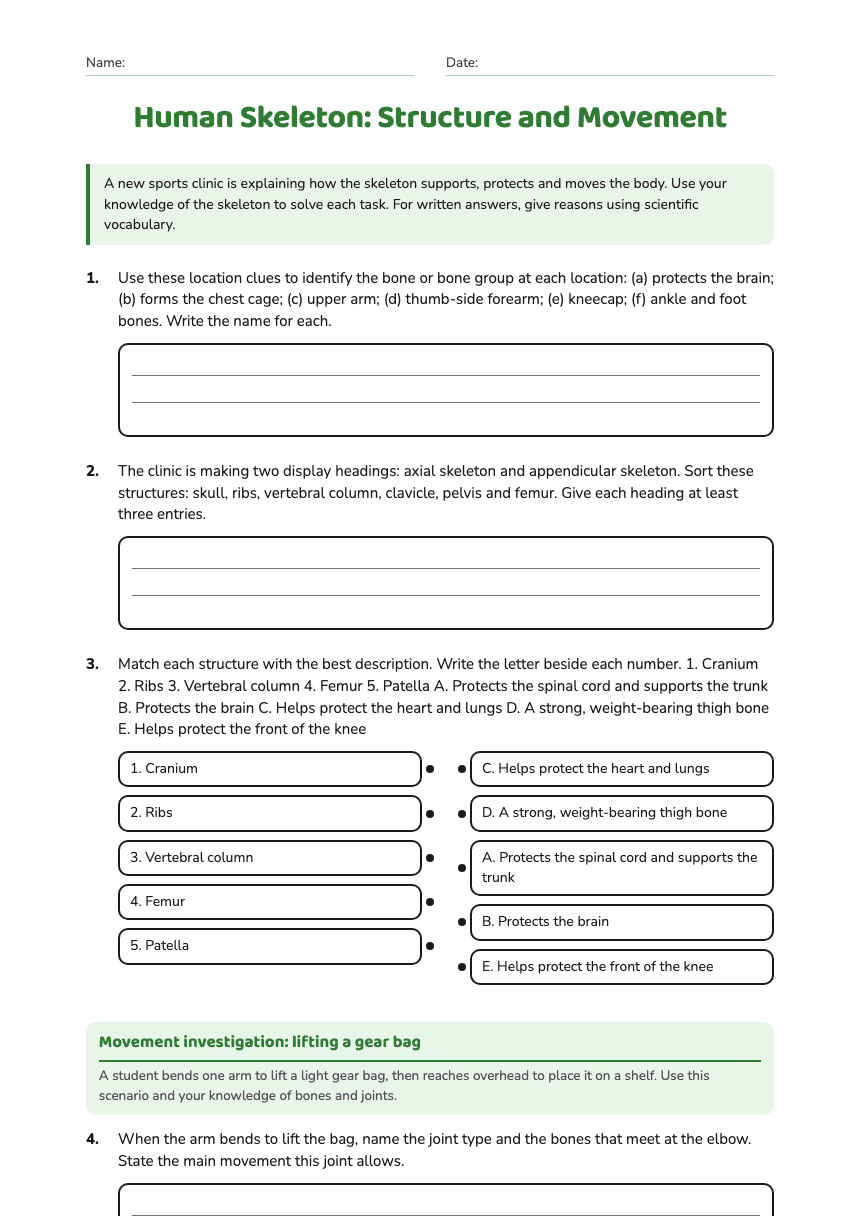
Name:Date:
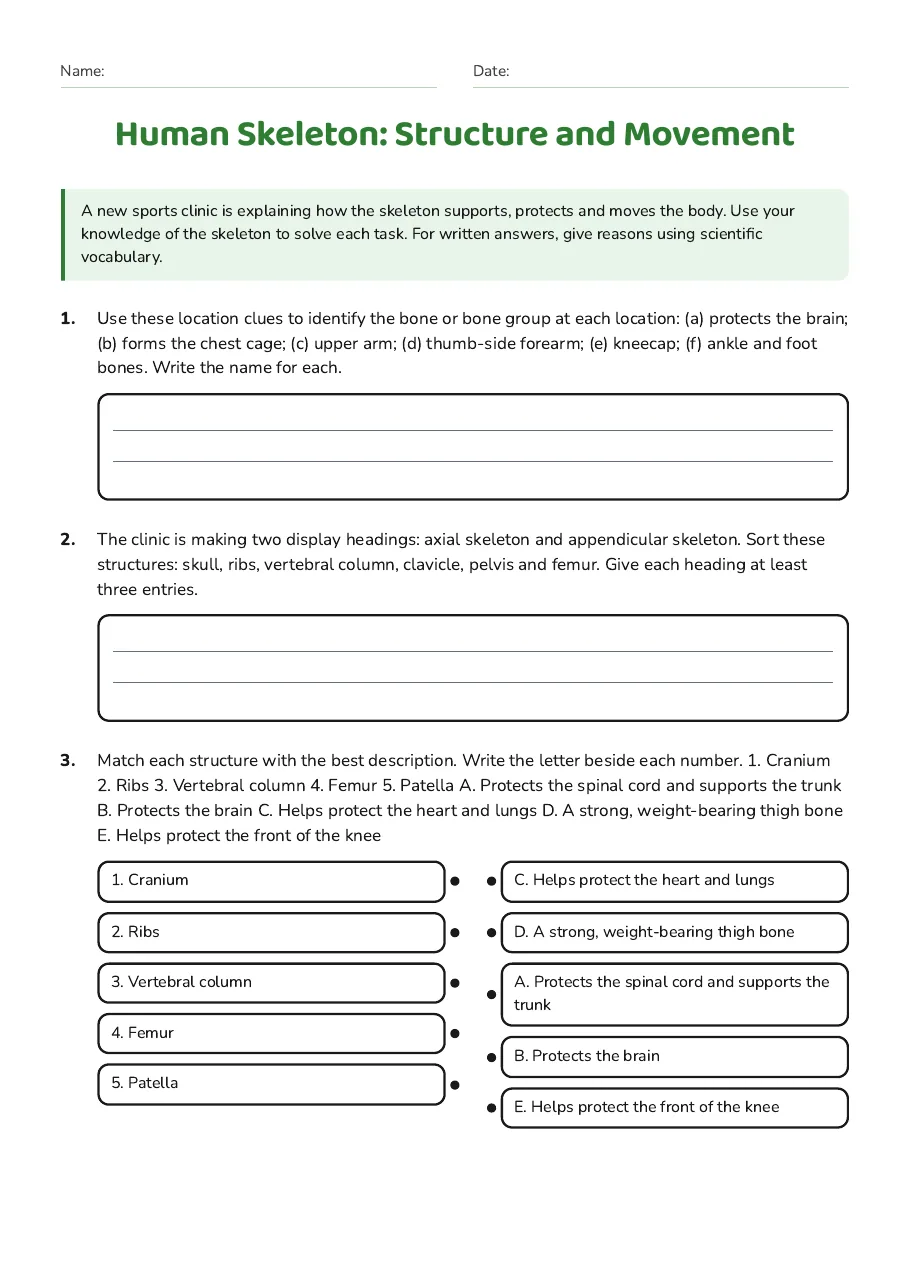
Human Skeleton: Structure and Movement
A new sports clinic is explaining how the skeleton supports, protects and moves the body. Use your knowledge of the skeleton to solve each task. For written answers, give reasons using scientific vocabulary.
1.Use these location clues to identify the bone or bone group at each location: (a) protects the brain; (b) forms the chest cage; (c) upper arm; (d) thumb-side forearm; (e) kneecap; (f) ankle and foot bones. Write the name for each.
2.The clinic is making two display headings: axial skeleton and appendicular skeleton. Sort these structures: skull, ribs, vertebral column, clavicle, pelvis and femur. Give each heading at least three entries.
3.Match each structure with the best description. Write the letter beside each number.
1. Cranium
2. Ribs
3. Vertebral column
4. Femur
5. Patella
A. Protects the spinal cord and supports the trunk
B. Protects the brain
C. Helps protect the heart and lungs
D. A strong, weight-bearing thigh bone
E. Helps protect the front of the knee
- 1. Cranium
- 2. Ribs
- 3. Vertebral column
- 4. Femur
- 5. Patella
- C. Helps protect the heart and lungs
- D. A strong, weight-bearing thigh bone
- A. Protects the spinal cord and supports the trunk
- B. Protects the brain
- E. Helps protect the front of the knee
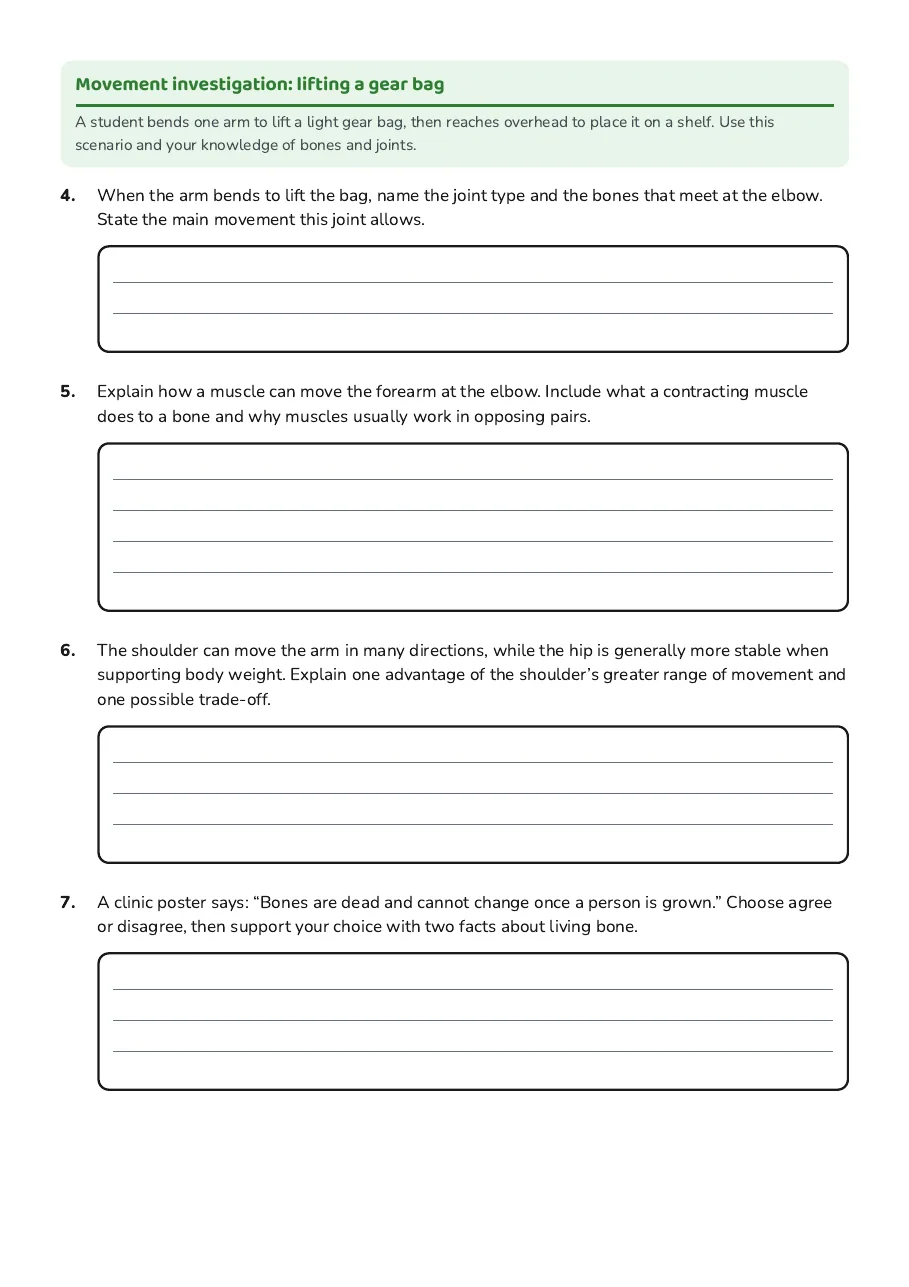
Movement investigation: lifting a gear bag
A student bends one arm to lift a light gear bag, then reaches overhead to place it on a shelf. Use this scenario and your knowledge of bones and joints.
4.When the arm bends to lift the bag, name the joint type and the bones that meet at the elbow. State the main movement this joint allows.
5.Explain how a muscle can move the forearm at the elbow. Include what a contracting muscle does to a bone and why muscles usually work in opposing pairs.
6.The shoulder can move the arm in many directions, while the hip is generally more stable when supporting body weight. Explain one advantage of the shoulder’s greater range of movement and one possible trade-off.
7.A clinic poster says: “Bones are dead and cannot change once a person is grown.” Choose agree or disagree, then support your choice with two facts about living bone.
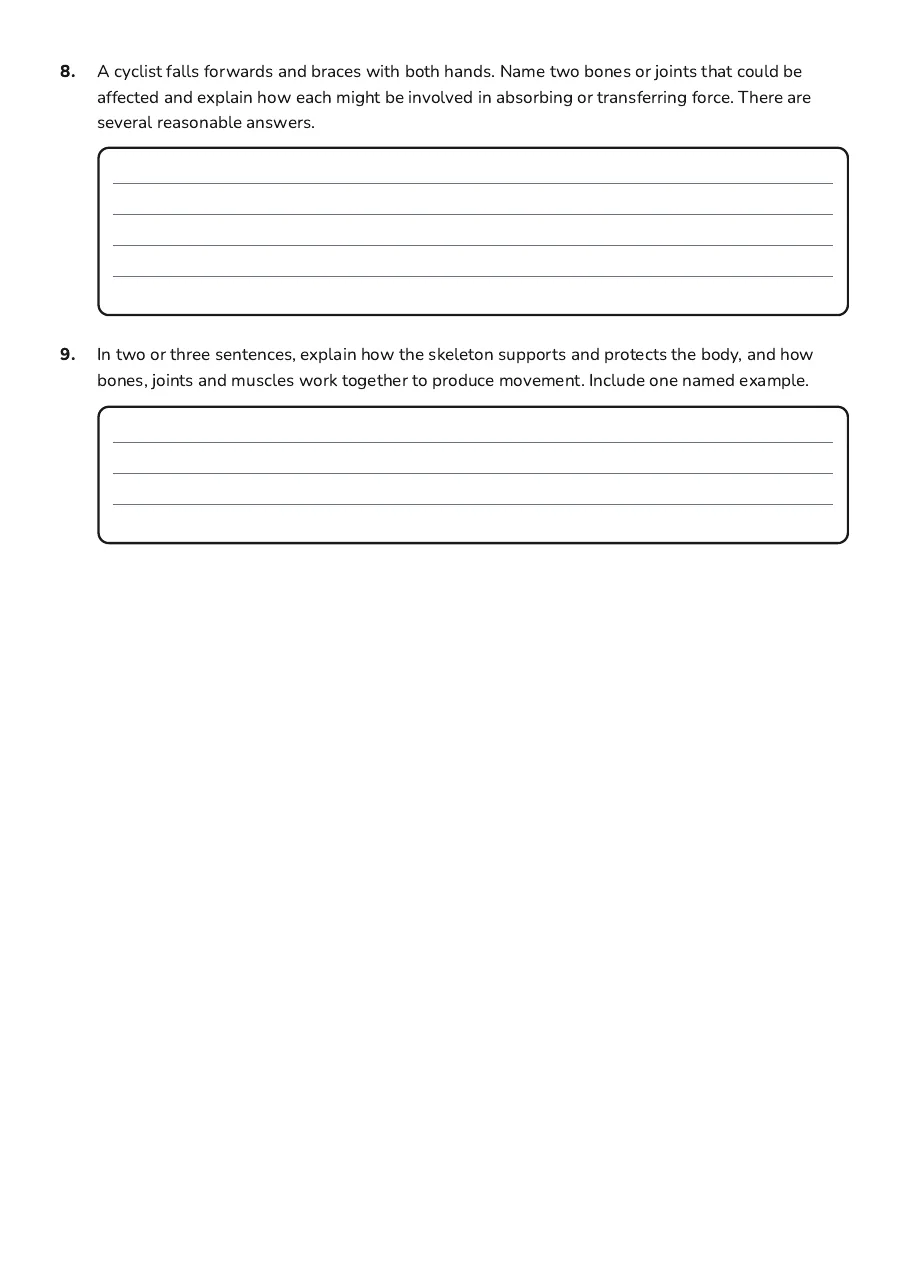
8.A cyclist falls forwards and braces with both hands. Name two bones or joints that could be affected and explain how each might be involved in absorbing or transferring force. There are several reasonable answers.
9.In two or three sentences, explain how the skeleton supports and protects the body, and how bones, joints and muscles work together to produce movement. Include one named example.
3 printable pages
Page 1
Page 2
Page 3
About This Worksheet
Free in Kuraplan
Sign up free, grab the PDF, and customize it for your class.
Print-Ready
Formatted for standard paper. Clean layout, easy to read.
AI-Generated
Created with Kuraplan's AI, designed for real classroom use.
For Teachers & Parents
Use in classrooms, for homework, tutoring, or homeschool.
Need a custom version of this worksheet?
Kuraplan's AI generates custom worksheets in seconds — differentiated for every learner, aligned to your curriculum.
Generate Custom Worksheets — Free No credit card Curriculum-aligned Under 60 seconds